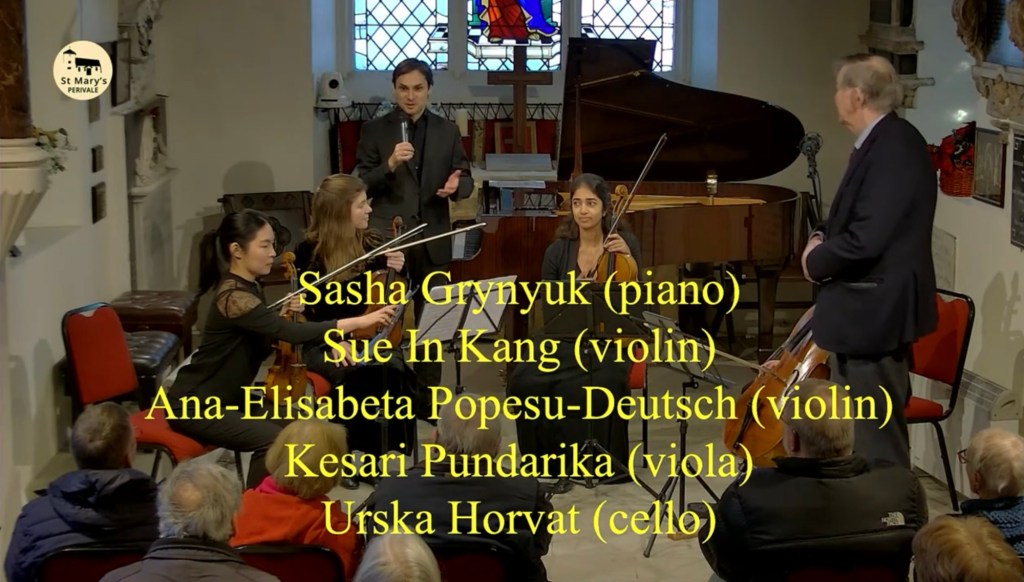
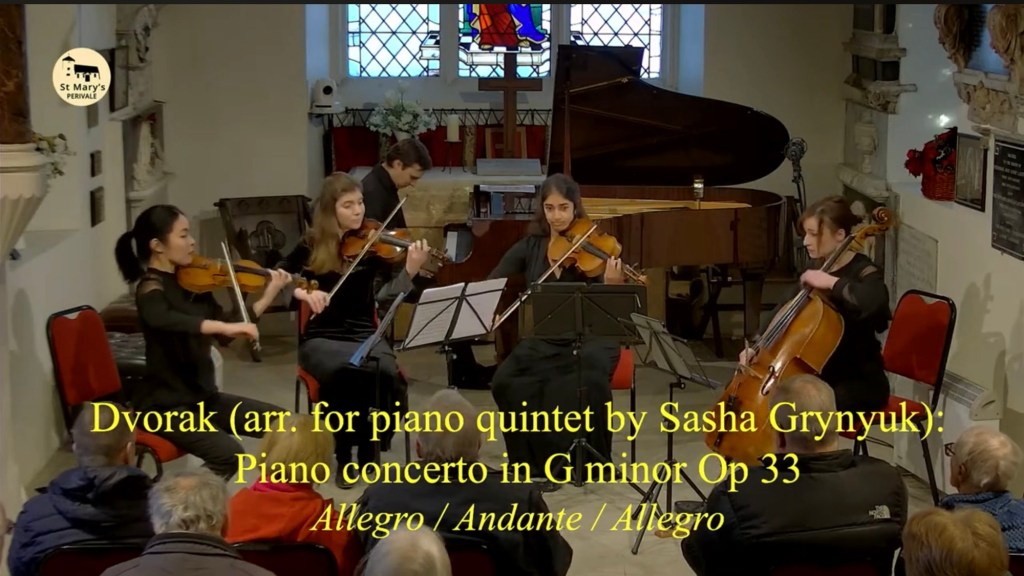
Sasha Grynyuk never fails to surprise and astonish with his superb musicianship and impeccable technical mastery.Today was even more astonishing to learn that he had transformed one of the most awkward piano concertos into a beautiful chamber work that could stand by side with one of the great works in the chamber repertoire.He not only played the Dvorak Concerto without the score but he had also reduced the full orchestral part to a string quartet so this beautiful concerto can be heard more often in the concert hall.Richter too never failed to astonish on his first appearances in the west not only with his pianistic perfection but also with his repertoire choices.He chose this concerto for his London orchestral debut and went on to make a landmark recording of it with Carlos Kleiber.I have never seen it programmed since in London or at least so very rarely.So it is thanks to Sasha for allowing us to hear this beautifully mellifluous work today.An orchestra of four beautiful young lady musicians who played with the same superb musicianship ,listening to each other as in the concerto there was a question and answer between the soloist and the orchestra.There is a pastoral character to the concerto that I had never been aware of with a continuous outpouring of melodic invention unmistakably traditional Czech .There were moments of passionate outbursts but like Grieg they were never overpowering but more of intensity than dramatic.The Andante in particular where the chiselled beauty of the piano rose above the harmonious warm background of the strings who were always ready to burst into melody .The dynamic opening of the solo piano in the Allegro reminded me of Brahms’ first Concerto with its dance like energy.There were moments of brilliance from Sasha but played with such musicianship that the actual technical mastery never drew attention to itself but just added to the overall architectural shape of the ‘quintet’.The cadenza too was astonishing for its pure musical shape created by cascades of notes played with such ease and naturalness.
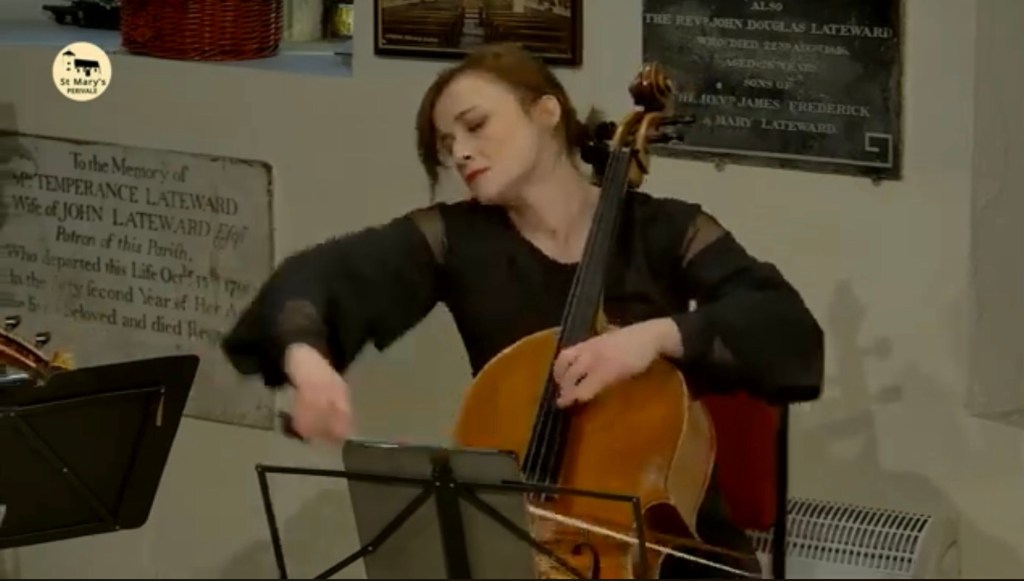
Some superb playing from his four companions too with the searing intensity of Urska Horvat’s cello matched by the simple beauty of Kesari Pundarika’s viola.The superb violins of Sue In Kang and Ana – Elisabeta Popesu- Deutsch.
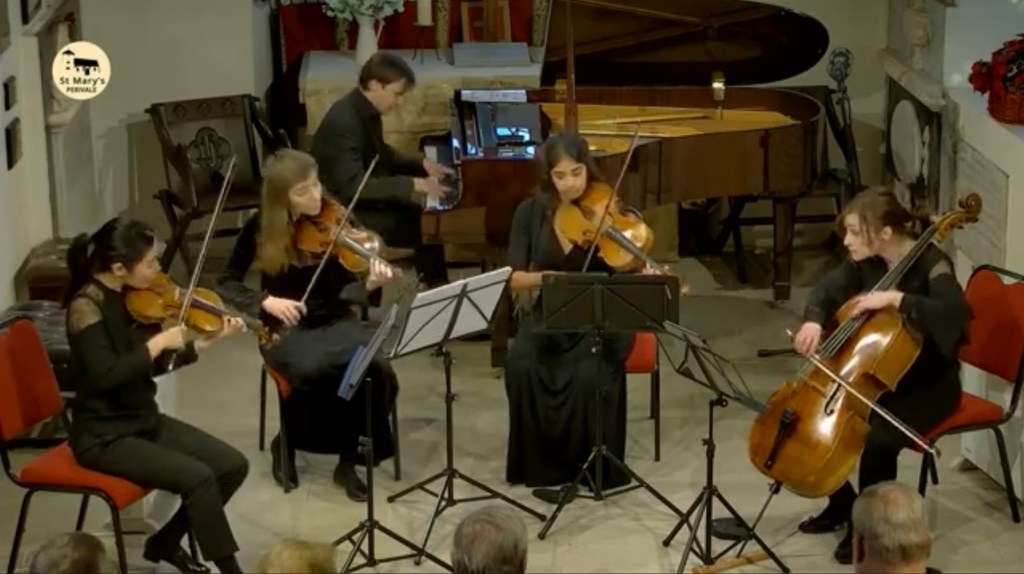
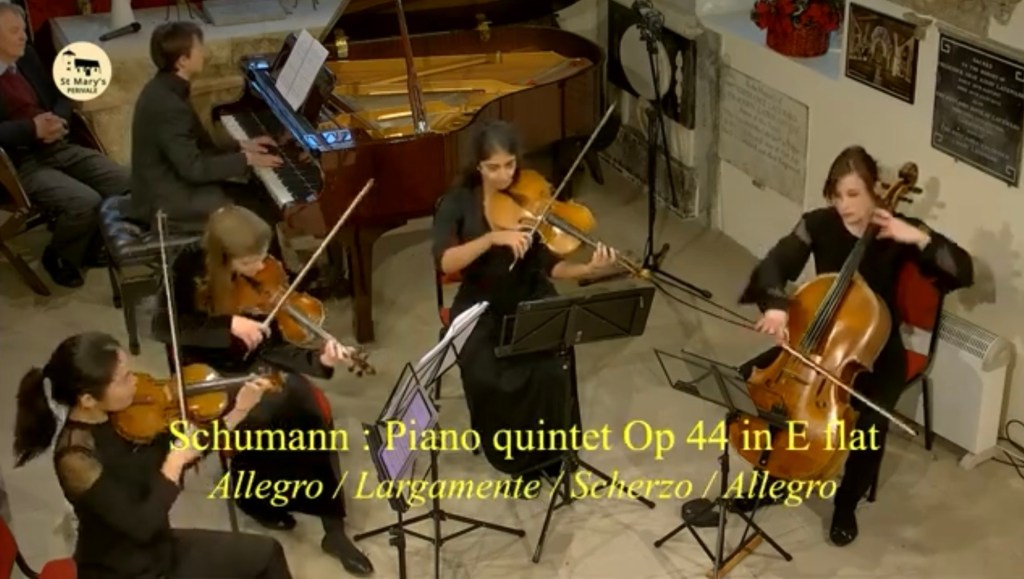
They all joined together in a performance of the Schumann Quintet that I have rarely heard played with such simplicity and clarity.What it lacked in the burning intensity of Rubinstein and the Guarneri Quartet all those years ago it gained in an architectural shape with playing of simple superb musicianship.Rubinstein as his solo career was coming to an end played the Brahms and Schumann Quintets in the Festival Hall and I remember Rubinstein well into his 80’s running on stage as he plunged into the first chords of the Schumann taking his colleagues very much by surprise.But of course he had this way of injecting energy into his beautiful playing like sudden electric shocks when he would even lift himself off the piano stool.Today there was the same superb playing but with musicians listening to each other and with modesty and humility showing us the simple beauty of all they played.
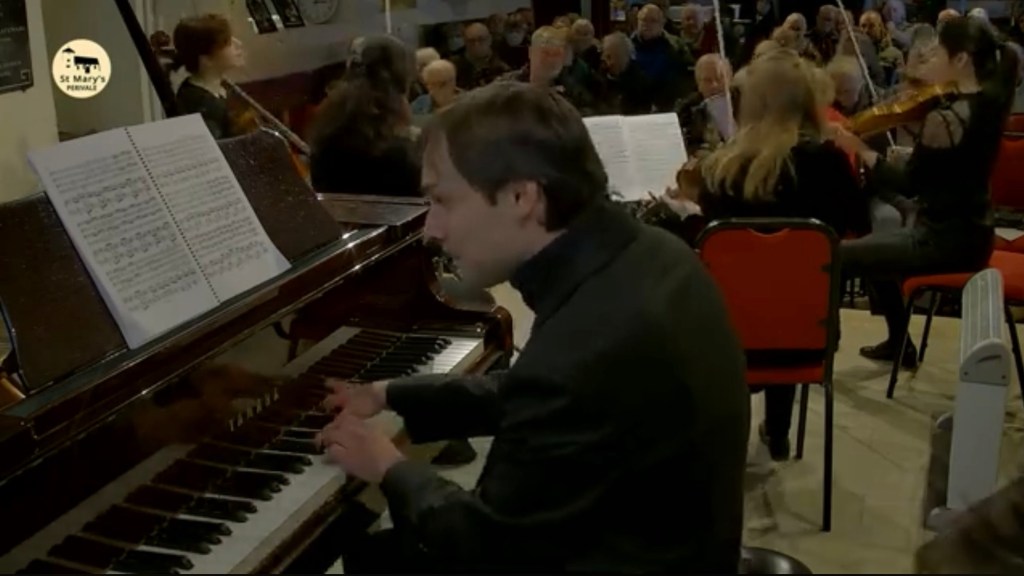
Winner of over ten international competitions, prizes and awards, Sasha was chosen as a ‘Rising Star’ for BBC Music Magazine and International Piano Magazine . His successes also include First Prizes in the Grieg International Piano Competition and the BNDES International Piano Competition, in addition to winning the Guildhall School of Music’s most prestigious award – the Gold Medal – previously won by such artists as Jacqueline Du Pré and Bryn Terfel.Sasha has performed in many major venues including Wigmore Hall, Barbican Hall, Royal Festival Hall, Queen Elizabeth Hall, Bridgewater Hall (Manchester), Wiener Konzerthaus, Weil Recital Hall (Carnegie Hall, New York), Teatro Real (Rio de Janeiro) and Salle Cortot (Paris). He has performed with such orchestras as the Royal Philharmonic, Bergen Philharmonic and Orchestra Sinfonica Brasiliera. His recording of music by Glenn Gould and Friedrich Gulda for Piano Classics was chosen as the record of the month for the German magazine Piano News and shortlisted for the New York Classical Radio Award. Among Sa sha’s ongoing projects are performances of Shostakovich’s original piano score for the 1929 silent film The New Babylon , which he premièred at LSO St. Luke’s and later performed at Leif Ove Andsnes’ Rosendal Festival, Norway. Born in Ukraine, Sasha studied at the Guildhall School in London. Sasha is a Keyboard Trust artist and currently benefits from the artistic guidance of its founder Noretta Conci-Leech.
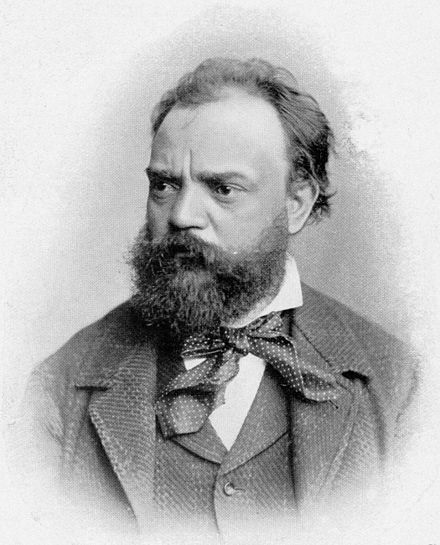
Born: September 8, 1841, Nelahozeves,Czechoslovakia
Died: May 1, 1904,Prague
Anna Čermáková and Antonín Dvořák were married on 17 November 1873 at St Peter’s church in Prague. During the first three years of their marriage they had three children – Otakar, Josefa and Růžena – but all of them died in infancy. Over the ten-year period between 1878 and 1888 the Dvořáks had another six children, all of whom survived into adulthood: Otilie, Anna, Magdalena, Antonín, Otakar and Aloisie. The oldest child, Otilie – “Otilka”, inherited her father’s talent for music and several of her short piano pieces have survived to this day. In 1898 she married Dvořák’s pupil, the composer Josef Suk. Their grandson Josef Suk (1929–2011) later became a fine violinist. Otilie died prematurely in 1905 at the age of twenty-seven. Dvořák’s daughter Magdalena (known as “Magda” by her family) was also musical and became a concert singer. Son Otakar was later credited for preserving a large number of recollections about his father, which he wrote in 1960.
Dvořák composed his piano concerto from late August through 14 September 1876. Its autograph version contains many corrections, erasures, cuts and additions, the bulk of which were made in the piano part. The work was premiered in Prague on 24 March 1878, with the orchestra of the Prague Provisional Theatre conducted by Adolf Czech with the pianist Karel Slavkovsky . The first performance in England was with soloist Oscar Beringer at the Crystal Palace on October 13 1883.
While working on the concerto, Dvořák himself realized that he had not created a virtuosic piece in which the piano does battle with the orchestra. Dvořák wrote: “I see I am unable to write a Concerto for a virtuoso; I must think of other things.” What Dvořák composed instead was a symphonic concerto in which the piano plays a leading part in the orchestra, rather than opposed to it.
In an effort to mitigate awkward passages and expand the pianist’s range of sonorities, the Czech pianist and pedagogue Vilem Kurz undertook an extensive rewriting of the solo part; the Kurz revision is frequently performed today.
The concerto was championed for many years by the noted Czech pianist Rudolf Firkusny , who played it with many different conductors and orchestras around the world before his death in 1994. Once a student of Kurz, Firkušný performed the revised solo part for much of his life, turning towards the original Dvořák score later on in his concert career.
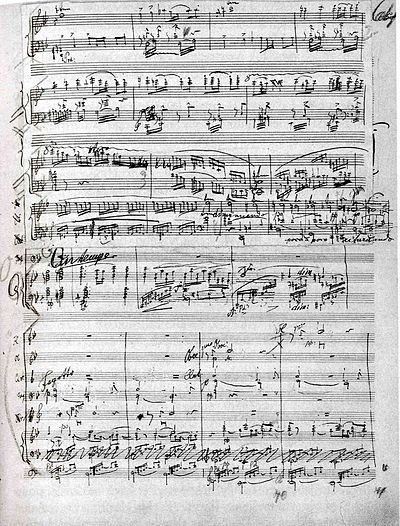
Leslie Howard who has recorded all of the works of Liszt declared “… there is nothing in Liszt that is anywhere near as difficult to play as the Dvořák Piano Concerto – a magnificent piece of music, but one of the most ungainly bits of piano writing ever printed”.
The concerto is scored for solo piano and an orchestra consisting of 2 flutes ,2 oboes , 2 clarinets, 2 bassoons , 2 horns, 2 trumpets , timpani , and strings .It has three movements:
- Allegro agitato
- Andante sostenuto
- Allegro con fuoco
- Championed by Sviatoslav Richter which he recorded with Bavarian State Orchestra conducted by Carlos Kleiber . EMI Great Recordings of the Century (catalog no. 66947)He also made his much awaited orchestral debut in London with it in the Royal Albert Hall together with the Chopin Andante spianato and Grande Polonaise
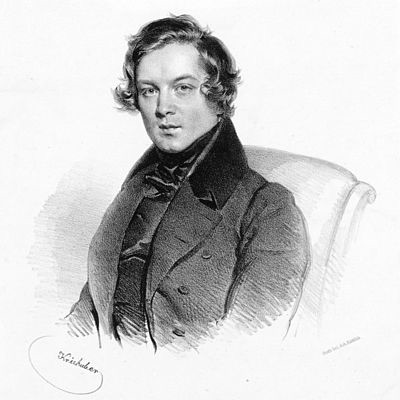
June 8, 1810, Zwickau ,Germany -July 29, 1856, Endenich,Bonn.
Schumann composed his piano quintet in just a few weeks in September and October 1842, in the course of his so-called Year of Chamber Music. Before 1842 Schumann had completed no chamber music at all, with the exception of an early piano quartet composed in 1829. Following his marriage to Clara in 1840, Schumann turned to the composition of songs, chamber music and orchestral works. During his year-long concentration in 1842 upon chamber music he executed the three string quartets, Op. 41, the piano quintet, Op. 44; the piano quartet, Op. 47; and the Phantasiestückefor piano trio, Op. 88. Schumann’s work in that year was buoyant in character as he had begun his career primarily as a composer for the keyboard; after his detour into writing for string quartet, according to Joan Chisell, the “reunion with the piano” which the piano quintet provoked gave “his creative imagination … a new lease on life.”
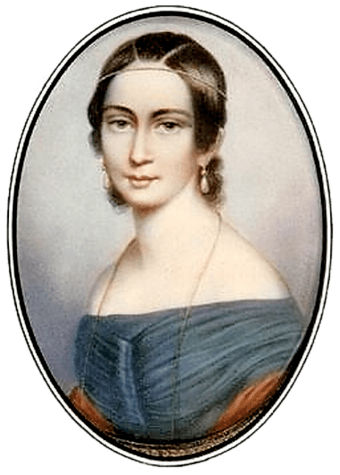
He dedicated the piano quintet to his wife Clara. She was due to perform the piano part in the first private performance of the quintet on the 6th December 1842 at the home of Henriette Voigt and her husband Carl.However she fell ill and Felix Mendelssohn stepped in, sight-reading the “fiendish” piano part.Mendelssohn’s suggestions to Schumann after this performance led to revisions to the inner movements, including the addition to the third movement of a second trio.
Clara Schumann did play the piano part at the quintet’s first public performance, which took place on the 8th January 1843 at the Leipzig Gewandhaus
Sasha Grynyuk Anniversary recital of a great pianist in Perivale
 ChristopherAxworthy-MusicCommentary