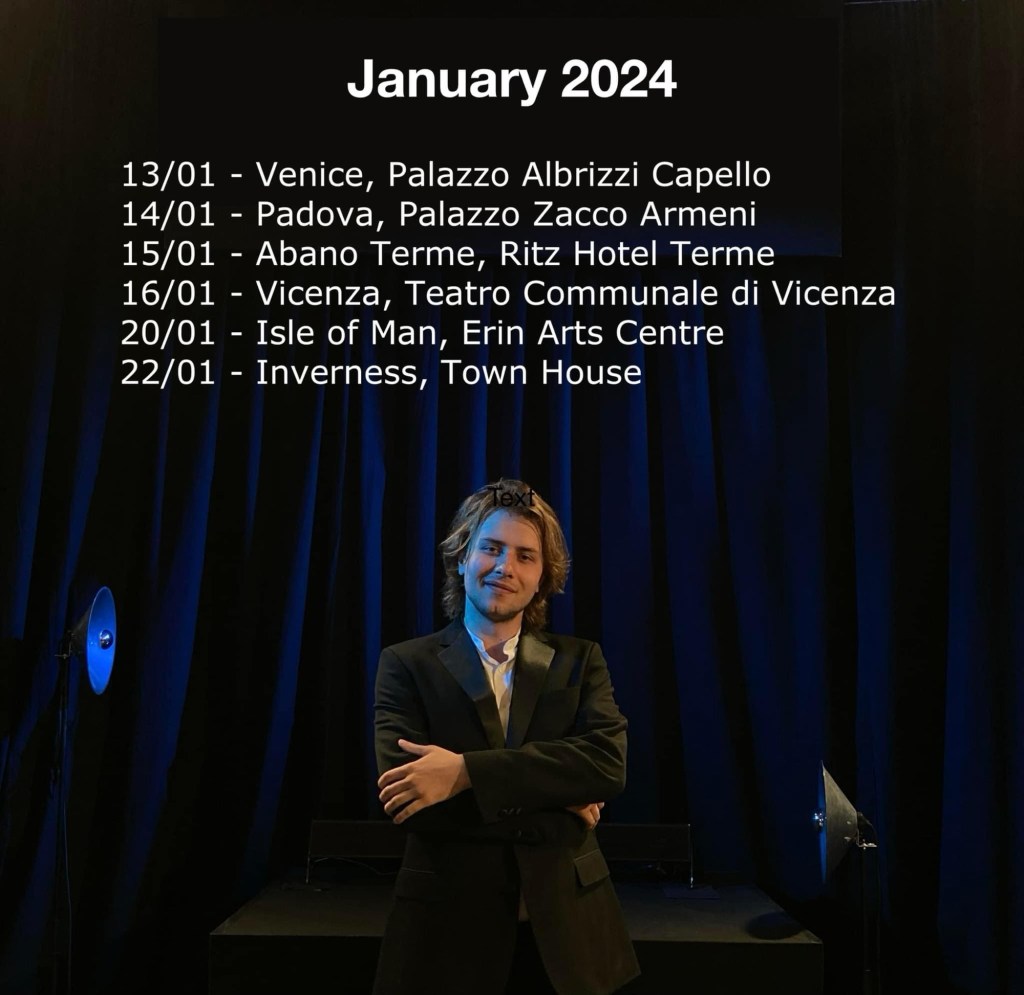
…. and was rewarded with the first of three recitals that include two masterworks from the piano repertoire kept at bay from one another with three little bons bons from Tchaikowsky’s ‘Sleeping Beauty’. They acted as a link between the sublime romantic outpourings of Schumann and the monumental edifice of Mussorgsky where the ‘Great Gate of Kiev’ takes on a particular significance these days.
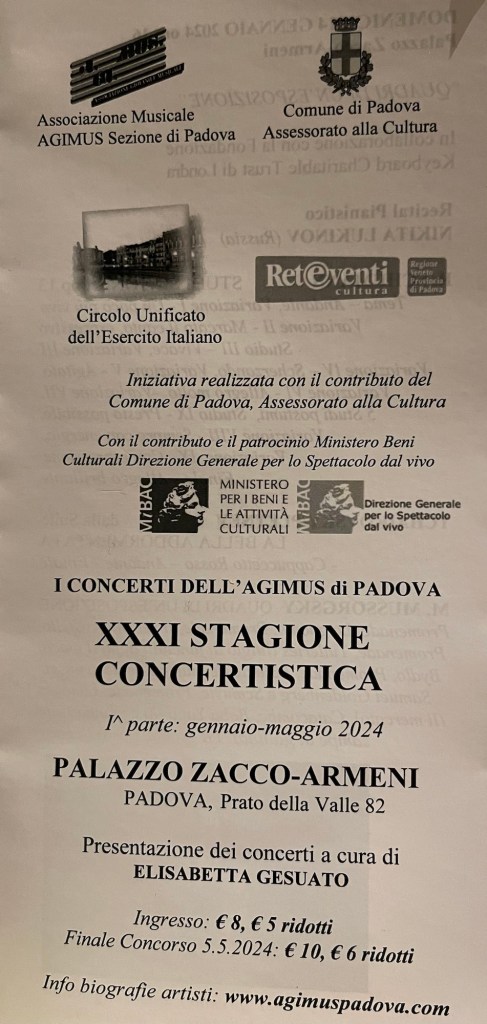
Schumann’s Symphonic Studies in the hands of this young poet becomes a lesson in style and musicianship.
From the subtle beauty of the opening theme played with a chameleonic sense of colour that allowed it to be transformed and remodelled with a technical mastery that was never placed in evidence but was always present.
The diabolical ‘ presto possibile ’ was played not like a tour de force of virtuosity but more with the Mendelssohnian radiance and lightness that Schumann intended coming as it does after the majesty of what Agosti used to liken to a Gothic Cathedral.Following on from four of the ‘posthumous’ studies that Brahms was to include in the first edition after Schumann’s death.These are ethereal improvised rough drafts that in the hands of a true poet can add a ray of sunlight on variations that verge almost on the too seriously complex as they lead to the Chopin like bel canto that precedes the nobility of the finale.
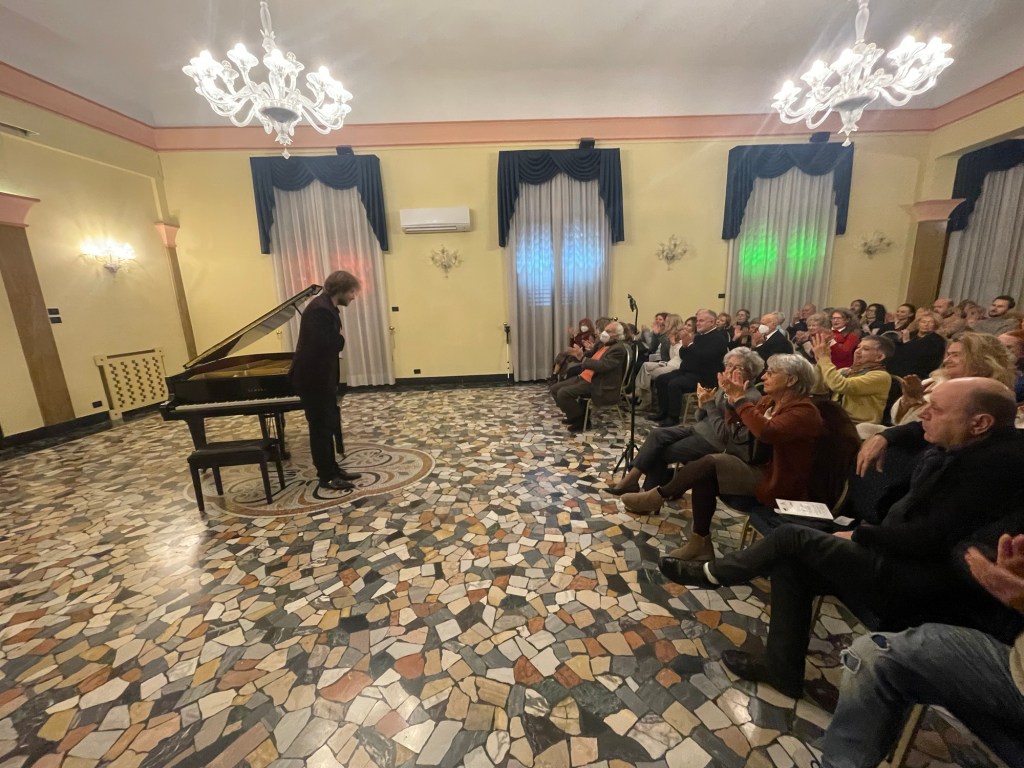
Nikita chose to play only four of the five ‘extra’ studies as it is only they that enter into his vision of an entire work as seen by his poetic and stylistic sensibility. After the ever more intense build – up of romantic fervour of the first studies these ethereal visions of another world add a completely new dimension to a work that can all too easily become a Paganinian tour de force instead of the sublime romantic outpourings of the genial Florestan and Eusebius hiding within the genius of Schumann.They were played with a delicacy and fantasy that illuminated a not easy piano in the beautiful oasis that is the Goethe Institute in the Palazzo Albrizzi-Capello that lies just a stone’s throw from the hustle and bustle of McDonalds !
The majesty and his superb sense of balance gave unusual shape to Schumann’s finale that in lesser hands can seem rather repetitive.It was a gradual build – up of tension in sound that exploded only with the last few tumultuous bars where Nikita allowed his true virtuosic colours to shine with an exhilarating brilliance that brought cheers from a small but enthusiastic audience.
Not least from our hosts,the Albrizzi-Capelli’s who in their enthusiasm were keen to point out that their audience had been decimated by a flu epidemic that has broken out in this wondrous floating city of dreams.
Well if they don’t want to come you can’t stop ‘em as Boris Berman was wont to say. Uchida more wisely would have said that it will remain as a golden memory in the minds of all those that can recount what marvels they have heard from this dashing young poet of the piano.
The excerpt of three pieces from ‘The Sleeping Beauty’ in the genial transcription of that very complex character Pletnev were an example of the schizophrenic genius of their authors.
‘Little Red Riding Hood’ was played with a bewitching sense of rhythmic flexibility that eventually took an astonishingly beguiling nose dive into the depths of the piano.This was to be awoken by the subtle fluidity of the Andante that worked itself into an astonishing romantic fervour as our young poet gave us an all embracing Liberacian touch of showmanship.Sailing up and down the keyboard with enviable ease as the melodic line with Thalbergian magic emerged from these sumptuous golden sounds.The fun and games he described in the finale were of orchestral proportions and this short interlude gained him the ovation for which they were penned and a well-earned rest before confronting the monument of Mussorgsky’s ‘Pictures’.
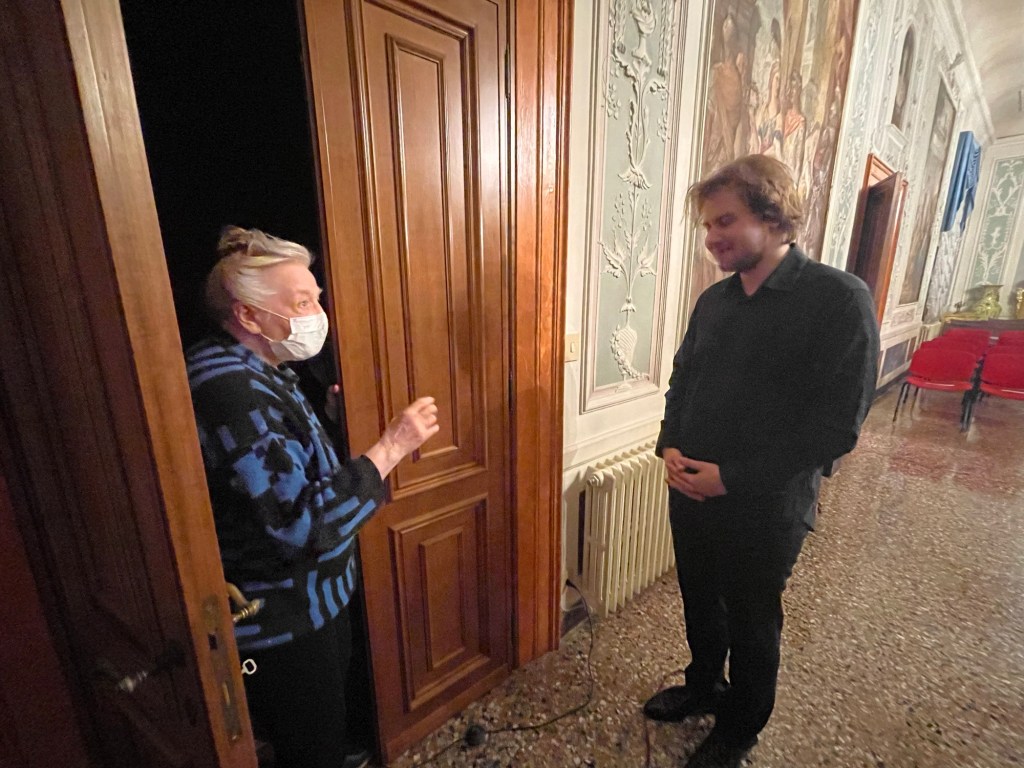
It had indeed woken our hostess suffering from serious health problems that were all forgotten as she too appeared and cheered from the door to her apartment that had miraculously been opened by the Aladdinesque goings-on from the other side!
‘The Great Gate of Kiev’ summed up a monumental performance of Mussorgsky’s promenade amongst the much lamented Hartmann’s posthumous exhibition.
There was the drama of Bydlo ,the magic land where the Old Castle is envisaged,squabbling children and excited chicks all described by the composer as he passed from one picture to another with ever more excited gait.
It was all played with extraordinarily vivid style but it was the authority of the ‘Catacombs’ that stopped us in our tracks as new unearthly sounds were revealed as the Latin title was to reveal:’Con mortuis in lingua morta’
‘Baba Yaga’ of course was terrifying and this modest Kwai was made to erupt as it probably never has been implored before .The extraordinary thing was that no matter how much sound Nikita was able to draw from this modest little piano it was never hard or ungrateful but always full and sonorous.
The enormous build – up of sound with the use of the pedal revealed from a distance the vision of a Great Gate that drew nearer and nearer as its glorious bells were heard to peal with ever more triumphant luminosity.
Our much loved hostess by now was on her feet cheering and asking for more as this young man had allowed her an all too temporary respite from her ailments.’Un poco di Schumann’ by Tchaikowsky was an intelligently genial choice and of course was played with the poetry that we had witnessed all afternoon.
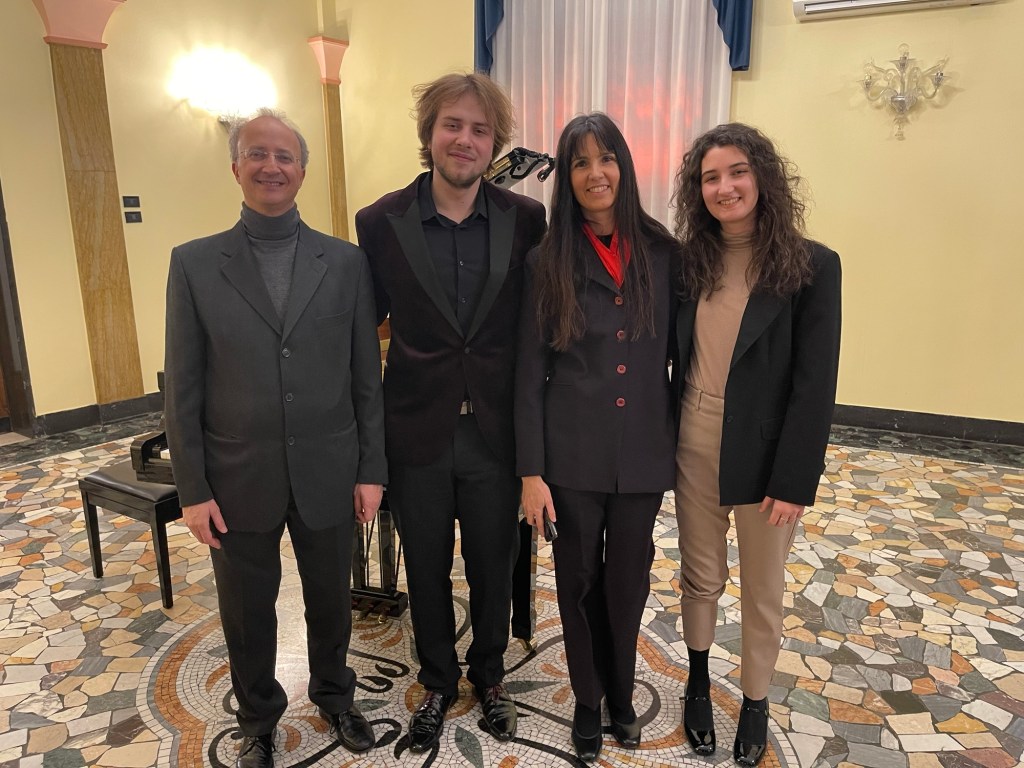
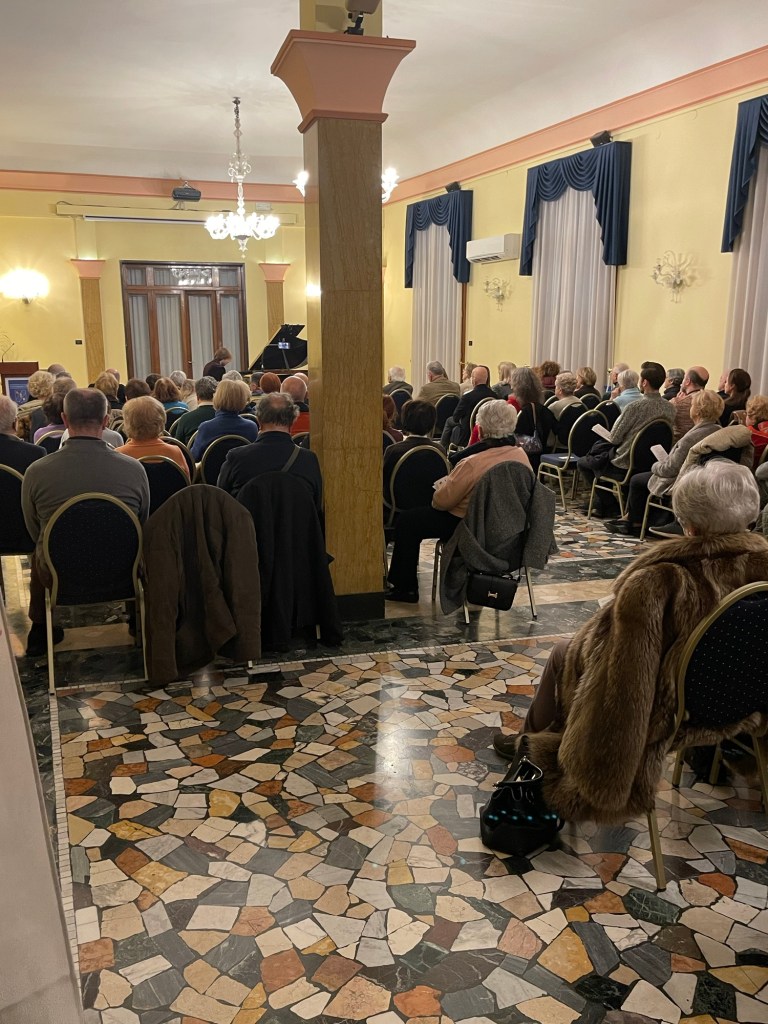
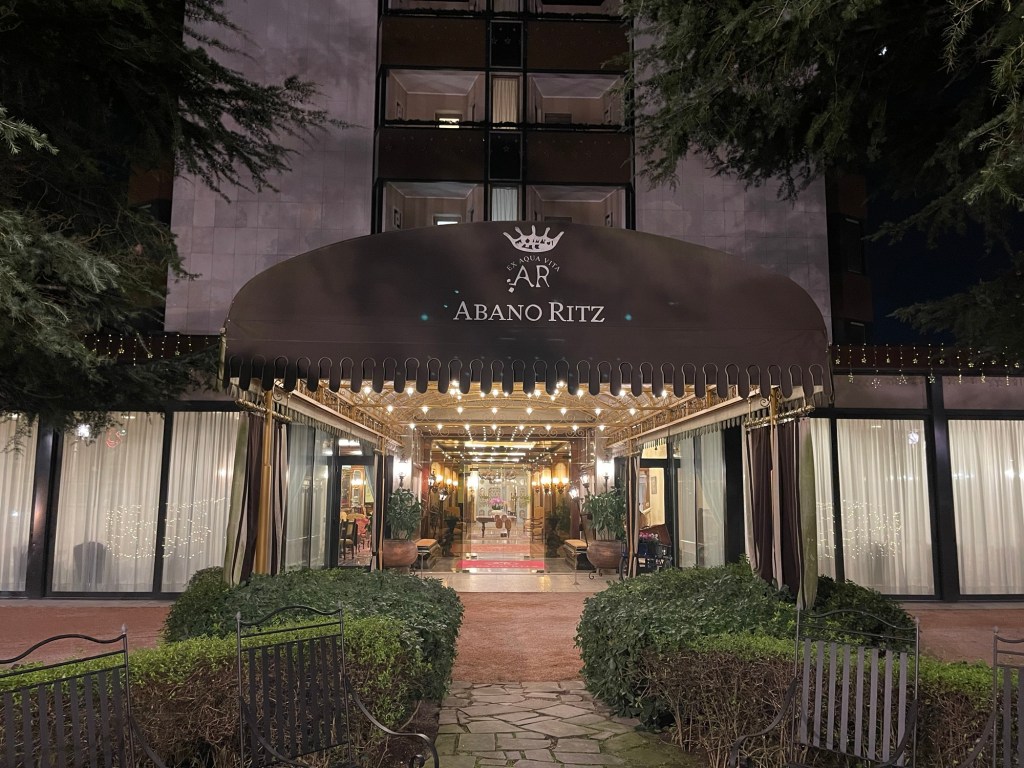
The tour continues …….The Ritz Abano Terme Sala dei Specchi…….we could have danced all night !
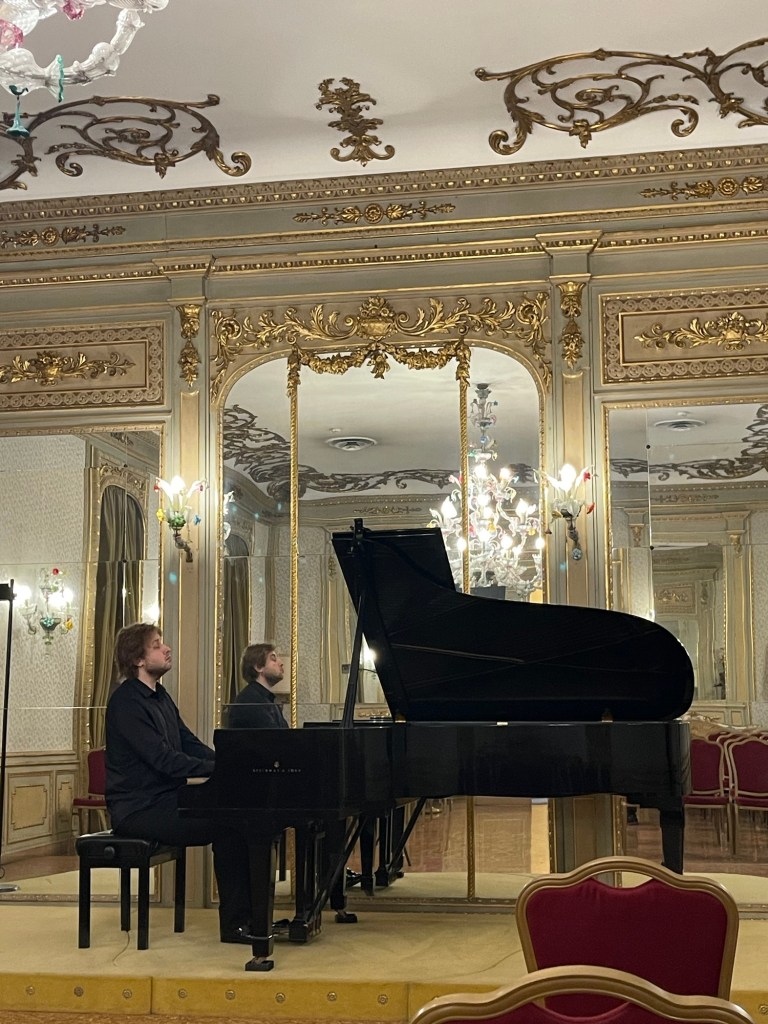
The lap of luxury but here more than any other venue on this tour a very small but appreciative after dinner audience ……as Boris Berman would say :’If they don’t want to come you can’t stop them! ‘
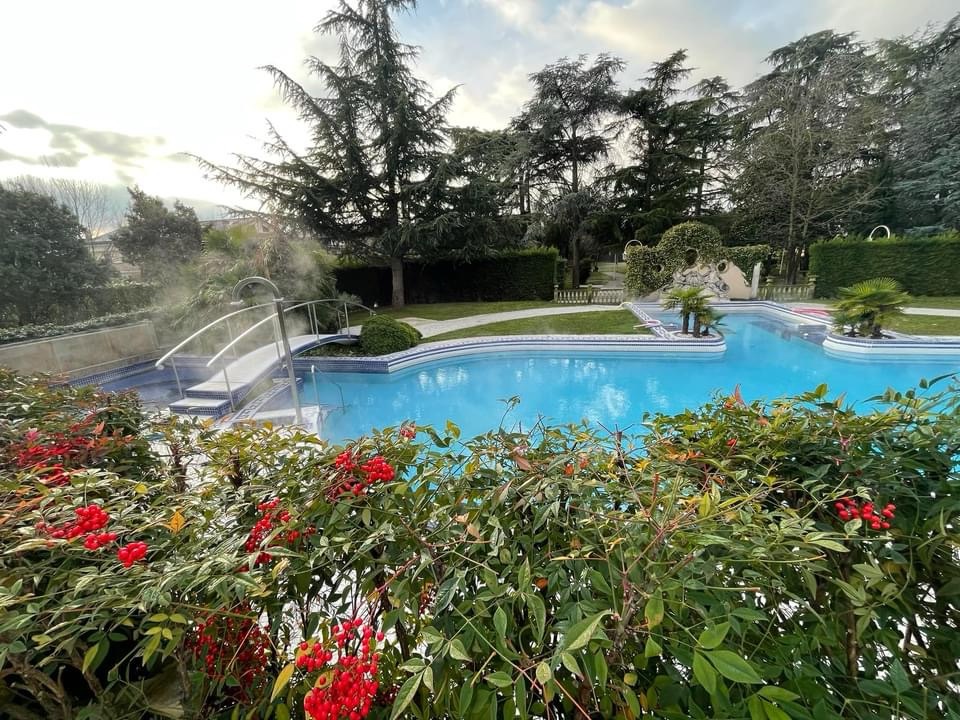
Well we didn’t but joined them in the hot outside pool and fabulous White Glove’s Restaurant .
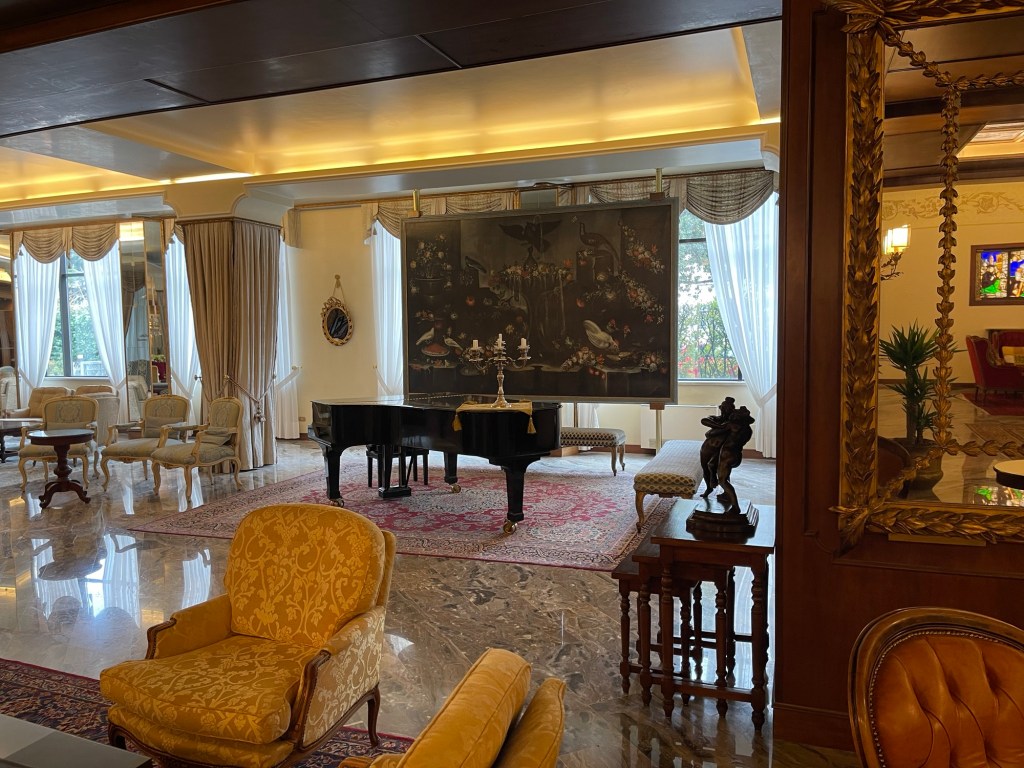
A shorter programme was heard resounding from the beautiful Steinway in the sumptuous Sala dei Specchi.Our dashing young Russian /Scottish virtuoso played his heart out as always and the Schumann Studies were even more full of the subtle sounds and beauty of a supreme stylist.The posthumous studies were indeed strands of gold as they found their real home in this refined atmosphere where beauty was reflected a thousand fold.
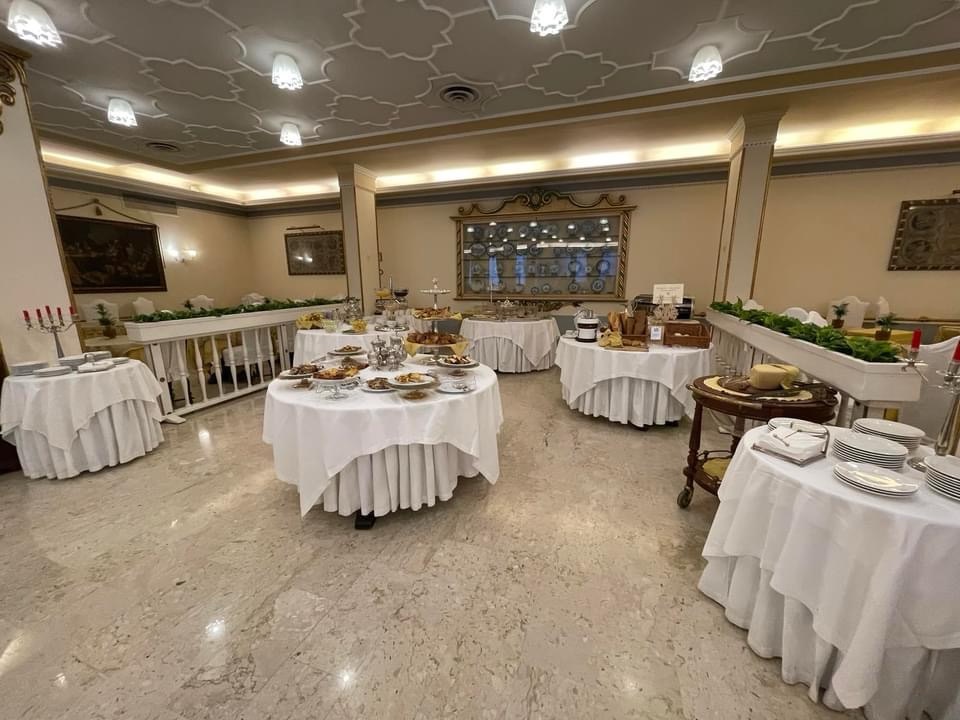
‘Sleeping Beauty’ was just the right piece to send us on our slumbers contemplating the multi-coloured breakfast that awaited accompanied by the delicate sounds of the ‘Moonlight’ Sonata discreetly played.Wafting our way again into the hot springs and for those who were foolhardy enough to raise their head there was a minus one temperature waiting to bite it off .
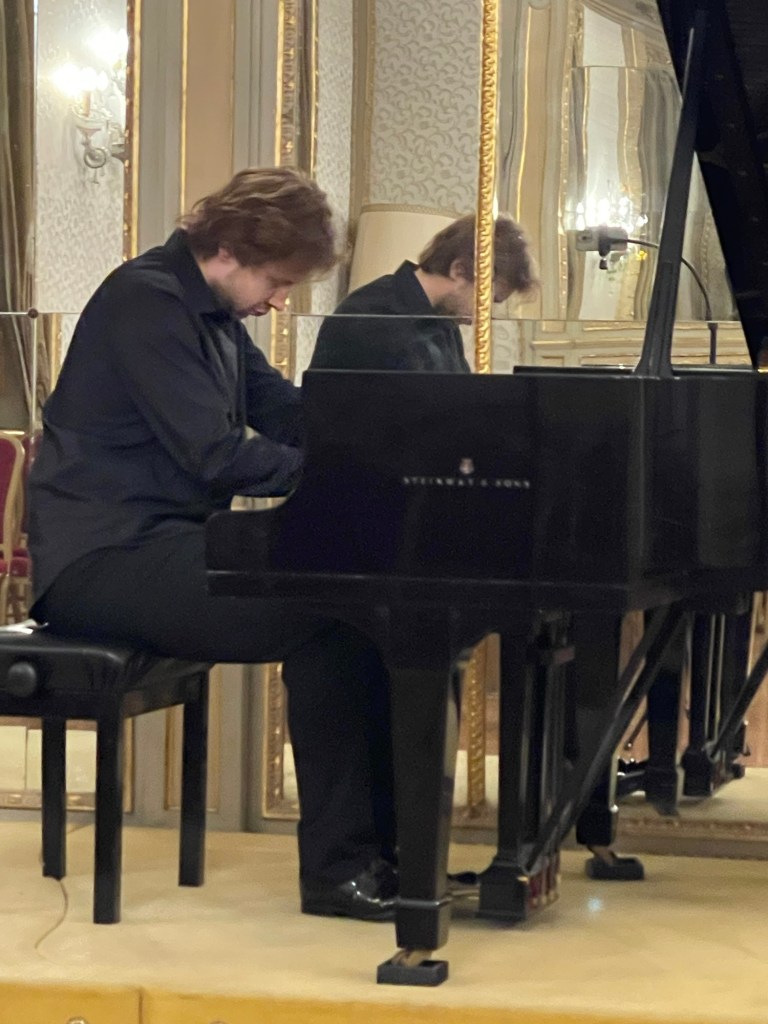
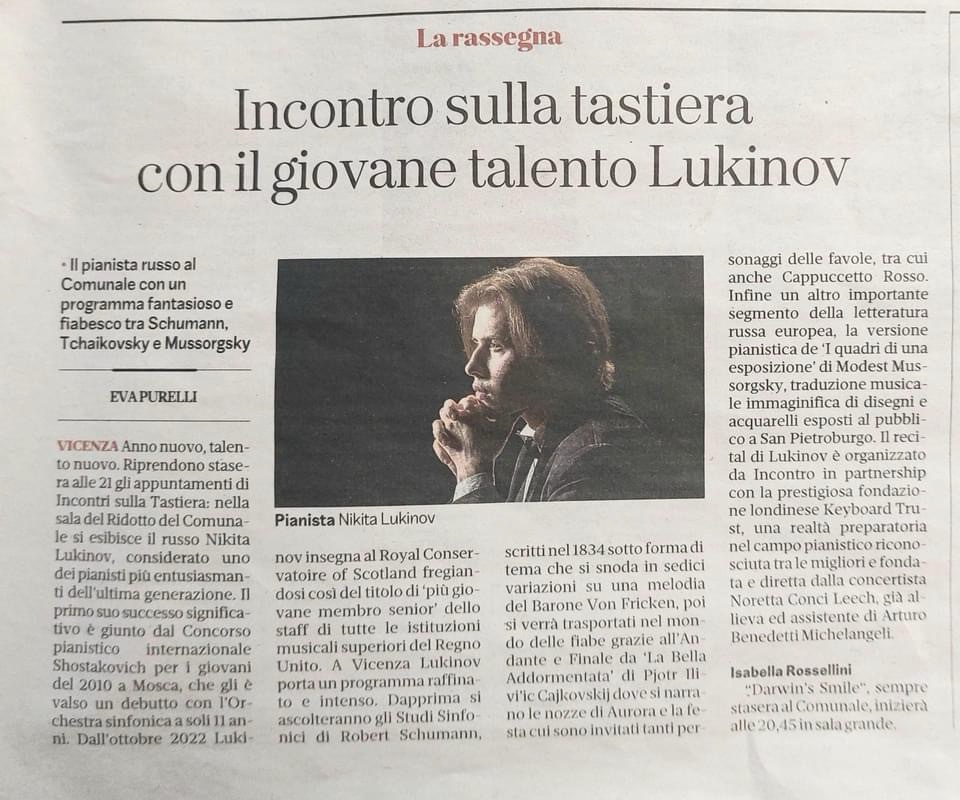
Now ready for the most important concert of this short KT tour for the Squeglia’s historic ‘Incontro sulla Tastiera ‘ in the Teatro Comunale in Vicenza.
Here is a very fine review of a special occasion on what Nikita described as the best instrument he has ever played on – Sokolov likes it too – che non guasta as they say in these parts!
Nikita’s Schumann ‘studies are canons covered in flowers because he is a supreme stylist …as Schumann was a supreme poet and called them ‘Symphonic’ ……………Studies.
The study ‘Presto Possible’ that everyone fears and more often than not stumble through he plays perfectly and it just goes to show his pianistic credentials and artistic choices- in a word :a real artist.A fine review from someone who really listens but just needs clarifying on one or two rather fundamental artistic points .
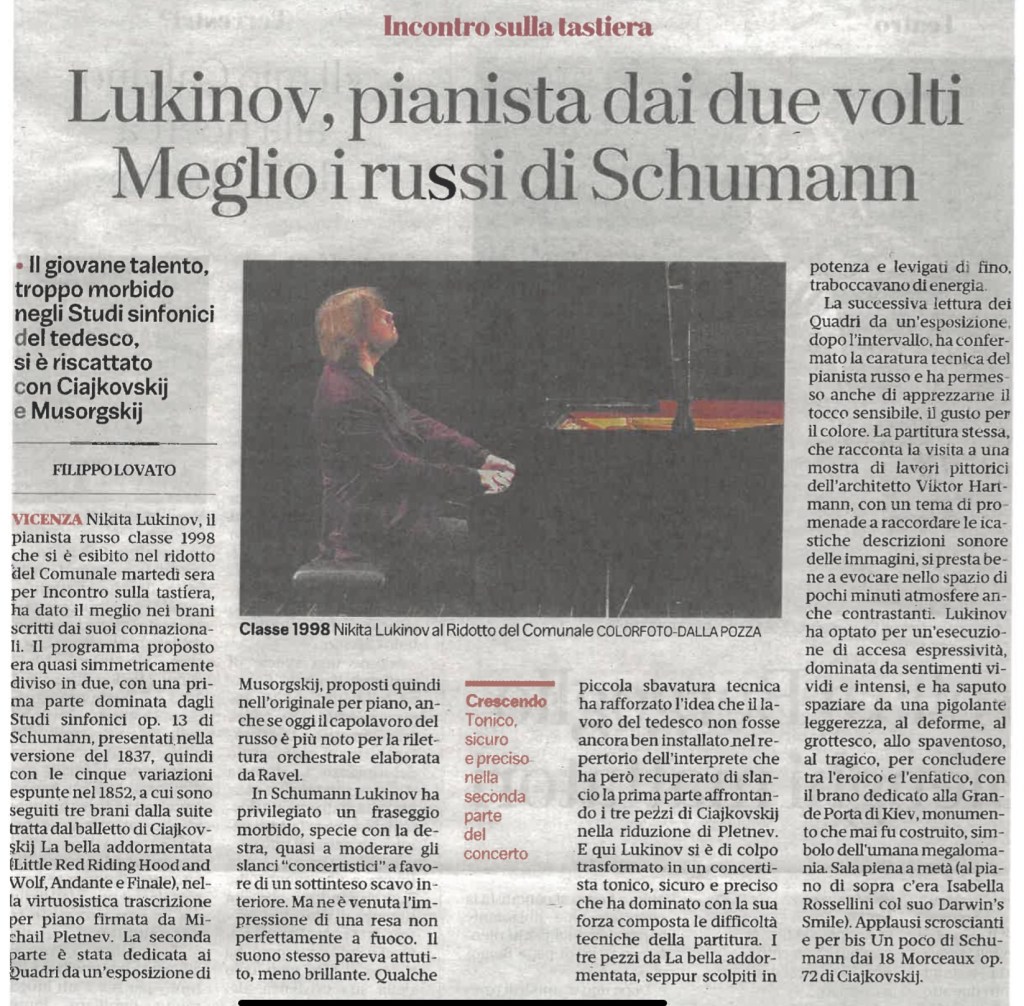
The two sides of Lukinov ,better the Russians than Schumann.
‘The young talented pianist was too delicate in the Germanic Symphonic Studies redeeming himself with Tchaikowsky and Mussorgsky.’
Nikita Lukinov,the Russian pianist born in 1998 played Tuesday evening in the small hall of the Teatro Comunale for the ‘Incontro sulla Tastiera’ and was shining brighter in the works by his compatriots.The symmetrical programme was divided into two parts.The first dominated by the Symphonic Studies op 13 in the 1837 version with the five variations of 1852 ,followed by three movements from the ‘Sleeping Beauty Suite’ from the Ballet by Tchaikowsky.; Little Red Riding Hood and the Woolf ,Andante and Finale in the virtuoso transcription for piano by Mikhail Pletnev.The second part was dedicated to ‘Pictures at an Exhibition’ by Mussorgsky in the original piano version even though this masterpiece is better known these days in the orchestral version by Ravel.In Schumann Lukinov chose a delicacy of phrasing especially with the right hand ,as if to prefer not the impetuous outward virtuosity but searching for a more interior meaning. It gave the impression of not being totally convincing with sounds that seemed less brilliant and more muffled.Some small blemishes only added weight to the idea that this was a new addition to his repertoire.But he recovered immediately in this first half with the three pieces by Tchaikowsky transcribed by Pletnev.Immediately here Lukinov was transformed into a full blooded virtuoso,sure and precise dominating the technical difficulties with aplomb.The three movements of the Sleeping Beauty were carved out with strength and astonishing energy.
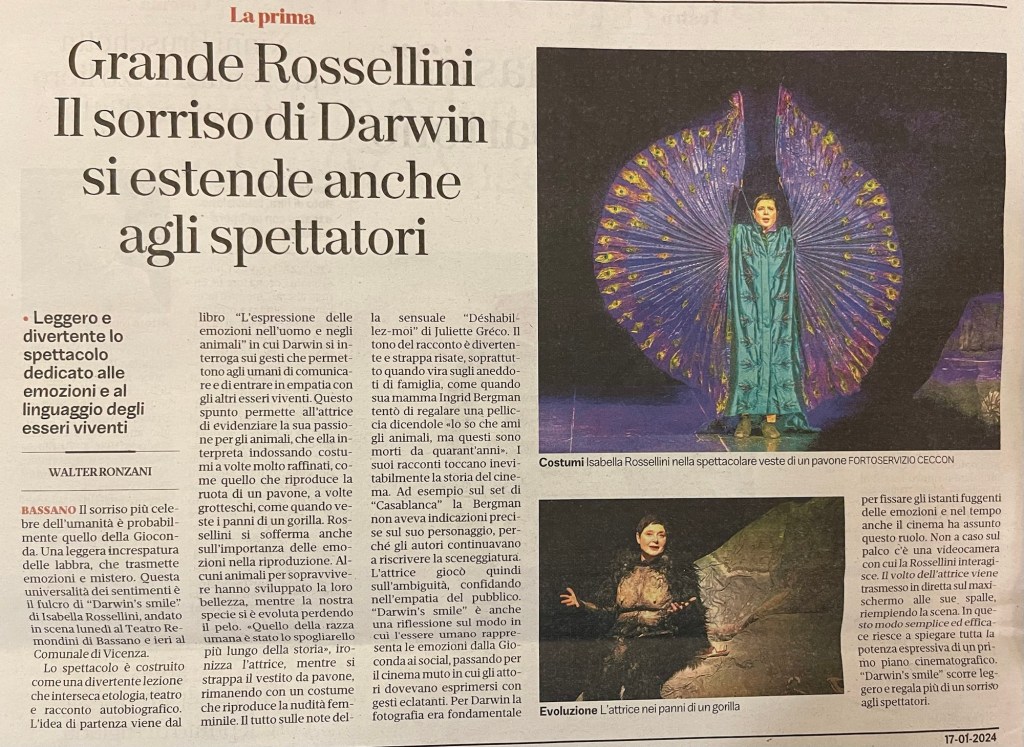
The performance of ‘Pictures at an Exhibition’ that followed after the interval only confirmed the technical mastery of this Russian pianist and allowed us to appreciate his delicate touch and sense of colour.The work itself describes the pictures of the Architect Viktor Hartmann,with the theme of the promenade linking the graphic pictures described in sounds creating different atmospheres in the space of just a few minutes .Lukinov chose an interpretation of great expressiveness dominated by strong and intense feelings as he showed us the chirping lightness ,the deformed,grotesque ,frightening,and tragic to finish with the heroic and emphatic movement dedicated to ‘The Great Gate of Kiev’, a monument that was never built but was a simbol of human megalomania .A half full hall because upstairs there was Isabella Rossellini with her ‘Darwin’s Smile’.Thunderous applause though and an encore of ‘Un poco di Schumann’from 18 pieces op 72 by Tchaikowsky .
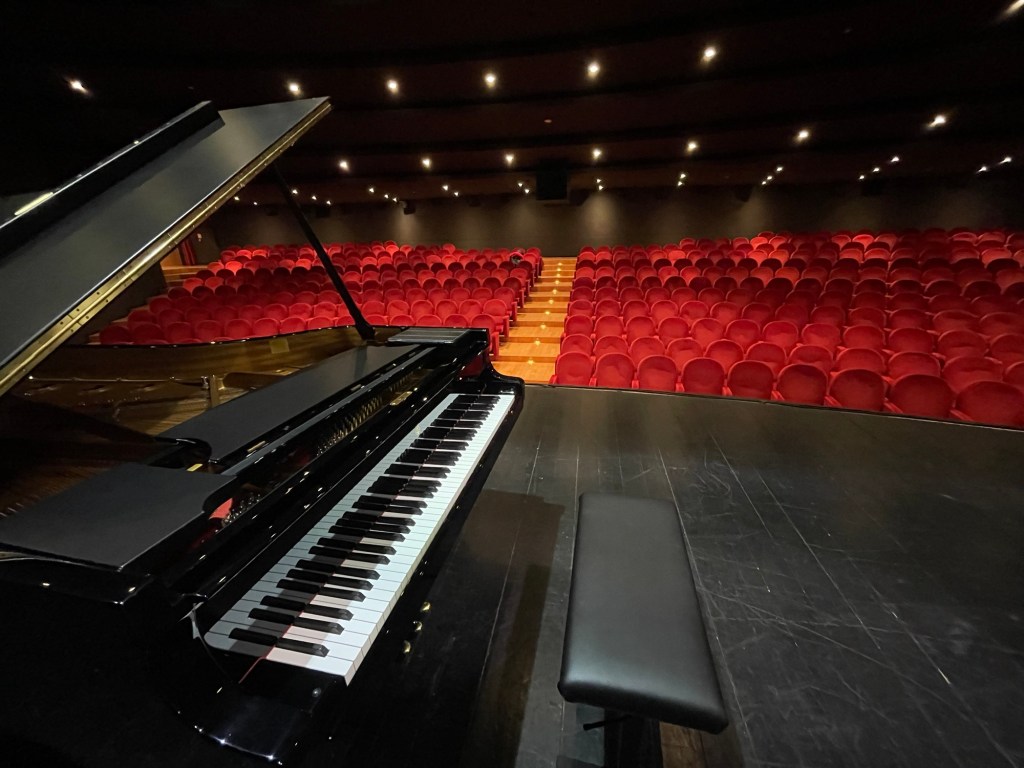
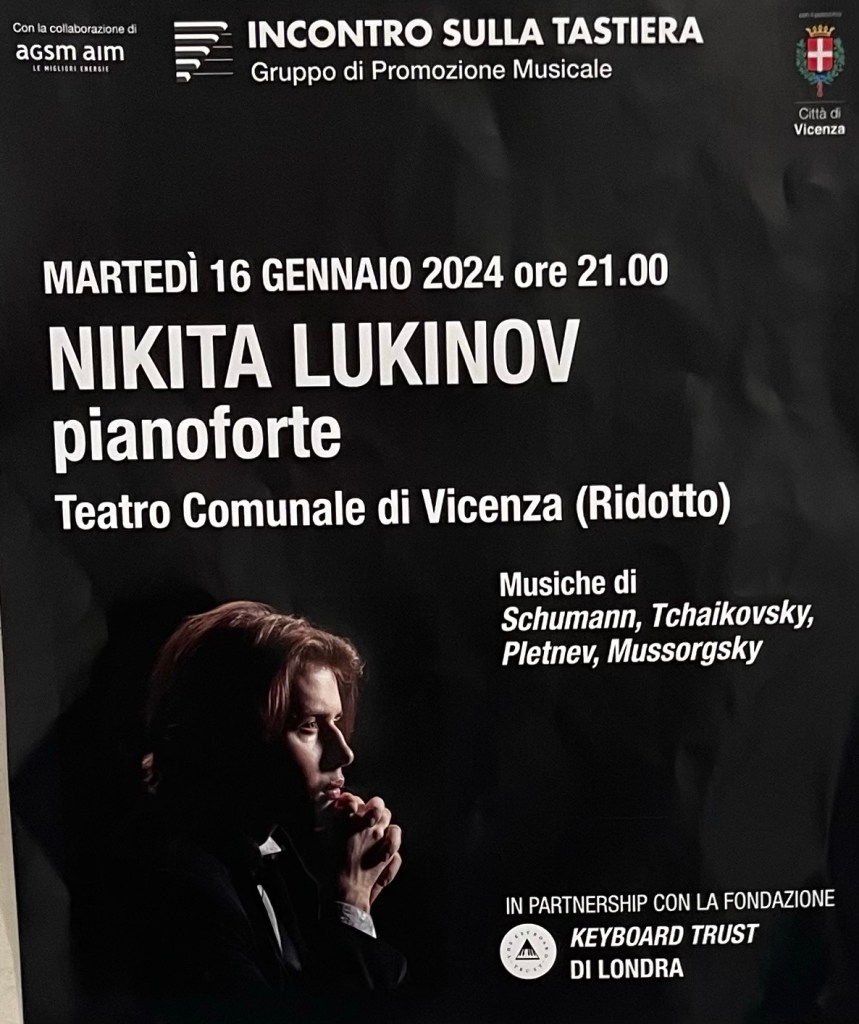
The main 900 seat theatre full to the rafters for a new one woman play and the smaller 400 seat theatre almost as full for Nikita’s final recital for the KT’s 20th Anniversary concert with the Incontri sulla Tastiera.
A concert dedicated for the past eight years to the memory of the mother of Ermanno Detto the ever generous sponsor of the concerts that Fernanda Muraro Detto used to frequent.
Maria Antonietta Squeglia the driving force behind the Incontri concerts was unfortunately laid low with broken vertebrae but her daughter Raffaella was there in her place as was Antonella Bartolomucci who introduced the concert.
Ermanno Detto was our genial host as was the President of Incontri Enrico Hullweck ,ex – mayor of Vicenza who had battled for many a year to bring to completion this extraordinary modern complex.
A magnificent new Steinway concert grand from the son of Zanta whose father is still the custodian of the magnificent old Steinway in the Sala Dei Giganti in Padua .This piano is the preferred piano of Sokolov and Nikita too said he had never played such a fine instrument .
What could be better for this final concert and Nikita rose to the occasion with performances of subtle beauty and a feeling of recreating works that he had played for four consecutive days.
There were some very subtle shadings and more time taken as certain corners were given an elasticity that can only happen when the performer and audience are united as one.This is surely the reason for live performances especially of well worn masterpieces.
There is an interaction between artist and audience which can illuminate and still find unexpectedly new things without distorting the overall structure or betraying the fidelity to the composer’s intentions .The ‘Gothic Cathedral’ variation ( n. 7 ) was a case in point as the opening majesty gave way to a timelessness like looking in wonder at a monumental edifice.
Nikita could also play much quieter (strange paradox on a larger piano) with whispered sounds of ravishing beauty that drew the audience to him rather than he having to project the sound to them.
Longer silences and held chords daringly allowed more time without breaking the subtle line that holds an interpretation together.Like the man on the high wire daring to risk all in moments when everything seemed to come together so naturally right.One must have the courage to risk and dare as a solo performer – playing safe is something you do in the recording studio as you search for the perfect performance .On stage you are in the circus arena which is only for the very few courageous souls that are prepared to risk all for moments of discovery and recreation.Not necessarily the note picking accuracy that are essential for studio recordings that are going to be listened to over and over again.
Public performance as Nikita showed us today needs to have an element of the showman that can reduce the public to tears and at the drop of a hat have them laughing or seduced by refined sounds and atmospheres.The music must be a living thing when the curtain goes up and the audience must be in your hands to be led on a voyage of discovery together into the very world of the composer they are transmitting.
I often quote the title of an article written in ‘Le Monde de la Musique’ about Shura Cherkassky which summed up in few words his extraordinary artistry:’Je joue, je sens , je transmets.’
Nikita today proved himself worthy of this supreme stylist but also with an extraordinary intelligence that could hold together as one Mussorgsky’s monumental ‘Pictures.’ They were multi-coloured pictures of extraordinarily different character but at the same time pictures that were housed under the same roof of this gallery.There were moments of almost inaudible sounds in the ‘Old Castle’ as there were terrifying outbursts when ‘Baba Yaga’ comes into view.The final pages of the ‘Great Gate’ were breathtaking in their gloriously rich sounds allowed to reverberate around the hall like the echo in a great Cathedral.
The charm and ease that he gave to the encore ‘Un poco di Schumann’ by Tchaikowsky was the same ease and style that he had brought earlier to three pieces from ‘The Sleeping Beauty Suite.’
It was playing of another age where showmanship is combined with the real technical mastery of a kaleidoscope of sounds in each finger.A heart and soul of gold but a mind and fingers of computer- like precision and intelligence – another paradox but then music is a world which is born and takes flight where words are just not enough.
Two triumphs under one roof Isabella Rossellini and Nikita Lukinov united in this magnificent city where Palladio had constructed the first covered theatre .And so as not to frighten the audience he painted clouds on the roof ………..Italy really is the Museum of the World as Rostropovich so rightly declared and like all art a true Voyage of Discovery.
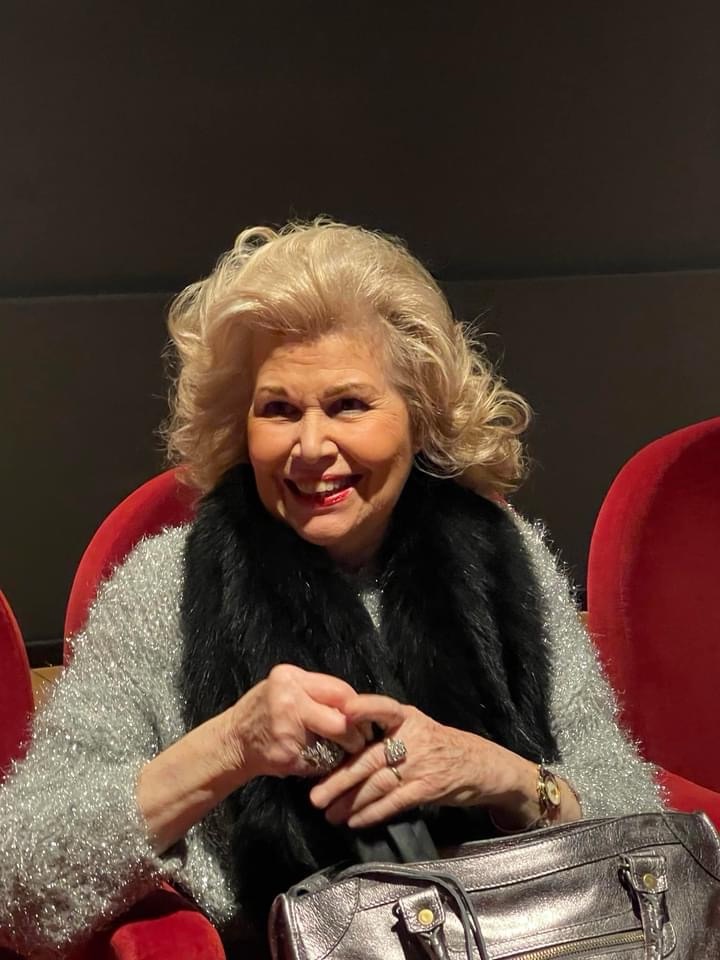
The ravishing ever youthful Marie Antonietta Squeglia, a long – time friend and colleague of Noretta Conci, invites one of the most enticing pianists from the KT stable to give a recital in her prestigious concert series that she holds every season in the Teatro Comunale during the winter months and the historic Teatro Olimpico in the months where heating is no longer needed or indeed allowed.
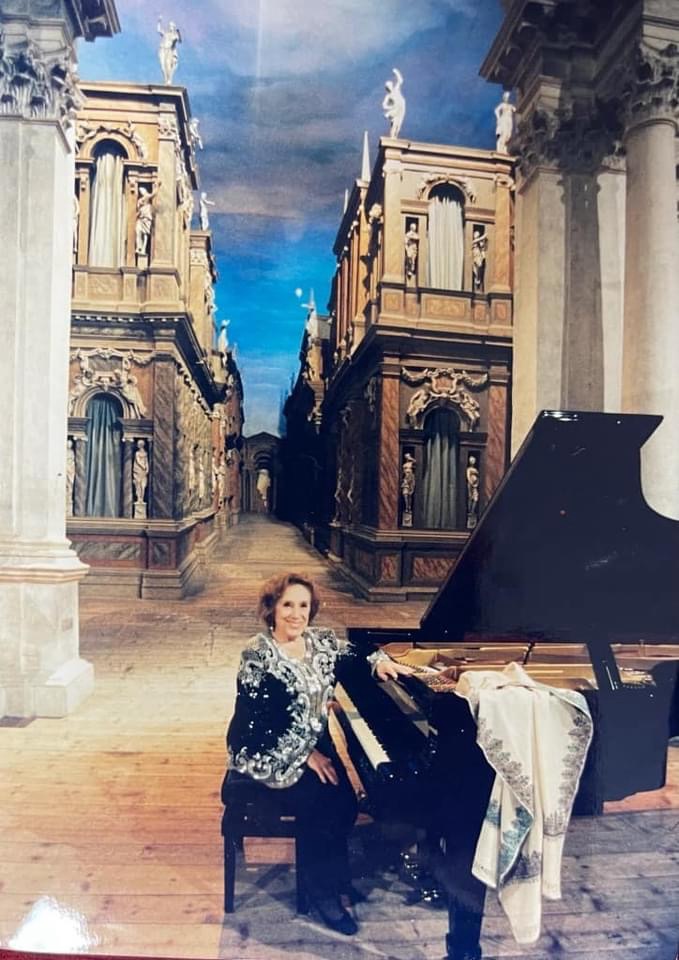
It was only Rosalyn Tureck who was allowed heating in this historic wooden edifice of Palladio but surrounded by good looking young firemen though …which of course she loved! She was less enamoured by the Borgato piano seated on stage that she was told was Radu Lupu’s favourite instrument .’Tureck only plays Steinway ‘ was her imperious reply as a match worthy of the cup final was played out to the bitter end !
The final concert of this short KT tour with Nikita’s sparring partner Isabella Rossellini in the extraordinary cultural centre that is the Teatro Comunale in Vicenza.
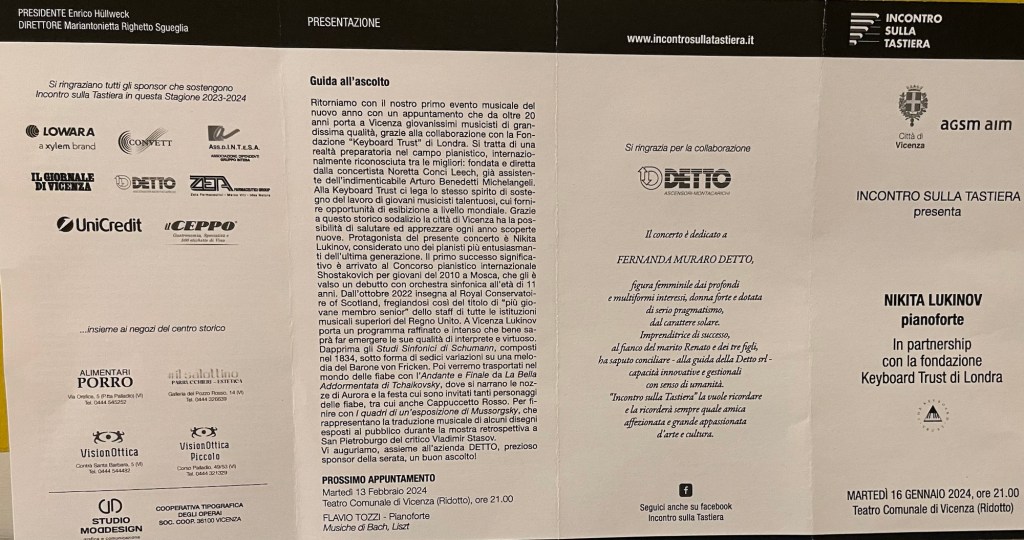
The main 900 seat theatre full to the rafters for a new one woman play and the smaller 400 seat theatre almost as full for Nikita’s final recital for the KT’s 20th Anniversary concert with the Incontri sulla Tastiera.
A concert dedicated for the past eight years to the memory of the mother of Ermanno Detto the ever generous sponsor of the concerts that Fernanda Muraro Detto used to frequent.
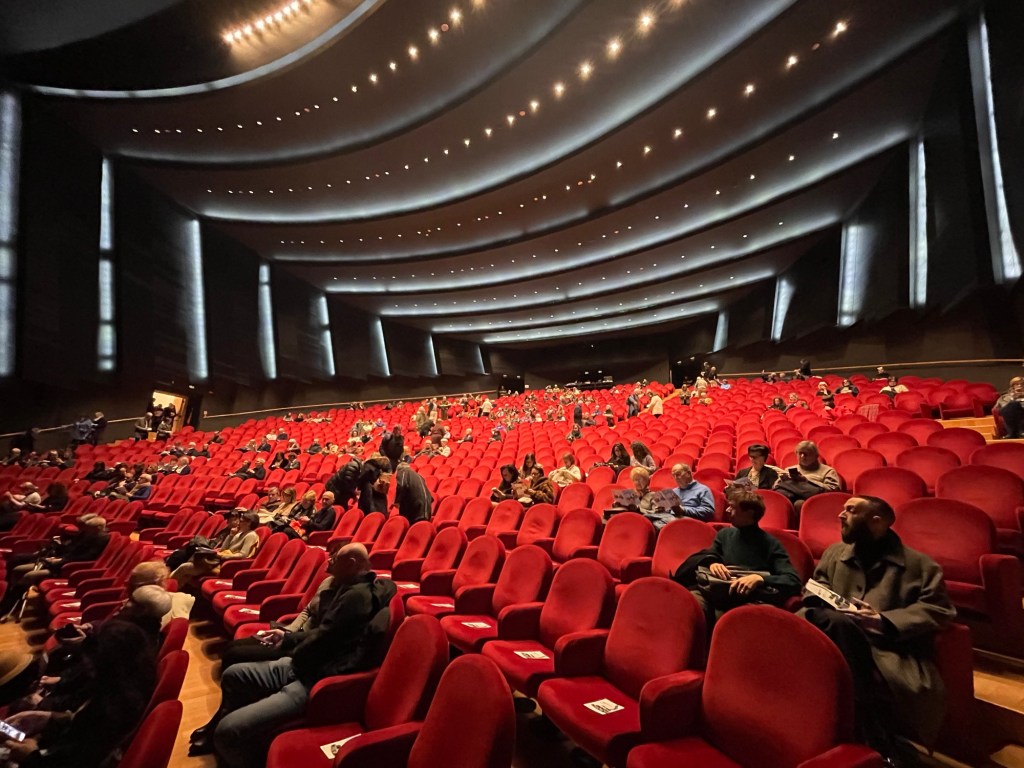
Maria Antonietta Squeglia the driving force behind the Incontri concerts was unfortunately laid low with broken vertebrae but her daughter Raffaella was there in her place as was Antonella Bartolomucci who introduced the concert.
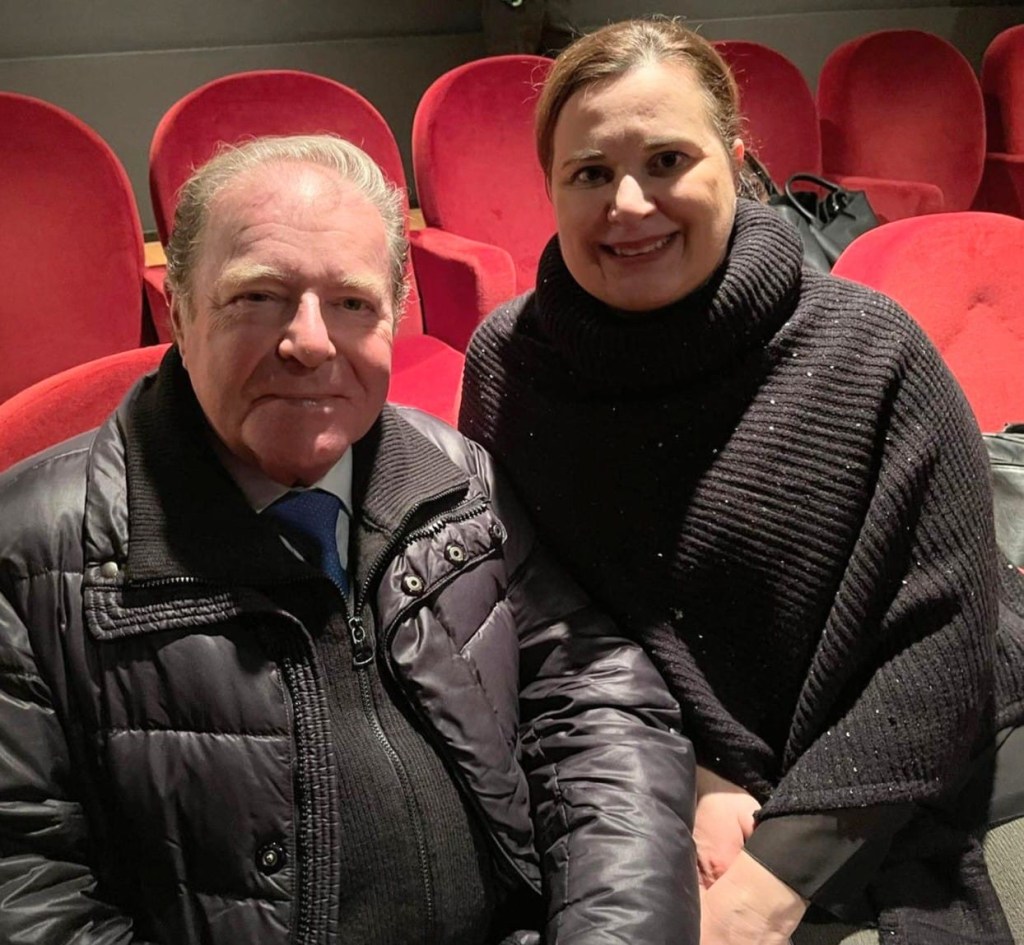
Ermanno Detto was our genial host as was the President of Incontri Enrico Hullweck ,ex- Mayor of Vicenza who had battled for many a year to bring to completion this extraordinary modern complex.
A magnificent new Steinway concert grand from the son of Zanta whose father is still the custodian of the magnificent old Steinway in the Sala Dei Giganti in Padua .This piano is the preferred piano of Sokolov and Nikita too said he had never played such a fine instrument .
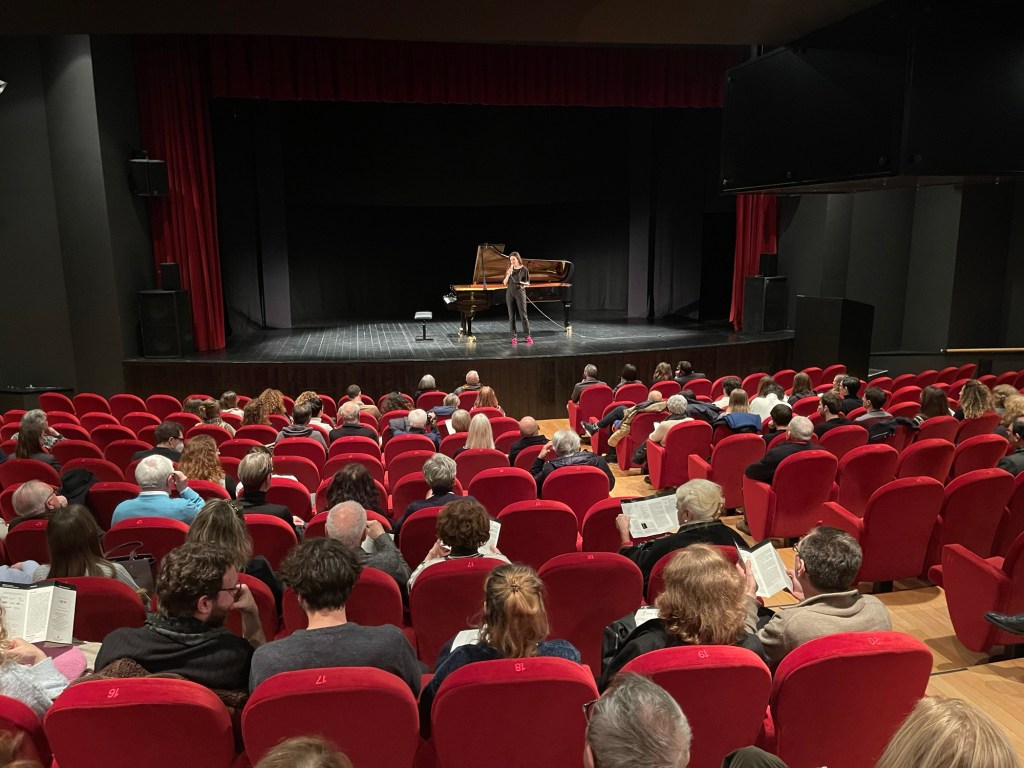
What could be better for this final concert and Nikita rose to the occasion with performances of subtle beauty and a feeling of recreating works that he had played for four consecutive days.
There were some very subtle shadings and more time taken as certain corners were given an elasticity that can only happen when the performer and audience are united as one.This is surely the reason for live performances especially of well worn masterpieces.
There is an interaction between artist and audience which can illuminate and still find unexpectedly new things without distorting the overall structure or betraying the fidelity to the composer’s intentions .The ‘Gothic Cathedral’ variation ( n. 7 ) was a case in point as the opening majesty gave way to a timelessness like looking in wonder at a monumental edifice.
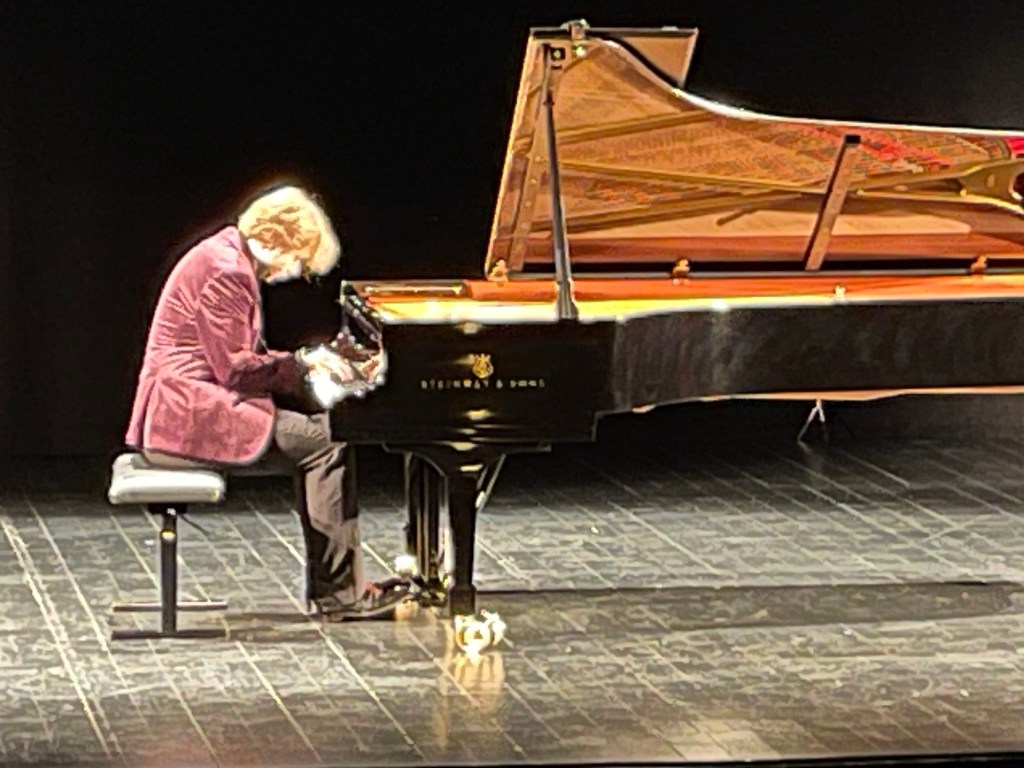
Nikita could also play much quieter (strange paradox on a larger piano) with whispered sounds of ravishing beauty that drew the audience to him rather than he having to project the sound to them.
Longer silences and held chords daringly allowed more time without breaking the subtle line that holds an interpretation together.Like the man on the high wire daring to risk all in moments when everything seemed to come together so naturally right.One must have the courage to risk and dare as a solo performer – playing safe is something you do in the recording studio as you search for the perfect performance .On stage you are in the circus arena which is only for the very few courageous souls that are prepared to risk all for moments of discovery and recreation.Not necessarily the note picking accuracy that are essential for studio recordings that are going to be listened to over and over again.
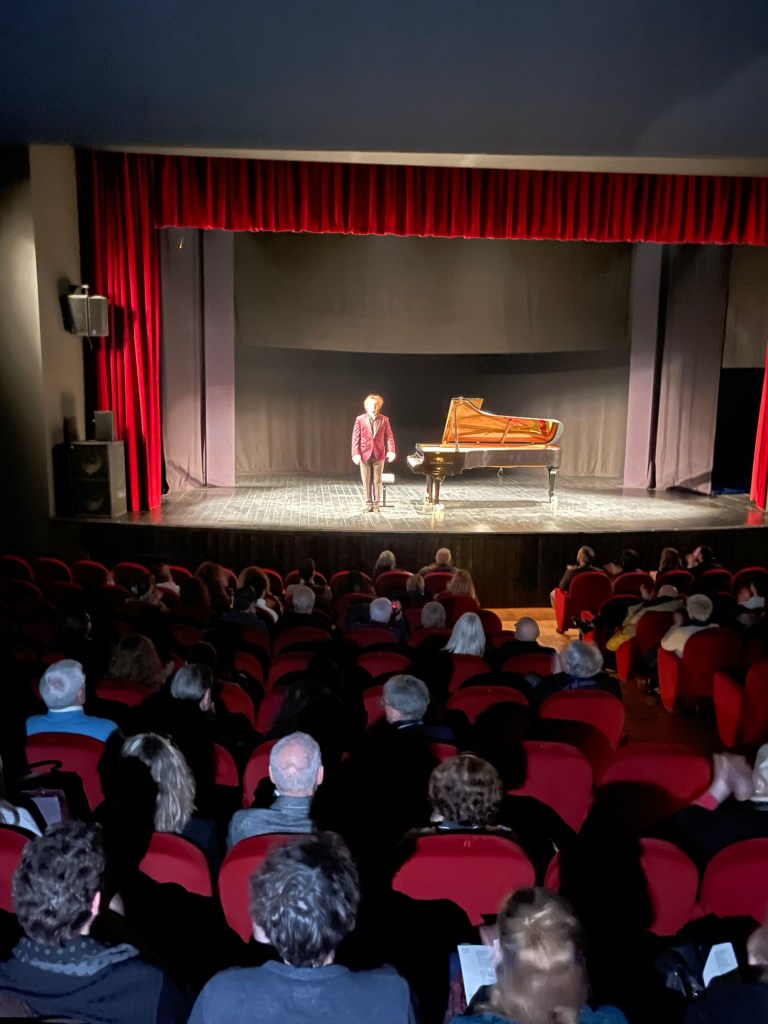
Public performance as Nikita showed us today needs to have an element of the showman that can reduce the public to tears and at the drop of a hat have them laughing or seduced by refined sounds and atmospheres.The music must be a living thing when the curtain goes up and the audience must be in your hands to be led on a voyage of discovery together into the very world of the composer they are transmitting.
I often quote the title of an article written in ‘Le Monde de la Musique’ about Shura Cherkassky which summed up in few words his extraordinary artistry : ‘Je joue, je sens, je transmets.’
Nikita today proved himself worthy of this supreme stylist but also with an extraordinary intelligence that could hold together as one Mussorgsky’s monumental ‘ Pictures.’ They were multi-coloured pictures of extraordinarily different character but at the same time pictures that were housed under the same roof of this gallery.There were moments of almost inaudible sounds in the ‘Old Castle’ as there were terrifying outbursts when ‘Baba Yaga’ comes into view.The final pages of the ‘Great Gate’ were breathtaking in their gloriously rich sounds allowed to reverberate around the hall like the echo in a great Cathedral.
The charm and ease that he gave to the encore ‘Un poco di Schumann’ by Tchaikowsky was with the same ease and style that he had brought earlier to three pieces from ‘The Sleeping Beauty Suite.’
It was piano playing of another age where showmanship is combined with the real technical mastery of a kaleidoscope of sounds in each finger.A heart and soul of gold but a mind and fingers of computer – like precision and intelligence – another paradox but then music is a world which is born and takes flight where words are just not enough.
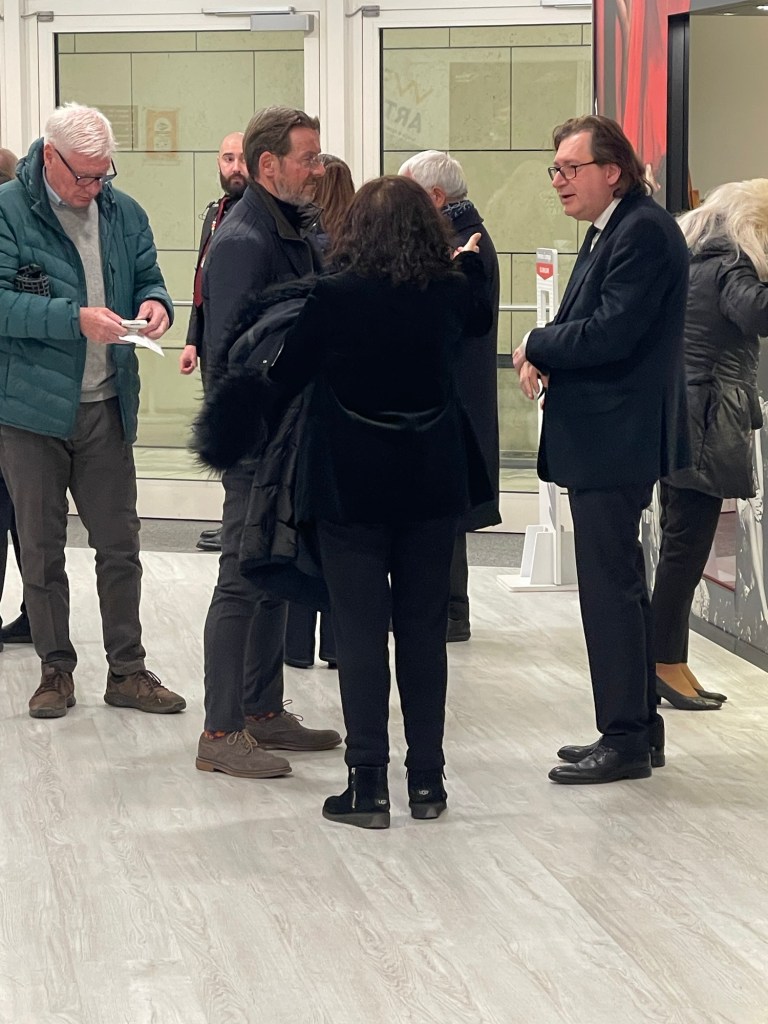
Two triumphs under one roof Isabella Rossellini and Nikita Lukinov united in this magnificent city where Palladio had constructed the first covered theatre. And so as not to frighten the audience he painted clouds on the roof …Italy really is the Museum of the World as Rostropovich so rightly declared and like all art a true Voyage of Discovery.
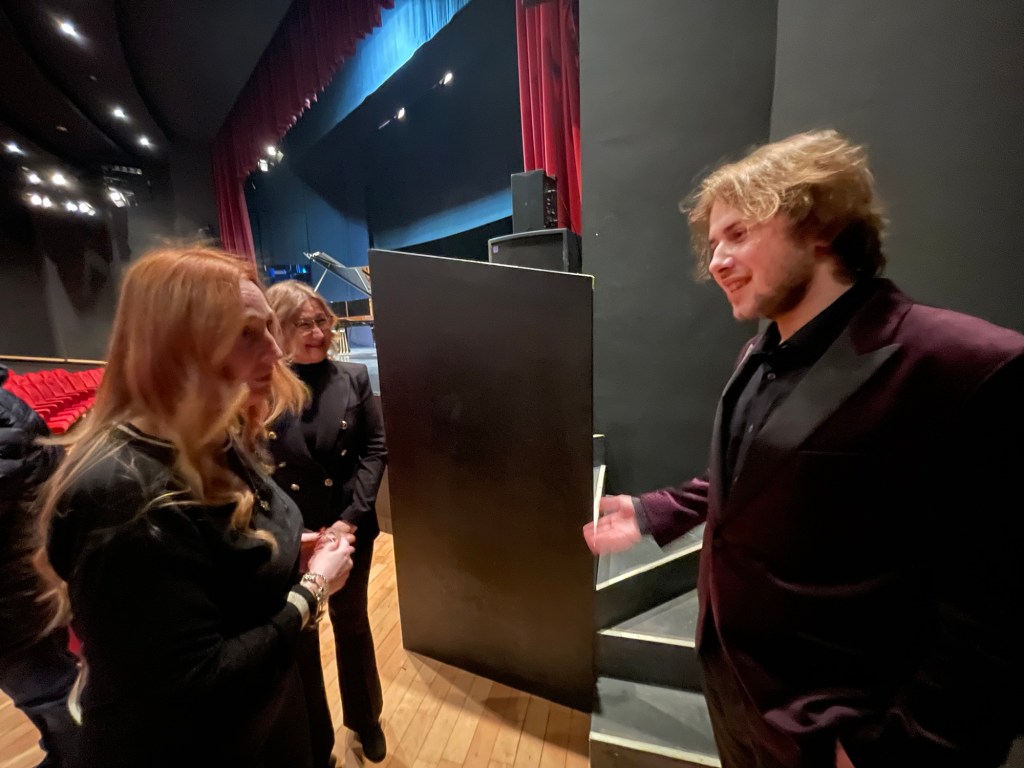
A stage at the Comunale that we will be sharing with Isabella Rossellini who will be performing her much awaited one woman show on the stage next to ours.
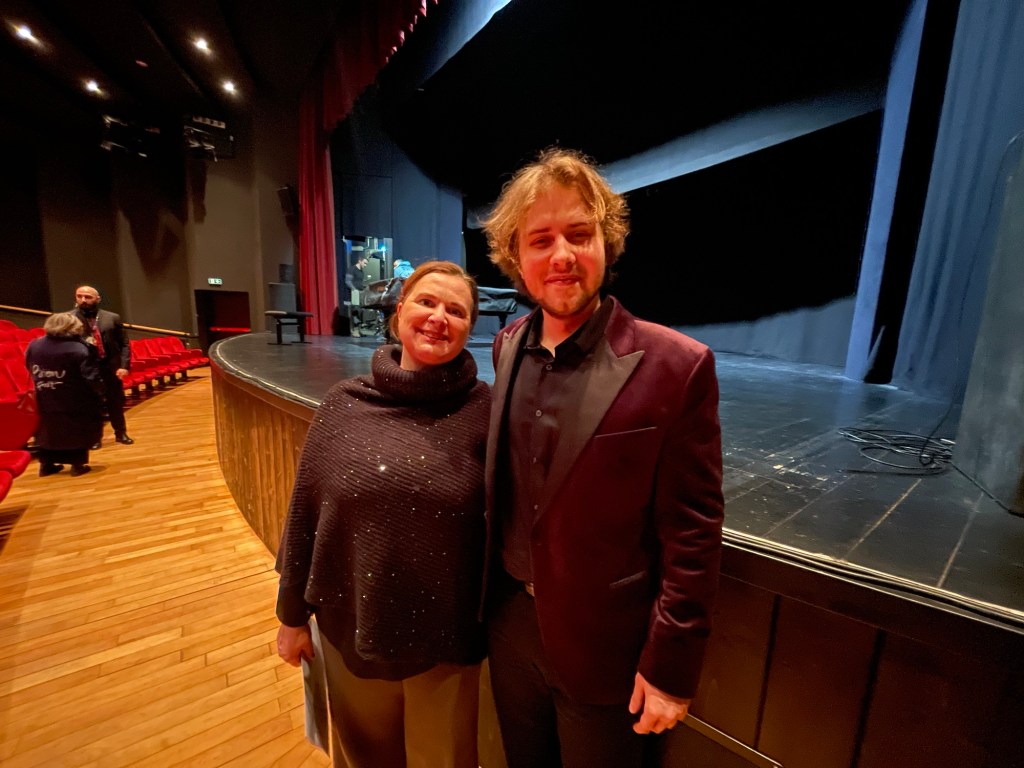

And so a magic carpet will fly our dashing young prince away to the Isle of Man where he will delight even more enthusiastic KT followers with his superb performances of Schumann,Tchaikowsky and Mussorgsky -and also a masterclass and introductory talk for the enthusiastic music lovers on this sceptered Isle
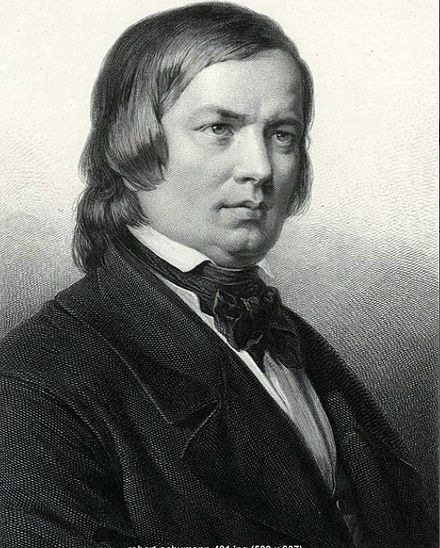
Born
8 June 1810
Zwickau,Saxony
Died
29 July 1856 (aged 46)
Bonn , Rhine Province, Prussia
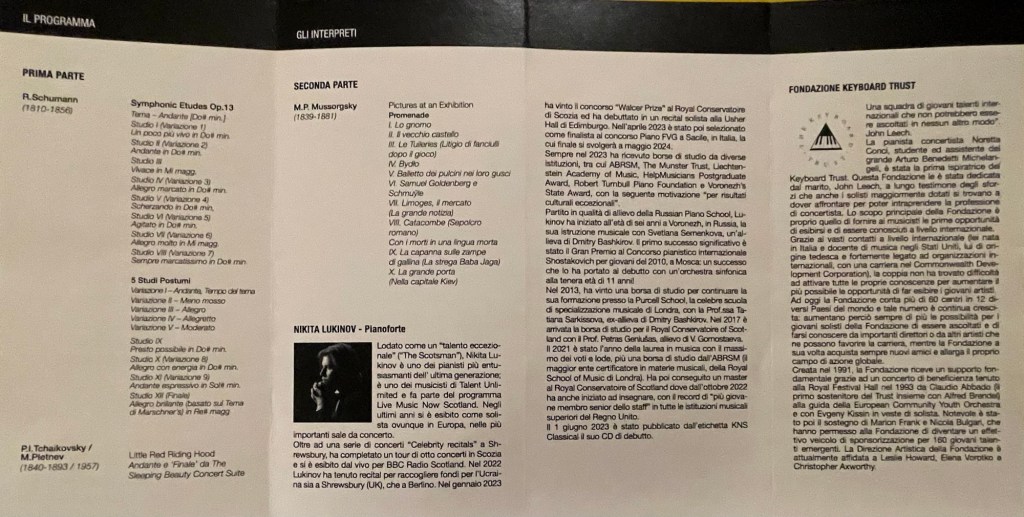
The Symphonic Studies Op. 13, began in 1834 as a theme and sixteen variations on a theme by Baron von Fricken, plus a further variation on an entirely different theme by Heinrich Marschner.The first edition in 1837 carried an annotation that the tune was “the composition of an amateur”: this referred to the origin of the theme, which had been sent to Schumann by Baron von Fricken, guardian of Ernestine von Fricken, the Estrella of his Carnaval op. 9. The baron, an amateur musician, had used the melody in a Theme with Variations for flute. Schumann had been engaged to Ernestine in 1834, only to break abruptly with her the year after. An autobiographical element is thus interwoven in the genesis of the Études symphoniques (as in that of many other works of Schumann’s).Of the sixteen variations Schumann composed on Fricken’s theme, only eleven were published by him. (An early version, completed between 1834 and January 1835, contained twelve movements). The final, twelfth, published étude was a variation on the theme from the Romance Du stolzes England freue dich(Proud England, rejoice!), from Heinrich Marschner’s opera Der Templer und die Judin based on Sir Walter Scott’s Ivanhoe (as a tribute to Schumann’s English friend, William Sterndale Bennett to whom it is dedicated )The earlier Fricken theme occasionally appears briefly during this étude. The work was first published in 1837 as XII Études Symphoniques. Only nine of the twelve études were specifically designated as variations. The entire work was dedicated to Schumann’s English friend, the pianist and composer, and Bennett played the piece frequently in England to great acclaim, but Schumann thought it was unsuitable for public performance and advised his wife Clara not to play it.The highly virtuosic demands of the piano writing are frequently aimed not merely at effect but at clarification of the polyphonic complexity and at delving more deeply into keyboard experimentation.
- Theme – Andante [C♯ minor]
- Etude I (Variation 1) – Un poco più vivo [C♯ minor]
- Etude II (Variation 2) – Andante [C♯ minor]
- Etude III – Vivace [E Major]
- Etude IV (Variation 3) – Allegro marcato [C♯ minor]
- Etude V (Variation 4) – Scherzando [C♯ minor]
- Etude VI (Variation 5) – Agitato [C♯ minor]
- Etude VII (Variation 6) – Allegro molto [E Major]
- Etude VIII (Variation 7) – Sempre marcatissimo [C♯ minor]
- Etude IX – Presto possibile [C♯ minor]
- Etude X (Variation 8) – Allegro con energia [C♯ minor]
- Etude XI (Variation 9) – Andante espressivo [G♯ minor]
- Etude XII (Finale) – Allegro brillante (based on Marschner’s theme) [D♭ Major]
On republishing the set in 1890, Johannes Brahms restored the five variations that had been cut by Schumann. These are now often played, but in positions within the cycle that vary somewhat with each performance; there are now twelve variations and these five so-called “posthumous” variations which exist as a supplement.
The five posthumously published sections (all based on Fricken’s theme) are:
- Variation I – Andante, Tempo del tema
- Variation II – Meno mosso
- Variation III – Allegro
- Variation IV – Allegretto
- Variation V – Moderato.
- Moderato.
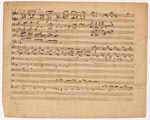
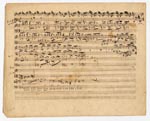
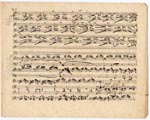
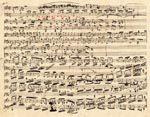
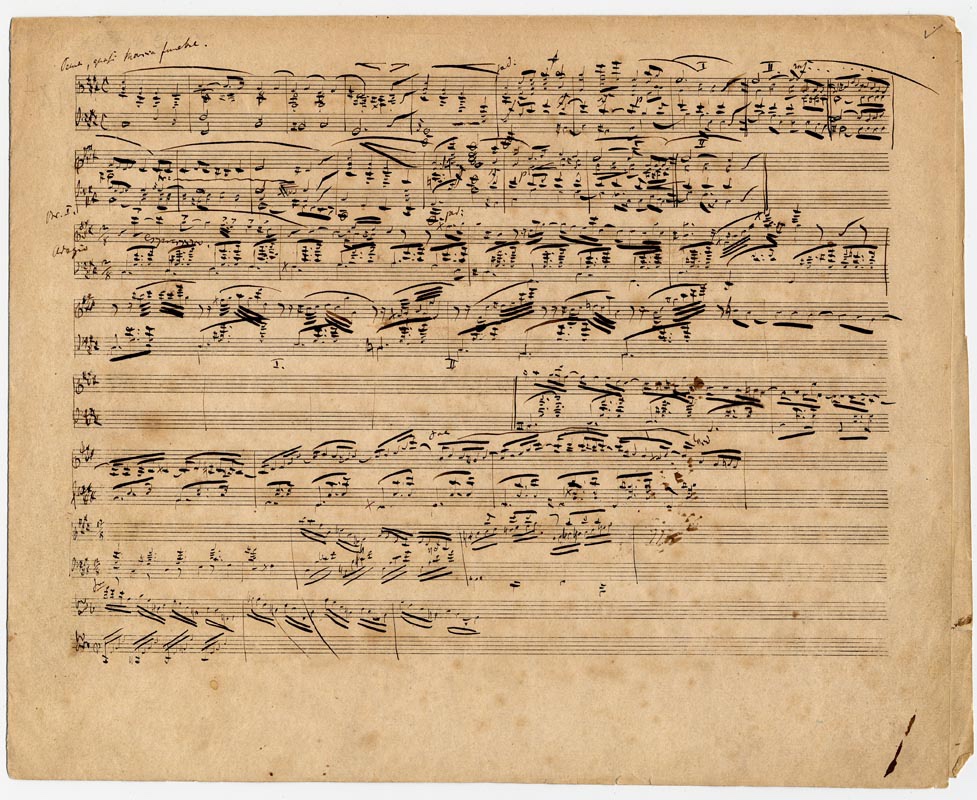
In 1834, Schumann fell in love with Ernestine von Fricken, a piano student of Friedrich Wieck, and for a time they seemed destined to marry. The relationship did not last—Schumann got cold feet after he learned that she had been born out of wedlock—but it inspired some notable music. Carnaval, Op. 9, a set of character pieces for piano, is based on a four-note motive derived from the name of Ernestine’s home town. The Etudes symphoniques, Op. 13, are variations on a theme by Ernestine’s father, Ignaz Ferdinand von Fricken, a nobleman and amateur composer. Of course, Schumann eventually transferred his affections to Clara Wieck, and it was she who gave the first performance of the Etudes symphoniques, in 1837. The piece was published by Haslinger that same year, with a dedication to the English composer William Sterndale Bennett rather than to Ernestine. A revised version appeared in 1852.
Our manuscript is a sketch that includes the theme and variations 1, 2, 5, 10, 12, as well as five others that were not published until 1873, in an appendix edited by none other than Johannes Brahms. It formerly belonged to Alice Tully (1902–1993), the philanthropist whose name graces a concert hall in Lincoln Center. She gave it to Vladimir Horowitz (who counted Schumann’s music among his many specialties in the piano repertoire), and two years after his death, his widow Wanda Toscanini Horowitz donated it to Yale. The other principal manuscript source for this piece belongs to the library of the Royal Museum of Mariemont, in Belgium.
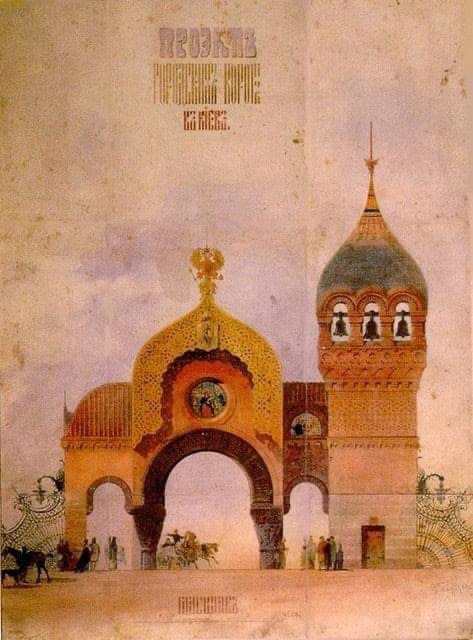
Pictures at an Exhibition is based on pictures by the artist, architect, and designer Viktor Hartmann. It was probably in 1868 that Mussorgsky first met Hartmann, not long after the latter’s return to Russia from abroad. Both men were devoted to the cause of an intrinsically Russian art and quickly became friends. They met in the home of the influential critic Vladimir Stasov, who followed both of their careers with interest. According to Stasov’s testimony, in 1868, Hartmann gave Mussorgsky two of the pictures that later formed the basis of Pictures at an Exhibition.
Concert Suite from the Ballet ‘The Sleeping Beauty’
Prologue
Dance of Pages
Vision
Andante
Fairy of Silver
The Pussed Tom-Cat and the White Cat
Gavotte
The Singing Canary
Little Red Riding Hood and Wolf
Adagio
Finale
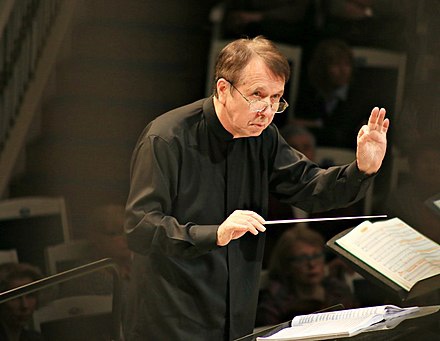
Mikhail Pletnev was born 14 April 1957 into a musical family in Arkhangelsk, then part of the Soviet Union .He studied for six years at the Special Music School of the Kazan Conservatory before entering the Moscow Central Music School at the age of 13, where he studied under Evgeny Timakin. In 1974, he entered the Moscow Conservatory , studying under Yakov Flier and Lev Vlassenko.At age 21, he won the Gold Medal at the VI International Tchaikovsky Competition in 1978, which earned him international recognition and drew great attention worldwide.
PICTURES AT AN EXHIBITION Promenade l
The Gnomes
Promenade ll
The Old Castle
Promenade lll
The Tuileries: Children’s dispute
after play
Bydlo
Promenade IV
Ballet of the unhatched chicks
Two Polish Jews: Rich and poor
Promenade V
The market at Limoges
Roman Catacombs – With the dead
in a dead language
Baba Yaga: The Witch
The Heroes Gate at Kiev
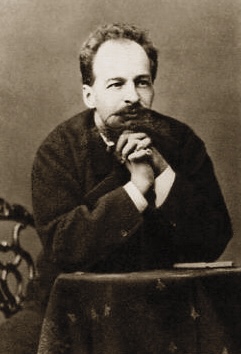
Hartmann’s sudden death on 4 August 1873 from an aneurysm shook Mussorgsky along with others in Russia’s art world. The loss of the artist, aged only 39, plunged the composer into deep despair. Stasov helped to organize a memorial exhibition of over 400 Hartmann works in the Imperial Academy of Arts in Saint Petersburg in February and March 1874. Mussorgsky lent the exhibition the two pictures Hartmann had given him, and viewed the show in person, inspired to compose Pictures at an Exhibition, quickly completing the score in three weeks (2–22 June 1874).Five days after finishing the composition, he wrote on the title page of the manuscript a tribute to Vladimir Stasov, to whom the work is dedicated.The music depicts his tour of the exhibition, with each of the ten numbers of the suite serving as a musical illustration of an individual work by Hartmann.Although composed very rapidly, during June 1874, the work did not appear in print until 1886, five years after the composer’s death, when a not very accurate edition by the composer’s friend and colleague Nikolai Rimsky-Korsakov was published.
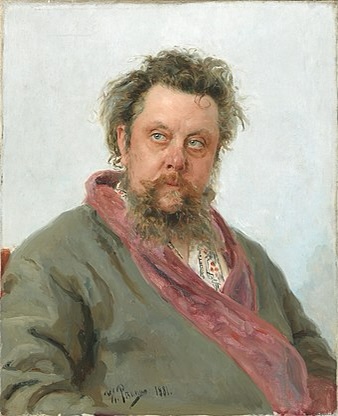
Mussorgsky suffered personally from alcoholism, it was also a behavior pattern considered typical for those of Mussorgsky’s generation who wanted to oppose the establishment and protest through extreme forms of behavior.One contemporary notes, “an intense worship of Bacchus was considered to be almost obligatory for a writer of that period.”Mussorgsky spent day and night in a Saint Petersburg tavern of low repute, the Maly Yaroslavets, accompanied by other bohemian dropouts. He and his fellow drinkers idealized their alcoholism, perhaps seeing it as ethical and aesthetic opposition. This bravado, however, led to little more than isolation and eventual self-destruction.
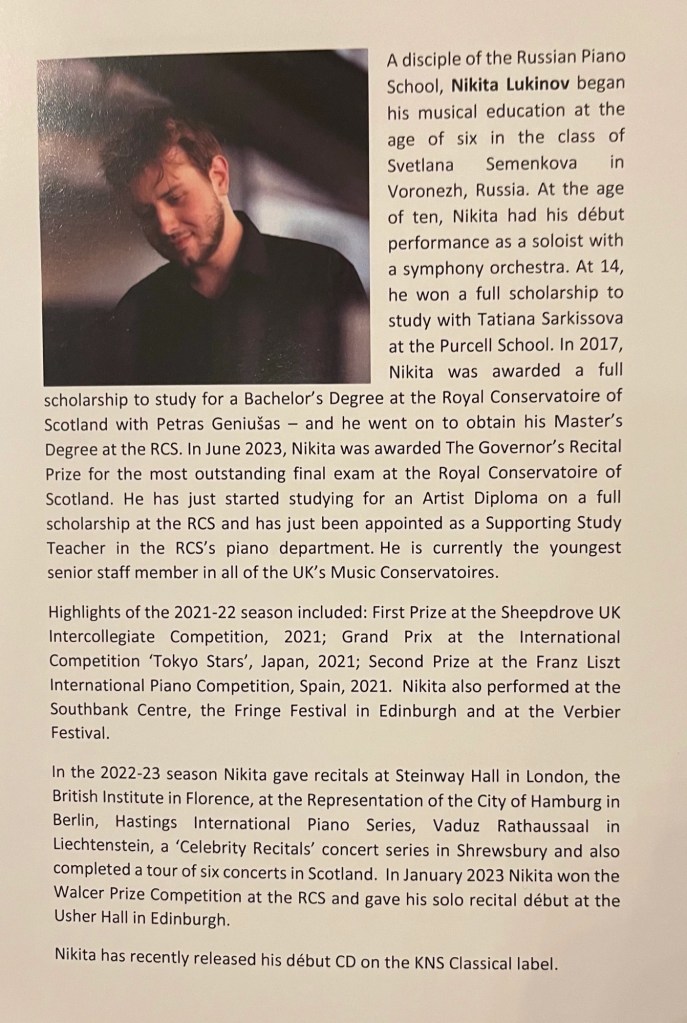

 ChristopherAxworthy-MusicCommentary
Una risposta a "Nikita Lukinov’s triumphant tour for the Keyboard Trust of Italy in Venice,Padua,Abano Terme ,Vicenza"