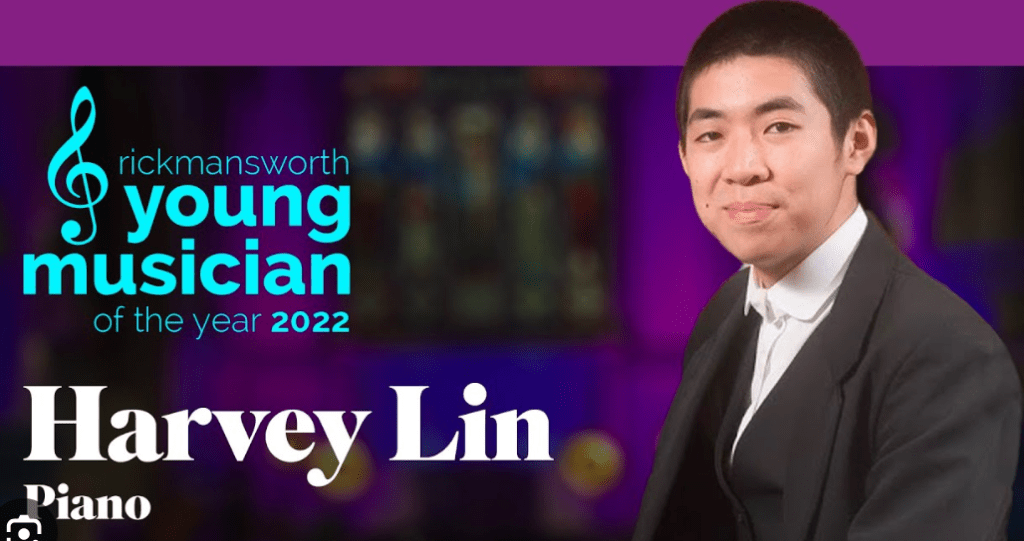

An opening concert for 2024 with a young maths and statistics undergraduate from Harvard University ready to give exemplary performances of major works from the piano repertoire.
St Mary’s never fails to surprise,delight and astonish as they offer a platform to a category that is never mentioned in the mass media.
Young musicians ready to dedicate their youth to the pursuit of sharing beauty and the discovery of a better world after years of single minded dedication.
Harvey Lin was just such a case as he demonstrated with superbly crafted music making of intelligence and love.

A Bach Italian concerto that was played with aristocratic authority as his sparkling non legato touch illuminated the Allegro with a rhythmic drive and delicately contrasted passages that passed from the tutti to the solo – as in his introduction where he had so eloquently described it from one manual to another.There was a languid beauty to the Andante – quasi religious as he said – with the sudden stillness of the coda that was indeed of another world.Even the presto finale was of a grandeur and joie de vivre that was played with exhilaration and exultation.

The Chopin B flat minor Sonata was also played with intelligence and beauty where even the return to the introduction – much debated by some – made such sense in his hands.An occasional added bass note just gave depth to the sound which was full but never hard and the beautiful second subject was played with real weight digging deep into the keys to extract the beauty that lay within.The opening treacherous left hand was just a wash of sound on which the wafts of melody were floated and that with the majestic opening would be transformed into a development section of nobility and grandeur.
The Scherzo was played with great authority and simplicity with the trio that could have been played with less searching for hidden counterpoints but with the same direct simplicity.There was a relentless sense of pulse in the Funeral March and a trio that this time was played with simple beautiful eloquence.The ‘wind blowing over the graves’ in the last movement was played with transcendental control and a sense of line that also gave it great shape as it weaved it’s way to the final majestic chords.

Mozart’s last Sonata was played with eloquence,clarity and charm.I would not have tried to vary the repeated passages but would have let them speak with the same eloquence with which Harvey’s superb natural musicianship had imbued all that he touched.I think he may have been just obediently following advice from lesser mortals!
There was a chiselled beauty to the Adagio where the echo effect he strived for in my opinion was not part of the musical conversation that in his sensitive hands could be so eloquent.The Allegretto was delicately graceful and brilliantly played ,full of sparkling wit.
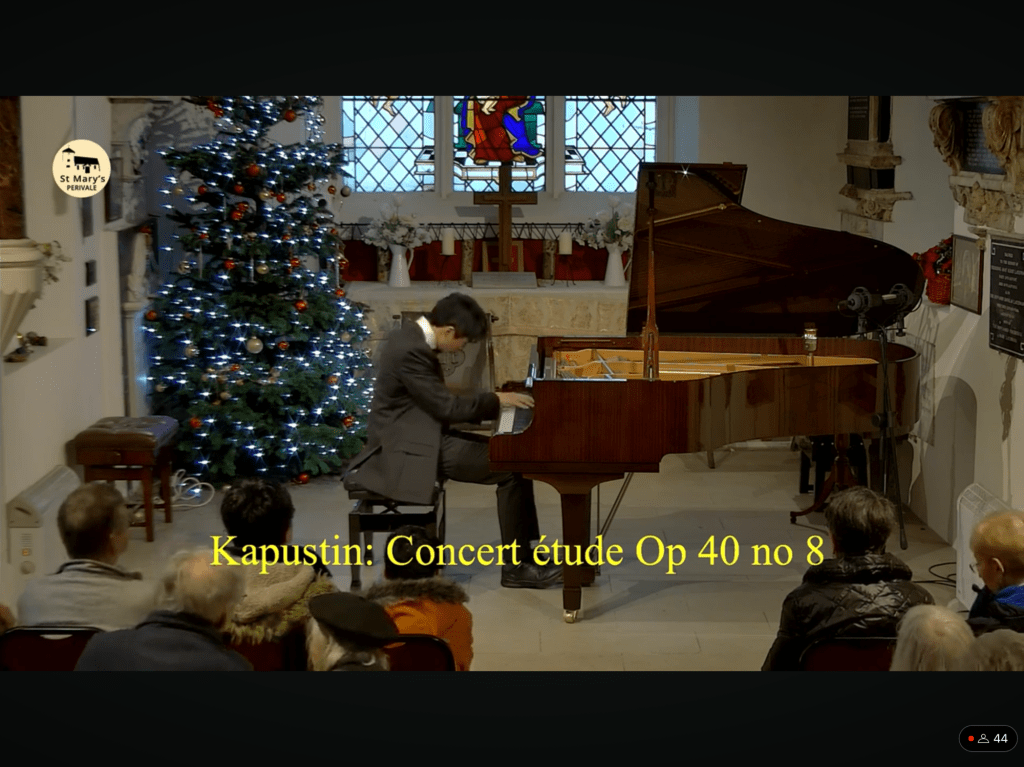
The Kapustin Jazz Etude was played with astonishing brilliance and drive.A superb lesson of a perpetuum mobile in jazz style played with technical brilliance and style.

The Liebermann Gargoyles I have only heard once before and it is a collection of four contrasting pieces of great effect.There was the dynamic drive in continual movement of the first.The luminosity and atmospheric slowly moving melodic line of the second followed by wondrous aeolian harp like sounds of the third on which was floated a melody of radiance and beauty.But it was the final savagely driven toccata that Harvey played with superb technical control and conviction that brought this opening concert of 2024 to a scintillating end.

Harvey Lin is a pianist based in London and a second-year undergraduate at Harvard University studying maths and statistics. Making his concerto debut aged 12, he is a two-time finalist of the BBC Young Musician of the Year Competition, and a prize-winner at the Enschede (2022), Euregio (2022), and Neapolitan Masters (2020) International Piano Competitions. He was also the winner of the Windsor and Maidenhead Symphony Orchestra Concerto Competition (2018) and a semi-finalist in the ‘Nutcracker’ International Competition, Russia (2015), which was broadcast on the ‘Russia-Kultura’ channel on Russian national TV.
Harvey has collaborated with the East Netherlands, Reading, and Harvard-Radcliffe Symphony Orchestras and has performed at the Royal Albert Hall (Elgar Room), Steinway Hall (London), St John’s College (Cambridge), Queen’s College (Oxford), and the Golden Hall of the Vienna Musikverein. Harvey has also participated in Music@Menlo, Oxford Piano Festival, and Northern Chords Festival, and was selected as a Tabor Piano Ambassador for the Leeds International Piano Competition in 2021. This summer, he was awarded a fellowship to Aspen Music Festival, where he studied with Professor Arie Vardi and Professor Hung-Kuan Chen, of the Hochschule für Musik Hannover and the Juilliard School respectively. His principal mentor is Boris Petrushansky of the Imola Music Academy, Italy.


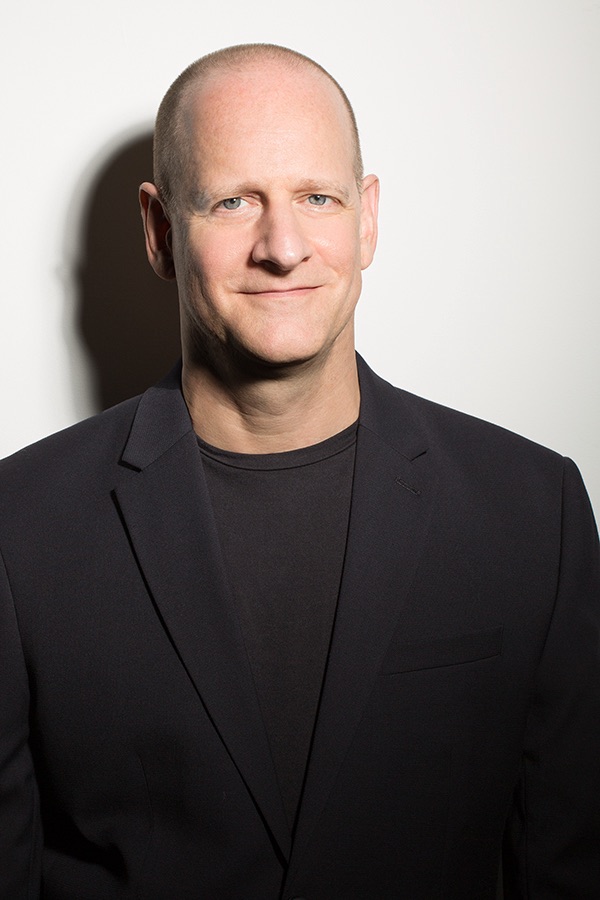
Lowell Liebermann born February 22, 1961, in New York City
At the age of sixteen, Liebermann performed at Carnegie Hall playing his Piano Sonata, op. 1. He studied at the Juilliard School of Music with David Diamond and Vincent Persichetti earning bachelor’s, master’s and doctoral degrees. The English composer-pianist Kaikhosru Shapurji Sorabjialso expressed interest in Liebermann’s early work, having critiqued the young composer’s Piano Sonata in a private exchange between the two; Liebermann’s Concerto for Piano, op. 12 would be dedicated to Sorabji.His most recorded works are his Sonata for Flute and Piano (1987), Gargoyles for piano (1989), and his Concerto for Flute and Orchestra (1992). Liebermann resides in New York City. He presently serves on the composition faculty at Mannes College The New School for Music and is the director of the Mannes American Composers Ensemble.
Gargoyles, Op. 29, a four-movement suite for solo piano written in 1989.
The suite was commissioned by the Tcherepnin Society for the pianist Eric Himy , who played its world premiere that October 14 at Alice Tully Hall in New York City.
The score exemplifies Liebermann’s modernist style, in which tonal harmony and expressive gestures grounded in tradition coexist with avant-garde procedures. The piece has become one of Liebermann’s most popular efforts, receiving more than ten recordings.
Many cathedral gargoyles portray grotesque faces with great humor, and Liebermann intends precisely that in his pieces, which have the mordant wit of Prokofiev’s “bad boy” style in their ancestry. The brief opening movement commences with an arresting three-note “signal” and move forward with perpetual motion rhythms , the narrative studded with shock-effects. The following Adagio semplice, by contrast, is deeply introverted, presenting melancholy melodizing over patterns based on two alternating chords. Later, a still slower melody unfolds against repetitions of a single note. Crystalline sonorities mark the third Gargoyle which floats a songful theme over luminous liquid swirls, and ultimately develops into a duet. Mordancy and menace return in the finale, which is dominated by demonic galloping rhythms, as textures grow steadily more dense and virtuoso gestures steadily more flamboyant.
Born
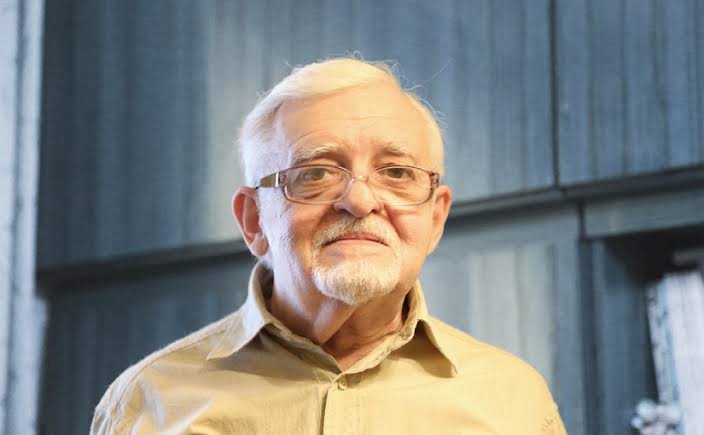
Николай Гиршевич Капустин
Nikolai Girshevich Kapustin 22 November 1937 Horlivka,Ukraine
Died 2 July 2020 (aged 82) Moscow
Although born in the Ukraine when he was age four, with his father fighting in World War II, his mother and grandmother moved with him and his sister to the Kyrgyz city of Tokmak.He composed his first piano sonata at age 13.From age 14, Kapustin studied piano with Avrelian Rubakh ( a pupil of Felix Blumenfeld , who also taught Simon Barere and Horowitz ). Beginning in 1954, he discovered jazz , an interest which his teacher supported.Kapustin studied from 1956 with Alexander Goldenweiser at the Moscow Conservatory , graduating ,playing amongst other things Prokofiev’s 2nd Concerto in 1961.During the 1950’s , Kapustin acquired a reputation as a jazz pianist, arranger and composer. He had his own quintet, which performed at an “upscale restaurant” monthly.Kapustin regarded himself though as a composer rather than a jazz musician: “I was never a jazz musician. I never tried to be a real jazz pianist, but I had to do it because of the composing. I’m not interested in improvisation – and what is a jazz musician without improvisation? All my improvisations are written, of course, and they became much better; it improved them.”
Among his works are 20 piano sonatas , six piano concertos other instrumental concertos, sets of piano variations ,etudes and concert studies.
 ChristopherAxworthy-MusicCommentary