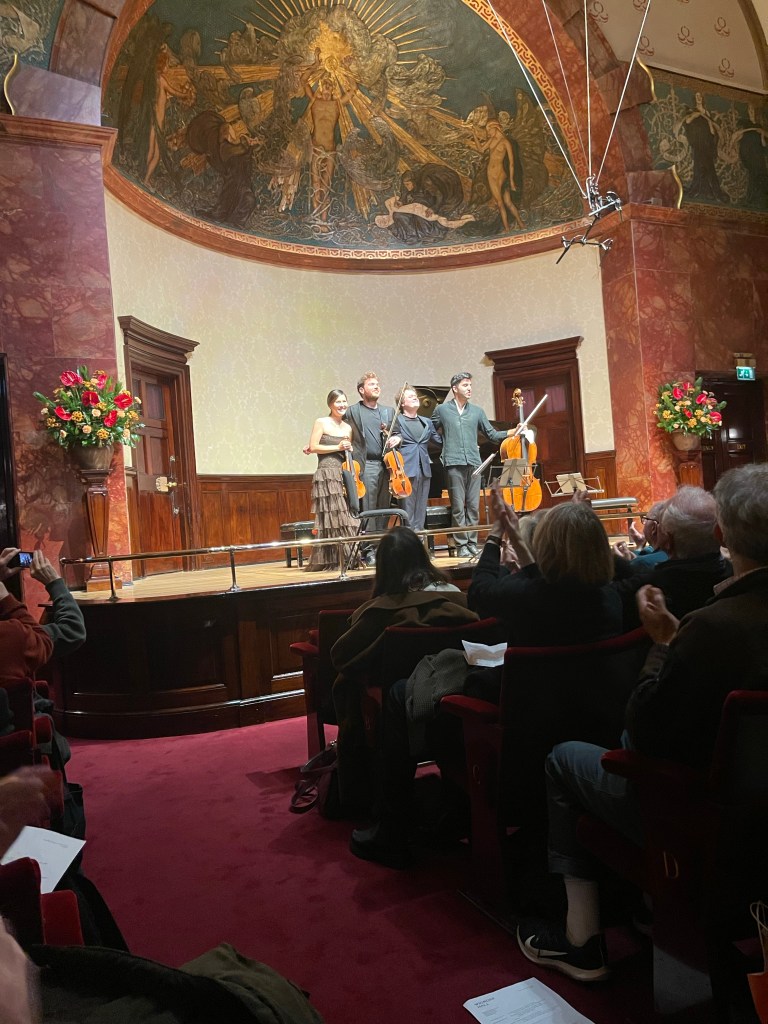
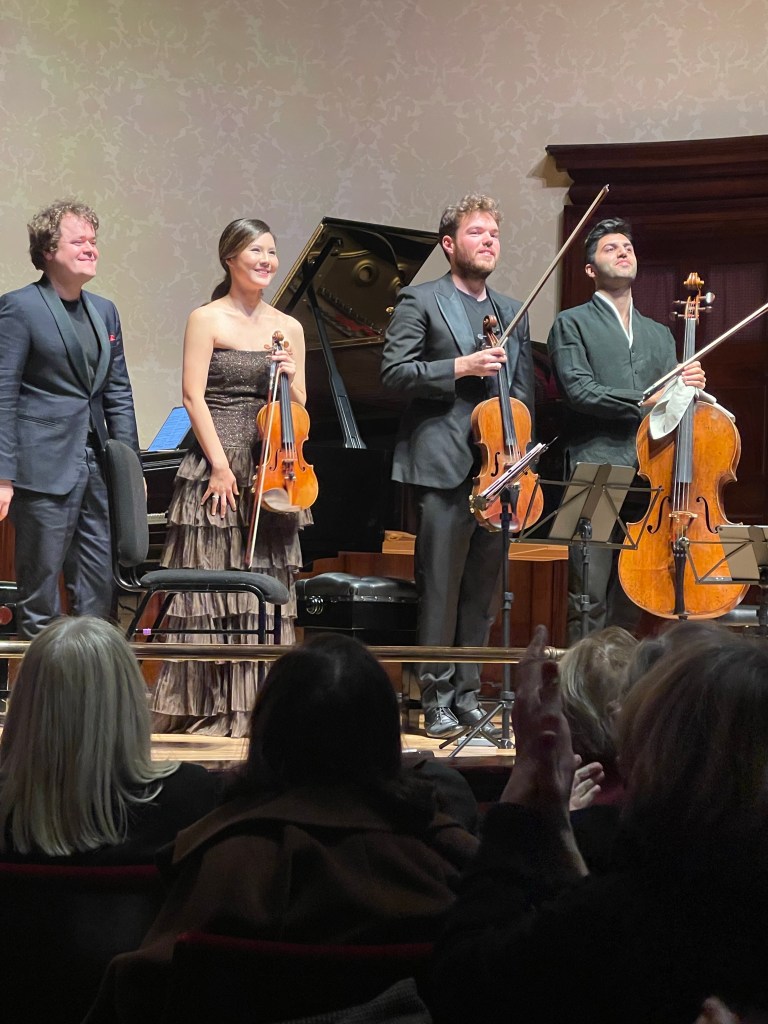
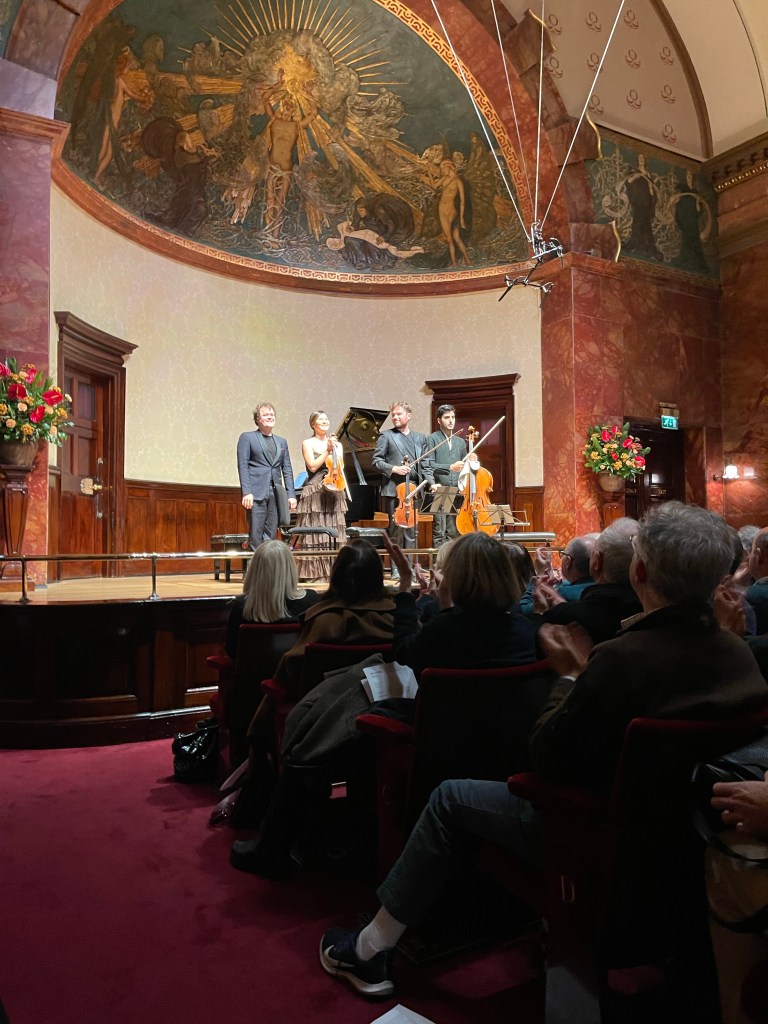
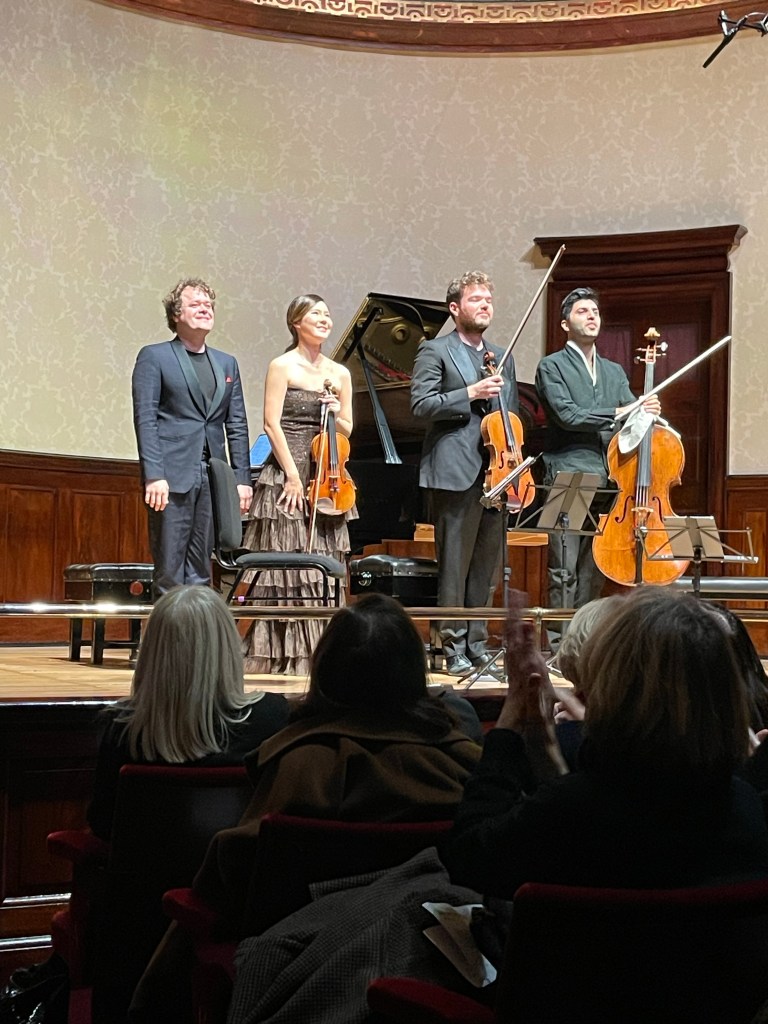
Benjamin Grosvenor piano Hyeyoon Park violin Timothy Ridout viola
Kian Soltani cello
Frank Bridge (1879-1941)
Phantasie Piano Quartet in F sharp minor (1910)
Andante con moto – Allegro vivace – Andante con moto
Gabriel Fauré (1845-1924) Piano Quartet No. 1 in C minor Op. 15 (1876-9, rev. 1883)
I. Allegro molto moderato • II. Scherzo. Allegro vivo • III. Adagio • IV. Allegro molto
Interval
Johannes Brahms (1833-1897) Piano Quartet No. 1 in G minor Op. 25 (1861)
I. Allegro • II. Intermezzo. Allegro ma non troppo – Trio. Animato • III. Andante con moto • IV. Rondo alla Zingarese.
The Phantasie Quartet a rhapsodic piece by Frank Bridge (1910) that his pupil Benjamin Britten would later describe as ‘Brahms tempered with Fauré’
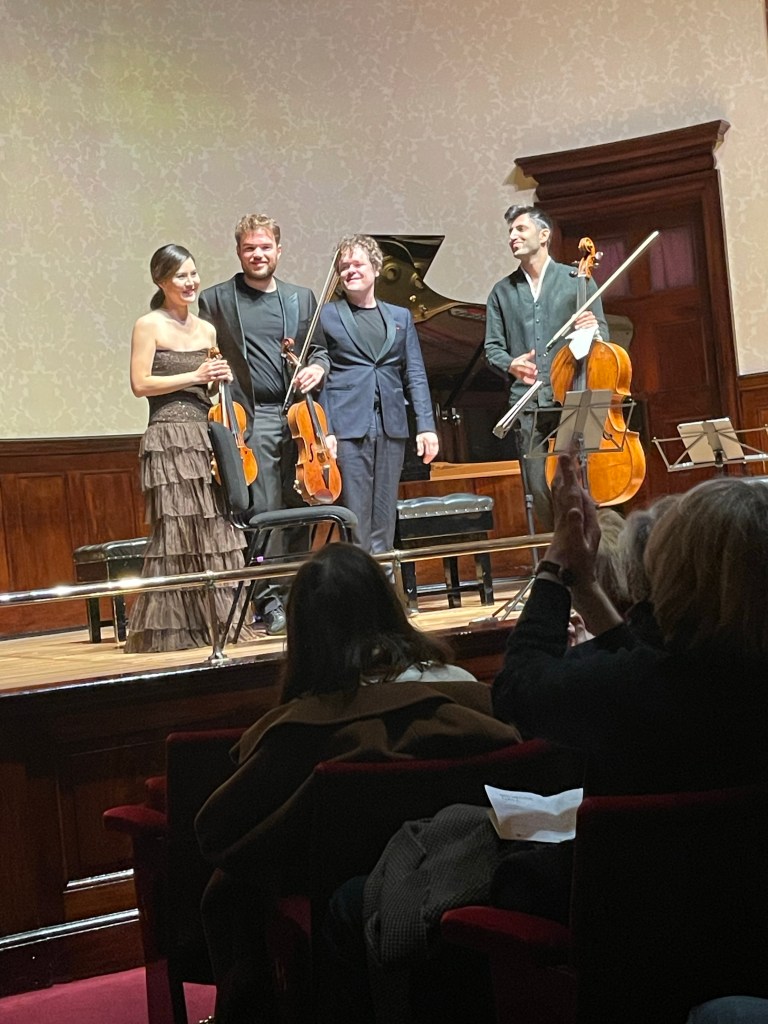
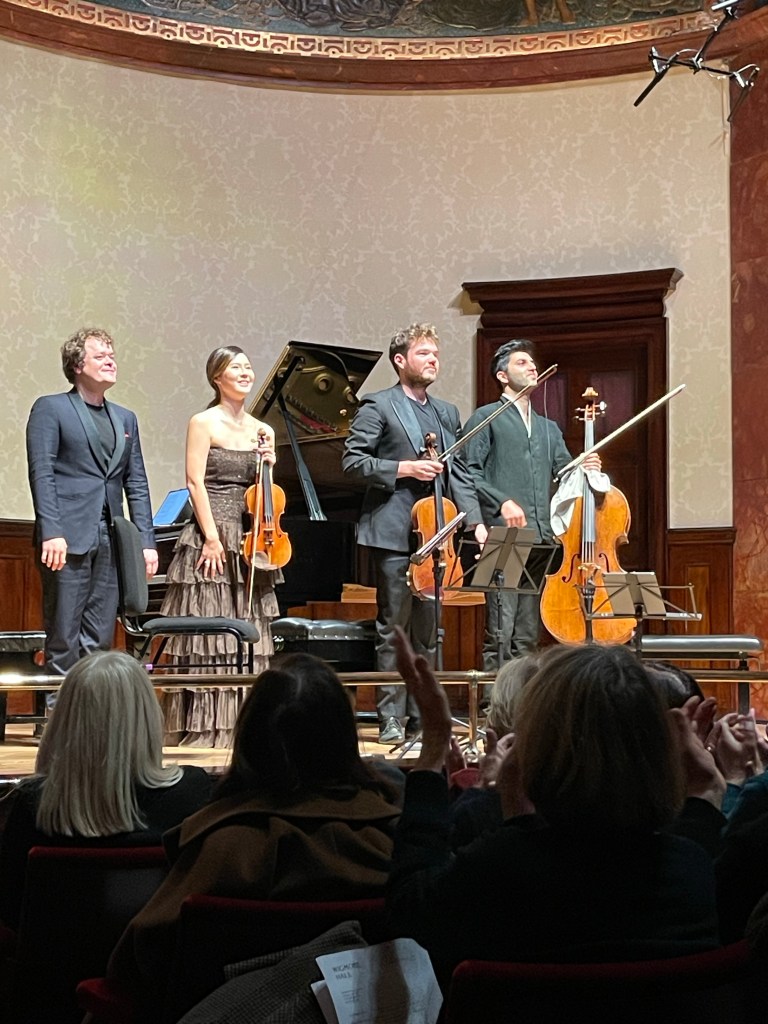
Music making by the Magnificent Four …..we know that Benjamin Grosvenor is one of the finest young pianists – the presence of Stephen Kovecevich just underlined that – but what stood out for his equally animal like passion was the viola of Timothy Ridout as he with such glee in his eye courted first Hyeyoon and then Kian before soaring into the heights together with endless streams of sumptuous sounds.
Ben crouched over the keyboard about to pounce into any crevace that needed filling …the magnificent violin of Hyeyoon crooning with Tim Ridout before passing it over with a knowing smile to the aristocratic golden sounds of Kian Soltanti.
Memorable the solo cello of Fauré’s adagio played with such golden nobility.
But it was the soaring searing passion that enveloped the west wind that had carried them along in the Allegro molto that was breathtaking as it reached an almost unbearable intensity .
Four magnificent players united as one …what a privilege to be able to evesdrop on such X certificate stuff ….the butler never saw anything like this and neither has this hall for a long long time……..and there was more to come ……..
Brahms with the breathless heart beat of the cello while the violin and viola embraced each other engulfed by the sumptuous sounds of the piano
There was a burning intensity to the Adagio that left Timothy Ridout visibly overcome with emotion but his fellow brethren left him no time to dally as The Gypsy Rondo just shot out of their hands with demonic glee. It was only matched by the tingling coda when all four threw caution to the wind as they were united in their intent -now we know the real meaning of strepitoso !
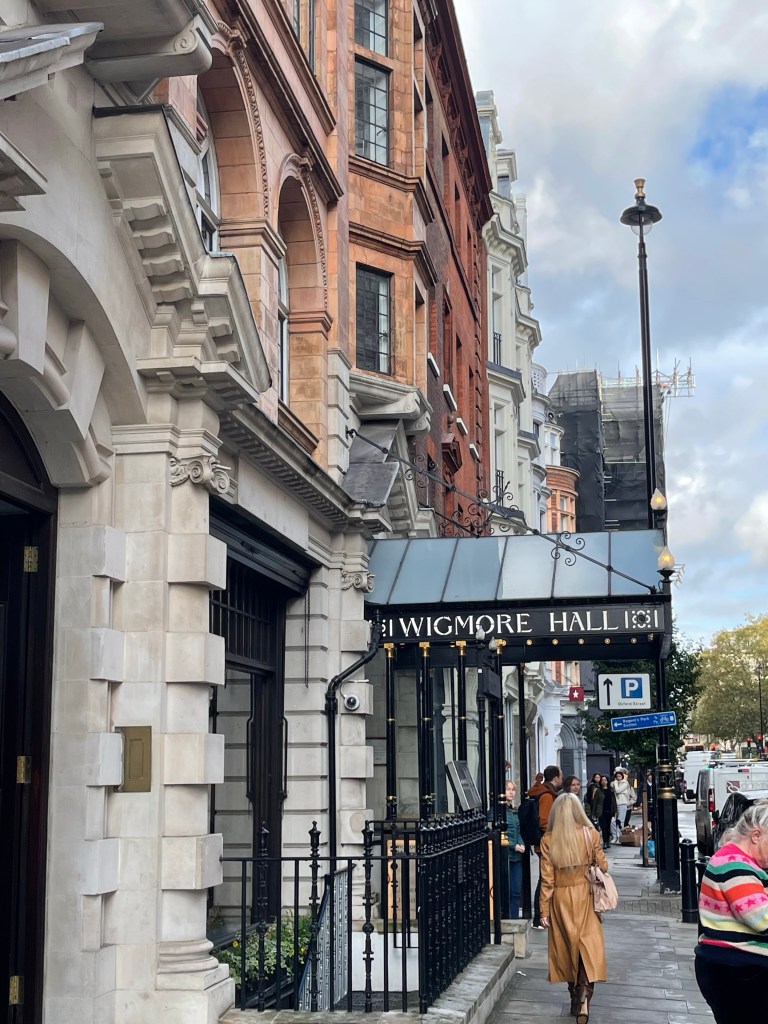
The usually sedate ‘Wiggies’ were reduced to animalesque cat calls as if they had received an electric shock of unimaginable intensity.
By insistent demand Kian announced they would play the Andante Cantabile by Schumann from the Quartet in E flat.
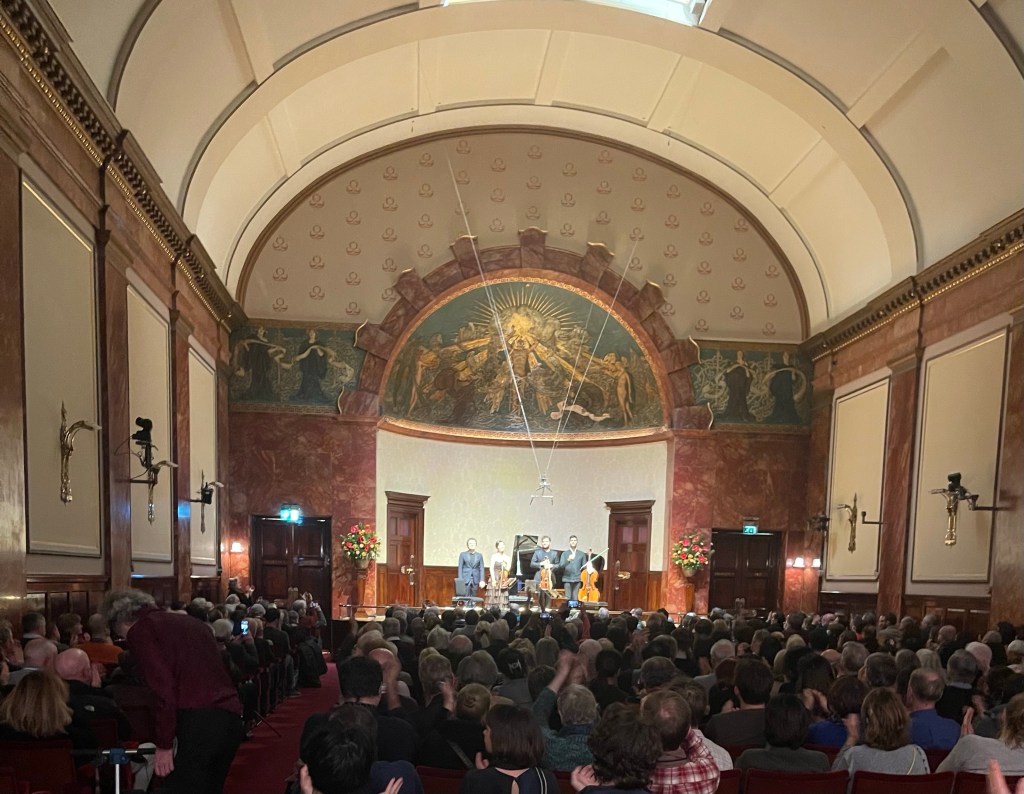
Here they reached truly sublime heights as all the rich layers of sound of Brahms were left long behind and only the deeply intense love that Schumann and Clara were to know was shared with an audience visibly moved by such naked passion ….minutes of aching silence spoke much louder than any words could do.
I had just stepped off the plane from Eindhoven and am in two minds to step back on to hear them all over again when they repeat the programme there on Thursday
Some marriages are made in heaven and it is so so rare as to be truly unique.Surely this is married bliss
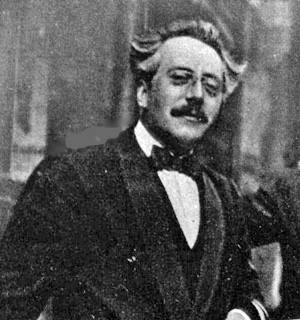
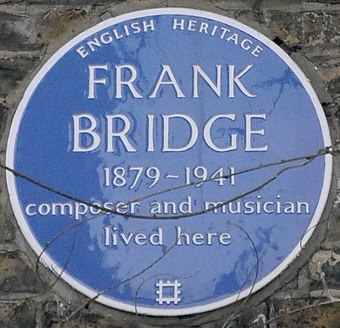
Bridge’s Phantasy Piano Quartet in F sharp minor built on his success in the first two of Walter Willson Cobbett’s Phantasie competitions, promoted under the auspices of The Worshipful Company of Musicians. The archaic spelling reflected Cobbett’s intention of establishing a new British chamber music genre, combining the ingredients of a standard chamber work into a single span, that would pay homage to the Fantasies and Fancies for viols that flourished in Elizabethan and Jacobean England. In 1905 Bridge was runner-up in the first competition, with a Phantasie for string quartet, and he won the second in 1907, with his Phantasie in C minor for piano trio. A few years later, in 1910, Bridge was one of a group of eleven British composers Cobbett commissioned to write a chamber music Phantasy: among them, Vaughan Williams contributed a Phantasy Quintet for strings, and Bridge the Phantasy Piano Quartet.His pupil Benjamin Britten revealed the essence of this work perfectly: ‘Sonorous yet lucid, with clear, clean lines, grateful to listen to and to play. It is the music of a practical musician, brought up in German orthodoxy, but who loved French romanticism and conception of sound—Brahms happily tempered with Fauré.
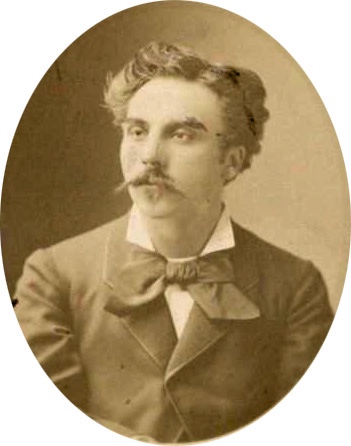
Gabriel Urbain Fauré (12 May 1845 – 4 November 1924) born in Palmiers ,Ariège, in the south of France, the fifth son and youngest of six children.His mother was advised to send the boy to the École de Musique Classique et Religieuse (School of Classical and Religious Music), better known which Louis Niedermeyer was setting up in Paris.After reflecting for a year, Fauré’s father agreed and took the nine-year-old boy to Paris in October 1854.When Niedermeyer died in March 1861, Camille Saint-Saens took charge of piano studies and introduced contemporary music, including that of Schumann,Liszt and Wagner. Fauré recalled in old age, “After allowing the lessons to run over, he would go to the piano and reveal to us those works of the masters from which the rigorous classical nature of our programme of study kept us at a distance and who, moreover, in those far-off years, were scarcely known. … At the time I was 15 or 16, and from this time dates the almost filial attachment … the immense admiration, the unceasing gratitude I [have] had for him, throughout my life.”
In 1877, after wooing her for five years, Fauré had finally become engaged to Marianne Viardot, daughter of the well-known singer Pauline Viardot . The engagement lasted for less than four months, and Marianne broke it off, to Fauré’s considerable distress. It was in the later stages of their relationship that he began work on the quartet, in the summer of 1876.He completed it in 1879, and revised it in 1883, completely rewriting the finale. The first performance of the original version was given on 14 February 1880. In a study dated 2008, Kathryn Koscho notes that the original finale has not survived, and is believed to have been destroyed by Fauré in his last days.It is considered one of the three masterpieces of his youth, along with the first violin sonatas and the Ballade in F sharp for piano
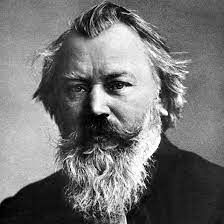
7 May 1833 Hamburg – 3 April 1897 (aged 63) Vienna,
The Piano Quartet No. 1 in G minor op 25 was composed between 1856 and 1861. It was premiered in 1861 in Hamburg, with Clara Schumann at the piano. It was also played in Vienna on 16 November 1862, with Brahms himself at the piano supported by members of the Hellmesberger Quartet.In January 1863 Brahms met Richard Wagner for the first time, for whom he played his Handel Variations op 24 which he had completed the previous year. The meeting was cordial, although Wagner was in later years to make critical, and even insulting, comments on Brahms’s music.Brahms however retained at this time and later a keen interest in Wagner’s music, helping with preparations for Wagner’s Vienna concerts in 1862/63,and being rewarded by Tausig with a manuscript of part of Wagner’s Tannhäuser (which Wagner demanded back in 1875).The Handel Variations also featured, together with the first Piano Quartet, in his first Viennese recitals, in which his performances were better received by the public and critics than his music..
 ChristopherAxworthy-MusicCommentary