Joseph Haydn (1732-1809)
Piano Sonata in B minor HXVI/32 (by 1776)
I. Allegro moderato • II. Menuet • III. Finale. Presto
Fryderyk Chopin (1810-1849)Etude in E flat minor Op. 10 No. 6 (1830-2) Etude in E Op. 10 No. 3 (1832)
Fantasy in F minor Op. 49 (1841)
Modest Mussorgsky (1839-1881)Pictures from an Exhibition (1874)
Promenade 1 • The Gnome • Promenade 2 •
The Old Castle • Promenade 3 • Tuileries • Bydlo • Promenade 4 • Ballet of the Unhatched Chicks • “Samuel” Goldenberg und “Schmuÿle” • Promenade 5 • The Market Place at Limoges • Catacombs (Sepulchrum Romanum) •
Cum mortuis in lingua mortua •
The Hut on Fowl’s Legs (Baba-Yaga) •
The Great Gate of Kiev
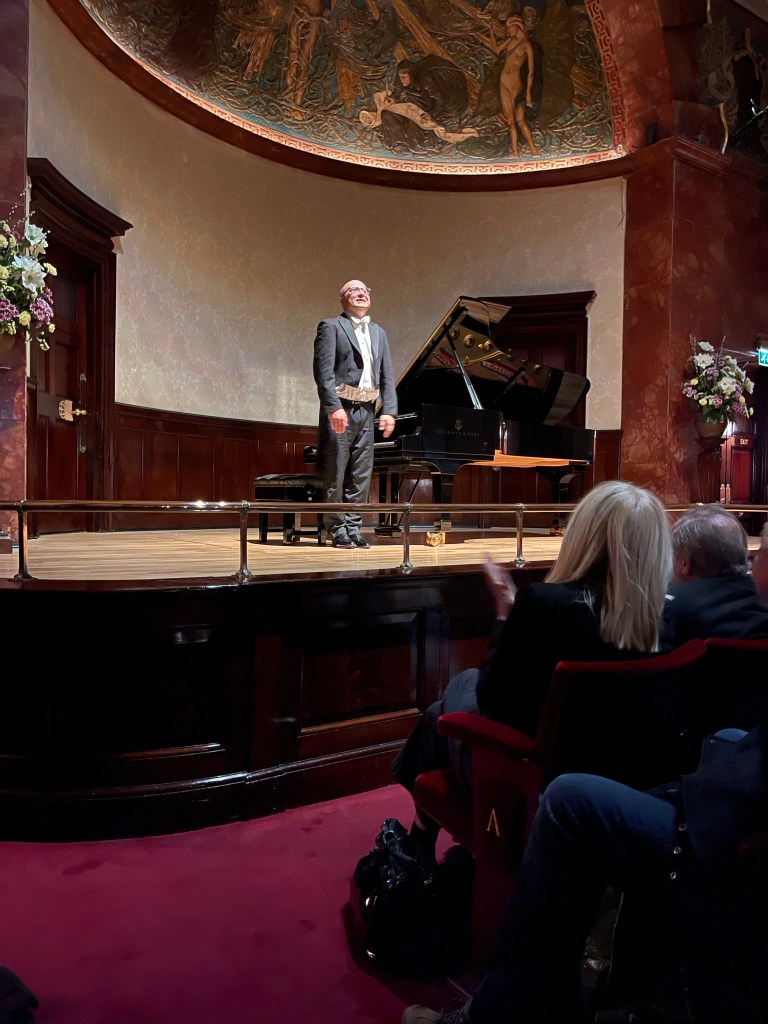
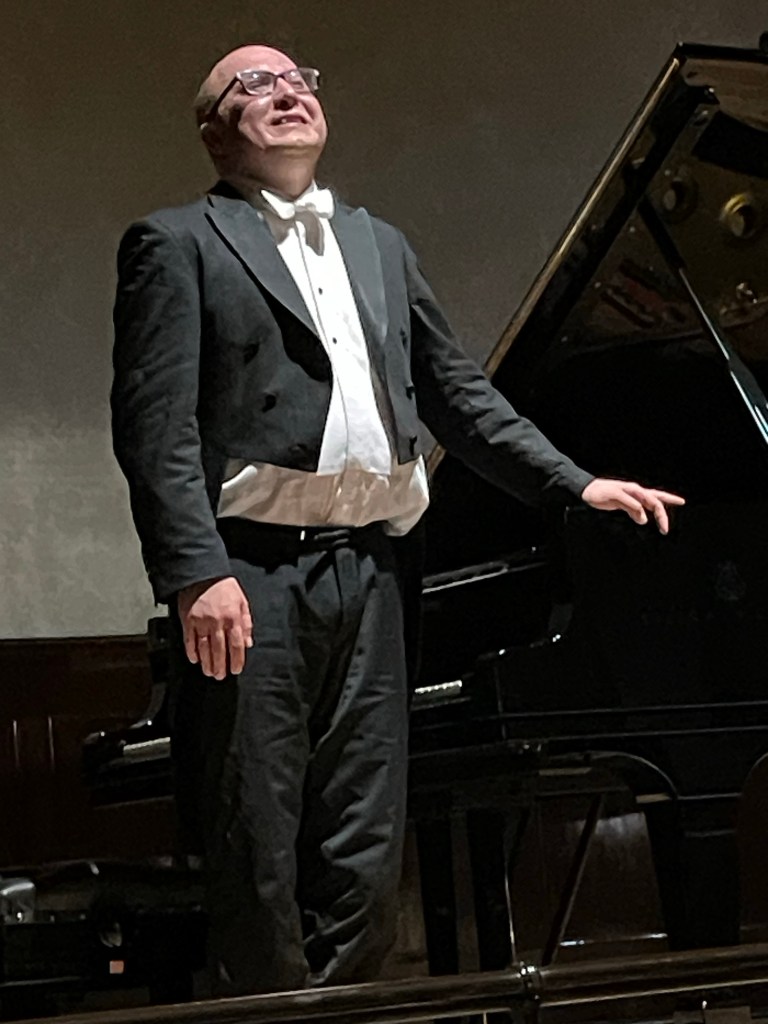
An ovation for Alexander Gavrylyuk after performances that recall Cherkassky for their refined multicoloured tone palette.
An exquisite Haydn B minor with such refined phrasing and delicacy of sound.A rare sensibility as he shaped the music with loving beauty allowing it to speak so simply and eloquently.Ravishing beauty of the Minuet where even the contrasting Trio was played with a rare sensibility .The Finale was played with scintillating character and spirit. Chopin’s two most lyrical studies from op 10 were played with the same aristocratic style of Cherkassky (who used to play Godowsky’s left hand version of n.6 in E flat minor too ).A chiselled beauty even rather monumental at times but a whole world in so few pages that was of an inspired artist sharing his thoughts with us.A Fantasy op 49 of dramatic contrasts and the same impetuosity as his temperament was occasionally unleashed by his red hot temperament
But it is Mussorgsky ‘Pictures’ that will resound around these walls for long to come with a breathtaking recreation of an old war horse given miraculous new life. The opening promenade I have never heard phrased so beautifully with a wondrous legato and a quite unique sensibility to balance .At times like a cat on a hot tin roof with the astonishing character that he brought to each picture but also harmonies and inner counterpoints that only a magician could find.I doubt ‘Gnomus’ or ‘Bydlo’ have ever been so terrifyingly portrayed as he seemed to wade through the mire like a monster in some devilish quicksand .The frenzy of “Baba Yaga’ that was attacked so violently but then astonished us with sudden changes of colour that took us by surprise.There was the sedate nobility of Goldenberg and the luminosity of Schmuyle and a Limoges Market Place of breathtaking activity .Chicks that just vanished into thin air with a chuckle and Catacombs that would give you nightmares .If the ‘Great Gate’ was rather too fast for the majesty and significance that it especially holds for us today the layers of sound and sense of balance I have only ever heard from Cherkassky.A true master of balance and colour and truly a Cherkassky look alike in so many memorable ways.I remember Shura playing ‘Pictures’ in the vast space of the Albert Hall and playing with such vehemence that he dislodged the soft pedal that made such an unearthly twang but just added another colour to his kaleidoscopic palette.
But it was the two encores by enormous insistence that showed his great artistry with a ravishing sense of balance that could allow the ‘Vocalise’ to sing as never before .It was this that I had heard on the radio a few years ago that stopped me in my tracks for its crystalline velvet beauty.The Scriabin Study op 2 was played with the beguiling sense of insinuation and aristocratic nobility of another age when pianist were magicians who could conjure up sounds that shone like jewels glistening on a sumptuous velvet plate .
A plate fit for a King and it was indeed a Prince who had enchanted,seduced and entranced us today as rarely before.
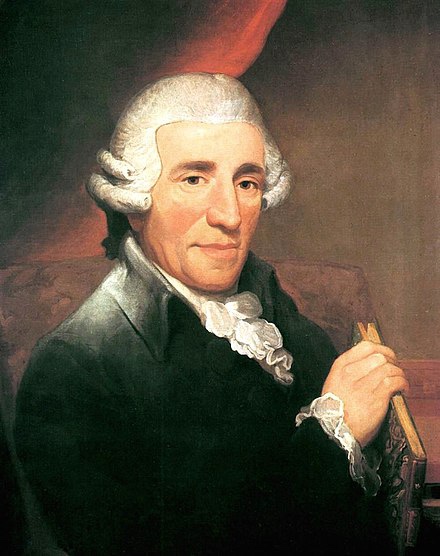
31 March 1732 – 31 May 1809
The 55 Haydn Sonatas are perhaps the least-known treasures of the piano repertoire. In them one can hear Haydn virtually inventing the classical style, from the early, somewhat tentative beginnings, through the bold experiments of the 1770s, to the adventurous late works. As with Beethoven (Haydn’s somewhat recalcitrant student) each sonata is a new exploration, and the element of surprise is ever present. Haydn delights in abrupt transitions, twists and turns, sudden pauses, and apparent non sequiturs; listening to him demands a constant alertness.
The 1770s, when Haydn’s Sonata in B minor was composed, was the age of Sturm und Drang (storm and stress) in German culture, an age when aberrant emotions were all the rage in music; and what better tonal avouring than the minor mode to convey these emotions?
It is also important to note that the 1770s was the period in which the harpsichord was gradually giving way to the new fortepiano, precursor of the modern grand, and there is much in this sonata to suggest that it still lingered eagerly on the harpsichord side of things, at least texturally.
This cross-over period between harpsichord and fortepiano plays out in the nature of the first movement’s two contrasting themes.
In place of a lyrical slow movement, Haydn offers us a minuet and trio which features thematic material as dramatically contrasting as the first and second themes of the first movement. The minuet is in the major mode, set high in the register, sparkling with trills
The trio is daringly in the minor mode, set low, and grinds grimly away in constant 16th-note motion.
Haydn wouldn’t be Haydn if he didn’t send you away with a toe-tapping finale and such a movement ends this sonata. To that end, Haydn’s go-to rhythmic device is repeated notes, and this nale chatters on constantly at an 8th-note patter, interrupted at random, it would seem, by surprising silences and dramatic pauses – as if to allow the performer to turn sideways and wink at his audience.
Pictures at an Exhibition is based on pictures by the artist, architect, and designer Viktor Hartmann. It was probably in 1868 that Mussorgsky first met Hartmann, not long after the latter’s return to Russia from abroad. Both men were devoted to the cause of an intrinsically Russian art and quickly became friends. They met in the home of the influential critic Vladimir Stasov, who followed both of their careers with interest. According to Stasov’s testimony, in 1868, Hartmann gave Mussorgsky two of the pictures that later formed the basis of Pictures at an Exhibition.
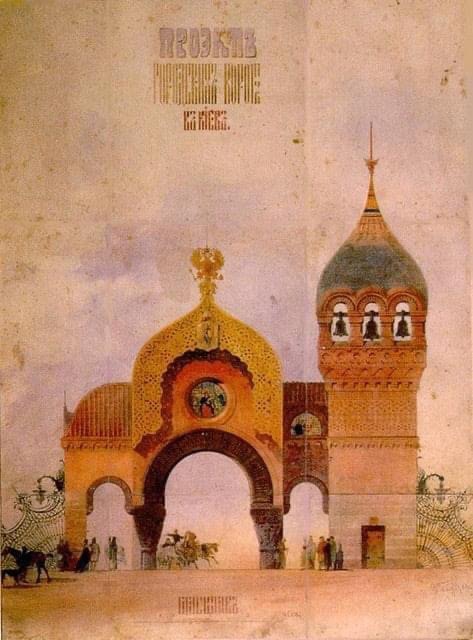
PICTURES AT AN EXHIBITION Promenade l
The Gnomes
Promenade ll
The Old Castle
Promenade lll
The Tuileries: Children’s dispute
after play
Bydlo
Promenade IV
Ballet of the unhatched chicks
Two Polish Jews: Rich and poor
Promenade V
The market at Limoges
Roman Catacombs – With the dead
in a dead language
Baba Yaga: The Witch
The Heroes Gate at Kiev
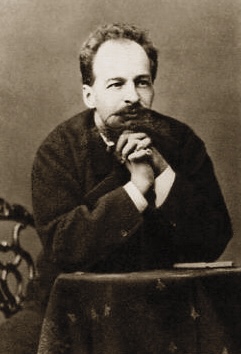
Hartmann’s sudden death on 4 August 1873 from an aneurysm shook Mussorgsky along with others in Russia’s art world. The loss of the artist, aged only 39, plunged the composer into deep despair. Stasov helped to organize a memorial exhibition of over 400 Hartmann works in the Imperial Academy of Arts in Saint Petersburg in February and March 1874. Mussorgsky lent the exhibition the two pictures Hartmann had given him, and viewed the show in person, inspired to compose Pictures at an Exhibition, quickly completing the score in three weeks (2–22 June 1874).Five days after finishing the composition, he wrote on the title page of the manuscript a tribute to Vladimir Stasov, to whom the work is dedicated.The music depicts his tour of the exhibition, with each of the ten numbers of the suite serving as a musical illustration of an individual work by Hartmann.Although composed very rapidly, during June 1874, the work did not appear in print until 1886, five years after the composer’s death, when a not very accurate edition by the composer’s friend and colleague Nikolai Rimsky-Korsakov was published.
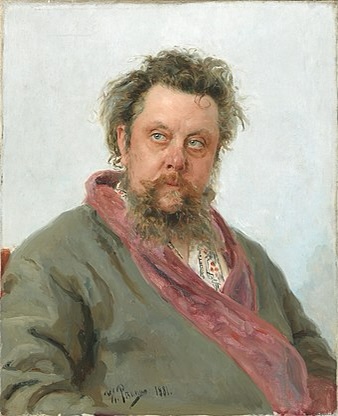
Mussorgsky suffered personally from alcoholism, it was also a behavior pattern considered typical for those of Mussorgsky’s generation who wanted to oppose the establishment and protest through extreme forms of behavior.One contemporary notes, “an intense worship of Bacchus was considered to be almost obligatory for a writer of that period.”Mussorgsky spent day and night in a Saint Petersburg tavern of low repute, the Maly Yaroslavets, accompanied by other bohemian dropouts. He and his fellow drinkers idealized their alcoholism, perhaps seeing it as ethical and aesthetic opposition. This bravado, however, led to little more than isolation and eventual self-destruction.
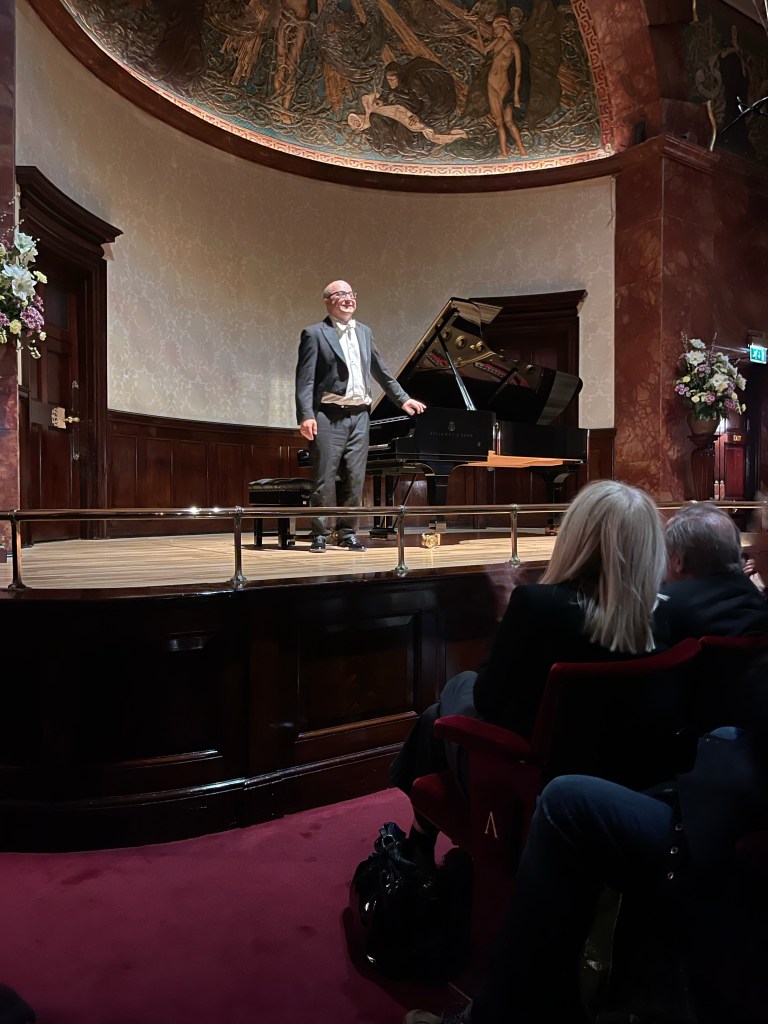
Alexander Gavrylyuk (born 19 August 1984) is a Ukrainian-born Australian pianist whose first concert performance was at the age of nine. He moved to Australia at the age of 13.A stunningly virtuosic pianist, Alexander is internationally recognised for his electrifying and poetic performances. His performance of Rachmaninov Piano Concerto No.3 at the BBC Proms was described as “revelatory” by the Times and “electrifying” by Limelight. For the 23/24 season, Alexander will be Artist in Residence at Wigmore Hall, performing three recitals across the season.
Highlights of the 2023-24 season include debuts with NDR Hannover, Bochum Symphoniker and Amsterdam Sinfonietta, as well as return visits to Sydney Symphony, Adelaide Symphony, Bournemouth Symphony, Aarhus Symphony & Rheinische Philharmonie. Recent highlights also include Detroit Symphony, Dallas Symphony, Polish Baltic Philharmonic, Sao Paolo Symphony & Rhode Island Philharmonic.
Born in Ukraine in 1984 and holding Australian citizenship, Alexander began his piano studies at the age of seven and gave his first concerto performance when he was nine years old. At the age of 13, Alexander moved to Sydney where he lived until 2006. He won First Prize and Gold Medal at the Horowitz International Piano Competition (1999), First Prize at the Hamamatsu International Piano Competition (2000), and Gold Medal at the Arthur Rubinstein International Piano Masters Competition (2005).
He has since gone on to perform with many of the world’s leading orchestras, including: New York, Los Angeles, Czech, Warsaw, Moscow, Seoul, Israel and Rotterdam Philharmonics; NHK, Chicago, Cincinnati and City of Birmingham Symphony orchestras; Royal Concertgebouw Orchestra, Philharmonia, Wiener Symphoniker, Orchestre National de Lille and the Stuttgarter Philharmoniker; collaborating with conductors such as Vladimir Ashkenazy, Alexandre Bloch, Herbert Blomstedt, Andrey Boreyko, Thomas Dausgaard, Valery Gergiev, Neeme Järvi, Vladimir Jurowski, Sebastian Lang-Lessing, Kirill Karabits, Louis Langrée, Cornelius Meister, Vassily Petrenko, Rafael Payare, Alexander Shelley, Yuri Simonov, Vladimir Spivakov, Markus Stenz, Sir Mark Elder, Thomas Søndergård, Gergely Madaras, Mario Venzago, Enrique Mazzola and Osmo Vänska.
Gavrylyuk has appeared at many of the world’s foremost festivals, including the Hollywood Bowl, Bravo! Vail Colorado, Mostly Mozart, the Ruhr Festival, the Kissinger Sommer International Music Festival, the Gergiev Festival in Rotterdam.
As a recitalist Alexander has performed at the Musikverein in Vienna, Tonhalle Zurich, Victoria Hall Geneva, Southbank Centre’s International Piano Series, Wigmore Hall, Concertgebouw Master Pianists Series, Suntory Hall, Tokyo Opera City Hall, Great Hall of Moscow Conservatory, Cologne Philharmonie, Tokyo City Concert Hall, San Francisco, Sydney Recital Hall and Melbourne Recital Centre. Alexander also performs regularly with his recital partner Janine Jansens throughout Europe.
Alexander is Artist in Residence at Chautauqua Institution where he leads the piano program as an artistic advisor. He supports a number of charities including Theme and Variations Foundation which aims to provide support and encouragement to young, aspiring Australian pianists as well as Opportunity Cambodia, which has built a residential educational facility for Cambodian children.
Alexander Gavrylyuk is a Steinway Artist.
 ChristopherAxworthy-MusicCommentary