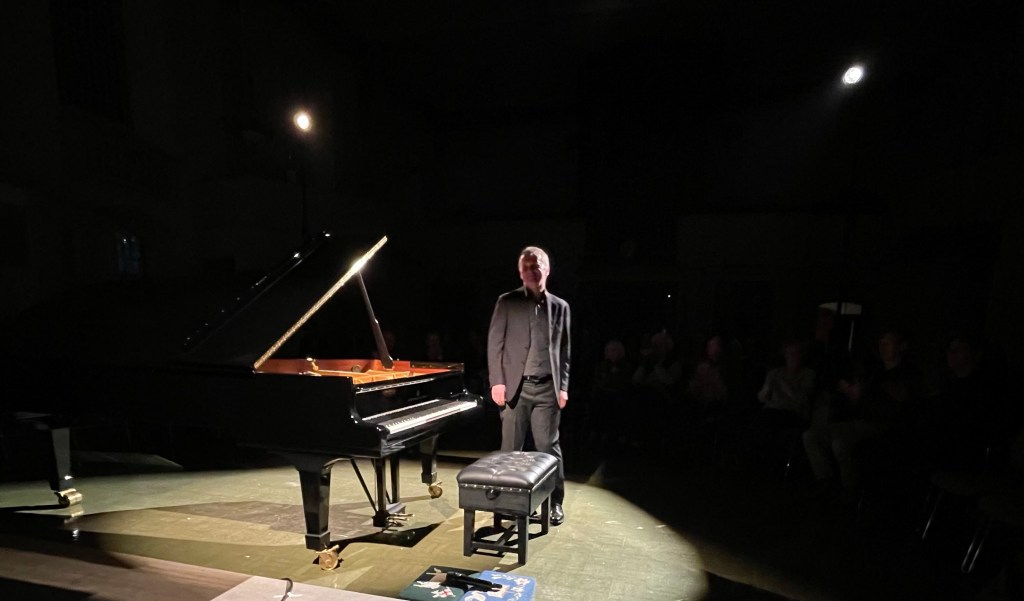
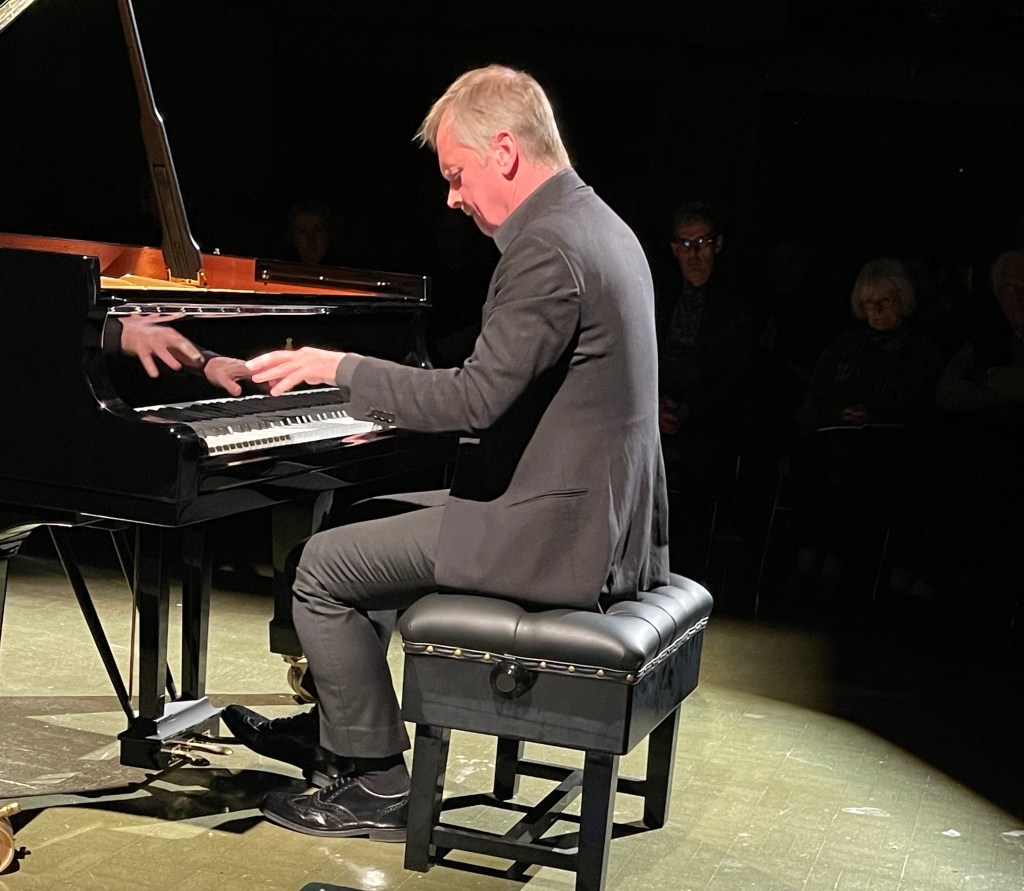
Steven Osborne
The ‘most thoughtful and questing of British pianists’ (Telegraph), Steven Osborne will perform Schubert’s Six moments musicaux and the late Sonata in A, D. 959, separated by a short Beethoven Bagatelle, Op. 33 No. 4. It is ten years since he was declared Instrumentalist of the Year by the Royal Philharmonic Society, but he remains one of Britain’s finest musicians, and a recent Wigmore Hall concert celebrating Rachmaninov’s 150th birthday received 5 stars in The Guardian and The Independent.
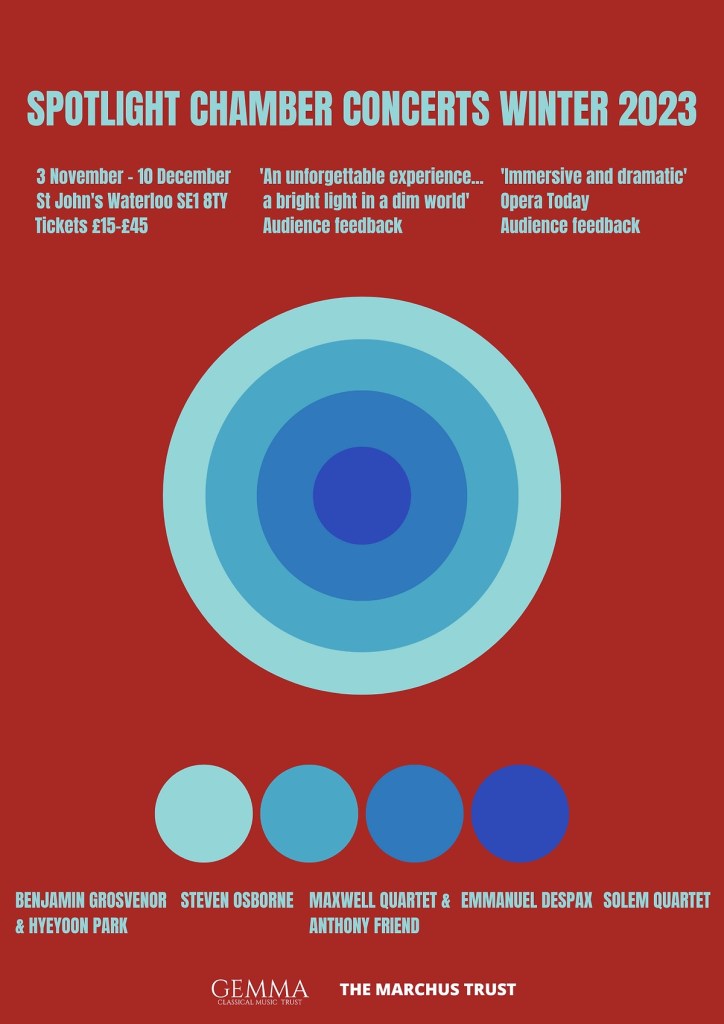
Park- Grosvenor ‘A sumptuous duo,spot on at St John’s where their light was shining brightly’
Another magnificent concert for spotlight at St John’s Waterloo.I have not heard such wonders since Zimerman or Uchida .Playing that drew us in to a secret world of ravishing beauty but also of startling contrasts.All with a palette of sounds that was truly a marvel, creating a world in which music evolves directly from the composer to the public through the hands of a supremely sensitive artist.One that with the humility of someone who thinks more of the music than himself and with superhuman mastery can communicate the music as if the ink was still wet on the page.
I have heard great things of Steven Osborne in repertoire of Prokofiev and Messiaen and never would have imagined what miracles he could produce with Schubert’s elusive Moments Musicaux D .780 and the great A major Sonata D .959.They were linked together with a single Beethoven Bagatelle op 33 n.4 of simple innocence.A monumental performance of the A major sonata in which time seemed to stand still. We were transported by this great artist to a much better world than the one we live in and it was only the sumptuous whispered sonorities of Schumann’s Romance in F sharp ,played as an encore, that prepared us for the world that awaited outside after this hour of escape to a much better place than we have ever known.

The first was played with a delicacy as the harmonies seemed to change so continually with outbursts of Florestan and Eusebius proportions.The second was played with subdued almost whispered chords of subtle richness interrupted by outbursts of unexpected vehemence.The beguiling third,so much the realm of Curzon,but by Osborne played with the same buoyancy,delicacy and joyous luminosity.There were whispered contrapuntal meanderings of the fourth with its etherial utterances and the surprise interruption of a lilting dance in its midst. Suddenly an eruption of rhythmic energy with a dynamic impulse of life.Playing like a man possessed pulling his fingers from the keys as though scolded by the burning intensity.The last was of purity and innocence with delicate confessions of etherial whispered sounds of pure magic.
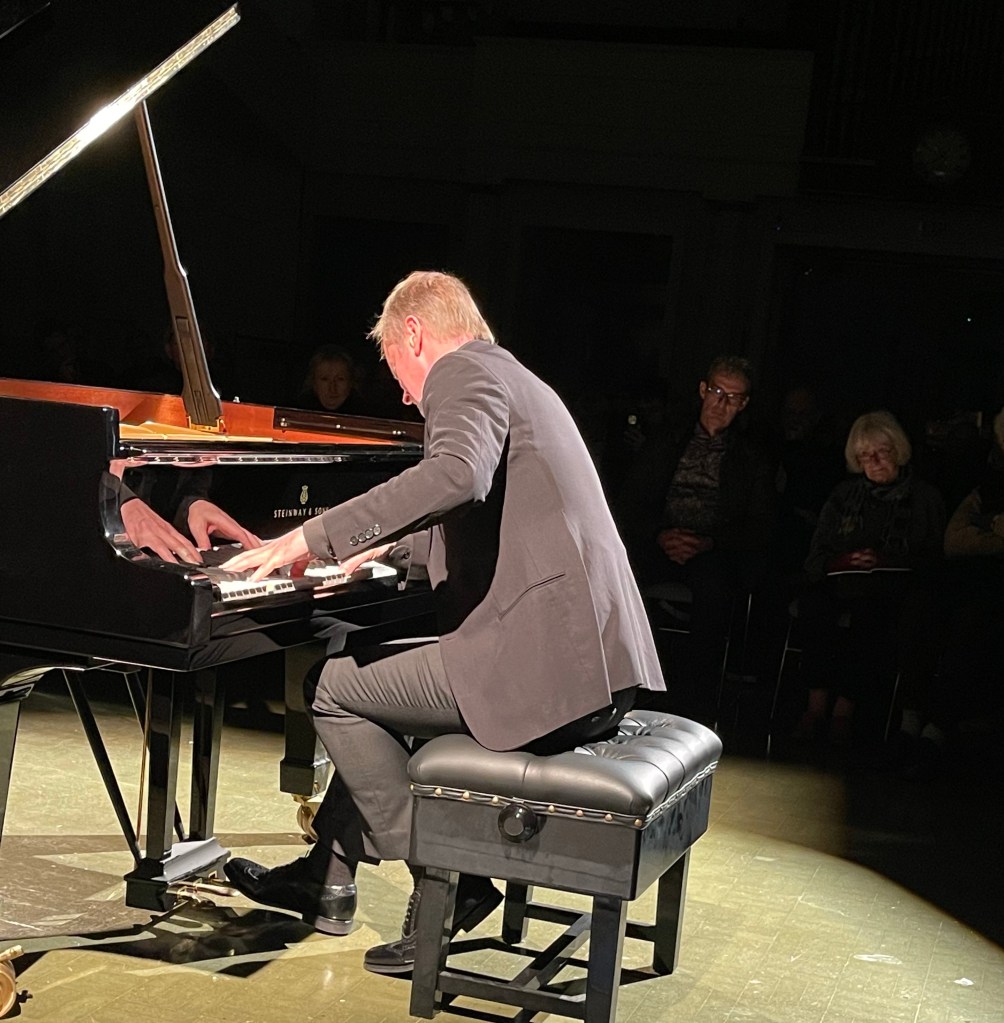
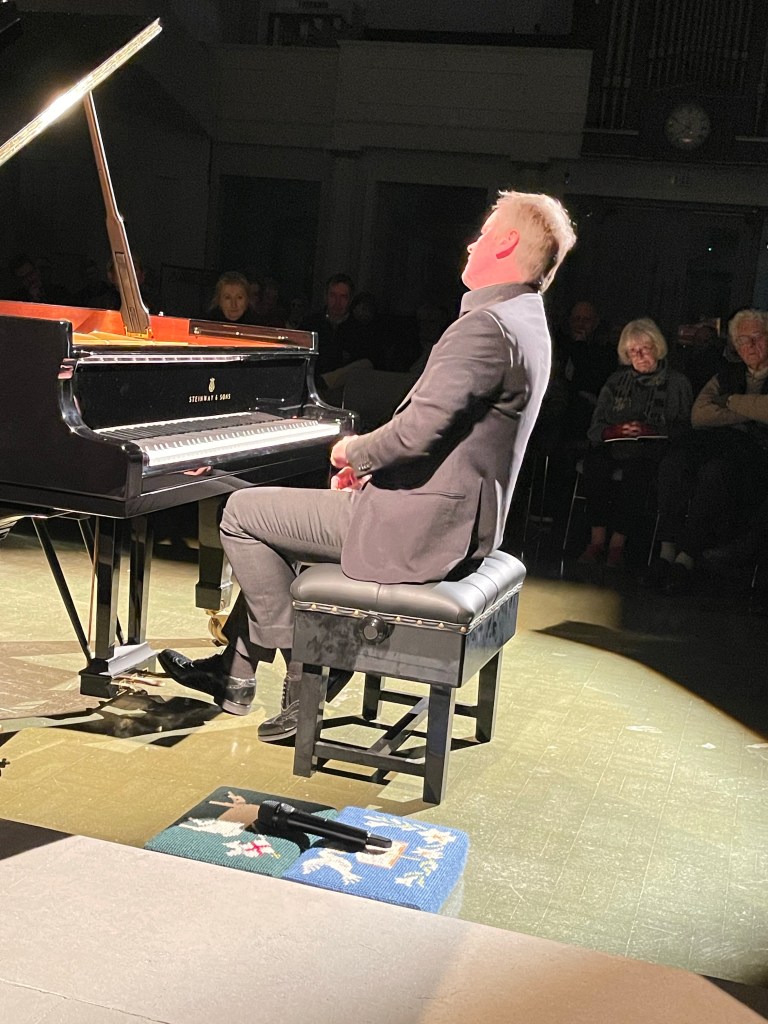
There was a desolate beauty to the ‘Andante’ with a marvel of phrasing of poignancy and beauty unwinding almost unnoticeably into an tumultuous Lisztian storm of notes and emotions.The beseeching recitativo lone voice was interrupted by sudden electric shocks followed by a whispered act of contrition as the opening melody returned embroidered with the heavenly counterpoints from the place that awaited Schubert just a few months later.What depth of meaning Osborne gave to the seemingly innocent final arpeggiated chords – a heart beating with a breathless feeling of hopelessness.
The ‘Scherzo’ just floated in with refined graceful delicacy with sudden injections of humour at the cadences .A ‘Trio’ with its pleading question and fleeting reply.
Sublime simplicity to the Rondo with a wondrous shaping of the long melodic lines with the jeux perlé accompaniment glistening above like jewels of shining stars.Breathtaking injections of energy nowhere more than in the ‘Presto’ of the coda.The breathtaking grandiloquence of the final chords at the end of such an exhilarating journey were from a great artist who had held us in his spell as he transmitted Schubert ‘s world to us so faithfully and where time had seemed to stand still.
Schubert Moments Musicaux Op.94 D 780 (Piano)
- Moderato in C
- Andantino in A flat
- Allegro moderato in F minor (ending in F major)
- Moderato in C sharp minor
- Allegro vivace in F minor (ends in F major)
- Allegretto in A♭ major (ends on an open octave in an A♭ minor context)
Schubert’s well-known collection of “Moments Musicaux” was published in 1828, during the last year of the composer’s life, but some of the pieces date back to the beginning of the 1820s. In 1823 he published his extremely popular “Air russe” which later became the third piece of the “Moments Musicaux” and during the following year the chordal sixth piece entitled “Plaintes d’un Troubadour”. The multi-faceted lyrical atmospheric pieces similar to Beethoven’s Bagatelles in their brevity and quixotic character and were written to satisfy the Viennese public’s growing appetite for Albumblätter – literally “album leaves” – short pieces which could be played and enjoyed at home. Like the Impromptus these short piano pieces seem to owe a debt to the Bohemian composer Tomasek and his pupil Jan Vorisek. The third of the set is in Rosamunde vein and the fourth in Baroque style.
The Bagatelles, op .33, for solo piano were composed in 1801–02 and published in 1803 through the Viennese publisher Bureau des arts et d’industrie. The seven bagatelles are quite typical of Beethoven’s early style, retaining many compositional features of the early classical period.Beethoven wrote three sets of Bagatelles : 7 op 33;11 op 119;6 op 126 written between 1801 and 1823.

Schubert’s last three piano sonatas D 958, 959 and 960, are his last major compositions for solo piano. They were written during the last months of his life, between the spring and autumn of 1828, but were not published until about ten years after his death, in 1838–39.Like the rest of Schubert’s piano sonatas, they were mostly neglected in the 19th century.The last year of Schubert’s life was marked by growing public acclaim for the composer’s works, but also by the gradual deterioration of his health. On March 26, 1828, together with other musicians in Vienna .Schubert gave a public concert of his own works, which was a great success and earned him a considerable profit.Schubert had been struggling with syphilis since 1822–23, and suffered from weakness, headaches and dizziness. However, he seems to have led a relatively normal life until September 1828, when new symptoms such as effusions of blood appeared. At this stage he moved from the Vienna home of his friend Franz von Schober to his brother Ferdinand’s house in the suburbs, following the advice of his doctor; unfortunately, this may have actually worsened his condition. However, up until the last weeks of his life in November 1828, he continued to compose an extraordinary amount of music, including such masterpieces as the three last sonatas.
Schubert played from the sonata trilogy at an evening gathering in Vienna on September 28th .In a letter to Probst (one of his publishers), dated October 2, 1828, Schubert mentioned the sonatas amongst other works he had recently completed and wished to publish.However, Probst was not interested in the sonatas,and by November 19, Schubert was dead.
In the following year, Schubert’s brother Ferdinand sold the sonatas’ to another publisher, Anton Diabelli ,who would only publish them about ten years later, in 1838 or 1839.Schubert had intended the sonatas to be dedicated to Hummel , whom he greatly admired. Hummel was a leading pianist, a pupil of Mozart .However, by the time the sonatas were published in 1839, Hummel was dead, and Diabelli, the new publisher, decided to dedicate them instead to composer Schumann who had praised many of Schubert’s works in his critical writings.The negative attitude towards Schubert’s piano sonatas persisted well into the twentieth century. Only around the centennial of Schubert’s death did these works begin to receive serious attention and critical acclaim, with the writings of Donald Francis Tovey , and the public performances of Artur Schnabel and Eduard Erdmann .During the following decades, the sonatas, and especially the final trilogy, received growing attention, and by the end of the century, came to be regarded as essential part of the repertoire One of the reasons for the long period of neglect of Schubert’s piano sonatas seems to be their dismissal as structurally and dramatically inferior to the sonatas of Beethoven. In fact, the last sonatas contain distinct allusions and similarities to works by Beethoven, a composer Schubert venerated. However, musicological analysis has shown that they maintain a mature, individual style. Schubert’s last sonatas are now praised for their mature style, manifested in unique features such as a cyclical formal and tonal design, chamber music textures, and a rare depth of emotional expression.
 ChristopherAxworthy-MusicCommentary
Una risposta a "Steven Osborne in the spotlight ‘ The secret world of a supremely sensitive artist’"