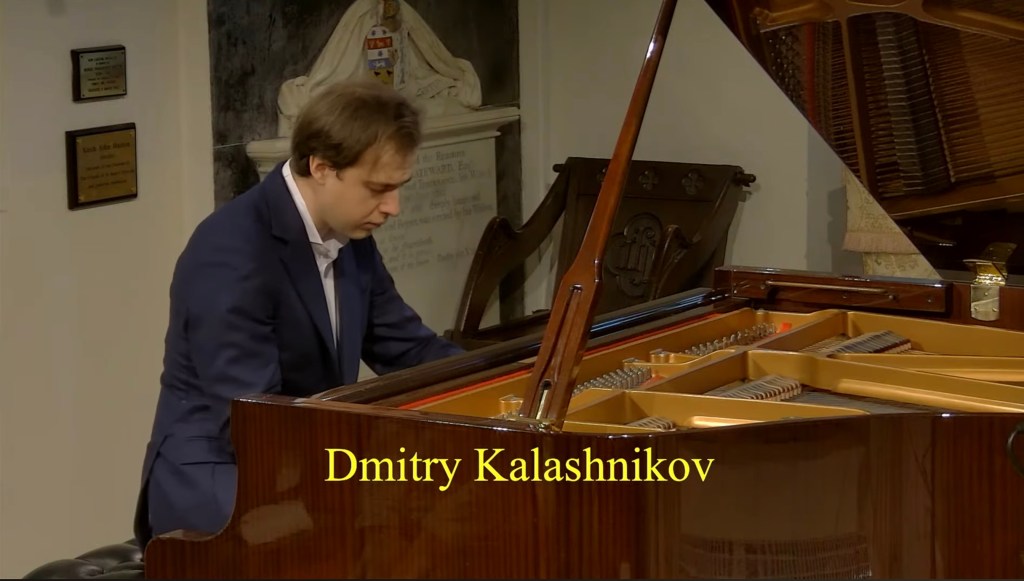

I think Dr Mather said it all when he thanked Dmitri for a phenomenal performance of spectacular proportions and that it was a privilege to have heard such playing.Playing that reminded me of the young Tamas Vasary or even more Sokolov of today .There was a sound that was very clean,crisp and clear but also multi coloured and in the greatest of climaxes sumptuously rich and never hard or ungrateful.A technical mastery allied to a musicianship that could change with chameleonic speed from the purity of Franck to the clarity of Scarlatti and Haydn and then turn the piano into an orchestra with Tchaikowsky and Saint- Saens.I have heard many remarkable hands play on this very instrument, in this extraordinary series that the genial Dr Mather and his team are dedicated to offering to young musicians,but I have never heard such sumptuous sounds as in the hands of this piano genius.A name that defies the beauty ,poetry and total mastery he has in his hands but surely a name to remember!
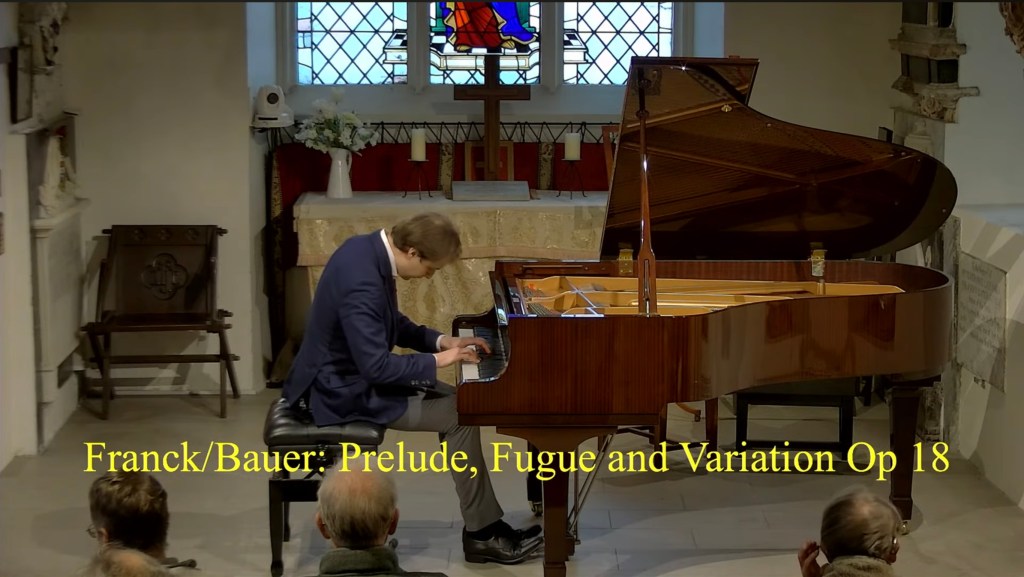
A hidden masterpiece revealed to us today by a true poet of the keyboard .
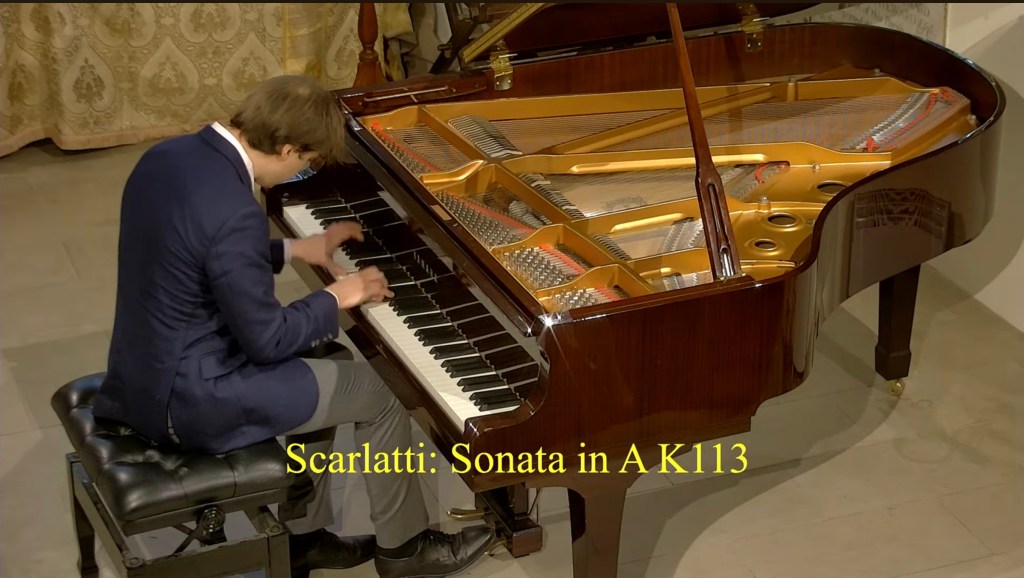
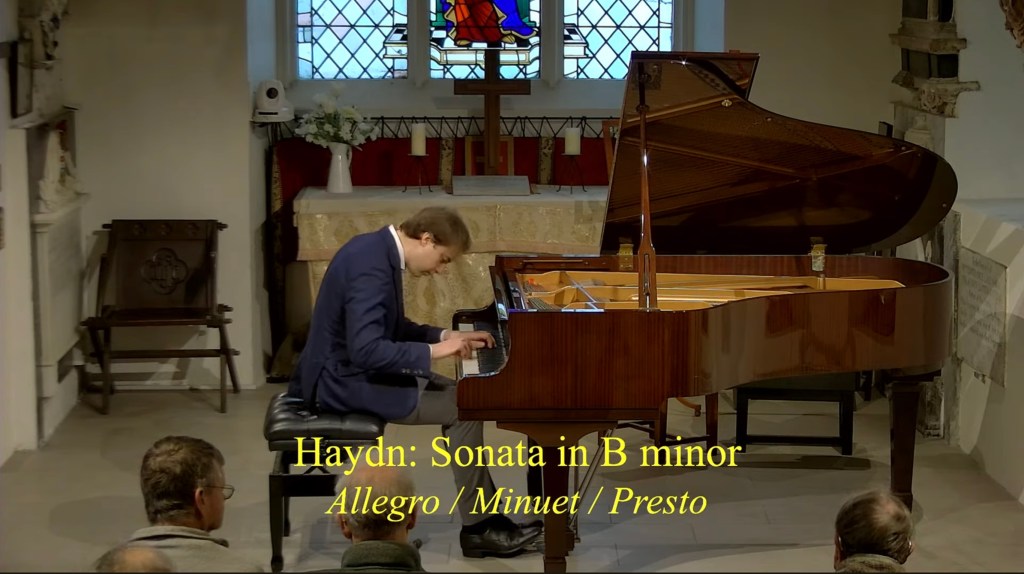
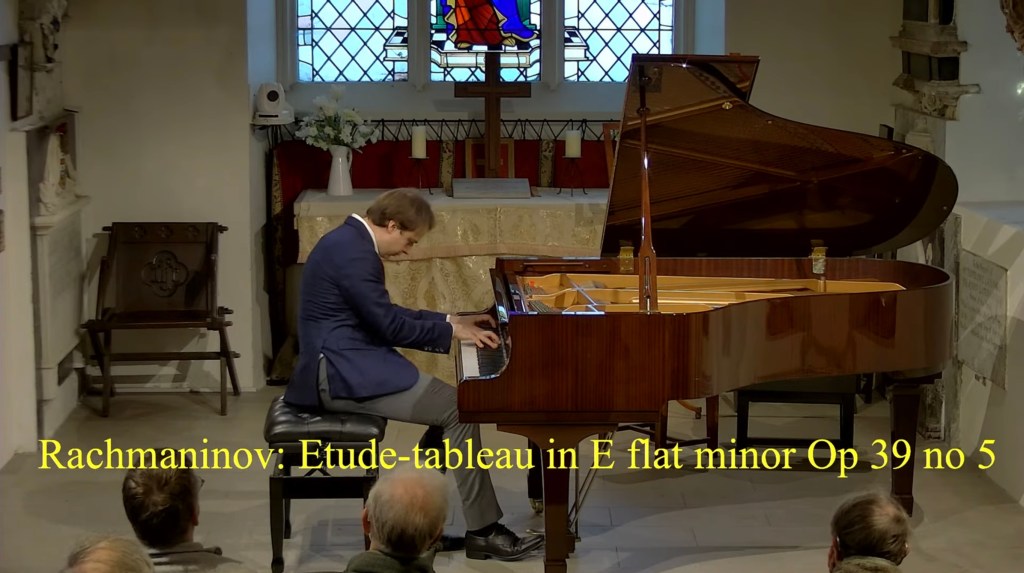
Playing of this grandeur and mastery I have only ever heard from Sokolov
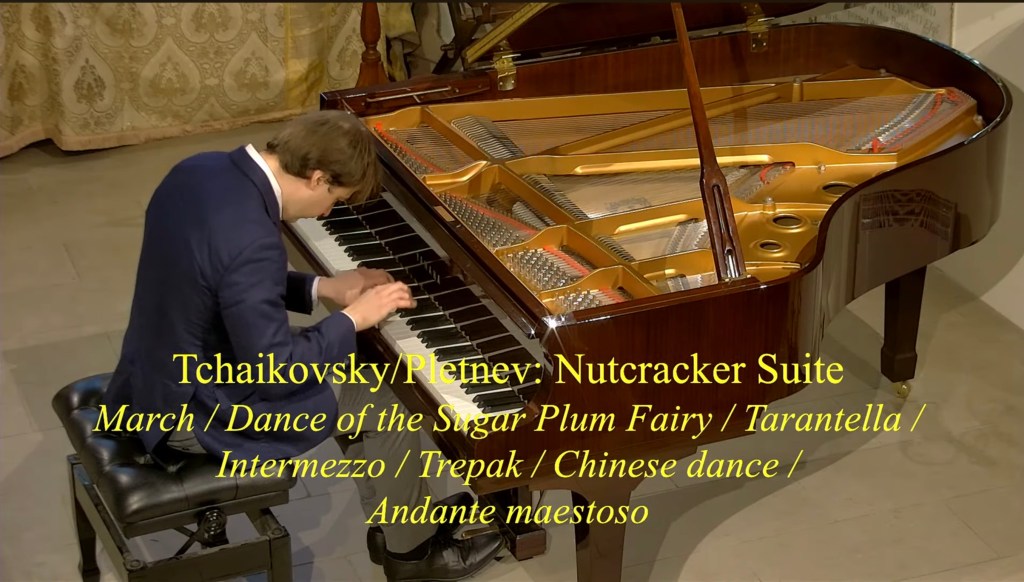
In this suite there is no doubt that we have real genius.The same unsettling genius of Tchaikowsky – but then genius is never easy to live with!
A magnificent performance from Dmitry who obviously relished this wonderfully written transcription.A ‘March’ of delicious charm and exhilaration as notes spread with ease over the entire keyboard.A luminosity to the ‘Sugar Plum Fairy ‘ with wondrous sounds that would make any orchestra green with envy.A ‘Tarantella’ with a beguiling web of notes ,and a truly wondrous sense of balance as the melody seemed to float on a stream of arpeggiated sounds in the ‘Intermezzo’.Virtuositic hi jinx of rhythmic energy abound in the ‘Trepak’ but what a wonder the ‘Chinese Dance’ was with the deep rumbling in the bass and the spirited melody at the opposite end of the keyboard all played with clockwork precision and irresistible charm.The Andante maestoso must be one of the greatest transcriptions ever made .Like Liszt’s Norma fantasy the secret world of Thalberg is taken to genial heights of sublime piano playing.
And that is what we heard today from the hands of a true master.
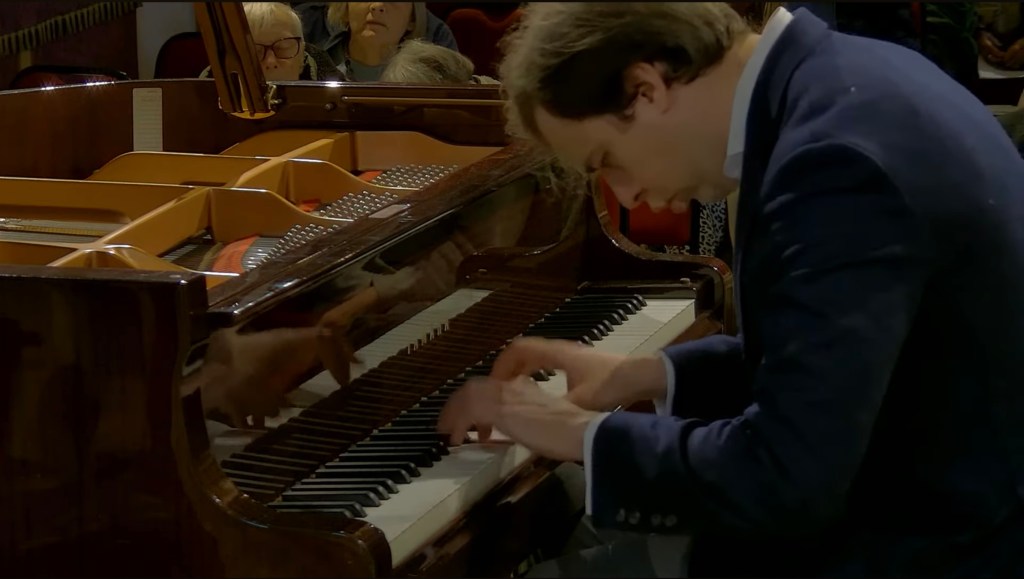
Dmitrii Kalashnikov was born in Moscow in 1994. He graduated with distinction from the Gnessin Moscow Special School of Music (2012; classes of Ada Traub and Tatiana Vorobieva) and the Tchaikovsky Moscow State Conservatory (2017; class of Elena Kuznetsova). In 2021 he completed his postgraduate studies at the Royal College of Music in London (class of Vanessa Latarche). He was a prize-winner at the Concours International de Piano du Conservatoire Russe Alexandre Scriabine (Paris, 2008; 1 st prize), the Jaques Samuel Pianos Intercollegiate Piano Competition (London, 2019; 1 st prize) and the Beethoven Senior Intercollegiate Piano Competition (London, 2021; 1 st prize). He is a grant-recipient of the New Names foundation, the Yuri Rozum International Charitable Foundation and the Homecoming Culture Development Fund, and has received the Prize of the Support for Talented Youth of the Government of the Russian Federation, the City of Moscow Prize and the George Stennett Award. He was also supported by a Neville Wathen Scholarship. He gives recitals at the Moscow Conservatory, the Gnesin Russian Academy of Music, the Moscow International Performing Arts Centre, London’s Wigmore Hall and at various venues in France, Austria, Poland, Estonia, Italy, Belgium and the United Kingdom. He has appeared on several occasions with the Russian National Orchestra under the baton of Mikhail Pletnev and in a duet with Pletnev on two pianos (conducted by Mischa Damev). He regularly performs at the Mariinsky International Piano Festival. In December 2018 he appeared at the Concert Hall of the Mariinsky Theatre with the Mariinsky Orchestra. He has taken part in various projects of the State Tretyakov Gallery. For several years he ran artistic soirees with the artist Gavriil Kochevrin for charitable events for orphans at the Marina Tsvetaeva House Museum (Moscow). These concert performances have seen the participation of Yevgeny Knyazev, Alexander Rudin and Boris Andrianov. In September 2019 he took part in the opening of the season at the Nizhny Novgorod State Academic Opera and Ballet Theatre named after A.S. Pushkin.
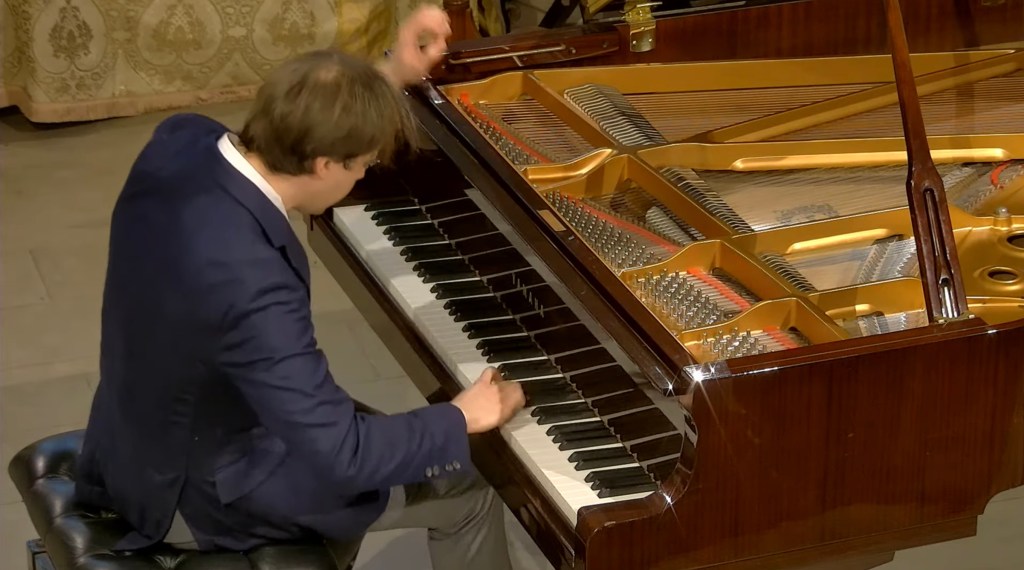
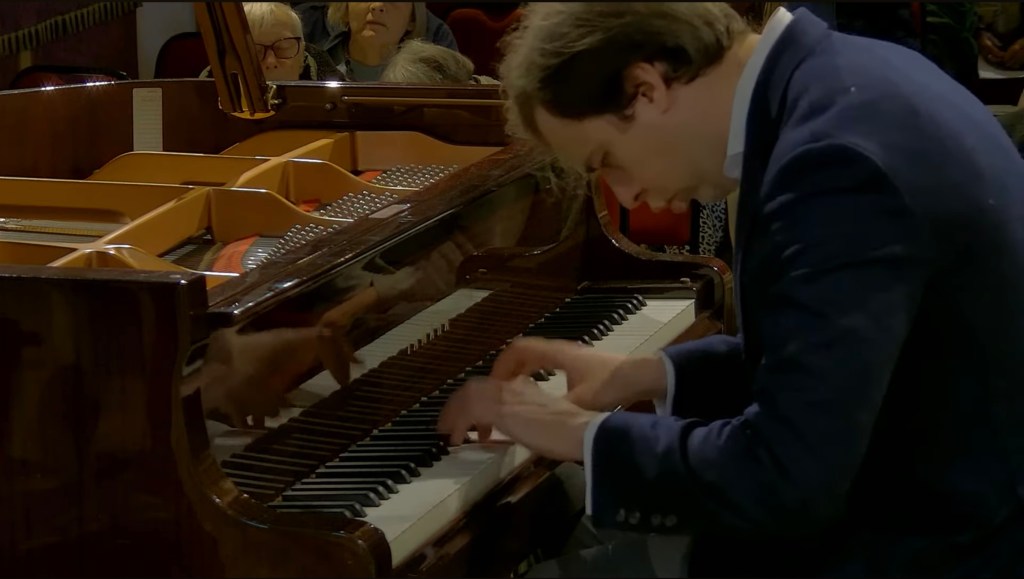
Dmitry Kalashnikov at St Mary’s Mastery and intelligence with explosions of virtuosity at the service of the music.
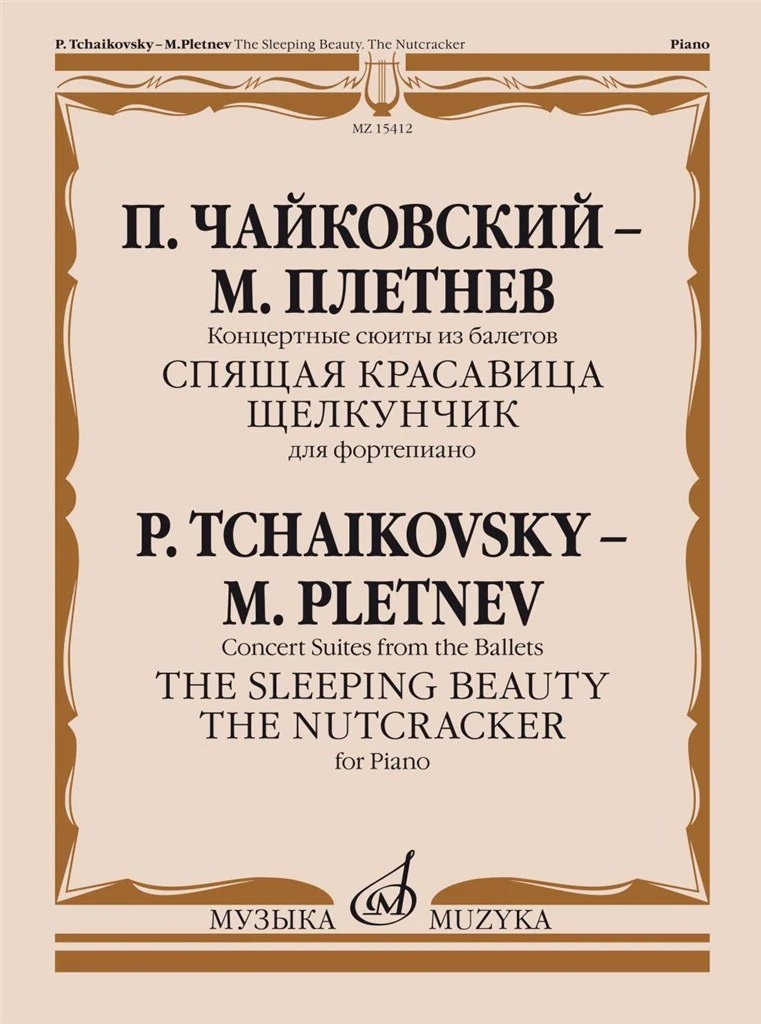
March
Dance of the Sugar-Plum Fairy
Tarantella
Intermezzo
Trepak (Russian Dance)
Chinese Dance
Andante maestoso

https://christopheraxworthymusiccommentary.com/2023/10/08/the-secret-world-of-pletnev-in-eindhoven-private-musings-of-ravishing-beauty/
14 April 1957 (age 66) was born into a musical family in Arkhangelsk part of the Soviet Union .He studied for six years at the Special Music School of the Kazan Conservatory before entering the Moscow Central Music School at the age of 13, where he studied under Evgeny Timakin. In 1974, he entered the Moscow Conservatory , studying under Yakov Flier and Lev Vlassenko At age 21, he won the Gold Medal at the VI international Tchaikovsky Competition in 1978, which earned him international recognition and drew great attention worldwide.
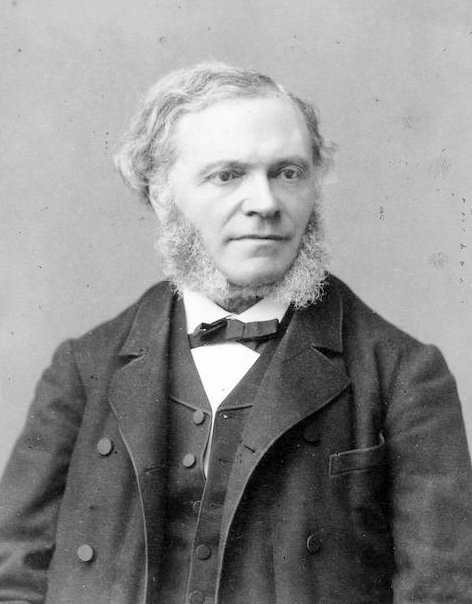
10 December 1822 – 8 November 1890
Franck was inspired to write this organ piece for the instrument at the church of Sainte-Clotilde. While it sounds majestic on the organ, it is also frequently heard in Harold Bauer’s transcription for the piano.The Prelude, Fugue and Variation, Op. 18 is one of Franck’s Six Pieces for organ, premiered by the composer at Sainte-Clotilde on 17 November 1864. They mark a decisive stage in his creative development, revealing how he was building on the post-Beethoven Germanic tradition in terms of the importance given to musical construction.
The Prelude, Fugue and Variation is dedicated to Saint-Saëns. Years earlier, when Franck published his Op. 1 trios, Liszt was among their admirers but had advised his younger colleague to write a new finale for the third of the trios and create a separate work from the original finale – this became Franck’s Fourth Piano Trio, Op. 2, dedicated to Liszt. In spring 1866, the Hungarian composer was in Paris for the French premiere of his Missa solennis for the consecration of the Basilica in Gran (Esztergom) at the Église Saint-Eustache on 15 March, a work about which Franck was enthusiastic. At the beginning of his stay, Liszt had come to listen to Franck improvising at Sainte-Clotilde and, apparently at Duparc’s instigation, a second private performance took place on 3 April. Franck wanted to play Liszt’s Prelude and Fugue on the Name BACH but the latter asked instead to hear Franck’s own Prelude, Fugue and Variation.
The piano transcription of this organ work was made by Harold Bauer (1873-1951), the British pianist who gave the world premiere of Debussy’s Children’s Corner and was the dedicatee of Ondine, the first piece in Ravel’s Gaspard de la nuit.Harold Bauer made his debut as a violinist in London in 1883, and for nine years toured England. In 1892, however, he went to Paris and studied with Paderewski for a year.In 1900, Harold Bauer made his debut in America with the Boston Symphony Orchestra, performing the U.S. premiere of Brahms’Piano Concerto No.1 in D minor. On 18 December 1908, he gave the world premiere performance of Debussy’s Children’s Corner Suite in Paris.After that he settled in the United States.He was also an influential teacher and editor, heading the Piano Department at the Manhattan School of Music . Starting in 1941, Bauer taught winter master classes at the University of Miami and served as a Visiting Professor at the University of Hartford Hartt .Students of Harold Bauer include notably Abbey Simon and Dora Zaslavsky.
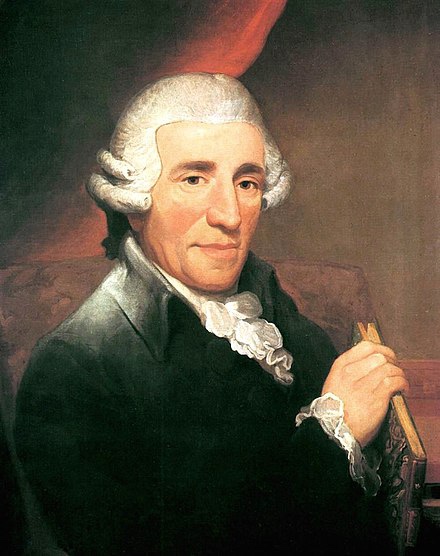
31 March 1732 – 31 May 1809
The 55 Haydn Sonatas are perhaps the least-known treasures of the piano repertoire. In them one can hear Haydn virtually inventing the classical style, from the early, somewhat tentative beginnings, through the bold experiments of the 1770s, to the adventurous late works. As with Beethoven (Haydn’s somewhat recalcitrant student) each sonata is a new exploration, and the element of surprise is ever present. Haydn delights in abrupt transitions, twists and turns, sudden pauses, and apparent non sequiturs; listening to him demands a constant alertness.
The 1770s, when Haydn’s Sonata in B minor was composed, was the age of Sturm und Drang (storm and stress) in German culture, an age when aberrant emotions were all the rage in music; and what better tonal avouring than the minor mode to convey these emotions?
It is also important to note that the 1770s was the period in which the harpsichord was gradually giving way to the new fortepiano, precursor of the modern grand, and there is much in this sonata to suggest that it still lingered eagerly on the harpsichord side of things, at least texturally.
This cross-over period between harpsichord and fortepiano plays out in the nature of the first movement’s two contrasting themes.
In place of a lyrical slow movement, Haydn offers us a minuet and trio which features thematic material as dramatically contrasting as the first and second themes of the first movement. The minuet is in the major mode, set high in the register, sparkling with trills
The trio is daringly in the minor mode, set low, and grinds grimly away in constant 16th-note motion.
Haydn wouldn’t be Haydn if he didn’t send you away with a toe-tapping finale and such a movement ends this sonata. To that end, Haydn’s go-to rhythmic device is repeated notes, and this nale chatters on constantly at an 8th-note patter, interrupted at random, it would seem, by surprising silences and dramatic pauses – as if to allow the performer to turn sideways and wink at his audience.
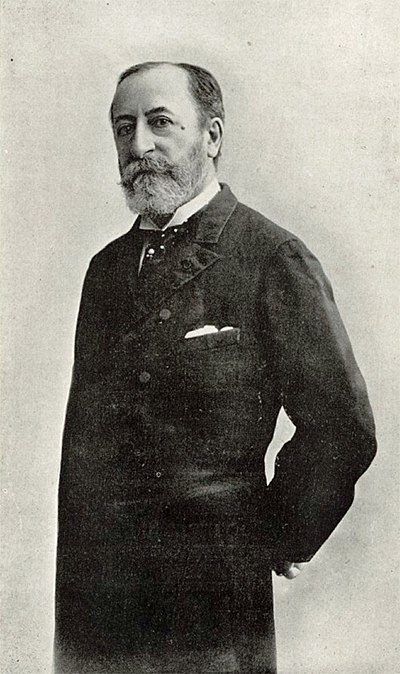
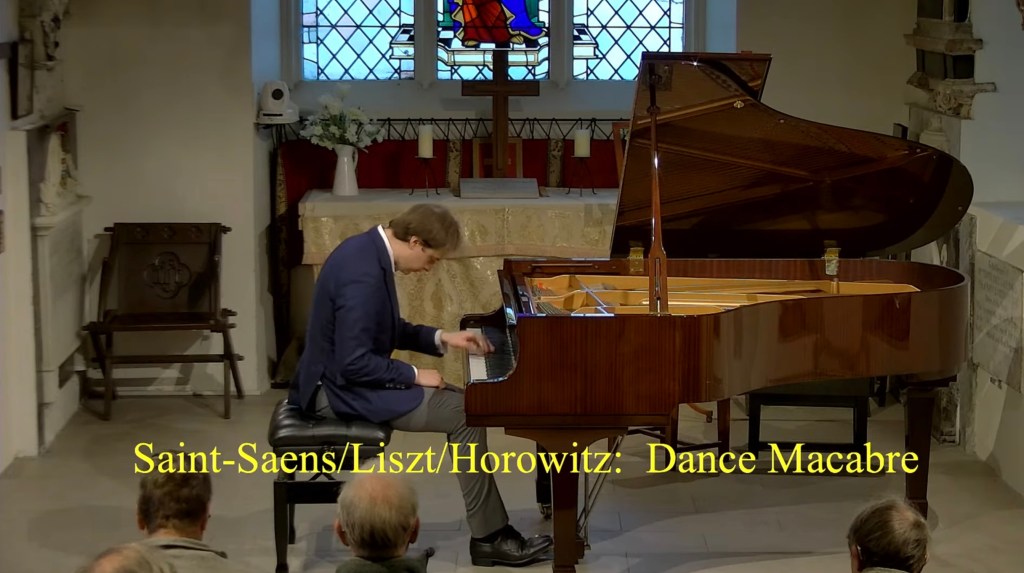
Danse macabre, Op 40, is a symphonic poem for orchestra, written in 1874 and was first performed on 24 January 1875. It started out in 1872 as an art song for voice and piano with a French text by the poet Henri Cazalis , based on the play Danza macàbra by Camillo Antona-Traversi.In 1874, the composer expanded and reworked the piece into a symphonic poem, replacing the vocal line with a solo violin part Shortly after the premiere, the piece was transcribed into a piano solo arrangement by Franz Liszt S.555 a good friend of Saint-Saëns in 1942, Vladimir Horowitz made extensive changes to the Liszt transcription and it is this version that is played most often today.

 ChristopherAxworthy-MusicCommentary