


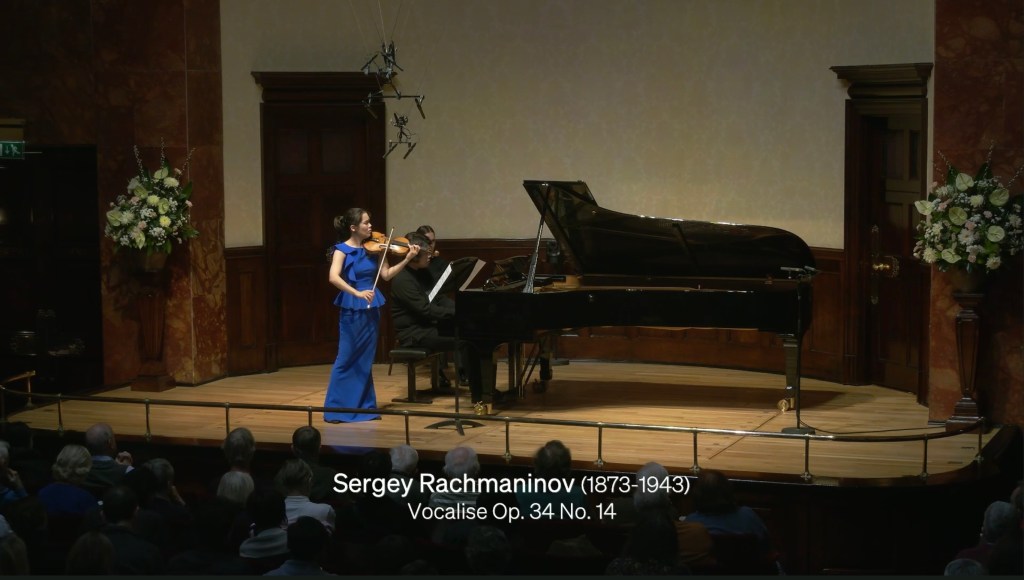
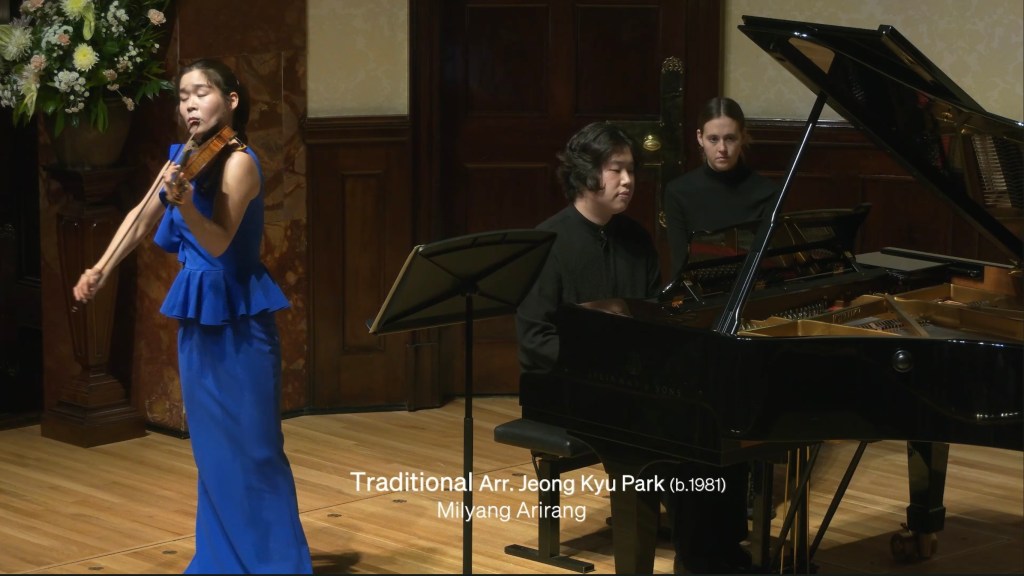
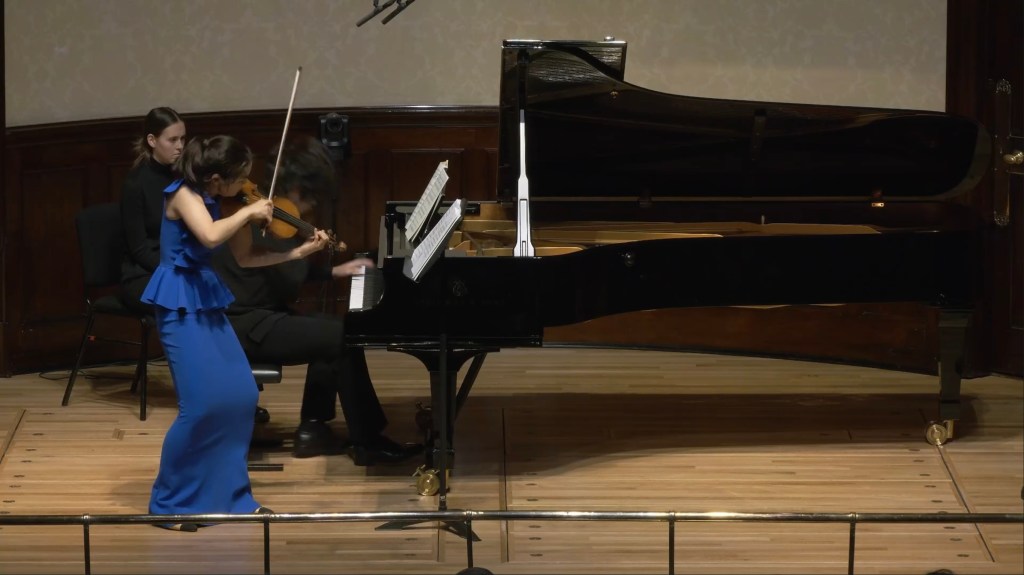
Some superb playing advertised as a duo but they truly played as one.Have the etherial passionate sounds of these last utterings of Debussy ever sounded so fresh and improvised?There was magic in the air with the lightness and insinuating sounds of the second movement that were rediscovered together as though for the first time .The concealed passion and throbbing heart beat of the last movement drew this world – Debussy’s – to a conclusion in only thirteen minutes.There was passion too in the Grieg sonata but it was the heartrending intimacy that was so touching. Looking at each other and both on the same wave just waiting for each other to emerge and submerge with a continual movement.Each swaying with the music indeed as Chopin said :the roots firmly in the ground but the branches free to move in the breeze.I did not think the ravishing beauty of Jae Hong’s Allegretto could be more lovingly tender or beautiful but then Esther’s violin took over with different sounds less luminous but of even greater intensity.An exhilarating prestissimo was played with extraordinary rhythmic energy bringing these two Sonatas to a magnificent end.Rachmaninov’s Vocalise was pure magic as the violin gently conversed with the piano in a duet of ravishing beauty but also of extraordinary balance.Jae Hong playing with the piano lid fully opened but there was never any moment when he might have overpowered this single violin.Two superb musicians listening to each other as they created a single unified whole .A lesson in humility and artistry as they thought more of the music they were making together than themselves.Yankee Doodle was a way to release the tension that had been created by so much wonderful music making.Jae Hong patiently accompanying the hi jinx of his partner and every so often letting the brass band in his hands and feet take over ……it was fun but it was the desolate Korean Melody and the deeply nostalgic Morning Song by Elgar that stole our hearts.
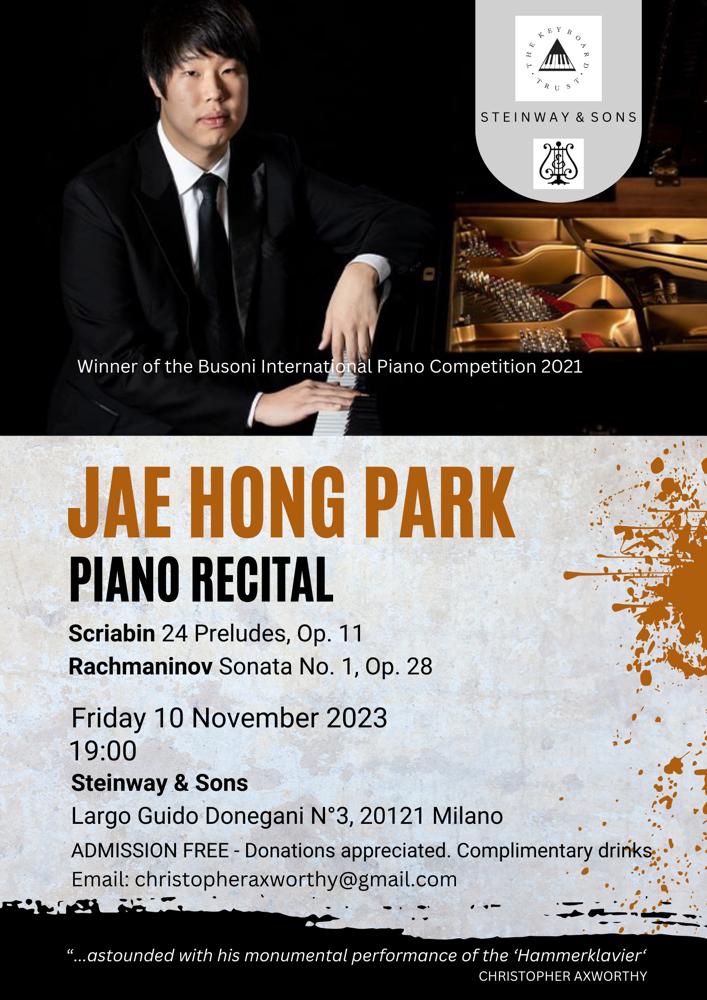
Jae Hong Park at Steinway Hall





22 August 1862 – 25 March 1918
The Debussy sonata for violin and piano in G minor, L.140, was written in 1917. It was the composer’s last major composition.The premiere took place on 5 May 1917, the violin part played by Gaston Poulet , with Debussy himself at the piano. It was his last public performance.
The work has three movements:
- Allegro vivo
- Intermède: Fantasque et léger
- Finale: Très animé
The unfinished sonatas
Six sonatas for various instruments (French: Six sonates pour divers instruments) was a projected cycle of sonatas that was interrupted by the composer’s death in 1918, after he had composed only half of the projected sonatas. He left behind his sonatas for cello and piano 1915), flute, viola and harp (1915), and violin and piano (1916–1917).Debussy wrote in the manuscript of his violin sonata that the fourth sonata should be written for oboe, horn,and harpsichord and the fifth for trumpet, clarinet, bassoon and piano.
From 1914, the composer, encouraged by the music publisher Jacques Durand intended to write a set of six sonatas for various instruments, in homage to the French composers of the 18th century. The effects of the First World War and an interest in baroque composers Couperin and Rameau inspired Debussy as he was writing the sonatas.
Durand, in his memoirs entitled Quelques souvenirs d’un éditeur de musique, wrote the following about the sonatas’ origin:
‘After his famous String Quartet, Debussy had not written any more chamber music. Then, at the Concerts Durand, he heard again the Septet with trumpet by Saint-Saëns and his sympathy for this means of musical expression was reawoken. He admitted the fact to me and I warmly encouraged him to follow his inclination. And that is how the idea of the six sonatas for various instruments came about.’
In a letter to the conductor Bernard Molinari, Debussy explained that the set should include “different combinations, with the last sonata combining the previously used instruments”. His death on 25 March 1918 prevented him from carrying out his plan, and only three of the six sonatas were completed and published by Durand, with a dedication to his second wife, Emma Bardac.
For the final and sixth sonata, Debussy envisioned a concerto where the sonorities of the “various instruments” combine, with the gracious assistance of the double bass.
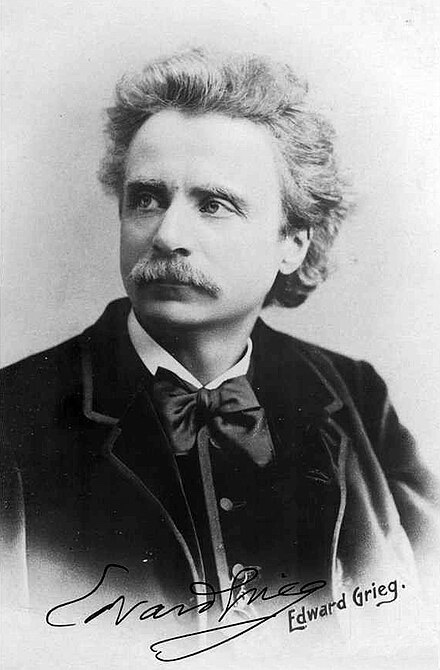
Grieg began composing his third and final violin sonata in the autumn of 1886. Whereas the first two sonatas were written in a matter of weeks, this sonata took him several months to complete.Although there were only two years between the first two violin sonatas, the Violin Sonata No 3 in C minor, Op 45, was not to follow for almost two decades: the last piece of chamber music Grieg completed, it was composed—at Grieg’s home, Troldhaugen, outside Bergen—in the second half of 1886, just spilling into the first days of 1887.The sonata is in three movements The second movement opens with a serene piano solo in E major with a lyrical melodic line. In the middle section, Grieg uses a playful dance tune. It also exists in a version for cello and piano that Grieg composed during the same time as the violin version and given to his brother as a birthday gift in May 1887, but appeared in print only in 2005 (by Henle).
Allegro molto ed appassionato – Allegretto espressivo alla Romanza – Allegro animato – Prestissimo
The sonata remains the most popular of the three works, and has established itself in the standard repertoire. The work was also a personal favorite of Grieg’s. Grieg played the piano part in the premiere, in the Leipzig Gewandhaus on 10 December 1887; the violinist was the eminent Adolph Brodsky, who had given the first performance of the Tchaikovsky Concerto six years earlier (and was later head of the Royal Manchester School of Music)To a certain extent, Grieg built on Norwegian folk melodies and rhythms in this three-movement sonata. However, Grieg considered the second sonata as the “Norwegian” sonata, while the third sonata was “the one with the broader horizon.” This was the last piece Grieg composed using sonata form.
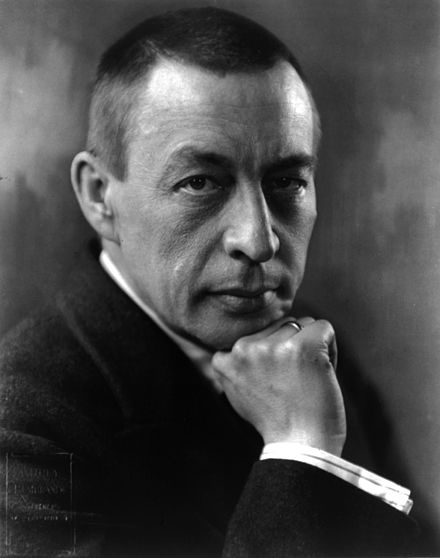
Born
1 April [20 March] 1873
Semyonovo, Staraya Russa ,Novgorod Governorate .Russian Empire
Died
28 March 1943 (aged 69)
Beverly Hills California, U.S.
“Vocalise” is a song composed and published in 1915 as the last of his 14 Songs or 14 Romances, Op.34.Written for high voice (soprano or tenor)it contains no words, but is sung using only one vowel of the singer’s choosing It was dedicated to soprano singer Antonina Nezhdanova. It is performed in various instrumental arrangements more frequently than in the original vocal version.In this case arranged by Jascha Heifetz.

The French violinist Henri Vieuxtemps wrote Souvenir d’Amérique, opus 17 for violin and piano, in 1843, during his first concert tour in the United States. This set of variations, based on the melody of the popular song Yankee Doodle, became the entertaining surprise encore piece at Vieuxtemps’ recitals. Its humorous spirit, together with its virtuosic firework displays and imaginative use of playing techniques, made Souvenir d’Amérique an instant audience favorite.


 ChristopherAxworthy-MusicCommentary