Johann Sebastian Bach Partita No 6 in E minor
1. Toccata
2. Allemande
3. Corrente
4. Air
5. Sarabande
6. Tempo di Gavotta
7. Gigue
Karol Szymanowski Mazurkas, Op 50
No 3 Moderato
No 7 Poco vivace
No 8 Moderato
No 5 Moderato
No 4 Allegramente, risoluto
Anton Webern Variations, Op 27
Ludwig van Beethoven Piano Sonata No 31
1. Moderato cantabile, molto espressivo
2. Allegro molto
3. Adagio, ma non troppo – Arioso dolente – Fuga: Allegro, ma non troppo – L’istesso tempo di Arioso – L’inversione della Fuga

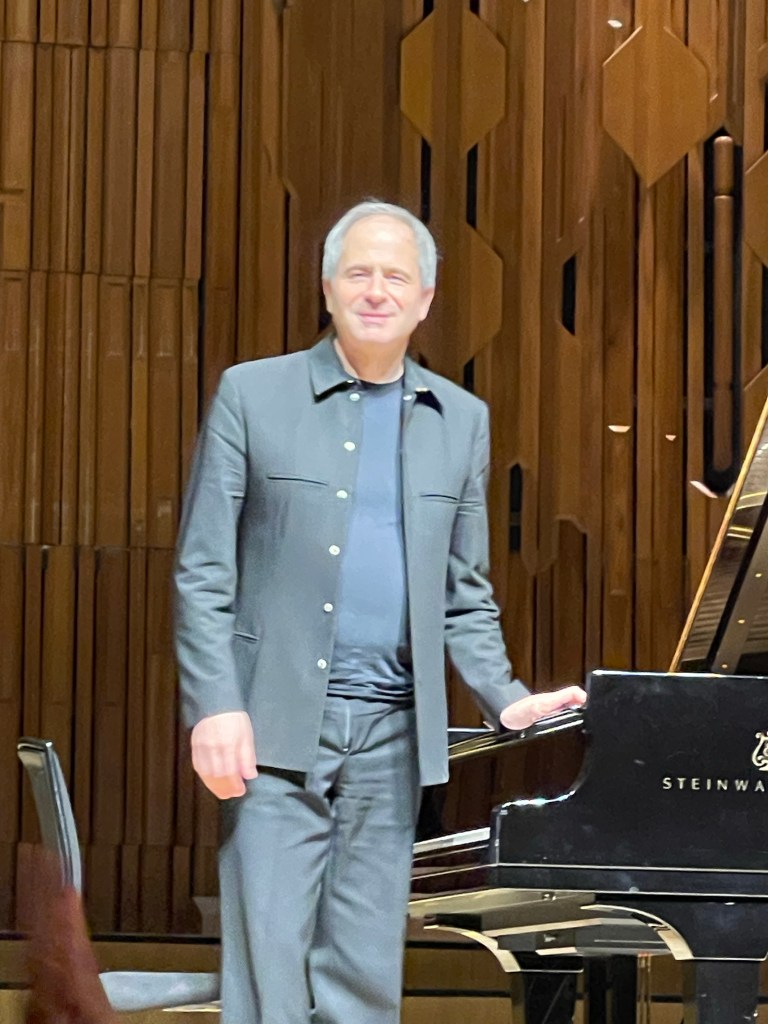
Performances of ravishing beauty with a kaleidoscope of sounds.An extraordinary palette of colours that gave new life to Bach’s monumental 6th Partita.There was delicacy and poise but nobility and clarity always with refined good taste and with very little use of the pedal.His fingers seemed instinctively to search out sounds and colours without ever disturbing the overall pulse or architectural shape.
A whispered luminosity he brought to Szymanowski’s extraordinary Mazurkas op 50.A subtle world of insinuating sounds and dance rhythms.
This was the ideal world for Webern’s variations too where the delicacy and multicoloured sounds drew these seemingly isolated notes into shapes of eloquence giving meaning to such a seemingly abstract art.There were pungent sounds too but rarely called upon as Anderewski inhabited a secret world that he chose to allow us to eavesdrop on.
A change of piano during the interval but the palette of sounds and whispered secrets were still the same .
Beethoven too slipped in on the final ethereal wave of the Webern variations.
But by now we had experienced his secret world of refined multicoloured sounds and in some way I found in need of something with more backbone and contrast.
This was Beethoven as seen from afar.A world of ravishing beauty and refined whispered sounds but was it the real Beethoven if we moved in closer?
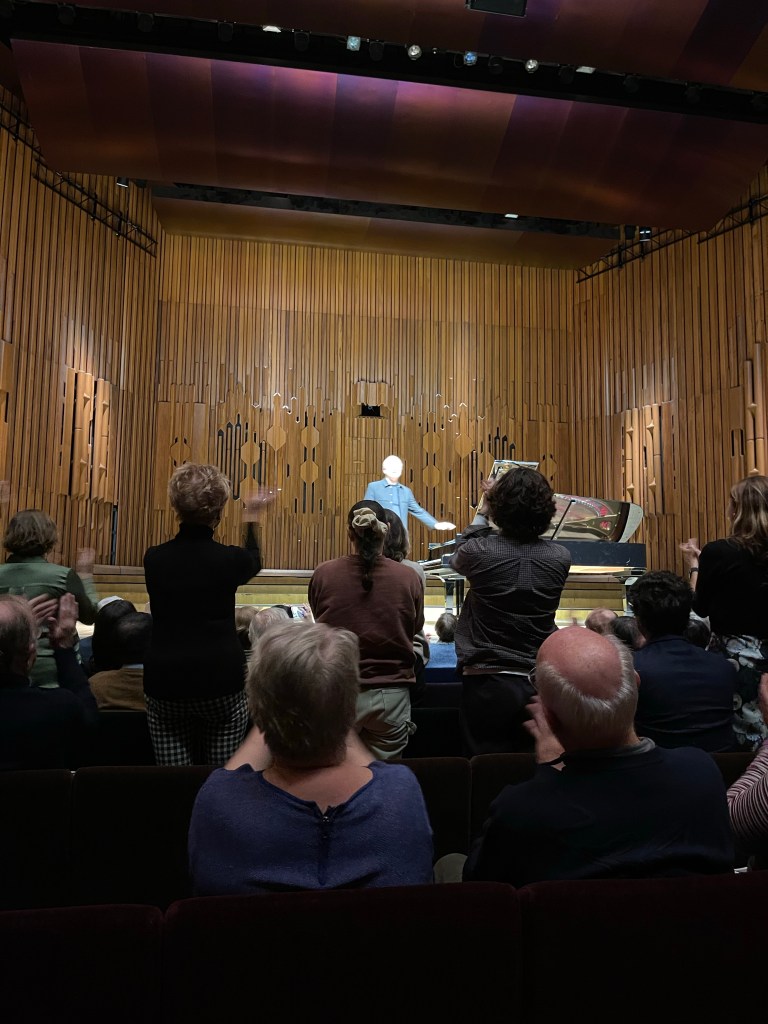
An audience that sat in awed silence as he drew us in to a secret world that even the three encores inhabited.(Bach and Bartok)
The only chiselled sounds above mezzo forte were momentarily in the Beethoven Scherzo but with hard ungrateful sounds that had no place in the world he inhabited.
A final note of the evening hammered into the bass which reminded me of his Schumann Piano Concerto that he had played with Pappano with such chiselled ungrateful sounds that I turned to a friend and said I thought he must hate it.It was obviously not part of the world that he inhabits.
A master pianist and a cult figure with a great following of admirers but who lives on a cloud of his own of extremes of sound that somehow do not always seem to connect.
A concert inhabited by Eusebius ………but Florestan where were you!
A concert full of wondrous things and a unique world that is wonderful to visit occasionally but a world where it would be hard to take up permanent residence.
A standing ovation for a unique artist and I too found myself on my feet.
Chapeau Maestro!
The Barbican presents Piotr Anderszewski:
From Bach to Webern, pianist Piotr Anderszewski finds fascinating connections between composers whose visionary ideas would change keyboard music forever.
Anderszewski is renowned for his interpretations of Bach and brings that special affinity to the monumental Partita No 6 which, in the words of musicologist David Schulenberg, is ‘the crowning work of the set and Bach’s greatest suite’. Rooted in traditional European dance styles, this is music that reveals Bach’s awe-inspiring ability to weave whole worlds of sound from the simplest ideas.
Fast forward 200 years, and Szymanowski – from Anderszewski’s homeland of Poland – infuses his mazurkas with the mind-bending rhythms and melodies of Polish folk dance. With his Variations, Webern takes an historical form and places it firmly in the 20th century, and Beethoven brings us full circle in his emotional penultimate piano sonata – a piece with echoes of Bach but that’s peppered with Romantic innovations.
Piotr Anderszewski is an artist who has long embraced the unexpected, whether in his repertoire choices or his interpretations. Bach has long been central to his art, but always with a fresh slant – as in his most recent recording of the composer’s music, where he boldly took selected preludes and fugues from the Second Book of the 48 and presented them in his own re-ordering.

Bach’s E minor Partita, BWV830 – the final one in a set of six that the composer proudly published as his ‘opus 1’ in 1731. Although it’s actually one of the earlier partitas to have been written, it’s easy to see why Bach placed it last, with its striking combination of sweeping brilliance and profundity.
For one of the greatest colourists of the 20th century, Karol Szymanowski the piano functioned as both inspiration and musical laboratory throughout his composing life. The 20 Mazurkas of Op 50 (1924–5), from which we hear Nos 3, 7, 8, 5 and 4, are from the final phase of Szymanowski’s style, one in which his own musical language became inextricably suffused with Polish nationalism.
A decade later Anton Webern was taking piano writing to a new level of concision in his Variations, Op 27 (1936). Webern was a member of the Second Viennese School, the movement founded by Arnold Schoenberg whose founding principle was that of ‘serialism’ (in which, unlike in time-honoured system of traditional tonality, all 12 notes of the chromatic scale are used to create a ‘row’ or ‘series’, determining not only the melodic lines of a piece but also its harmonies).
Webern’s three brief movements are all built from the same tone row.The yearning opening phrases of the first movement, via the capricious spikely energetic second, to the contrasts within the last, from introspection to buoyancy.
Beethoven’s A flat major Sonata, Op 110, was his penultimate sonata, written in 1821,
The outward gentleness of the opening movement belies its tautness of form, and the contrast with the brief second, a scherzo marked Allegro molto – capricious, gruffly humorous, even violent – is extreme. Beethoven subversively sneaks in references to two street songs popular at the time: Unsa Kätz häd Katzln ghabt (‘Our cat has had kittens’) and Ich bin lüderlich, du bist lüderlich (‘I’m dissolute, you’re dissolute’)!
But it’s in the finale that the weight of the sonata lies, and it begins with a declamatory, recitative-like passage that starts in the minor, moving to an emotionally pained aria-like section.Beethoven introduces a quietly authoritative fugue, based on a theme reminiscent of the one that opened the sonata. Its progress interrupted by the aria once more, its line now disjunct and almost sobbing for breath. The way in which the composer moves into the major via a sequence of G major chords is a passage of pure radiance, that Edwin Fischer described as ‘like a reawakening heartbeat’. This leads to a second appearance of the fugue in inversion culminating in a magnificently triumphant conclusion.
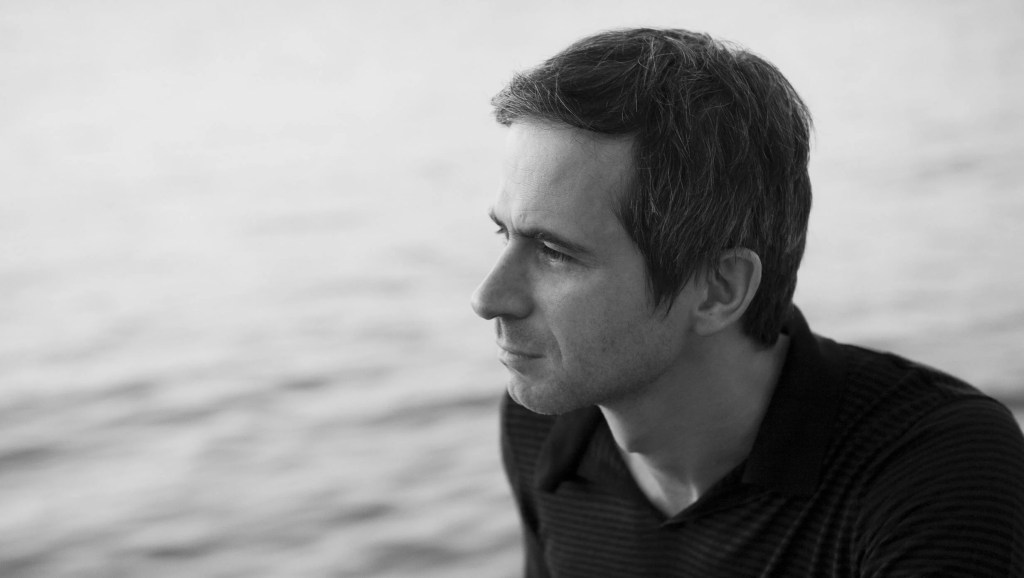
Piotr Anderszewski is regarded as one of the outstanding musicians of his generation.
He appears regularly in recital at such concert halls as the Vienna Konzerthaus, Berlin Philharmonie, Wigmore Hall, Carnegie Hall, Théâtre des Champs-Élysées and Concertgebouw Amsterdam. His collaborations with orchestra have included appearances with the Berlin Philharmonic, Berlin Staatskapelle, London and NHK Symphony orchestras and Philharmonia Orchestra. He has also placed a special emphasis on playing and directing, working with Scottish Chamber Orchestra, Chamber Orchestra of Europe and Camerata Salzburg, among others.
He has been an exclusive artist with Warner Classics/Erato (previously Virgin Classics) since 2000. His first recording for the label was Beethoven’s Diabelli Variations, which went on to receive a number of prizes. He has also recorded Grammy-nominated discs of Bach’s Partitas Nos 1, 3 and 6 and Szymanowski’s solo piano works, the latter receiving a Gramophone Award in 2006. His recording devoted to works by Robert Schumann received BBC Music Magazine’s Record of the Year Award in 2012. His disc of Bach’s English Suites Nos 1, 3 and 5, released in 2014, went on to win Gramophone and ECHO Klassik awards in 2015. His most recent release, featuring a selection of Preludes and Fugues from Bach’s Well-Tempered Clavier Book 2, won a Gramophone Award in 2021.
The intensity and originality of his interpretations have been recognised with the Gilmore Award, the Szymanowski Prize and a Royal Philharmonic Society Award.
He has also been the subject of several documentaries by the film maker Bruno Monsaingeon. Piotr Anderszewski plays Diabelli Variations (2001) explores his particular relationship with Beethoven’s iconic work, while Unquiet Traveller (2008) is an unusual artist portrait, capturing Piotr Anderszewski’s reflections on music, performance and his Polish-Hungarian roots.
In 2016 he got behind the camera himself to explore his relationship with his native Warsaw, creating a film entitled Je m’appelle Varsovie.
Last season he gave a new recital programme at the Philharmonie de Paris, Vienna Musikverein, Alte Oper Frankfurt and other major concert halls in Europe and Asia. He also performed with leading orchestras including the Leipzig Gewandhausorchester, Kammerakademie Potsdam, Finnish Radio and NHK Symphony orchestras and Orchestre Philharmonique de Radio France.
This season includes solo recitals throughout Europe at prestigious venues including the Muziekgebouw Amsterdam, Konserthuset Stockholm, Gulbenkian Portugal and Philharmonie Cologne, as well as on tour in Japan and Singapore. Concerto highlights include concerts with the Zurich Tonhalle, NDR Hamburg, Taiwan Symphony Orchestra and a tour with Sinfonia Varsovia.

 ChristopherAxworthy-MusicCommentary
Una risposta a "Piotr Anderszewski at the Barbican ‘A world of ravishing beauty and refined whispers’"