

Ashley Fripp’s 37th appearance at St Mary’s since 2005 was marked quite rightly by an unusually full and appreciative audience.Ashley is one of the finest most serious musicians I know who I had first encountered in the village of Sermoneta in Italy where every year during the summer months the Pontine Festival brings some of the greatest musicians to the hills near to Rome to give concerts and masterclasses.A festival that had started in the ‘60’s with Yehudi Menuhin and Josef Szigeti and every year since brings great music to where I luckily have a holiday home on the seashore.He had come to study with Eliso Virsaladze,the great Russian pianist and pedagogue much admired by Sviatoslav Richter.It was she who pointed out to me a young very talented British boy who had joined her class and she was very impressed by his pianistic and musical artistry.I later found Ashley in Fiesole overlooking Florence where Eliso was holding her masterclasses five times a year.Ashley was already on the threshold of a career in music in London ,having won the Gold medal at the Guildhall School of Music ,but was still keen to perfect his skills with one of the greatest musicians of our time.
Ashley Fripp in Florence – A walk to the Paradise Garden
While he was there he also gave a recital in the Harold Acton Library,part of the British Institute ,where he gave a truly memorable performance of Chopin’s B minor Sonata.It was he who introduced me to this beautiful venue and the director and thanks to him we now hold a series of concerts there every year for the Keyboard Trust.
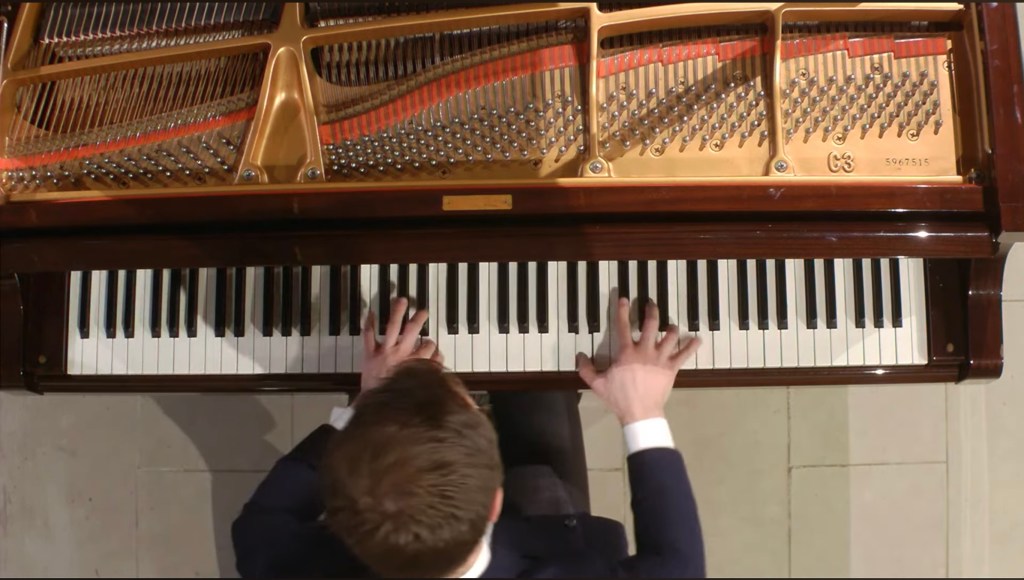
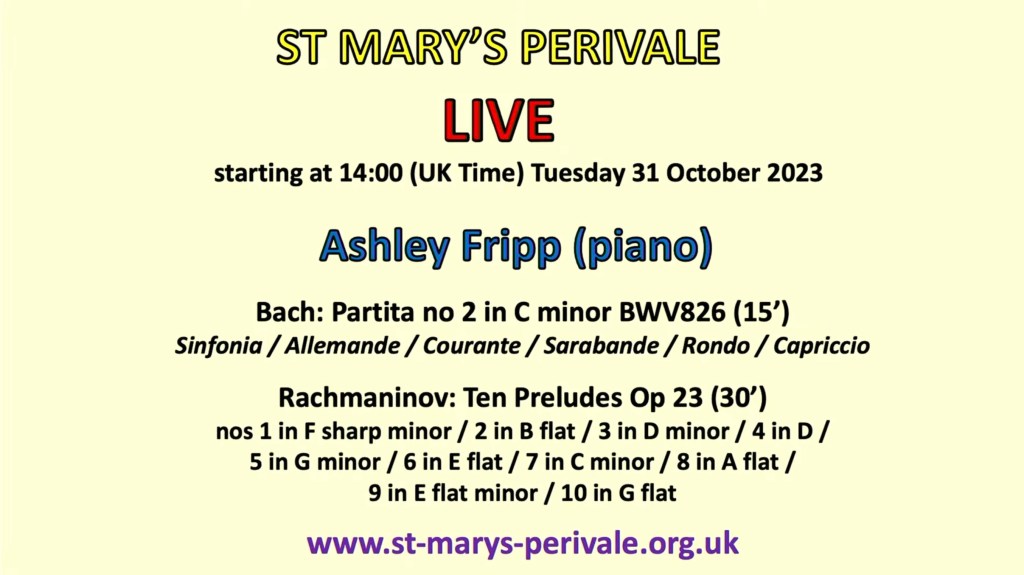
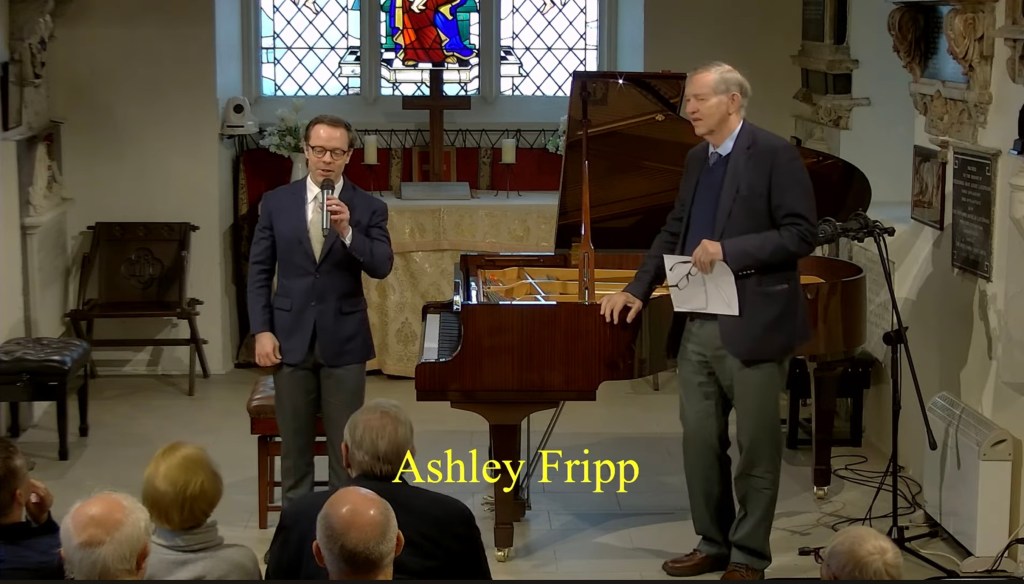
Today Ashley presented two major works and his eloquent introductions illuminated the journey we were about to take together with simple clarity and intelligence.It was the same qualities that he brought to his performances with superb technical control and artistry.An architectural shape to all he did and an impeccable sense of style that made for a great contrast from the non legato world of Bach where the song and the dance reign to the sumptuous romantic sounds of Rachmaninov. But even in Rachmaninov he was able to link the ten miniature tone poems or preludes into one emotional whole.As he pointed out there was a link between the first prelude in the minor and last in the major with the first prelude in F sharp minor and the last in G flat ( F sharp) major.The same sense of unity and form that Bach had brought to his Partita Ashley’s superb musicianship could see in Rachmaninov too.Superbly played throughout without any showmanship but with simplicity and an attention to the composers wishes that gave great strength and authority to all he did .


British pianist Ashley Fripp has performed extensively as recitalist, concerto soloist and chamber musician throughout Europe, Asia, North America, Africa and Australia in many of the world’s most prestigious concert halls. Highlights include the Carnegie Hall (New York), Musikverein (Vienna), Concertgebouw (Amsterdam), the Philharmonie halls of Cologne, Paris, Luxembourg and Warsaw, the Bozar (Brussels), the Royal Festival, Barbican and Wigmore Halls (London), the Laeiszhalle (Hamburg), Palace of Arts (Budapest), the Megaron (Athens), Konzerthaus Dortmund, the Gulbenkian Auditorium (Lisbon) and the Konserthus (Stockholm).
He has won prizes at more than a dozen national and international competitions, including at the Hamamatsu (Japan), Birmingham and Leeds International Piano Competitions, the Royal Over-Seas League Competition, the Concours Européen de Piano (France) and the coveted Gold Medal from the Guildhall School of Music & Drama. Ashley was awarded the Worshipful Company of Musicians’ highest award, The Prince’s Prize, and was chosen as a ‘Rising Star’ by the European Concert Hall Organisation (ECHO). He has also performed in the Chipping Campden, Edinburgh, Brighton, Bath, Buxton, City of London, and St. Magnus International Festivals as well as the Oxford International Piano Festival, the Festival Pontino di Musica (Italy) and the Powsin International Piano Festival (Poland). Ashley also gave an open-air Chopin recital beside the world-famous Chopin monument in Warsaw’s Royal Lazienki Park to an audience of 2,500 people.
Ashley Fripp studied at the Guildhall School of Music & Drama with Ronan O’Hora and with Eliso Virsaladze at the Scuola di Musica di Fiesole (Italy). In 2021 he was awarded a doctorate for his research into the piano music of British composer Thomas Adès. Future engagements include his debut at the Mecklenburg-Vorpommern Festival (Germany) and a commercial film production of Rachmaninoff Piano Concertos Nos. 1 & 2 with accompanying concert tours in Germany and the Czech Republic with the Prague International Youth Orchestra.

The Partita for keyboard No. 2 in C minor, BWV.826, is a suite of six movements written for the .It was announced in 1727,issued individually, and then published as Bach’s Clavier-Ubung in 1731.

1 April [O.S.20 March] 1873
Semyonovo, Staraya Russa,Novgorod Russa ,Novgorod Governorate ,Russian Empire
Died
28 March 1943 (aged 69)
Beverly Hills California, U.S.A

Ten Preludes, op 23, was composed in 1901 and 1903. Together with the Prelude in C sharp minor op 3/2 and the 13 Preludes op 32 this set is part of a full suite of 24 preludes in all the major and minor keys.Rachmaninoff completed Prelude No. 5 in 1901. The remaining preludes were completed after Rachmaninoff’s marriage to his cousin Natalia Satina: Nos. 1, 4, and 10 premiered in Moscow on February 10, 1903, and the remaining seven were completed soon thereafter.The years 1900–1903 were difficult for Rachmaninoff and his motivation for writing the Preludes was predominantly financial.He composed the works in the Hotel America, financially dependent on his cousin Alexander Siloti , to whom the Preludes are dedicated.Of the comparative popularity of his Ten Preludes and his early Prelude op.3 n.2 ,a favourite of audiences, Rachmaninoff remarked: “…I think the Preludes of Op. 23 are far better music than my first Prelude, but the public has shown no disposition to share in my belief….”The composer never played all of the Preludes in one sitting, instead performing selections of them, consisting of preludes from both his Op. 23 and Op. 32 sets which were of contrasting character
Ashley Fripp ignites Bach and Chopin with supreme artistry and musicianship
Ashley Fripp at St Mary’s poetry and intelligence of a great musician
 ChristopherAxworthy-MusicCommentary