Cristiana Pegoraro at Tuscia University -The little girl who became a star

Stagione concertistica pubblica
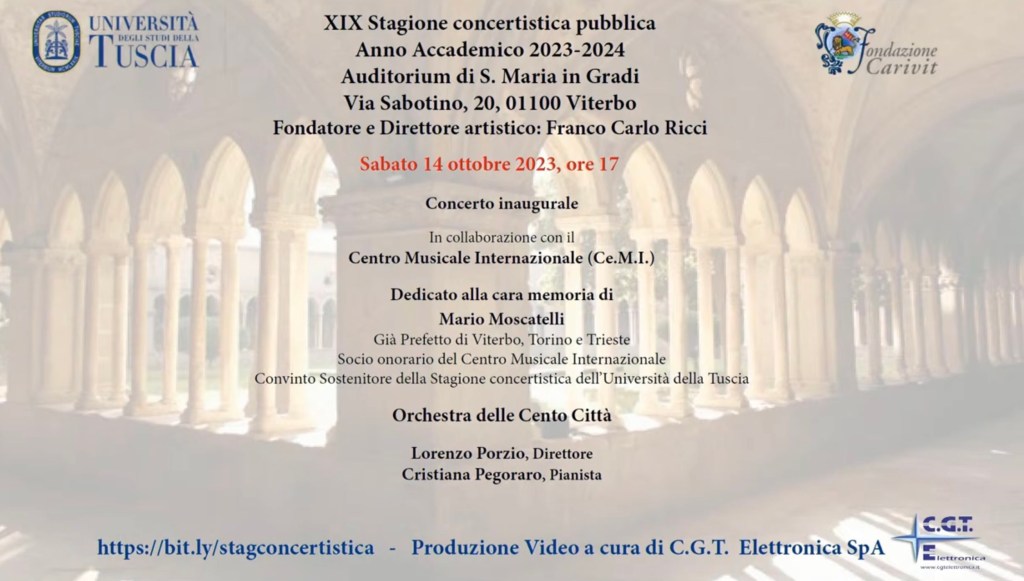
dell’Università degli Studi della Tuscia riprende l’attività inaugurando la XIX Edizione 2023-2024 sabato 14 ottobre 2023, alle 17. Come sempre i concerti si terranno nell’Auditorium di S. Maria in Gradi.
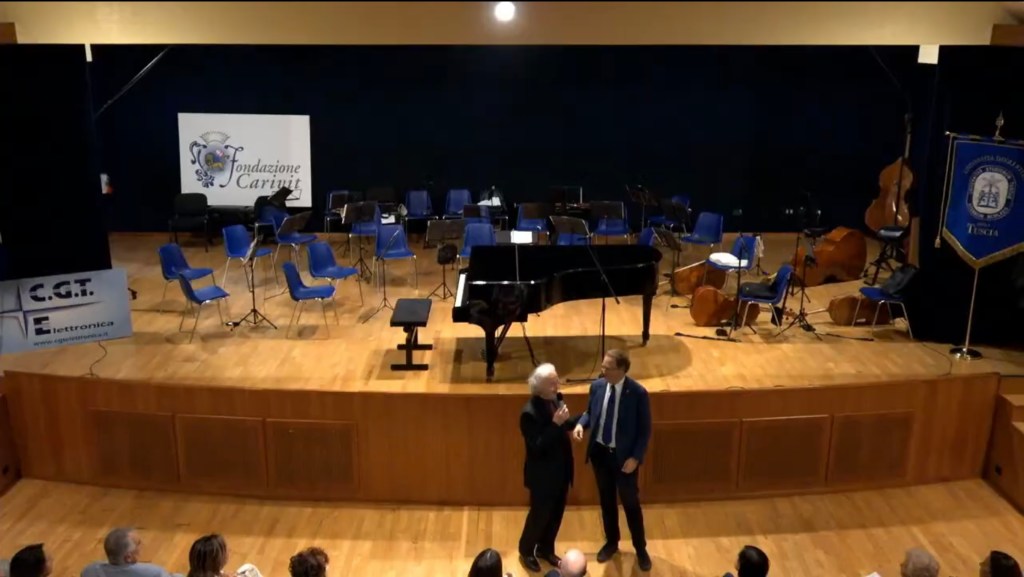
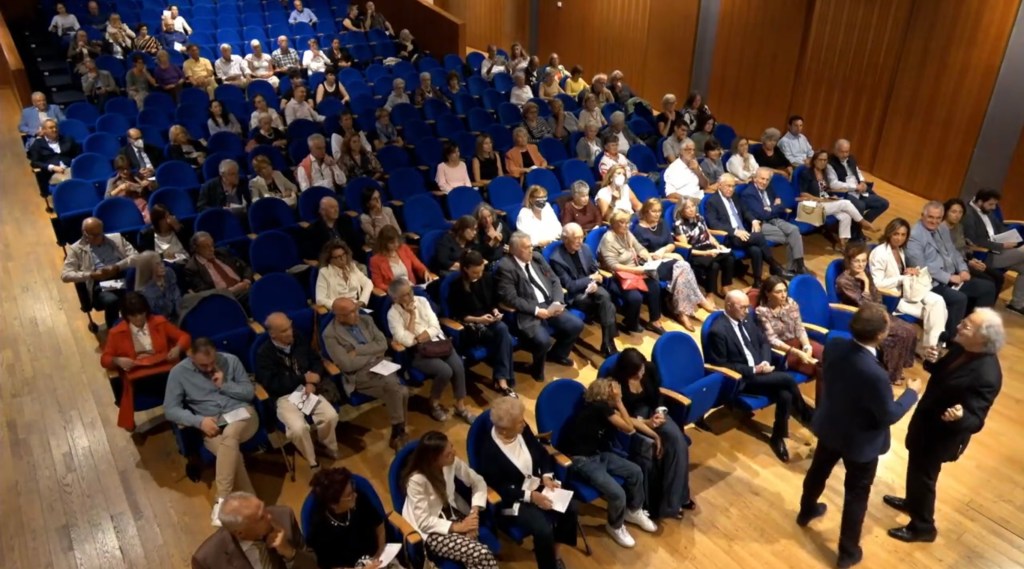
Il Concerto d’inaugurazione della Stagione concertistica dell’Università della Tuscia al quale, in considerazione dell’importanza dell’evento, hanno assicurato la presenza il Rettore dell’Ateneo, Prof. Stefano Ubertini, e il Direttore generale, Dott.ssa Alessandra Moscatelli.
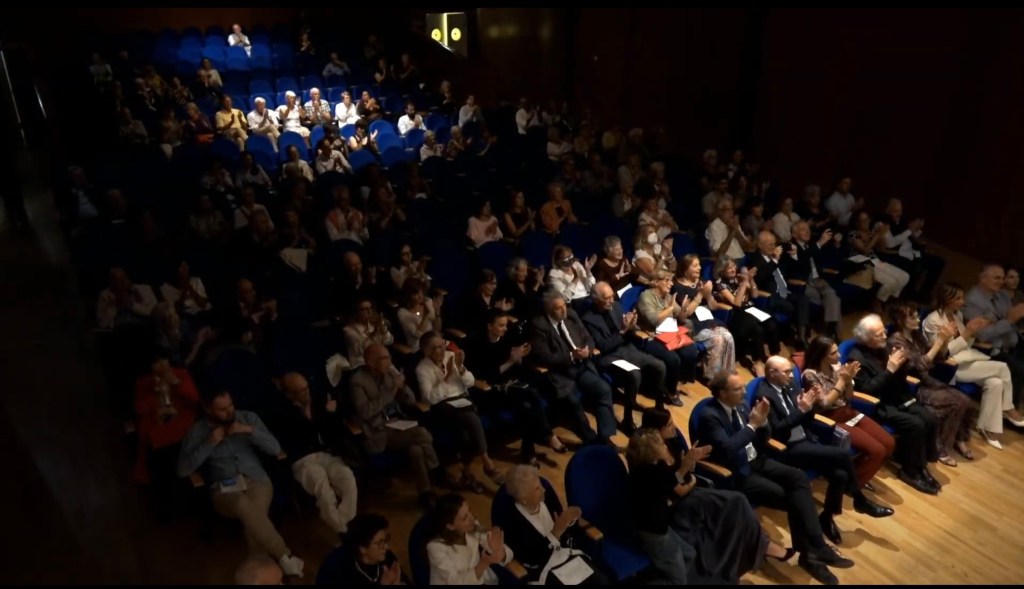
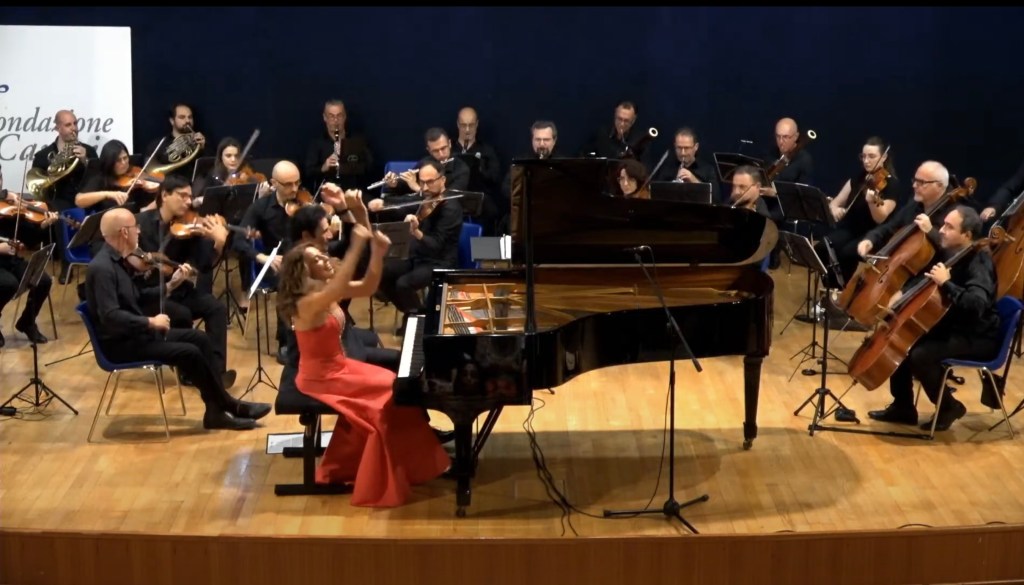
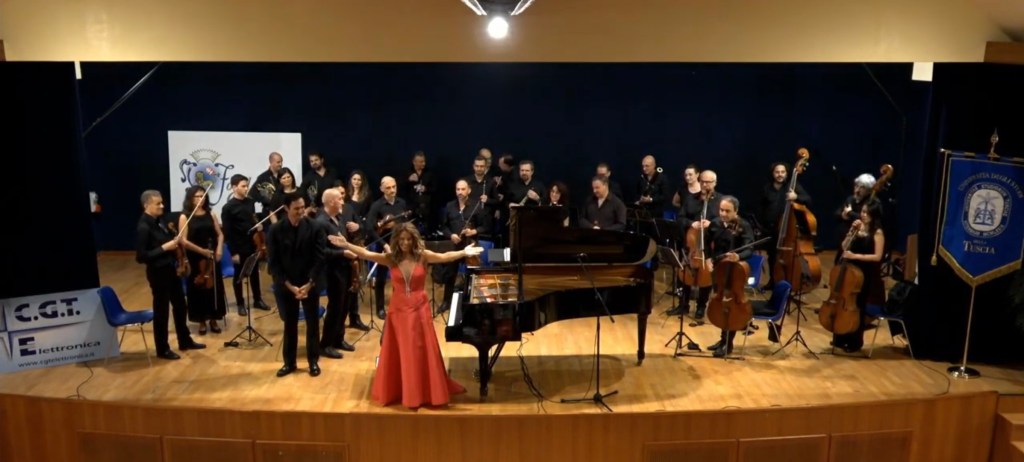
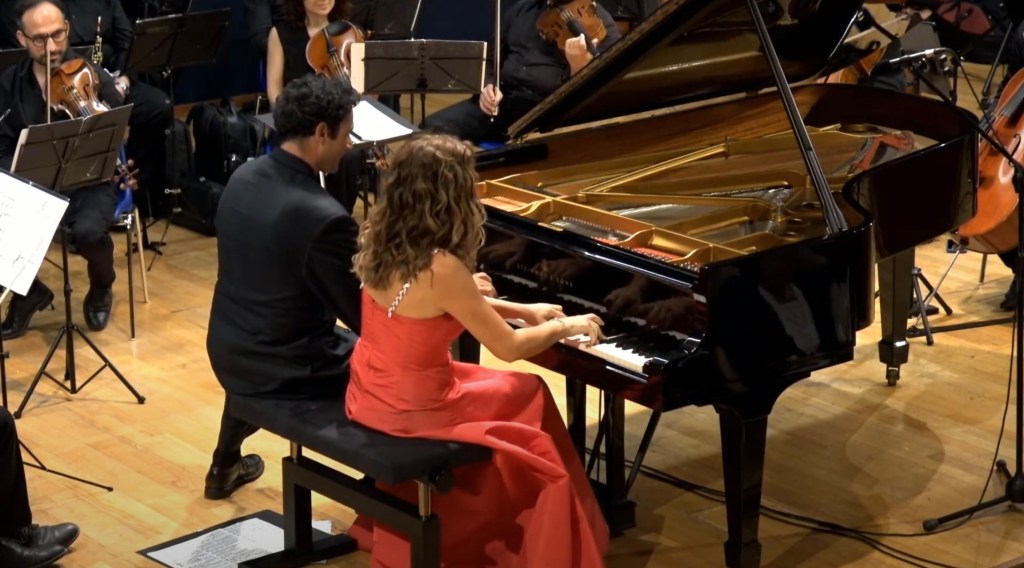
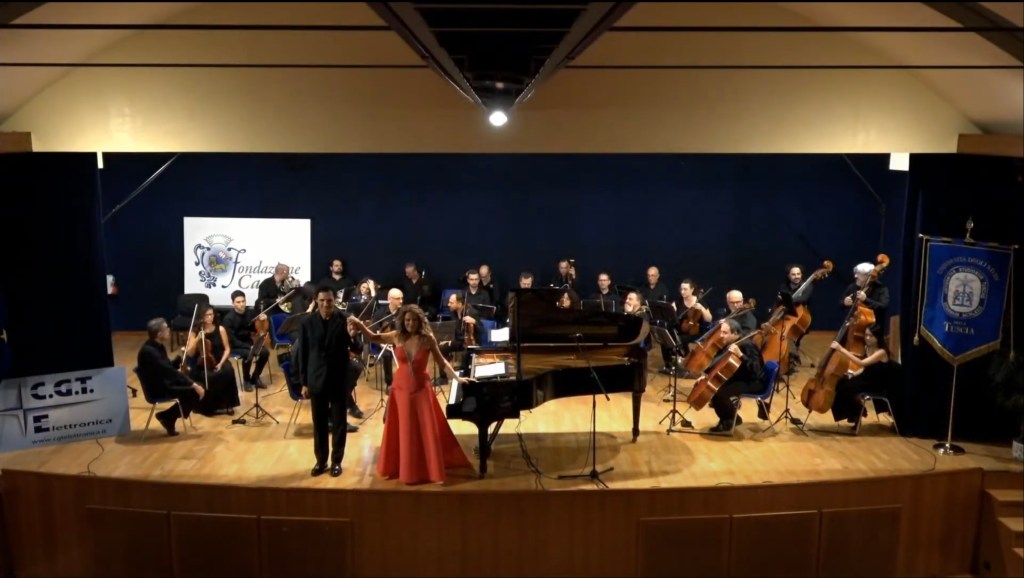
Sarà un evento di particolare importanza perché ne saranno protagonisti Lorenzo Porzio, alla guida dell’Orchestra delle Cento Città e la pianista Cristiana Pegoraro. Il programma, di grande interesse e godibilità prevede di Wolfgang Amadeus Mozart (Salisburgo, 1756-Vienna, 1791) il
Concerto per pianoforte e orchestra K. 488 e la Sinfonia K 550 n. 40.
L’evento, in collaborazione con il Centro Musicale Internazionale (Ce.m.i.), è
dedicato alla cara memoria di Mario Moscatelli, che
recentemente ci ha lasciato.
Già Prefetto di Viterbo, Torino e Trieste, il Dott. Moscatelli era Socio onorario del Centro Musicale Internazionale e Convinto Sostenitore della Stagione concertistica dell’Università della Tuscia.
Nella sala antistante l’Auditorium, dopo il concerto, la nota Casa vinicola Casale del Giglio sarà presente con il “Banco di Assaggio ” per far conoscere varie etichette dei propri vini bianchi, rosati e rossi.

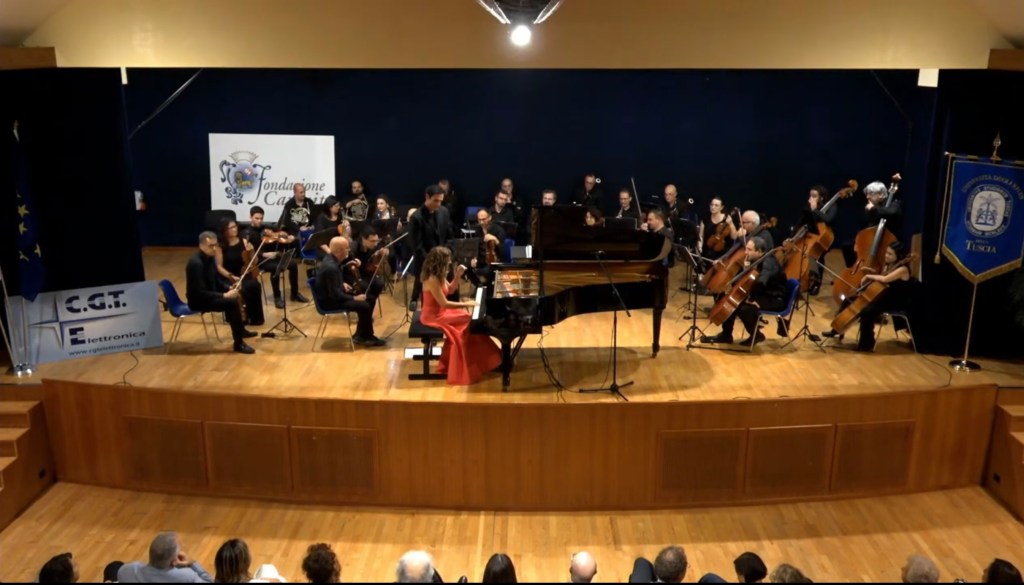
Some fine playing from the Orchestra delle Cento Città under Lorenzo Porzio with a programme dedicated to the genius of Mozart.A programme announced as the G minor Symphony and the A major piano concerto K.488 but there were surprises too.The first was the inclusion of the Overture to La Nozze di Figaro that opened the programme.An exhilarating performance full of rhythmic nervous energy beautifully shaped and its four minutes brought vividly to life.I remember my wife,Ileana Ghione asking a family friend, the great conductor and pedagogue,Franco Ferrara what was the secret of conducting?He just opened his arms in a gesture like entering water with a naturalness and continual flowing movement.Of course in the hands of a genius like Franco Ferrara it was so simple but in other hands it can seem like stabbing at the orchestral players with disjointed movements that can often lead to ragged ensemble and an overall lack of fluidity and cohesion .
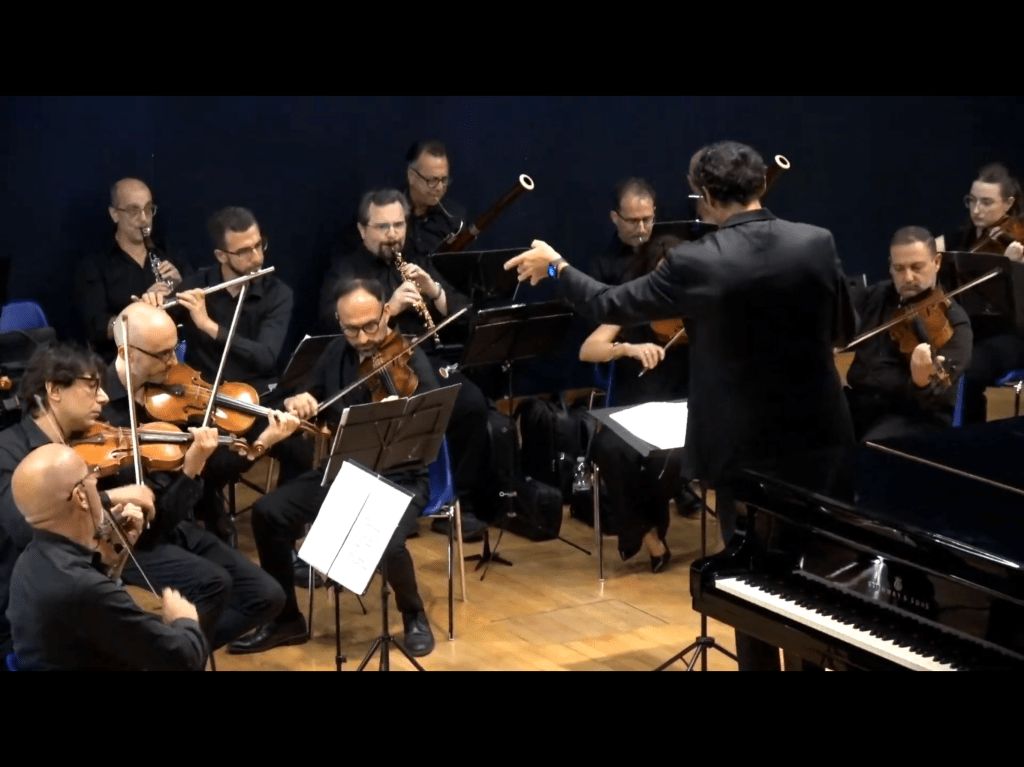
It was refreshing to watch the beauty and fluidity of the arms of Lorenzo Porzio as he waded in to the musical sea with his excellent companions.The opening Molto Allegro of the G minor Symphony with a beautifully flowing tempo and superb phrasing contrasted both the lyrical and rhythmic but never loosing the underlying drive and sense of architectural shape.There was great drama too in the development where he found a clarity of line of intelligent musicianship with the question and answer between instruments.There was a Pastoral feel to the Andante with the wind players magical accompaniment to the sublime string melodic line .A real duet of almost chamber music proportions with the players listening attentively to their musical colleagues in a real musical conversation .Overseen but never interrupted by such a sensitive conductor who realised that this remarkable Andante is the very heart of this Symphony.The Menuetto was played with a nobility of driving dance rhythms .There was a beautiful contrasting lyricism to the trio as the strings were answered by the wind with great lyricism and charm.A buoyancy to the Allegro assai with its dynamic rhythmic contrasts of question and answer between the strings and the wind all superbly directed and never loosing the overall shape of this masterpiece, much admired by Beethoven and Schubert ,which is Mozart’s final Symphonic trilogy of which this could be considered the wonderfully lyrical central movement.
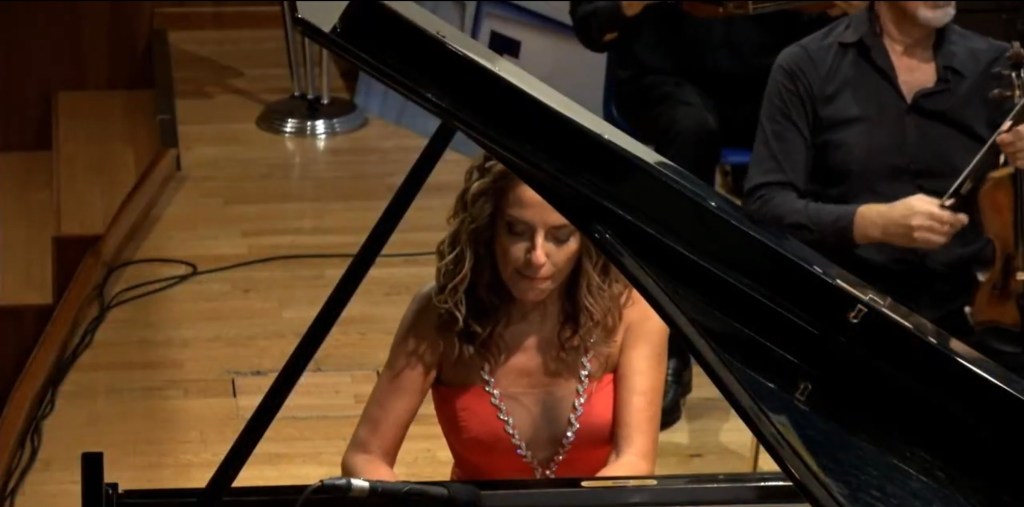
There was a beautiful fluidity too to the opening of the A major Piano Concerto K.488 which created the ideal opening for the crystalline playing of Cristiana Pegoraro.There was beautifully sensitive playing too in the second subject with great delicacy but never loosing the simplicity and clarity that is the Mozart that can be too difficult for adults but too easy for children.There is a sublime simplicity which Cristiana showed us with disarming elegance and ease with the evident joy of discovery.Nowhere more so than in Mozart’s own cadenza played with the same freedom and sense of improvisation that the composer himself must have discovered on the spur of the moment.

The ‘Adagio’ reached moments of sublime beauty with the piano and orchestra playing with equal sensitivity.A real duet in which the simple unadorned notes of the piano shone like jewels as the strings merely plucked their instruments with the wind providing the warmth of the harmonic invention.Cristiana happy to play Mozart’s notes without any of the ornamentation that we are plagued with these days in the name of authenticity.What a relief it was to hear this truly sublime simplicity!There was an infectious ‘joie de vivre’ to the ‘Allegro assai’ with virtuoso bassoon playing too replying to the pianists left hand with great technical skill and artistry.Cristiana with Lorenzo managed to purvey their obvious enjoyment at making music together in a continual joyous conversation between the piano and orchestra.An ovation from the audience at this opening concert of the season and it was now time to share one of Cristiana’s own compositions with an audience demanding more.’
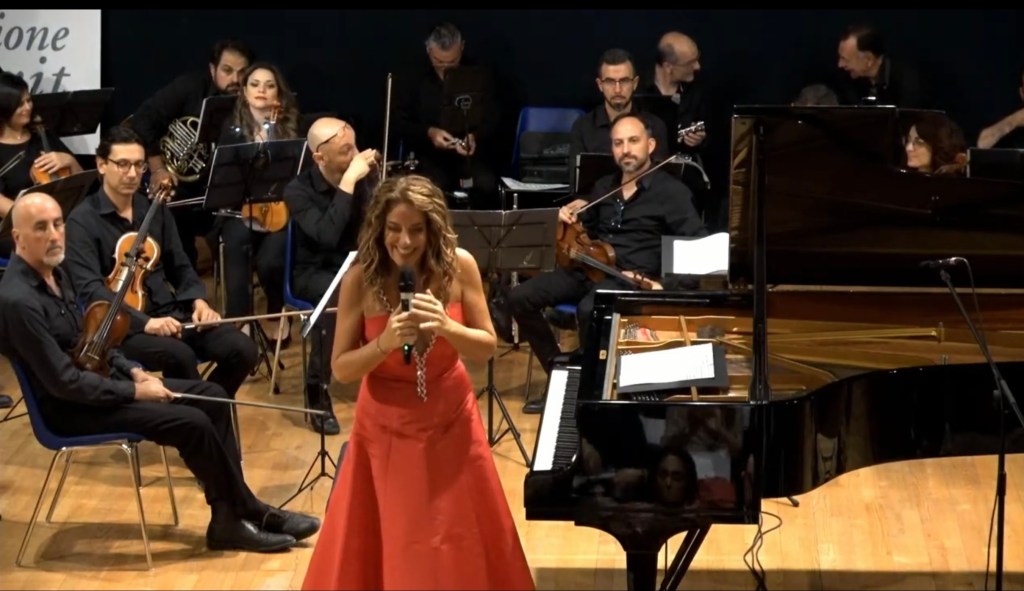
Sail Away’ is a piece that Cristiana has played in her recitals throughout the world and is a moving voyage of life .Life that is such a wondrous gift to us all.And what a joyous atmosphere she was able to create with her superb playing spilling over into an even more unexpected encore.
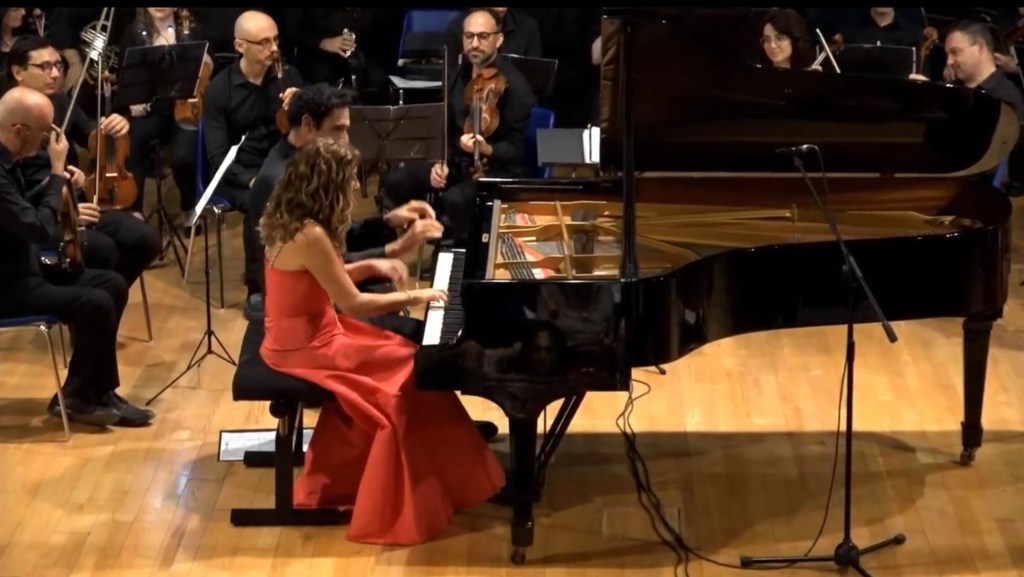
The ‘Turkish March’ by Mozart not only the last movement of his Piano Sonata but on this occasion turned into a joyous march in which her companion Lorenzo joined her at the keyboard as he also conducted the orchestra in the ‘chorus’.What a wonderfully joyous start to a glorious season of great music making .

The Piano Concerto No. 23 K.488 was finished, according to Mozart’s own catalogue, on March 2, 1786, two months prior to the premiere of his opera, Le nozze di Figaro ,and some three weeks prior to the completion of his concert in C minor K 491.It was one of three subscription concerts given that spring and was probably played by Mozart himself at one of these.

Symphony No. 40 in g minor K.550 was written in 1788 and is sometimes referred to as the “Great G minor symphony”, to distinguish it from the “Little G minor symphony”, n.25.
The date of completion of this symphony is known exactly, since Mozart in his mature years kept a full catalogue of his completed works; he entered the 40th Symphony into it on 25 July 1788.Work on the symphony occupied an exceptionally productive period of just a few weeks during which time he also completed the 39th and 41 st (Jupiter ) Symphonies (26 June and 10 August, respectively)..It has been suggested that Mozart composed the three symphonies as a unified work, pointing, among other things, to the fact that the Symphony No. 40, as the middle work, has no introduction (unlike No. 39) and does not have a finale of the scale of No. 41’s.Schumann regarded it as possessing “Grecian lightness and grace”.Charles Rosen called the symphony “a work of passion, violence, and grief.”Beethoven knew the symphony well, copying out 29 bars from the score in one of his sketchbooks.Schubert likewise copied down the music of Mozart’s minuet.
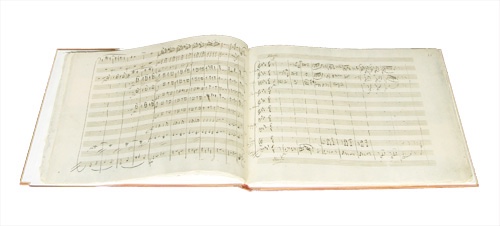
The symphony is scored (in its revised version) for flute , 2 oboes , 2 clarinets,, 2 bassoons , 2 horns , and strings .
The work is in four movements :Molto allegro ,Andante ,Menuetto,Allegretto-Trio.finale.Allegro assai .
Mozart revised his symphony and this “demonstrates that it was in fact performed, for Mozart would hardly have gone to the trouble of adding the clarinets and rewriting the flutes and oboes to accommodate them, had he not had a specific performance in view.”The orchestra for the 1791 Vienna concert included the clarinetist brothers Anton and Johann Nepomuk Stadler ; which, as Zaslaw points out, limits the possibilities to just the 39 th and 40th symphonies.
“The version without clarinets must also have been performed, for the reorchestrated version of two passages in the slow movement, which exists in Mozart’s hand, must have resulted from his having heard the work and discovered an aspect needing improvement.”
In 1782, the French playwright, Beaumarchais, offered private readings to King Louis XIV of his comedy of manners, The Marriage of Figaro. Instead of being pleased, the monarch decided the story was “detestable and must never be produced.” The irreverence was simply too much. As “forbidden fruit,” the play became the rage of the aristocracy, and it surfaced repeatedly in secret productions (one even including the King’s wife.) Like the King, Napoleon also sniffed danger in the plot, and he declared that the play was “the revolution already in action.” The Austrian government echoed the danger and banned the play from its borders. In 1784, the play was presented publicly in Paris to great acclaim, and within a year, Germany had twelve translations on hand. The Marriage of Figaro was unquenchable.
After searching through hundreds of plays for an opera buffa, Mozart decided this was just the ticket. With the librettist Lorenzo da Ponte, the pair produced the opera Marriage of Figaro in only six weeks. The Overture was completed only two days before the opening on May 1, 1786.
The overture to the opera Le nozze di Figaro, the first of Mozart’s three collaborations with librettist Lorenzo Da Ponte (the other two are Don Giovanni and Così fan tutte), begins with a busy whispering and buzzing that develops quickly into a short-breathed little theme that might just slip by the less than alert listener. Then, bang!, comes a tutti with trumpets and drums, the music subsequently driven by scampering violins, flutes, and oboes in a succession of hectically upbeat figurations, the whole accomplished in four minutes. The piece is self-contained, which is to say that it does not quote themes from the opera proper nor does its ending fade into the opening measures of the opera, both also characteristic of the overtures to Mozart’s Abduction from the Seraglio, Così fan tutte, and The Magic Flute. The Figaro overture does, however, give us a delectable foretaste of the mood of its opera: fleet, witty, often acerbic in its humor.The overture, it might be noted, originally contained a slow middle section with a melancholy oboe solo. But contrast be damned, Mozart wisely decided, and maintained the swirling, manically jolly mood throughout. Figaro was first presented on the stage of Vienna’s Burgtheater in May of 1786. The composer conducted from the keyboard.Written for 2 flutes, 2 oboes, 2 clarinets, 2 bassoons, 2 trumpets, 2 horns, timpani, and strings


Stagione concertistica pubblica
Auditorium di S. Maria in Gradi
Via Sabotino, 20, 01100 Viterbo
Fondatore e Direttore artistico: Franco Carlo Ricci
XIX Stagione concertistica 2023-2024
Ottobre 2023
Sabato 14, ore 17
In collaborazione con il
Centro Musicale Internazionale (Ce.M.I.)
Concerto dedicato alla cara memoria di
Mario Moscatelli
Già Prefetto di Viterbo, Torino e Trieste
Socio onorario del Centro Musicale Internazionale
Convinto Sostenitore della Stagione concertistica dell’Università della Tuscia
Orchestra delle Cento Città
Lorenzo Porzio, direttore
Cristiana Pegoraro, pianoforte
Wolfgang Amadeus Mozart (Salisburgo, 1756-Vienna, 1791)
Concerto per pianoforte n. 23 in la maggiore, K 488
(Allegro; Adagio; Allegro assai)
Sinfonia n. 40 in sol minore, K 550
(Molto allegro; Andante; Minuetto e trio. Allegretto; Allegro assai )
Sabato 21, ore 17
In collaborazione con il
Club Rotary Roma-ovest e il
Centro Musicale Internazionale
Orchestra “I concerti del Tempio”
Direttore
Daniele Camiz
Talenti emergenti del Magisterium pianistico di Marcella Crudeli
Wolfgang Amadeus Mozart (Salisburgo, 1756-Vienna, 1791)
Idomeneo Re di Creta K 366
Ouverture
Wolfgang Amadeus Mozart (Salisburgo, 1756-Vienna, 1791)
Dal Concerto in La Maggiore KW 414
(Primo movimento – Allegro)
Pianista
Giuseppe Manes
Ludwig van Beethoven (Bonn, 770-Vienna, 1827)
Dal Concerto N. 2 in Si Bemolle Maggiore op. 19
(Primo movimento – Allegro con brio)
Pianista
Marianna Ruggiero
Ludwig van Beethoven (Bonn, 770-Vienna, 1827)
Concerto N. 1 in Do Maggiore op. 15
(Allegro con brio; Largo Rondò-Allegro)
Pianista
Vera Cecino
Sabato 28 ore 17
Pianista
Riccardo Natale
Georg Friedrich Händel (Halle, 1685-Londra, 1759)
Suite HWV 427 in Fa maggiore
Fryderyk Chopin (Żelazowa Wola, 1810-Parigi, 1849)
Quattro Mazurke op. 30
Polonaise op. 44
*
Robert Schumann (Zwickau, 1810-Endenich, 1856)
Davidsbundlertänze op. 6
Novembre 2023
Sabato 11, ore 17
“Giuliana Soscia Indo Jazz Project”
Giuliana Soscia, direzione, pianoforte, composizioni, arrangiamenti
Feat. Mario Marzi, sax soprano, contralto e baritono
Paolo Innarella, flauto, bansuri, sax soprano e tenore
Rohan Dasgupta, sitar
Marco de Tilla, contrabbasso
Sanjay Kansa Banik, tabla
Programma
Composizioni e arrangiamenti di Giuliana Soscia
Samsara, Indian Blues, Arabesque, Gange, Alpha Indi, Bloodshed
In collaborazione con
ISMEO-Associazione Internazionale di Studi sul Mediterraneo e l’Oriente
Progetto MUR CUP B85F21002660001
Sabato 18, ore 17
Gianluca Giganti, violoncello
Anna Lisa Bellini, pianoforte
In ricordo di Sergio Viterbini a 80 anni dalla morte
Fryderyk Chopin (Żelazowa Wola, 1810-Parigi, 1849)
Introduction et Polonaise, op. 3
Giuseppe Martucci (Capua, 1856-Napoli, 1909)
Due Romanze op. 72
Francesco Cilea (Palmi, 1866-Varazze, 1950)
Romanza dalla Sonata op. 38
Sergio Viterbini (Viterbo1890-1943)
Sogno
Canto d’amore
Il Kuku
Fryderyk Chopin (Żelazowa Wola, 1810-Parigi, 1849)
Sonata in sol minore op. 65
(Allegro moderato; Scherzo: Allegro con brio (re minore);
Largo (si bemolle maggiore); Finale: Allegro)
Sabato 25, ore 17
Pianista
Arturo Stalteri
MUSICA DALLA TERRA DI MEZZO
Prima Parte
Arturo Stàlteri
Le ultime luci di Brea
Verso Lòrien
Un viaggio inaspettato
Èowyn
Gandalf the white
The grey havens’ lullaby
Cavalieri neri
Seconda Parte
Howard Shore (Toronto, 1946)
Hobbit theme
Leonard Rosenman (New York, 1924-Los Angeles, 2008)
Theme from The Lord of the Rings
Mithrandir
Annbjørg Lien (Ålesund, Norvegia, 1971)
Galadriel
Enya (Gaoth Dobhair, Irlanda, 1961)
Lothlòrien
May it be
Bo Hansson (Göteborg, Svezia, 1943-2010, Stoccolma)
Homeward bound
The old forest
Dicembre 2023
Sabato 2, ore 17
Matteo Bonaccorso, flauto
Marco Nucci, flauto
Jacopo Petrucci, pianoforte
Jacques Ibert (Parigi, 1890-1962)
Deux Interludes per due flauti e pianoforte.
Claude Debussy (Saint-Germain-en-Laye, 1862-Parigi, 1918)
Images I per pianoforte solo
(Reflets dans l’eau; Hommage à Rameau; Mouvement)
Petite suite per due flauti e pianoforte
(En bateau; Cortège; Menuet; Ballet)
Maurice Ravel (Ciboure, 1875-Parigi, 1937)
Suite da Ma Mère l’Oye per due flauti e pianoforte
(Pavane de la Belle au bois dormant; Petit Poucet; Laideronnette, impératrice des pagodes; Les entretiens de la belle et de la bête; Le jardin féerique)
Sabato 16, ore 17
Pierfrancesco Fiordaliso, Violino
Sebastiano Brusco, pianoforte
Wolfgang Amadeus Mozart (Salisburgo, 1756-Vienna, 1791)
Sonata per violino e pianoforte n. 18 in G Major, K. 301
Ludwig van Beethoven (Bonn, 770-Vienna, 1827)
Sonata “La primavera” per violino e pianoforte op. 24 n. 5
César Franck (Liegi, 1822-Parigi, 1890)
Sonata n. 1 per violino e pianoforte in la maggiore
Gennaio 2024
Sabato 13, ore 17
Cesare Chiacchiaretta, fisarmonica
Marco Colacioppo, pianoforte
“Welcome to USA”
Ennio Morricone (Roma, 1928- 2020)
C’era una volta in America
George Gershwin (Brooklyn, 1898-Beverly Hills, 1937)
Porgy and bess-Rapsodia in blu
Leonard Bernstein (Lawrence, 1918-New York, 1990)
West Side Story
Scott Joplin (Texarkana, 1868-New York, 1917)
Suite
Sabato 20, ore 17
In collaborazione con il
Club Rotary Roma-ovest
Duo Degas
Gala Chistiakova e Diego Benocci
Pianoforte a quattro mani
Primo premio assoluto nella sezione “Duo a quattro mani”
Concorso Internazionale “Roma” 2022
Sergej Rachmaninov (Onega, Velikij Novgorod, 1873-Beverly Hills, 1943)
Sei Morceaux op. 11
(Barcarolle; Scherzo; Thème russe; Valse; Romance; Glory (Slava)
Pëtr Il’ič Čajkovskij (Votkinsk, 1840-San Pietroburgo, 1893)
Trascrizioni dei celebri balletti
Il Lago dei cigni
(Scène; Danse des cygnes; Czardas: Danse hongroise)
(trascrizione di E. Langer)
La Bella Addormentata
Valse
(trascrizione di S. Rachmaninov)
Lo Schiaccianoci
Marche
(Danse de la Fée-Dragée; “Trépak” Danse russe;
Danse chinoise; Valse des fleurs)
(trascrizione di E. Langer)
Sabato 27, ore 17
Pianista
Filip Michalak
(In collaborazione con Keyboard Charitable Trust di Londra)
Johann Sebastian Bach (Eisenach, 1685-Lipsia, 1750)
Myra Hess (Londra, 1890-1965)
Gesù, gioia dei desideri dell’uomo
Johann Sebastian Bach (Eisenach, 1685-Lipsia, 1750)
Ferruccio Busoni (Empoli, 1866-Berlino,1924)
Ti invoco Signore Gesù Cristo
Wolfgang Amadeus Mozart (Salisburgo, 1756-Vienna, 1791)
Rondo alla turca (dalla Sonata in A K331)
Wolfgang Amadeus Mozart (Salisburgo, 1756-Vienna, 1791)
Yevgeny Sudbin (San Pietroburgo, 1980)
‘Lacrimosa’ dal Requiem K 626 di Mozart
Franz Schubert (Vienna, 1797-Vienna, 1828)
Franz Liszt (Raiding, 1811-Bayreuth, 1886)
Ständchen (Serenade)
Fryderyk Chopin (Żelazowa Wola, 1810-Parigi, 1849)
Valzer Op. 64 nn. 1 e 2
Nocturne Op 9 n. 2
Franz Liszt (Raiding, 1811-Bayreuth, 1886)
Liebestraum n. 3
Notturno
Robert Schumann (Zwickau, 1810-Endenich, 1856)
Träumerei
Pëtr Il’ič Čajkovskij (Votkinsk, 1840-San Pietroburgo, 1893)
Michail Vasil’evič Pletnëv (Arcangelo, Russia, 1957)
March (Nutcracker Suite)
Sergej Rachmaninov (Onega, Velikij Novgorod, 1873-Beverly Hills, 1943)
Vyacheslav Gryaznov (Yuzhno-Sakhalinsk, Unione Sovietica, 1982)
Vocalise Op 35 n. 14
Edvard Grieg (Bergen, Norvegia, 1843-Bergen, 1907)
“Nell’antro del re della montagna” (Dalla suite op. 46 del Peer Gynt)
Johannes Brahms (Amburgo, 1833-Vienna, 1897)
Valzer in La bemolle Op. 39 n. 15
Astor Piazzolla (Mar del Plata, Argentina, 1921-Buenos Aires, 1992)
Oblivion
Libertango
Febbraio 2024
Sabato 03, ore 17
Flautista, Flavio Serafini
Pianista, Makanè Akita
Johann Sebastian Bach (Eisenach, 1685-Lipsia, 1750)
Sonata in sol minore per violino (o flauto traverso) e clavicembalo, BWV 1020
(Allegro moderato; Adagio; Allegro)
Carl Reinecke (Altona, 1824-Berlino, 1910)
Undine
(Allegro; Intermezzo; Andante; Finale
*
Claude Debussy (Saint-Germain-en-Laye, 1862-Parigi, 1918)
Prélude a l’après-midi d’un faune, L 87
Georges Bizet (Parigi, 1838-Bougival, 1875)
François Borne (Montpellier, 1840-Tolosa,1920)
Fantaisie brillante sur ‘Carmen’
Sabato 10, ore 17
Pianisti
Marcella Crudeli
Emanuele Savron
Johannes Brahms (Amburgo, 1833-Vienna, 1897)
Esecuzione integrale delle Danze ungheresi
Danza n. 1 in Sol minore: Allegro molto
Danza n. 2 in Re Minore: Allegro non assai
Danza n. 3 in Fa Maggiore: Allegretto
Danza n. 4 in Fa Minore: Poco sostenuto
Danza n. 5 in Fa Diesis Minore: Allegro
Danza n. 6 in Re Bemolle Maggiore: Vivace
Danza n. 7 in La Maggiore: Allegretto
Danza n. 8 in La Minore: Presto
Danza n. 9 in Mi Minore: Allegro non troppo
Danza n. 10 in Mi Maggiore: Presto
Danza n. 11 in Re Minore: Poco andante
Danza n. 12 in Re Minore: Presto
Danza n. 13 in Re Maggiore: Andantino grazioso
Danza n. 14 in Re Minore: Un poco andante
Danza n. 15 in Si Bemolle Maggiore: Allegretto grazioso
Danza n. 16 in Fa Minore: Con moto
Danza n. 17 in Fa Diesis Minore: Andantino
Danza n. 18 in Re Maggiore: Molto vivace
Danza n. 19 in Si Minore: Allegretto
Danza n. 20 in Mi Minore: Poco allegretto
Danza n. 21 in Mi Minore: Vivace
Sabato 17, ore 17
Trio Romae
Marco Bonfigli, clarinetto
Luca Peverini, violoncello
Michelangelo Carbonara, pianoforte
Johannes Brahms (Amburgo, 1833-Vienna, 1897)
Trio op. 114 in la minore
(Allegro; Adagio; Andantino grazioso; Allegro)
Michail Glinka (Novospasskoe, Russia, 1804-Berlino, 1857)
Trio in re minore
(Allegro moderato; Scherzo: Vivacissimo; Largo; Allegro con spirito)
Astor Piazzolla (Mar del Plata, Argentina, 1921-Buenos Aires, 1992)
Cuatro Estaciones Porteñas
Primavera Porteña
Verano Porteño
Otono Porteño
Invierno Porteño
Sabato 24, ore 17
Eccellenze del Liceo Musicale “S. Rosa da Viterbo”
Programma de definire
Marzo 2024
Sabato 02, ore 17
Pianista
Walter Fischetti
Notturno
John Field (Dublino, 1782-Mosca, 1837)
Notturno H 36 (1817)
Michail Glinka (Novospasskoe, Russia, 1804-Berlino, 1857)
Notturno (1828)
Fryderyk Chopin (Żelazowa Wola, 1810-Parigi, 1849)
Notturno op. 27 n. 1 (1837)
Franz Liszt (Raiding, 1811-Bayreuth, 1886)
Notturno n. 3 (1850)
Gabriel Fauré (Pamiers, 1845- Parigi, 1924)
Notturno op. 36 n. 4 (1884)
Sergej Rachmaninov (Onega, Velikij Novgorod, 1873-Beverly Hills, 1943)
Notturno n. 1 (1888)
***
Edvard Grieg (Bergen, Norvegia, 1843-1907)
Notturno (1891)
Aleksandr Skrjabin (Mosca, 1872-19150
Notturno op. 9 per la mano sinistra (1894)
Ottorino Respighi (Bologna, 1879-Roma, 1936)
Notturno (1904)
Aleksej Stančinskij (Obolsunovo, Russia, 1888-Logačevo, 1914)
Notturno (1907)
Francis Poulenc (Parigi, 1899-Parigi, – 1963)
Notturno n. 1 (1929)
Salvatore Sciarrino (Palermo, 1947)
Notturno crudele n. 2 (2000)
Sabato 09, ore 17
Pianista
Paola Bugiotti
Johann Sebastian Bach (Eisenach, 1685-Lipsia, 1750)
Preludio in fa min. da “Il Clavicembalo ben temperato” vol. II
Franz Joseph Haydn (Rohrau, 1732-Vienna, 1809)
Andante con Variazioni in fa min.
Franz Liszt (Raiding, 1811-Bayreuth, 1886)
Rapsodia Ungherese n. 5 in mi min. Eroica – Elegiaca
Aleksandr Skrjabin (Mosca 1872-1915)
Due Poemi op. 32
(Andante cantabile; Allegro. Con Eleganza. Con fiducia)
Fryderyk Chopin (Żelazowa Wola, 1810-Parigi, 1849)
Valzer in La bemolle magg. Op. 69 n. 1
Fantasia – Improvviso in Do diesis min. op 66
Ballata n. 3 in La bemolle magg. Op. 47
Sabato 16, ore 17
Trio Calliope
Vincenza Isaia, clarinetto
Luca Peverini, violoncello
Tiziana Cosentino, pianoforte
Luigi Boccherini (Lucca, 1743-Madrid, 1805)
Sonata in sol per violoncello e pianoforte
(Largo; Minuetto; allegro alla militare)
Ludwig van Beethoven (Bonn, 770-Vienna, 1827)
Trio op. 11
(Allegro con brio; Adagio; Allegretto con variazioni)
Robert Schumann (Zwickau, 1810-Endenich, 1856)
Fantasiestucke op 73 per clarinetto e pianoforte
(Delicato e con espressione; Animato; Leggero rapido e con fuoco)
Max Bruch (Colonia, 1838-Friedenau, 1920)
Da 8 pezzi op. 83
(1. Andante; 2. Allegro con moto; 5. Rumanische Melodie; 6. Nachtegesang)
Sabato 23, ore 17
Riccardo Taddei, fisarmonica
Teodora Ristic, pianoforte
Cècile Bruned, flauto
Monica Nicoara, voce
Dario Epifani, contrabbasso
Riccardo Taddei (vivente)
Tu nombre
Astor Piazzolla (Mar del Plata, Argentina, 1921-Buenos Aires, 1992)
Adios Nonino
El Titere
Chiquilin de Bachin
Balada para mi muerte
Zum
La muerte del Angel
Resurreccion del Angel
*
Astor Piazzolla (Mar del Plata, Argentina, 1921-Buenos Aires, 1992)
Vuelvo al Sur
Vamos Nina
Julian Peralta (1974)
Pompeja
Lugano
Agustín Lara (Tlacotalpan, Messico, 1897- Città del Messico, 1970)
Piensa en mi
Carlos Eleta Almarán (Panama 1918-2013)
Historia de un amor
Aprile 2024
Sabato 06, ore 17
Pianista
Marek Szlezer (Cracovia, 1981)
Fryderyk Chopin (Żelazowa Wola, 1810-Parigi, 1849)
Polacca in la maggiore op. 40 n. 1
Ballata in la b maggiore op. 47
3 Mazurche op.59
Ignacy Jan Paderewski (Kuryłówka, Polonia, 1860-New York, 1941)
Notturno in si b maggiore op. 16 n. 4
Jadwiga Sarnecka (Sławuta 1877 (oppure Szarogród 1883), Polonia-Cracovia, 1913)
Studio in fa minore
Impression in do minore op. post.
I Ballata
Karol Szymanowski (Tymošivka, Polonia, 1882-Losanna, 1937)
Studio in si b minore op. 4 n. 3
Serenata di Don Giovanni op. 30
4 Mazurche dall’ op.50
Ludomir Różycki (Varsavia, 1883- Katowice, Polonia, 1953)
Tre danze polacche op. 37
Sabato 13, ore 17
Liliana Bernardi, violino
Paola Volpe, pianoforte
Ludwig van Beethoven (Bonn, 1770-Vienna, 1827)
Sonata n. 5 Fa Magg. “La Primavera”
(Allegro; Adagio molto espressivo; Scherzo, Rondo)
Franz Schubert (Vienna, 1797-1828)
Sonata n. 3 in sol min.
(Allegro giusto; Andante, Minuetto e trio; Allegro moderato)
Edvard Grieg (Bergen, Norvegia, 1843-1907)
Sonata n. 3 in do min.
(Allegro molto e appassionato; Allegretto espressivo alla Romanza; Allegro animato)
Sabato 20, ore 17
Pianista
Matteo Biscetti
Sassofonista
Francesco Pecorari
Paul Hindemith (Hanau, 16 novembre 1895 – Francoforte, 28 dicembre 1963)
Sonata per sax e pianoforte
Heitor Villa-Lobos (Rio de Janeiro, 1887-1959)
Fantasia
– Emanuele Micacchi (Vivente)
To be lost in thought
Jacques François Antoine Ibert (Parigi, 890- 1962)
Aria per sax e pianoforte
Dean Heath (Vivente)
Out of the cool
Phil Woods (Springfield, Massachusetts, 1931-East Stroudsburg, Pennsylvania, 2015)
Sonata per sax e pianoforte
Sabato 27, ore 17
Sandro De Palma
Ludwig van Beethoven (Bonn, 1770-Vienna, 1827)
Bagattelle op. 126
Sonata per pianoforte n. 32 in do minore, op. 111
(Maestoso. Allegro con brio ed appassionato;
Arietta. Adagio molto semplice cantabile (do maggiore)
Robert Schumann (Zwickau, 1810-Endenich, 1856)
Fantasia in do maggiore op. 17
(Durchaus phantastisch und leidenschaftlich vorzutragen; Massig. Durchaus energisch; Langsam getragen. Durchwegleise zu halten)
Maggio 2024
Sabato 04, ore 17
In collaborazione con l’Accademia Avos di Roma
Quintetto
Massimo Spada, pianoforte
Mirei Yamada, violino
e tre allievi di talento dell’Accademia Avos
Erich Wolfgang Korngold (Brno, 1897-Los Angeles, 1957)
Quintetto
César Franck (Liegi, 1822-Parigi, 1890)
Quintetto
Sabato 11, ore 17
Duo Marco Sollini-Salvatore Barbatano
Pianoforte a quattro mani
Gabriel Fauré (Pamiers, 1845-Parigi, 1924)
Dolly: Suite op. 56
Claude Debussy (Saint-Germain-en-Laye, 1862-Parigi, 1918)
Petite Suite
Maurice Ravel (Ciboure, 1875-Parigi, 1937)
Ma Mère l’Oye
Bolero
Sabato 18, ore 17
Orchestra Sapienza
Direttore Francesco Vizioli
Programma da definire
La Direzione artistica si riserva
di apportare al Programma Generale le modifiche
che si rendessero necessarie per motivi di forza maggiore

Università della Tuscia, Giugno 2023
 ChristopherAxworthy-MusicCommentary