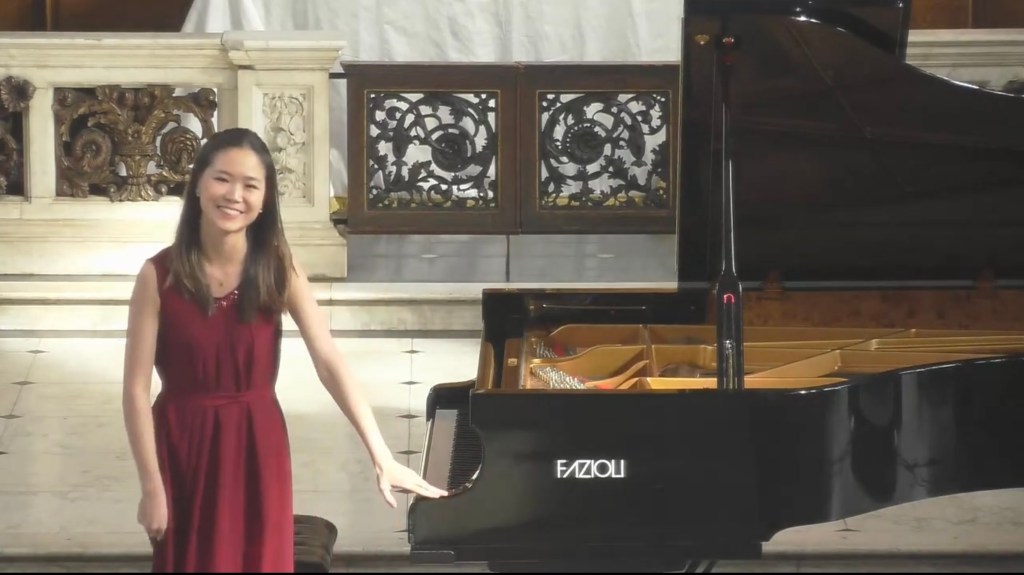
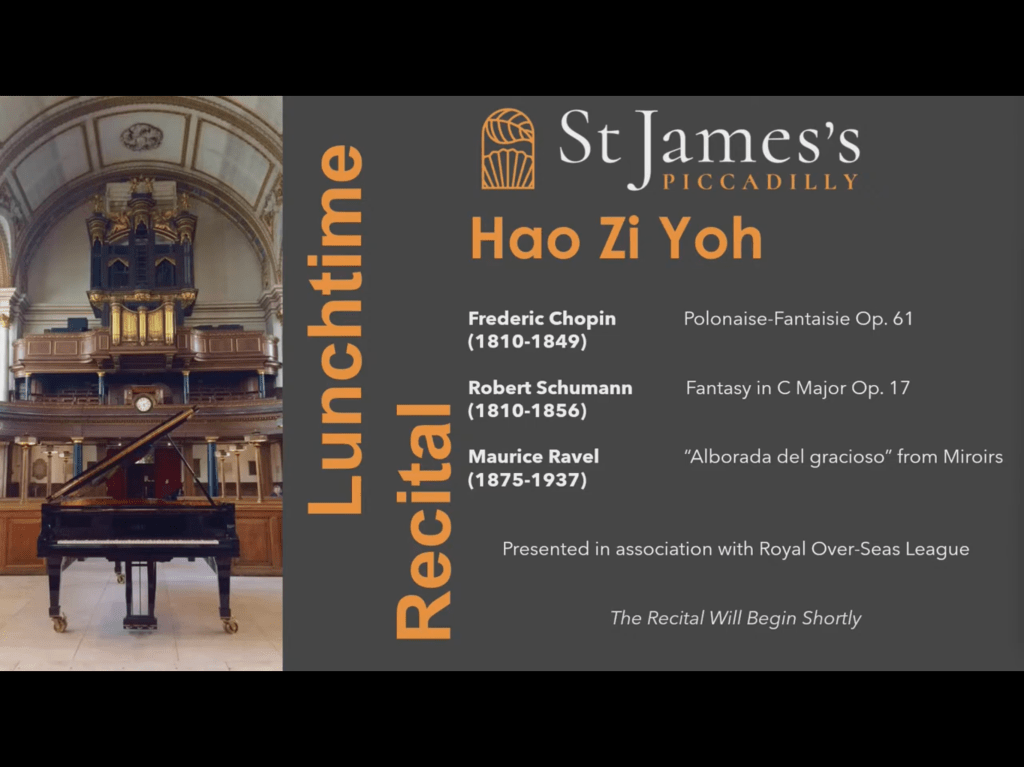
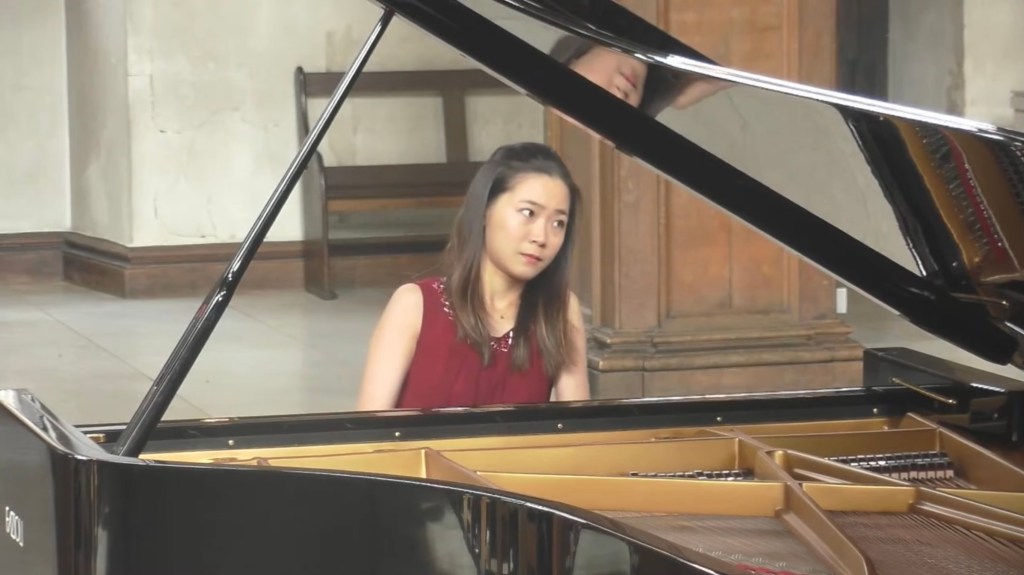
An intelligence that allows her to look deep into the score and extract what the composer actually wrote and not just adhere to the so called ‘Chopin tradition’.
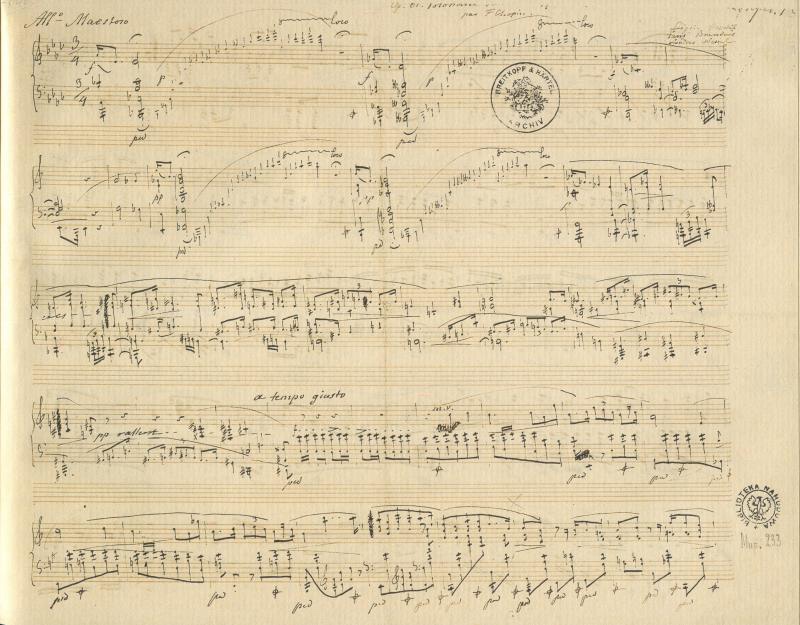
If the opening arpeggios seemed at first rather slow one only has to look at the score to see how they were written and to hear how Hao Zi transformed them into the vital link between the central ‘più lento’ and the reawakening of the Polonaise.
Passages that could in lesser hands be seen as empty scales took on a deeply poetic significance in Hao Zi’s hands as they lead into the central heart of this ‘Fantaisie Polonaise’.The ‘più lento’ was played with poetic poise as it lead to the opening fanfare that was now pregnant with poignancy.A deep nostalgic lament gradually unwinding in a tumultuous torrent of seamless scales leading to the glorious climax of the ‘Polonaise’.Played with authority ,aristocratic poise and passion as it gradually lay exhausted and spent on the final desolate A flat on high.Chopin’s penultimate work is perhaps his greatest work where architectural form and poetic content are united in a completely innovative way.

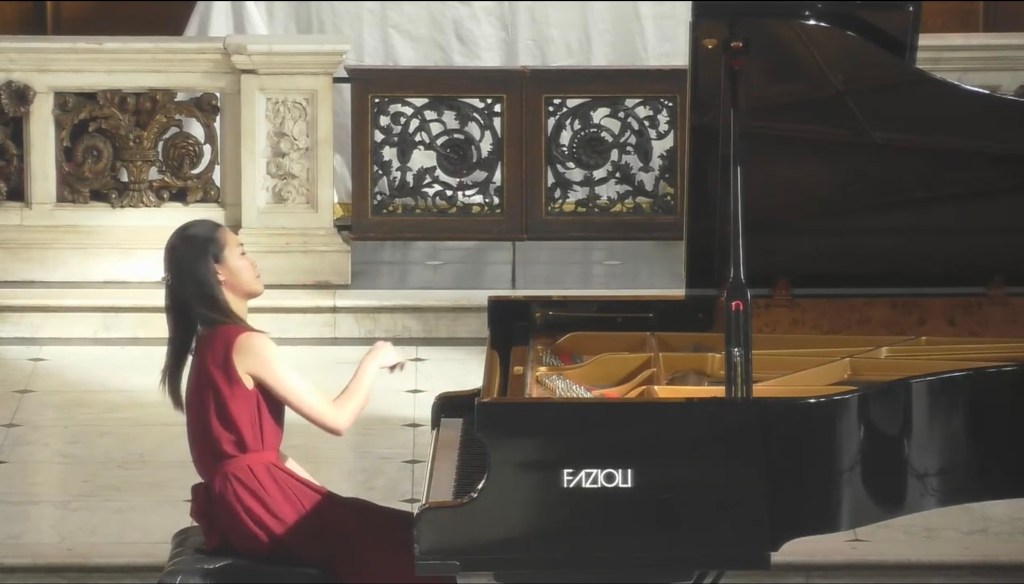
The Polonaise-fantaisie op 61, is dedicated to Mme A. Veyret, written and published in 1846.
This work was slow to gain favour with musicians, due to its harmonic complexity and intricate form.It “works on the hearer’s imagination with a power of suggestion equaled only by the F minor Fantasy or the fourth Ballade “, to quote the critic and renowned musicologist Arthur Hedley in 1947
It is intimately indebted to the polonaise for its metre,much of its rhythm , and some of its melodic character, but the fantaisie is the operative formal paradigm, and Chopin is said to have referred initially to the piece only as a Fantasy. Parallels with the Fantaisie in F minor include the work’s overall tonality, A-flat, the key of its slower middle section, B major , and the motive of the descending fourth.The Polonaise-Fantaisie represents a change in Chopin’s style from ‘late’ to ‘last’.It is suggested that the formal ambiguities of the piece (particularly the unconventional and musically misleading transitions into and out of the lyrical inner section) are the most significant defining qualities of this ‘last style’, which only includes this and one other piece—the F minor Mazurka op 68 n.4,Chopin’s last composition
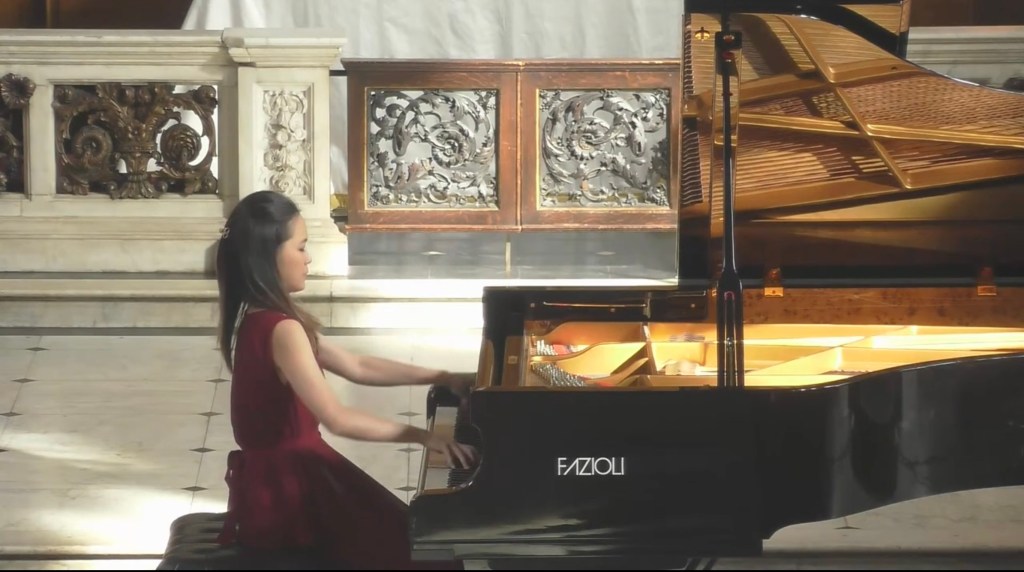
A sense of line that made this opening a long song of passion and delicacy with a wondrous sense of balance as one hand answered the other.The central passionate climax immediately dissolved into whispered secrets of disarming simplicity.There was ravishing beauty of the final page with subtle voicing of inner parts that made Schumann’s loving quote of Beethoven’s ‘distant beloved’ even more poignant.
Applause slightly disturbed the spell but not for long as Hao Zi lead us to the March with dynamic drive and great care of Schumann’s very precise dynamics.Her architectural sense of line made sense of Schumann’s sometimes obsessive dotted rhythms as she transformed the composers knotty twine into phrases of beauty and shape as only a true artist can do.
The serenity of the ‘etwas langsamer’ and a very professional untying of a cunning unexpected knot as she took us to the treacherous coda with fearless musicianship and control with the final E flat chord magically transformed to the calming balm of C major .
The rich harmonic support allowed loving care and beauty to sustain this miraculous outpouring that Schumann penned for his Clara – the mother to be of his eight children !
There was a disarming fluidity and transparency of sound after the first great climax as the melodic line became ever more beguilingly insinuating as it searched for the sublime outlet of Robert’s final moving declaration of undying love.
The final three chords ‘Adagio’ not rallentando just showed Hao Zi’s total dedication in bringing to life the wishes of the composer she is so faithfully serving.
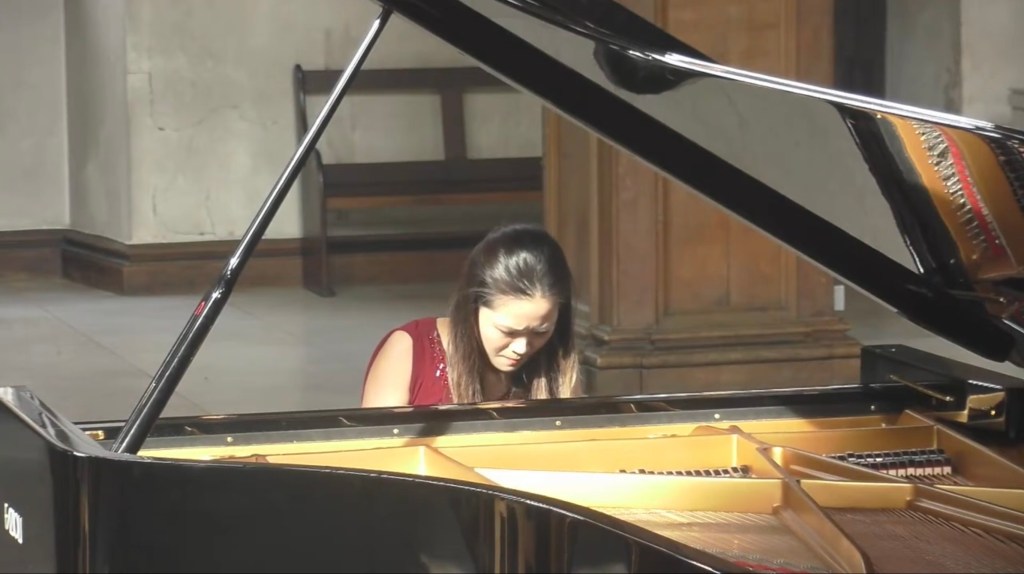
The Fantasie in C, op.17, was written by Robert Schumann in 1836. It was revised prior to publication in 1839, when it was dedicated to Franz Liszt.Liszt in return dedicated his B minor Sonata to Schumann.The two works are generally considered to be the pinnacles of piano music of the Romantic period.The Fantasie is in loose sonata form. Its three movements are headed:Durchaus fantastisch und leidenschaftlich vorzutragen; Im Legenden-Ton –Mäßig. Durchaus energisch – Langsam getragen. Durchweg leise zu halten. The piece has its origin in early 1836, when Schumann composed a piece entitled Ruines expressing his distress at being parted from his beloved Clara Wieck (later to become his wife). This later became the first movement of the Fantasy.Later that year, he wrote two more movements to create a work intended as a contribution to the appeal for funds to erect a monument to Beethoven in his birthplace, Bonn.
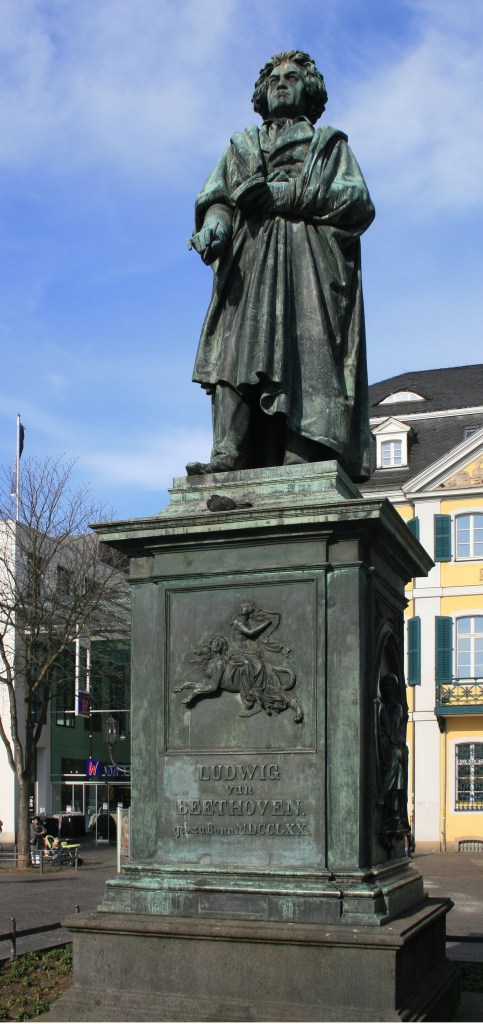
Liszt’s Beethoven Monument in Bonn
The movements’ subtitles (Ruins, Trophies, Palms) became Ruins, Triumphal Arch, and Constellation, and were then removed altogether before Breitkopf & Härtel eventually issued the Fantasie in May 1839.Schumann prefaced the work with a quote from Friedrich Schlegel:Durch alle Töne tönet Im bunten Erdentraum Ein leiser Ton gezogen Fur den, der heimlich lauschet.(Resounding through all the notes In the earth’s colourful dream There sounds a faint long-drawn note For the one who listens in secret.)Agosti a student of Busoni who was a student of Liszt wrote the word Cla-ra in my score over the long A to G in the last movement.
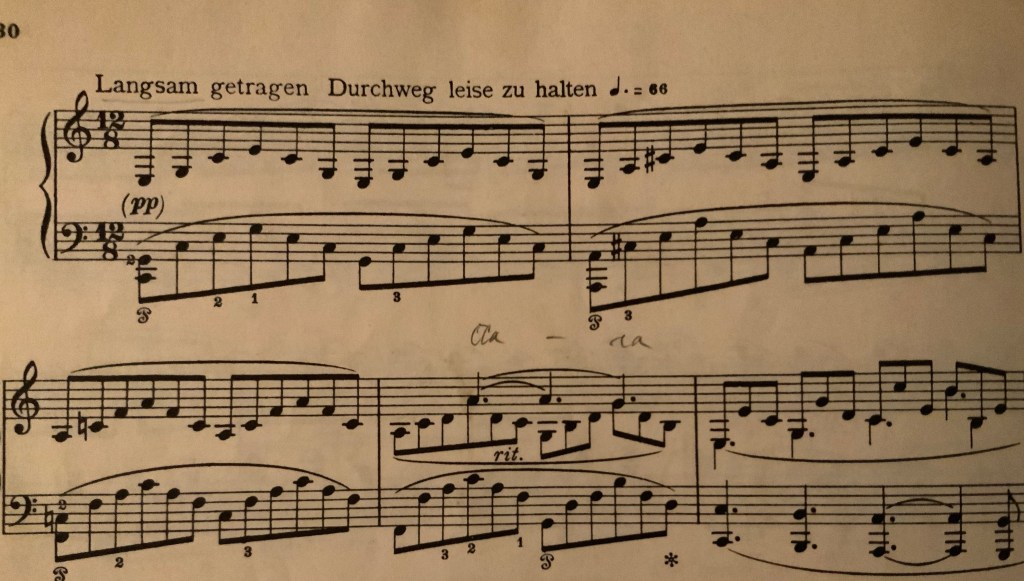
Cla- ra written by Agosti a pupil of Busoni who was a pupil of Liszt.
There is a musical quotation of a phrase from Beethoven’s song cycle An die ferne Geliebte (to the distant beloved )in the coda of the first movement :’Accept then these songs beloved, which I sang for you alone.’All Schumann wrote to Clara: The first movement may well be the most passionate I have ever composed – a deep lament for you. They still had many tribulations to suffer before they finally married four years later.
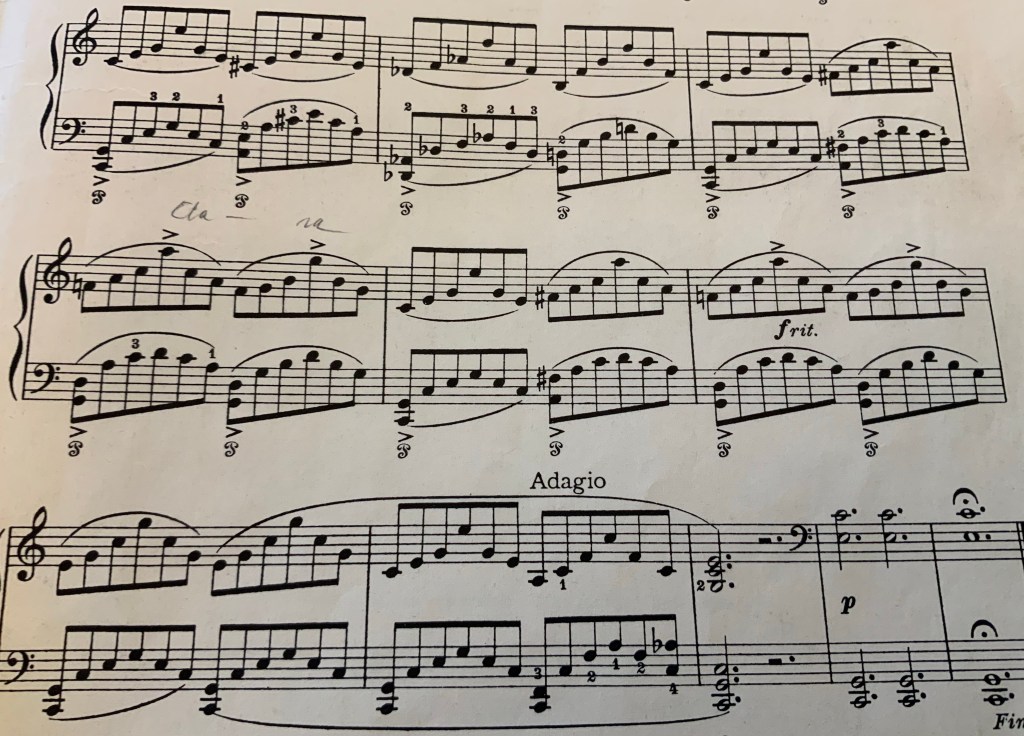
Cla- ra in Agosti’s hand in my score
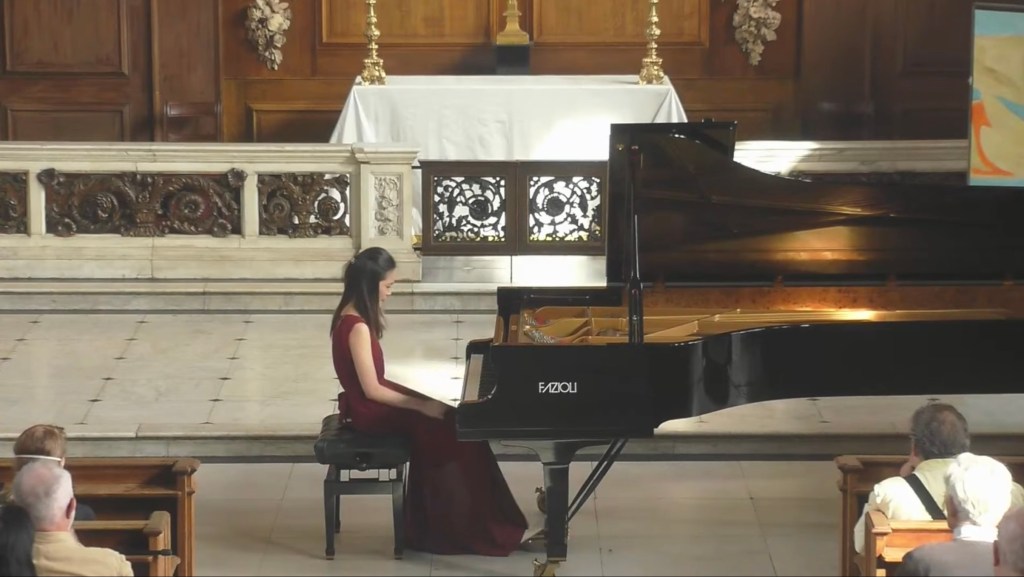
Liszt had played the piece to Schumann privately, and later incorporated it into his teaching repertory, but he considered it unsuitable for public performance and never played it in public.However, Liszt returned the honour by dedicating his own Sonata in B minor to Schumann in 1853. Clara Schumann did not start to perform the Fantasie in her concerts until 1866,ten years after the composer died ,the Liszt Sonata she never played as she considered it ‘a blind noise’!
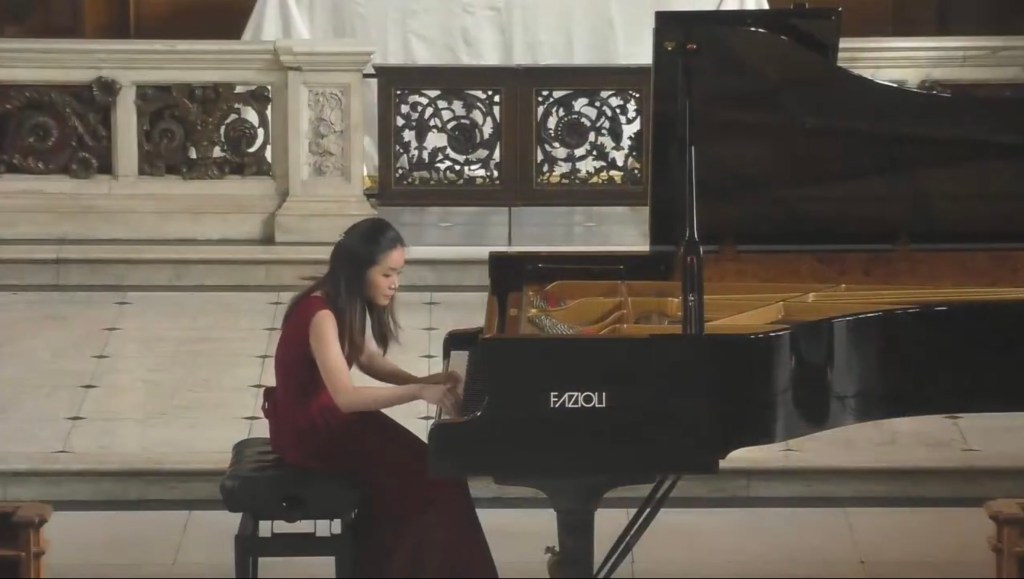
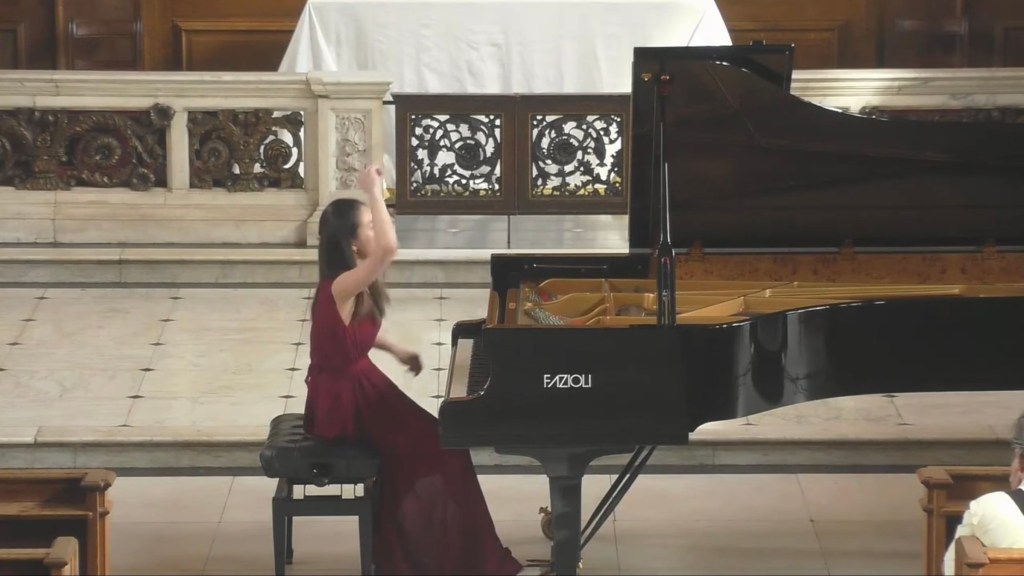
Alborada del gracioso (“The Jester’s Aubade “), is one of the five movements of Ravel’s piano suite Miroirs written in 1904–05.It is a musical announcement of dawn, a sunrise song, the equivalent of a French or English aubade and the roots of the term can be traced to the old troubadour tradition in which the song portrayed the parting of two lovers at dawn.A gracioso was a figure from Spanish comedy, variously described as a jester or a clown,the classic genial buffoon,the standard grotesque lover,a humorous or amusingly entertaining person,and a servant or squire who often comments satirically on the actions of his superiors.Diaghilev also commissioned Ravel to orchestrate the Alborada (and the Chabrier piece, the Menuet pompeux) for a production of the ballet, retitled Les jardins d’Aranjuez, at the Alhambra Theatre , London in 1919.Before the ballet opened in London the orchestral Alborada was premiered in Paris on 17 May 1919 .

Hao Zi Yoh Italian tour for the Keyboard Trust.The refined elegance and sensibility of a great artist
 ChristopherAxworthy-MusicCommentary