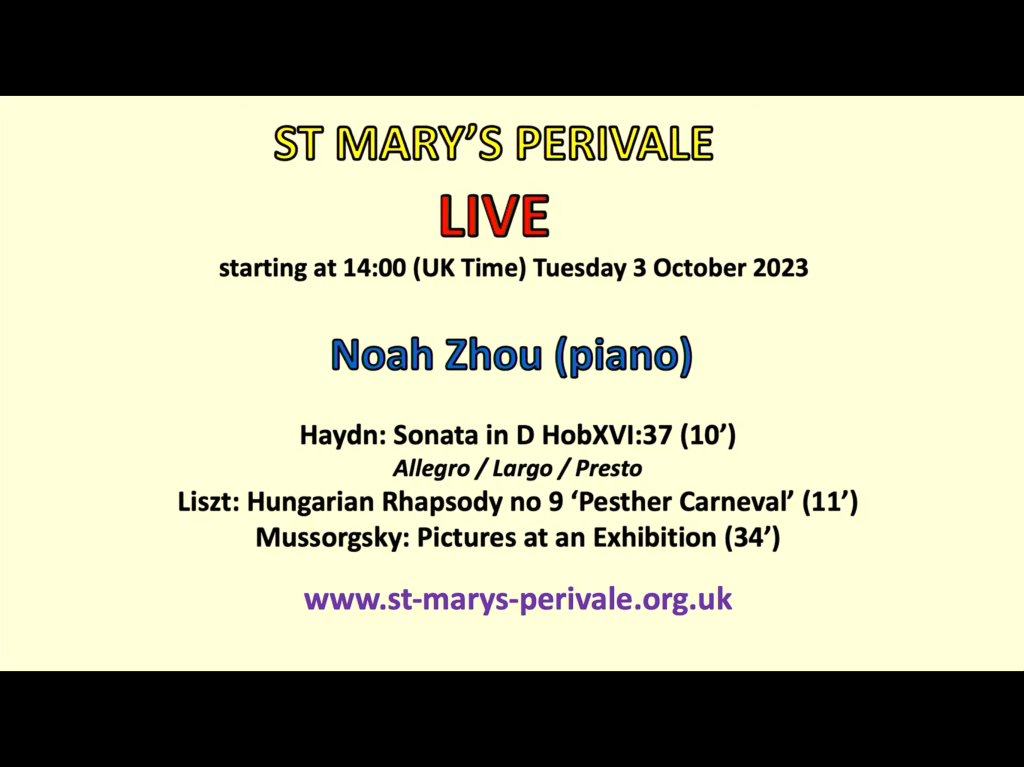
Tuesday 3 October 2.00 pm
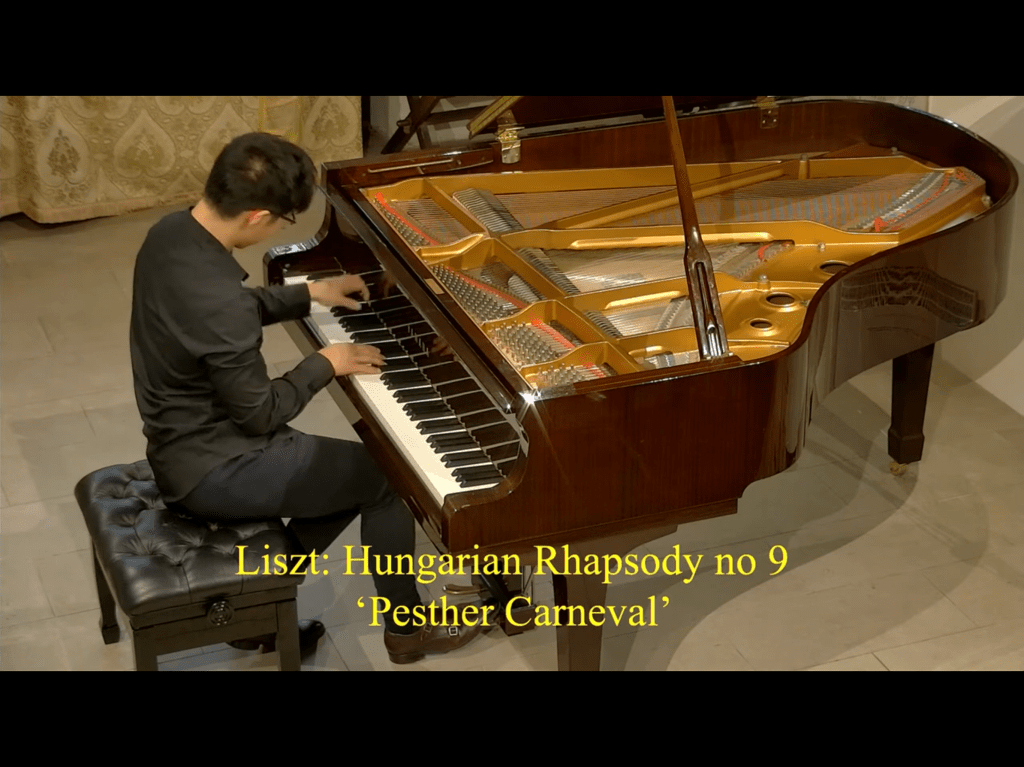
Hungarian Rhapsody No. 9, S.244/9in E flat , is the ninth .It is nicknamed the “Carnival in Pest” or “Pesther Carneval” and was composed in 1847. Liszt also made versions of the piece for piano four hands and for piano, violin, and cello.Liszt used five themes in this rhapsody. The first of these, possibly Italian in origin, can be found in one Liszt’s manuscript notebooks. The second theme is a csardas by an unknown composer. After the third theme, which is an unidentified folk tune, Liszt quotes an authentic Hungarian folk song, A kertmegi káposzta. The final theme quoted is a third folk tune, Mikor én még legény voltam.The Hungarian Rhapsodies, S.244 R.106 are a set of 19 pieces based on Hungarian folk themes and were composed during 1846–1853, and later in 1882 and 1885. In their original piano form, the Hungarian Rhapsodies are noted for their difficultyLiszt incorporated many themes he had heard in his native western Hungary and which he believed to be folk music, though many were in fact tunes written by members of the Hungarian upper middle class, or by composers such as Jozsef Kossovits often played by Roma (Gypsy) bands. The large scale structure of each was influenced by the verbunkos,a Hungarian dance in several parts, each with a different tempo Within this structure, Liszt preserved the two main structural elements of typical Gypsy improvisation—the lassan (“slow”) and the friska (“fast”). At the same time, Liszt incorporated a number of effects unique to the sound of Gypsy bands, especially the pianistic equivalent of the cimbalon .He also makes much use of the Hungarian gypsy scale
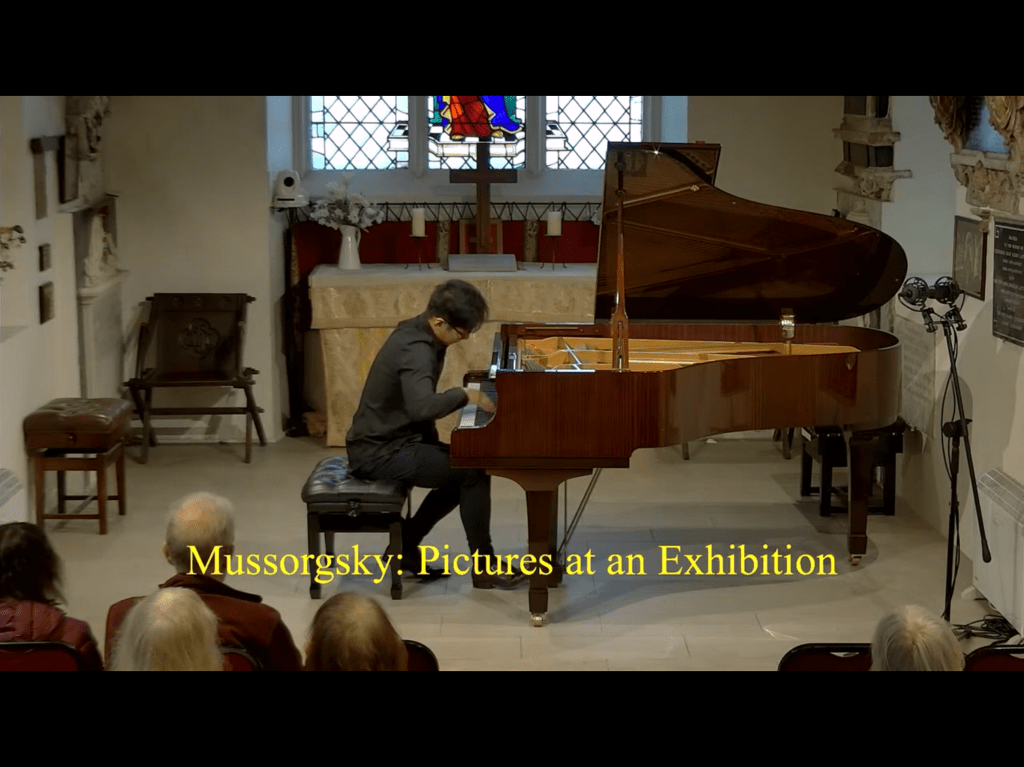
Each of the ten pictures was shaped with astonishing characterisation as he lived so intensely each piece finding a chameleonic sense of colour and shape to each one.
‘Gnomus’ rudely interrupted the promenade where his orchestral feel for the octaves in’ Poco meno mosso pesante’ meant that he could bring out the bass which gave great depth to the sound in which each of the octaves were made up of individual sounds.The terrifying left hand trills were but vibrations leading to a final cry and a mad rush for shelter.Extraordinary virtuosity made for an easy escape ‘velocissimo con tutta forza’.’The old castle’was allowed to flow with great intensity and the highlighting of inner harmonies gave great depth and richness to the sound.’Tuileries’ was played with enviable jeux perlé and beguiling capriciousness.Rumbustuous ‘Bydlo’ suddenly took to the stage but with a beautiful sense of phrasing and colouring and the final appearance in the tenor register was of quite ravishing beauty.A Promenade made in heaven was only interrupted by the frenzied activity of the ‘Ballet and cackling of unhatched chicks’.The trills of the trio were played with irresistible energy before ‘Samuel Goldenberg’ entered the scene with nobility and authority ,Schmuyle’s beautiful pleadings were mere vibrations of sound before Goldenberg gave us full blast in the bass leading to the rather forlorn addieu of Schmuyle with the final word,of course , to Goldenberg.
There was extraordinary dexterity in the ‘Market Place of Limoges’ with some transcendental playing of mastery and musicianship.It was a revelation of how the notes were allowed to vibrate in Catacombae – one could literally feel the beats as he played with real weight and not just hardness- delving deep into the notes where true secrets lie for those that can find them.’Con mortuis’ entered in a whisper with the left hand melody so beautifully and sensitively shaped.A breathtaking savagery to ‘Baba Yaga’ played with relentless energy with the beautiful orchestral oasis of the Andante mosso and the streaks of lightening that heralded the return of the demonic ‘Baba Yaga’.’The Great Gate of Kiev’ was played with aristocratic control with the opening statement only forte leaving enough space for the fortissimo vibrations of E flat later.Control,passion and aristocratic good taste gave the final bars a weight and timely significance for the true Gateway to Freedom.
Pictures at an Exhibition is based on pictures by the artist, architect, and designer Viktor Hartmann. It was probably in 1868 that Mussorgsky first met Hartmann, not long after the latter’s return to Russia from abroad. Both men were devoted to the cause of an intrinsically Russian art and quickly became friends. They met in the home of the influential critic Vladimir Stasov, who followed both of their careers with interest. According to Stasov’s testimony, in 1868, Hartmann gave Mussorgsky two of the pictures that later formed the basis of Pictures at an Exhibition.
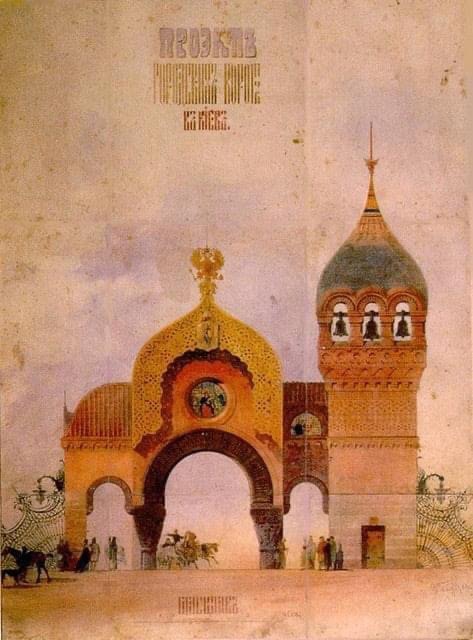
PICTURES AT AN EXHIBITION Promenade l
The Gnomes
Promenade ll
The Old Castle
Promenade lll
The Tuileries: Children’s dispute
after play
Bydlo
Promenade IV
Ballet of the unhatched chicks
Two Polish Jews: Rich and poor
Promenade V
The market at Limoges
Roman Catacombs – With the dead
in a dead language
Baba Yaga: The Witch
The Heroes Gate at Kiev
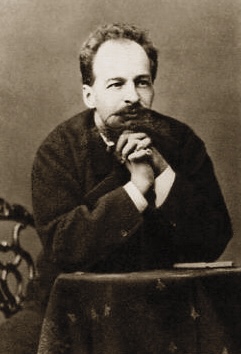
Hartmann’s sudden death on 4 August 1873 from an aneurysm shook Mussorgsky along with others in Russia’s art world. The loss of the artist, aged only 39, plunged the composer into deep despair. Stasov helped to organize a memorial exhibition of over 400 Hartmann works in the Imperial Academy of Arts in Saint Petersburg in February and March 1874. Mussorgsky lent the exhibition the two pictures Hartmann had given him, and viewed the show in person, inspired to compose Pictures at an Exhibition, quickly completing the score in three weeks (2–22 June 1874).Five days after finishing the composition, he wrote on the title page of the manuscript a tribute to Vladimir Stasov, to whom the work is dedicated.The music depicts his tour of the exhibition, with each of the ten numbers of the suite serving as a musical illustration of an individual work by Hartmann.Although composed very rapidly, during June 1874, the work did not appear in print until 1886, five years after the composer’s death, when a not very accurate edition by the composer’s friend and colleague Nikolai Rimsky-Korsakov was published.
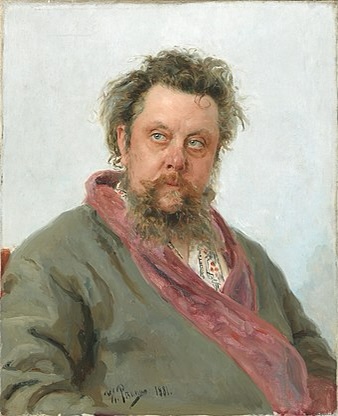
Mussorgsky suffered personally from alcoholism, it was also a behavior pattern considered typical for those of Mussorgsky’s generation who wanted to oppose the establishment and protest through extreme forms of behavior.One contemporary notes, “an intense worship of Bacchus was considered to be almost obligatory for a writer of that period.”Mussorgsky spent day and night in a Saint Petersburg tavern of low repute, the Maly Yaroslavets, accompanied by other bohemian dropouts. He and his fellow drinkers idealized their alcoholism, perhaps seeing it as ethical and aesthetic opposition. This bravado, however, led to little more than isolation and eventual self-destruction.
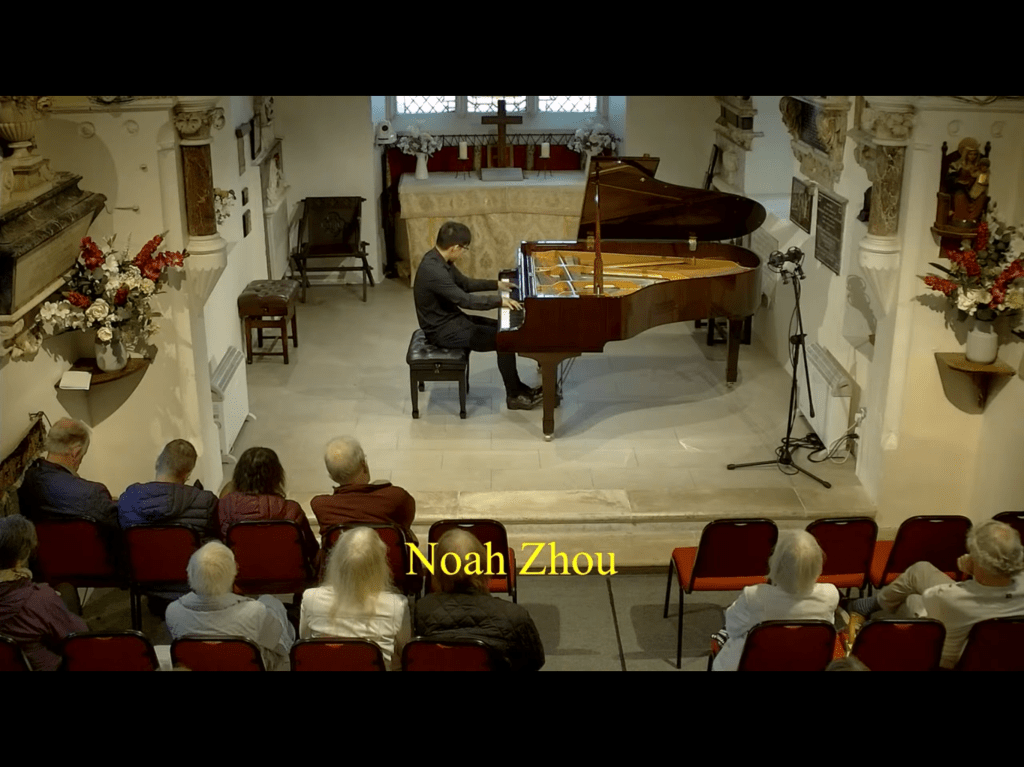
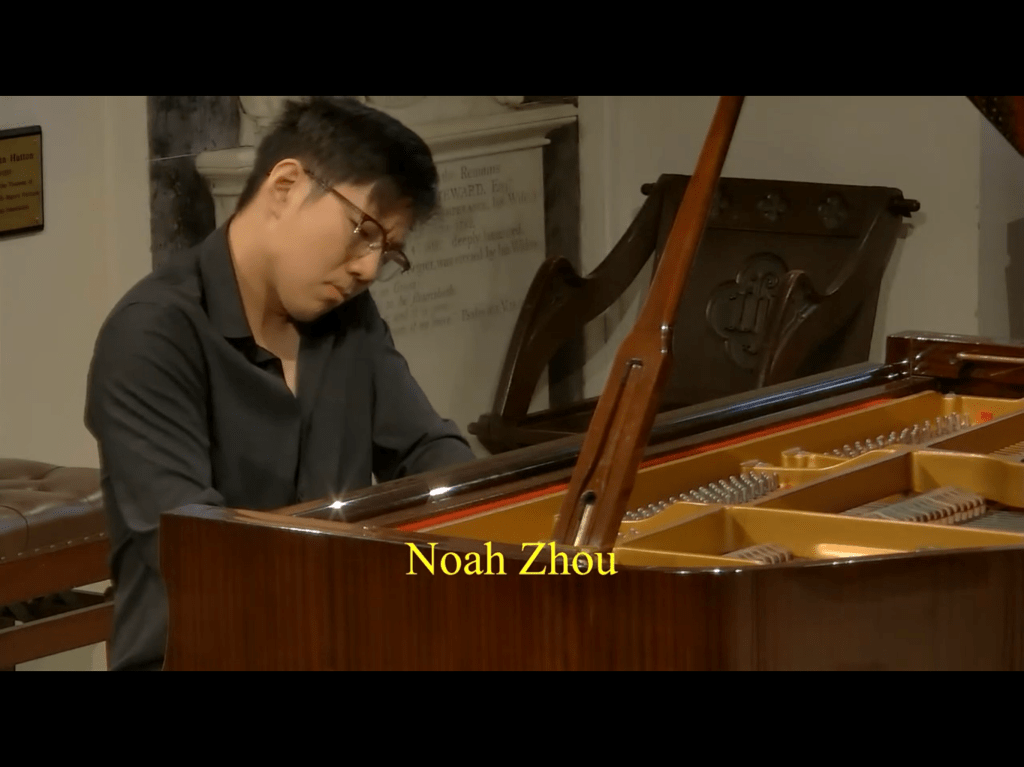
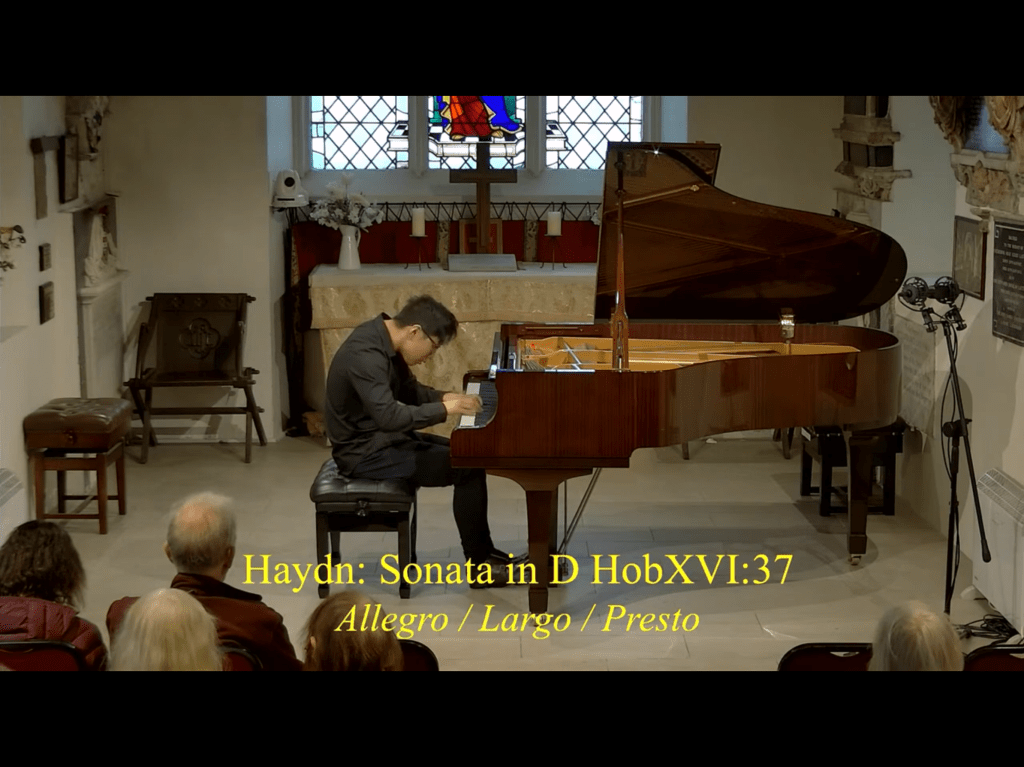
Based in London, British-Chinese pianist Noah Zhou began his musical journey at the age of 5. Generously supported by the Eileen Rowe Musical Trust for a number of years, he has since gone on to have completed his Bachelor’s degree at the Royal Academy of Music, where he was awarded the Sir Elton John Scholarship. Now he is pursuing his Master’s at the same institution, where he studies with the Emeritus Head of Keyboard, Christopher Elton. He is also generously supported by the Hattori Foundation and the Countess of Munster Trust.
Noah has been the recipient of a number of awards, notably 2nd Prize at the YPF European Grand Prix (2022), as well as the Royal Philharmonic Society of Great Britain’s Duet Prize for Best Young Instrumentalist (2018). He has also been awarded 1st Prizes at Valsesia Musica International Competition (2021) and the Euregio Piano Award (2021). On top of this, Noah has to his name the titles of Laureate of the Rio International Competition (2022); Horowitz International Competition (2019); Campillos International Competition (2021), and was a finalist at the UK Piano Open (2020); and Manchester International Concerto Competition (2019).
Noah is a frequent performer – orchestras with which he has collaborated include, the Phion Orchestra of the Netherlands (under Antony Hermus); the National Philharmonic Orchestra of Ukraine (under Vitaliy Protasov); the Brazilian National Symphony Orchestra (under Roberto Tibiriçá); the Danube Symphony Orchestra (under András Deák); the Manchester Camerata (under Stephen Threlfall); the Pazardzhik Symphony Orchestra (under Grigor Palikarov); and the Malaga Symphony Orchestra (under Victor Eloy Lopez Cerezo).
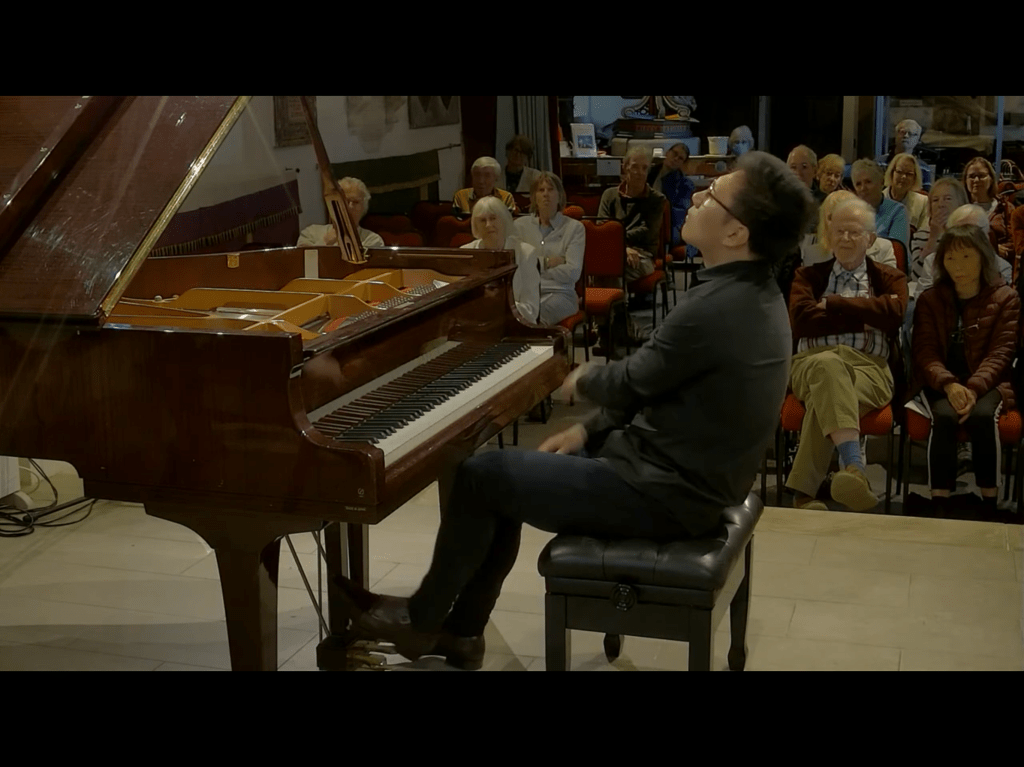
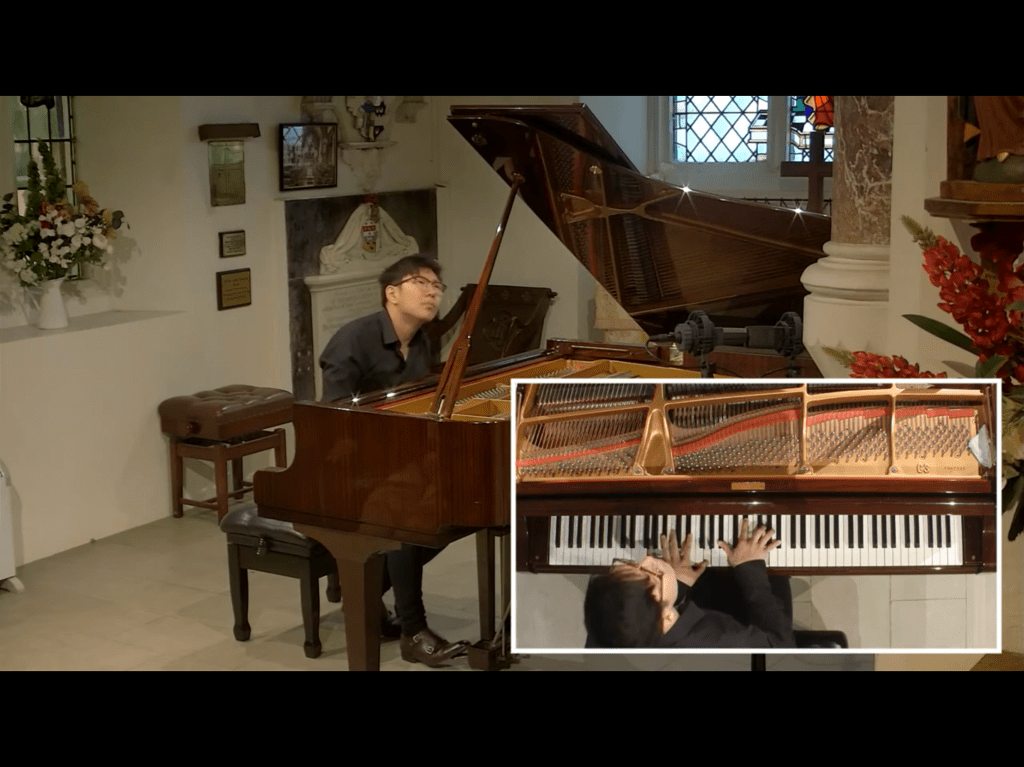
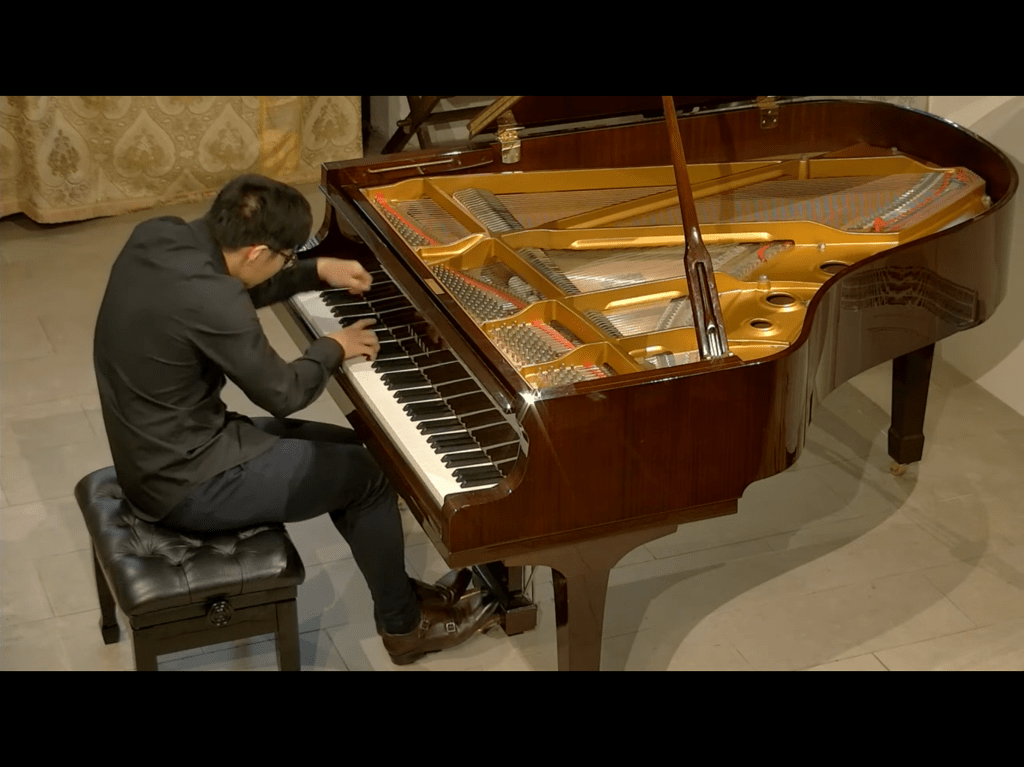
Noah Zhou at St Mary’s the virtuosity and poetry of a great artist
 ChristopherAxworthy-MusicCommentary