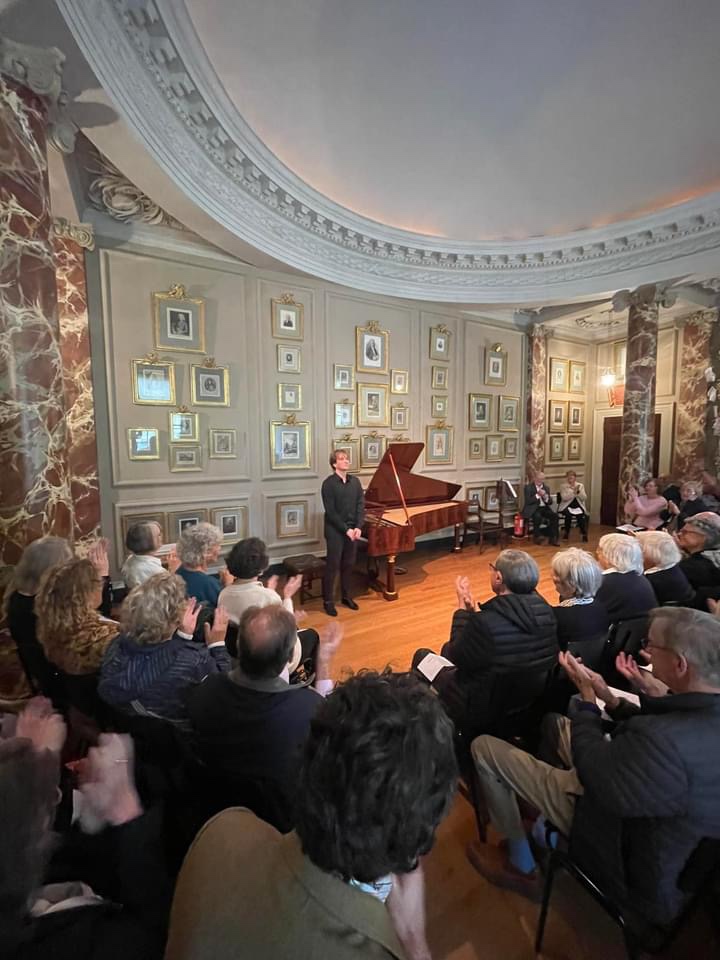
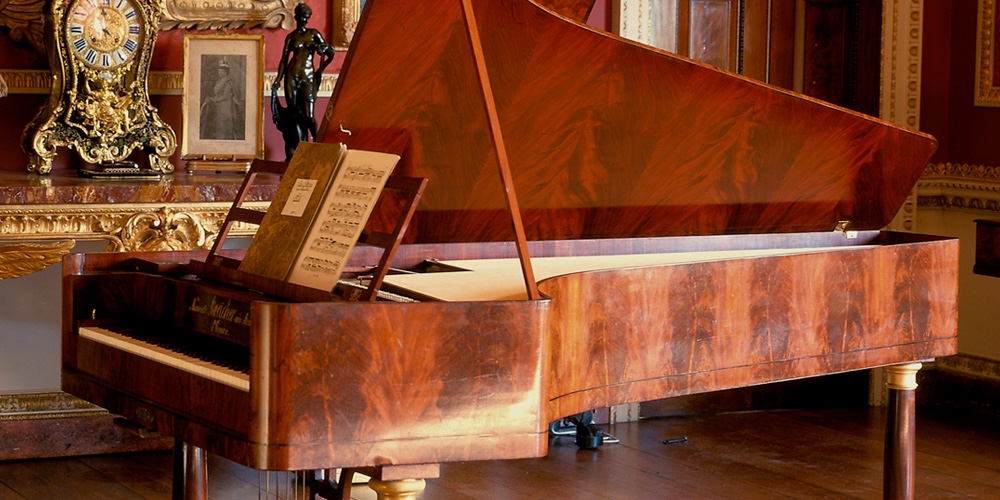
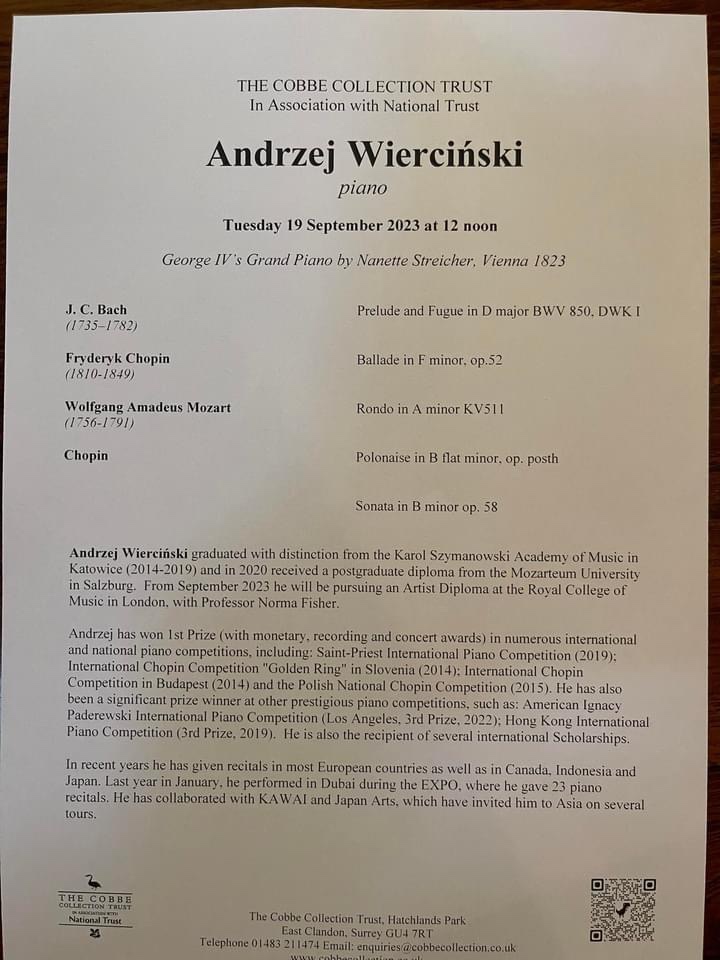
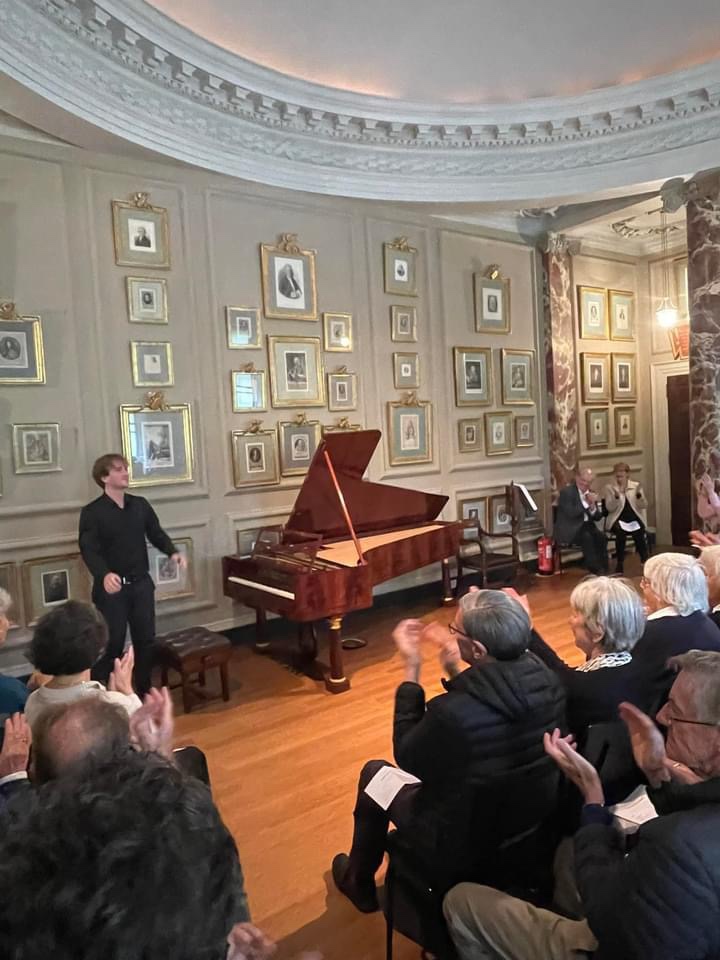
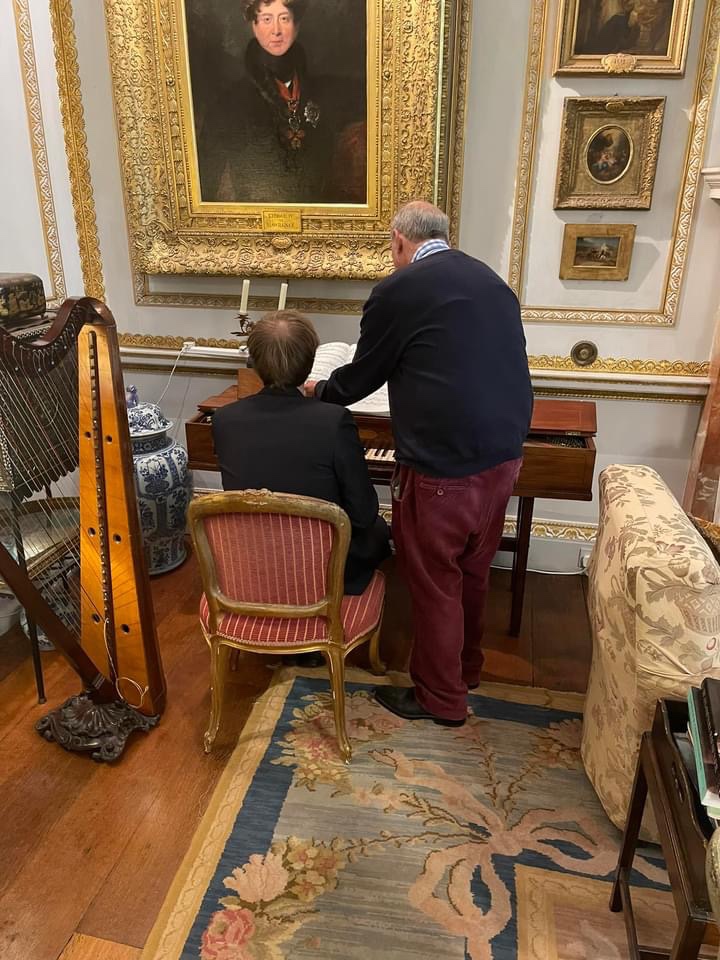
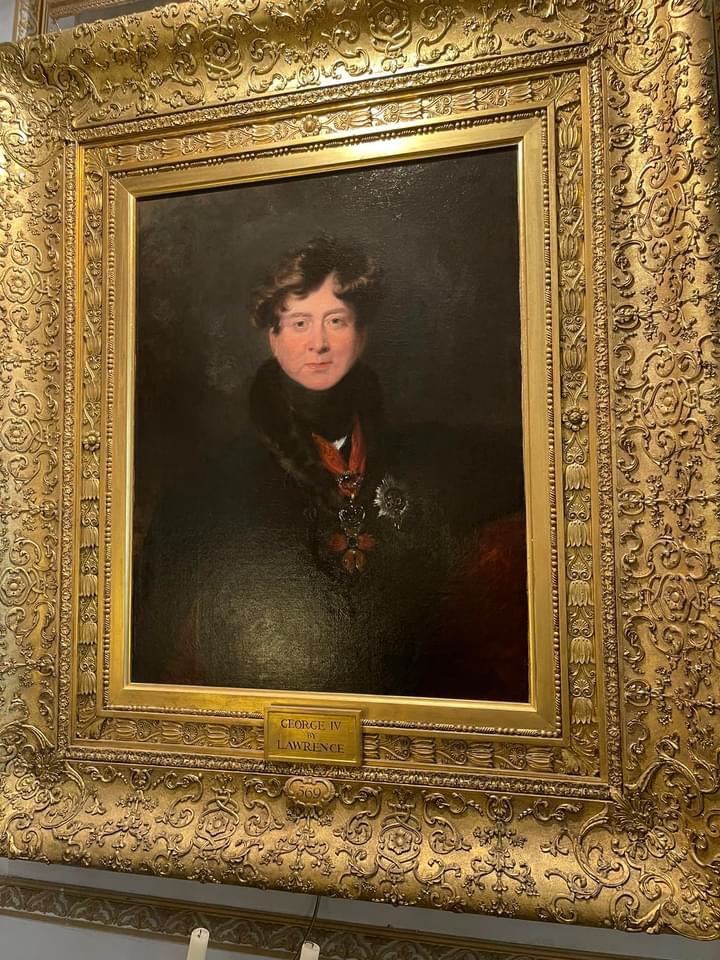
A triumph at Hatchlands but it was Chopin’s Erard that stole Andrzej heart before his concert on George IVs remarkable 1823 Streicher Viennese piano.A piano beautifully restored and it was Alec Cobbe who explained to Andrzej how to drive it .Six pedals needs some working out.Fazioli now has four pedals and if playing with an I pad you can add another two which equals six.But this piano was built two hundred years ago when there were certainly no I pads and pedals had a completely different meaning and usage.
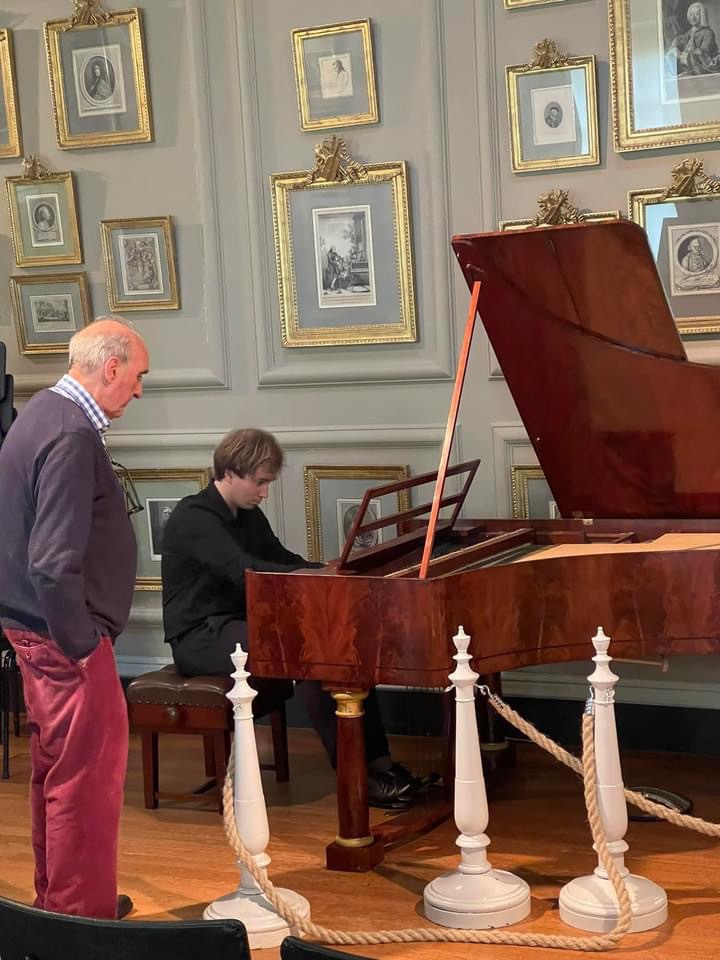
With just an hour to get used to driving the left and the right pedals Andrzej though had fallen in love with the veiled beauty of sound of the Erard that Chopin had used in Scotland on his final tour just a year before his death.Andrzej spent most of his precious rehearsal time entranced by the sound of this instrument .However it was quite remarkable how on the Streicher piano he was able to immediately adapt the sound via the pedals during the concert that gave clarity and delicacy in the Bach and Mozart and depth of sound in the Chopin.A musician who listens to himself and can instantly search for and find sounds that can bring the music alive with intelligence,scholarship and passion is a musician to be reckoned with.
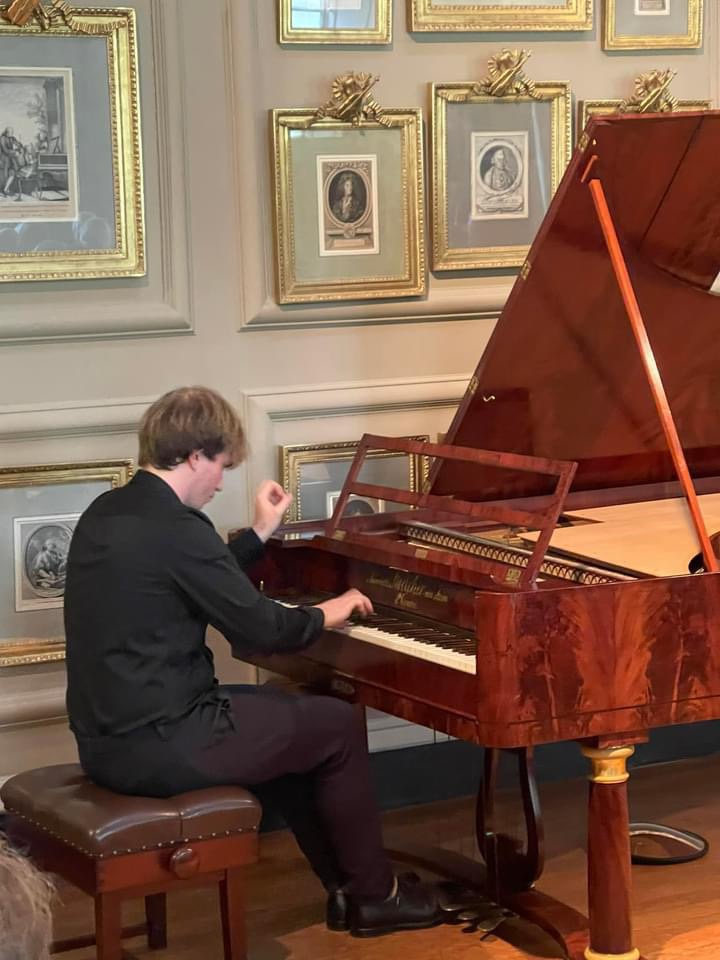
The Bach Prelude and Fugue in D Book 1 immediately showed us the refined tone palette he could find with delicacy and a rhythmic dance from the bass that I remember very well from Rosalyn Tureck’s much more robust performance on the modern Steinway.An infectious lilt to the music almost like riding a horse but on this instrument there were some very subtle shadings and colours .The Fugue,too,unusually staccato but the short note never accented which gave a beautiful rhythmic propulsion to the fugue that was shaped with the same care as a tone poem and not just allowed to bounce along on its own as we are all too often used to hearing.A Prelude and Fugue shaped into a wondrous overture with the great artistry that was to be the hallmark of the entire concert.

The Chopin Fourth Ballade which had sounded ravishingly veiled on the Erard was here much brighter but Andrzej allowed the music to breathe so naturally with the variations gaining each time in nobility with masterly control.The return of the introduction with the inner tenor register slightly highlighted gave such depth to the sound as it spun into the heights with an etherial cadenza before the contrapuntal return of the theme that was played with ever more crystalline clarity.The final variations were played with passionate commitment but also a remarkable control of texture that made the final glorious full sonority so overwhelming.The five adjoining chords leading to the coda were played with disarming simplicity without any fuss just five simple chords to diffuse the sumptuous climax before a busy coda of transcendental difficulty.But even here the remarkable time and shape he brought to this afterthought revealed the genius of Chopin that this was not just empty virtuosity but textures of passionate poignancy as the temperature rose to boiling point before cascading to the final noble chords of one of the greatest most poetic creations of the Romantic piano repertoire.

Back to Mozart and a shift to the left with the pedals to find that beautiful clarity of Bach once more.A clarity with a delicacy of sound that suited the intimacy of Mozart’s Rondo in Aminor.Andrzej later was to experiment on J C Bach’s piano on which Mozart himself had played his A minor Sonata ; but in the concert on the Streicher piano he had found the ideal colour that revealed the disarming simplicity and poignant beauty of this jewel in Mozart’s crown.
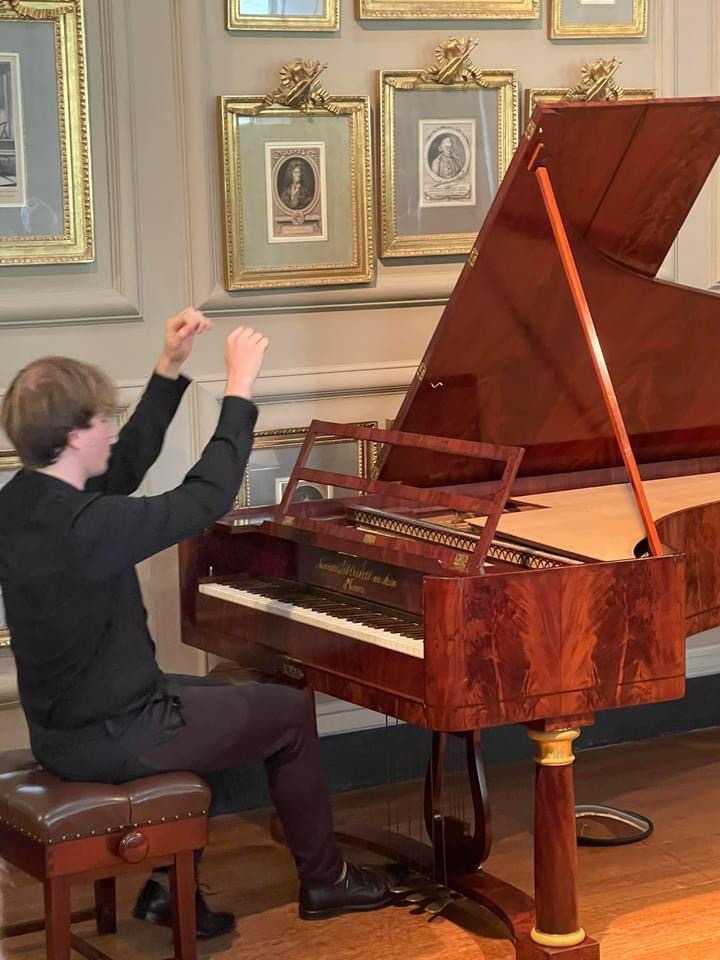
He chose Chopin to finish this short lunchtime concert and it was the early youthful Polonaise published after his death that was able to demonstrate the restrained grandeur with the delicate jeux perlé virtuosity that Chopin would have astonished the salons of his youth with.Exquisite charm of the central musette contrasted with the return of the refined showmanship of the Polonaise.Andrzej was to play another Polonaise by a contemporary,Kurpinski,as an encore which demonstrated the same charm and style of the period

March 6, 1785
Włoszakowice, Kingdom of Poland, Polish-Lithuanian Commonwealth
Died
September 18, 1857 (aged 72)
Warsaw, Kingdom of Poland, Russian Empire
Karol Kazimierz Kurpiński (March 6, 1785 – September 18, 1857) was a Polish composer,conductor and pedagogue .A romanticist and one of the most revered composers before Chopin who he met in 1828. He helped to lay the foundations of a national style and prepared the ground for Polish music of the Romantic period particularly Chopin. He contributed to the development of Polish opera, introducing new musical devices and achieving a novel mode of expression
This was to be no ordinary concert but a voyage in time to find the very source of the creative process which in no way limits fantasy,passion or commitment but puts it into the context of the age in which it was born.What a surprise Alec Cobbe had,to discover a Polonaise by Beethoven that Andrzej played on Haydn’s own piano.A piano that Beethoven too would have known in the period of the first three Sonatas op 2 that Beethoven was to dedicate to his teacher.
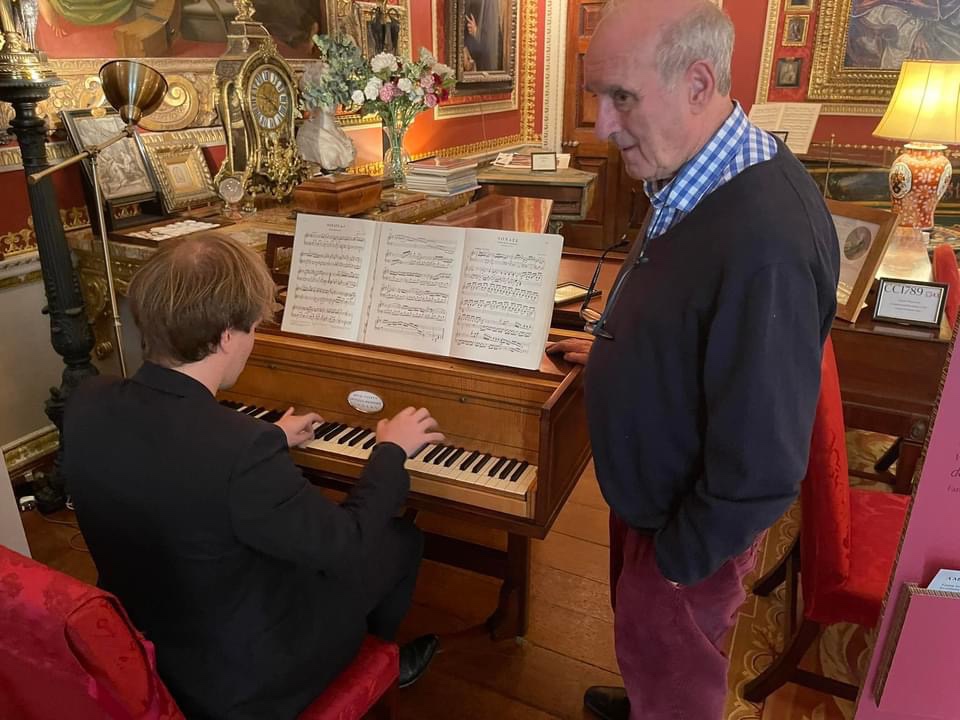
Surrounded by so many beautiful instruments all wonderfully restored and to be able to play the same instruments that composers had used to create eternal masterpieces is a lesson indeed.But all these instruments are in rooms that are a size that allows them to be fully appreciated and not, as so often happens,antique instruments being brought into halls that can accomodate many more than these poor instruments can comunicate with in the same manner.To quote myself :’…….an example to us all of how Mozart could be played respecting the period but not being intimidated by it…….. becoming one,as the very operatic meaning of Mozart was transmitted through them to us thirsty for such enticing musical integrity and inspiration and dare I add ‘authenticity!’(https://christopheraxworthymusiccommentary.com/2023/08/25/impeccable-living-mozart-as-queen-bodicea-drives-her-flaming-chariot-to-meet-grieg-salasswigutpastuszka-and-the-ohorkiestra-take-warsaw-by-storm/).

The final work in this all too short recital was the Sonata in B minor op 58 by Chopin.A performance in which architecture and artistry combined with poetry and passion bringing to life a masterpiece written towards the end of Chopin’s short life.A subdued opening of the Allegro Maestoso as Alec Cobbe had advised.The more restrained you play the greater the effect on this instrument.There was a subtle aristocratic shape to the second subject ‘sostenuto’ as Chopin writes but not a change of tempo and it was this overall architectural shape that gave such nobility to a work that in lesser hands can sound so fragmented.The left hand in the development was like a recitativo leading to the triumphant return of the opening this time in all its blazing glory.A Scherzo of clarity,like quick silver, as it weaved a wondrous shape with such luminosity of sound.A Trio that was with a gloriously replenished full sound of unusual brooding nobility but also wistful and beseeching as it searched for its way back to the Scherzo that in the end just seemed to evolve out of thin air.Straight into the mighty opening chords of the Largo before the purity of the melodic line on a pulsating accompaniment like a constant and reflective heart beat.The long and expansive meanderings that follow were of poignant beauty and the sudden unexpected appearance of the tenor and bass voices were revealed as if by magic.The opening melodic line returning with an even mellower sound leading us to the poignant beauty of the final duet between the two beautiful worlds with which Chopin had so entranced us.The Finale grew out of the final chord of the Largo building up to the agitato Rondo with very carefully controlled and phrased octaves spread over the entire keyboard.A masterly control of sound and tempo left Andrzej time to even add an ornament to the second appearance of the rondo theme as it gradually built to a climax of extraordinary technical mastery.A building of tension and excitement that that finally burst into flames with the treacherous final page played with the security and total abandon of a young virtuoso on the crest of a wave.


At this date, French piano-building was in its infancy, the instruments in Paris being mostly imported from London, and Bach clearly thought it necessary to bring a London instrument with him. He might have been asked to do so by the duc de Noailles, for in at least two instances Bach is known to have received requests from friends – Denis Diderot and Madame Brillon, a pupil – to choose a London piano for them. In both cases, he selected one made by Zumpe. Bach signed his name on the soundboard of this piano, almost certainly when he chose it in the makers’ workshop.
It is most probable that this piano was present whilst the two composers were guests of the duc de Noailles. It would have been used for much of the music-making described by Mozart and may well have been used by him for an early, if not the first, performance of his great piano sonata K.310 in A minor, which he had just composed.
The maréchal was clearly on good terms with the town, for when the Revolution came, instead of his house being sacked it was merely confiscated and immediately leased back to him on terms from which his sons could benefit after him. It was not until the 1840s when a new road was planned to run through the centre of the building that the contents of the house were dispersed and the building partially demolished. Miraculously, the duc de Noailles’ beautiful Salon de Musique, in which this historic week of music took place, survives in one of the fragments of the Hotel de Noailles still standing on either side of a street in Saint-Germain.
The instrument shows considerable evolution in size and fullness of sound from the earlier instrument by Zumpe.

Andrzej Wiercinski at La Mortella Ischia The William Walton Foundation – Refined artistry and musical intelligence in Paradise
Andrzej Wiercinski at St Mary’s the making of a great artist

 ChristopherAxworthy-MusicCommentary
Una risposta a "Andrzej Wiercinski at Hatchlands – The Cobbe Collection Trust.A great pianist on a wondrous voyage of discovery"