
At the centre of Mihai Ritivoiu’s recital is the timeless music of that greatest of composers, J.S. Bach and the influence he had on many composers through the ages. Father of the fugue, Beethoven was to emulate this musical device in his Op.110 sonata, and Busoni was inspired to make his own transcriptions of many of Bach’s works. Similarly Mihai himself brings us right up to date with his own variations on one of Bach’s Chorales as well as performing a new work by Stephane Delplace, which he recently premiered.
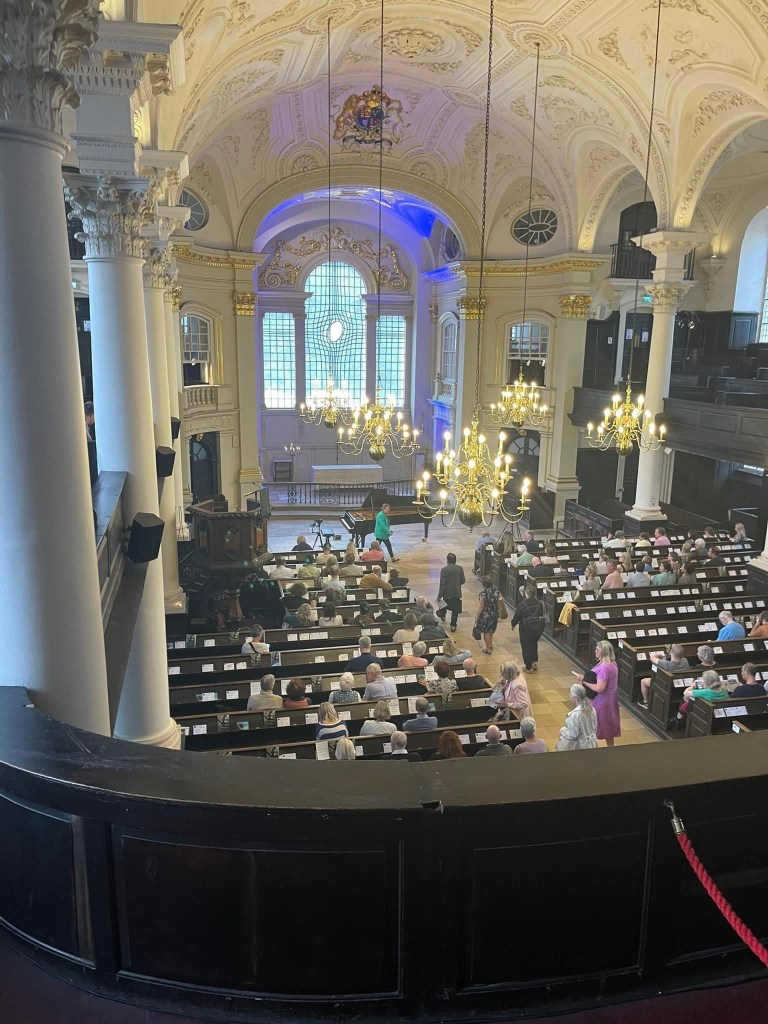
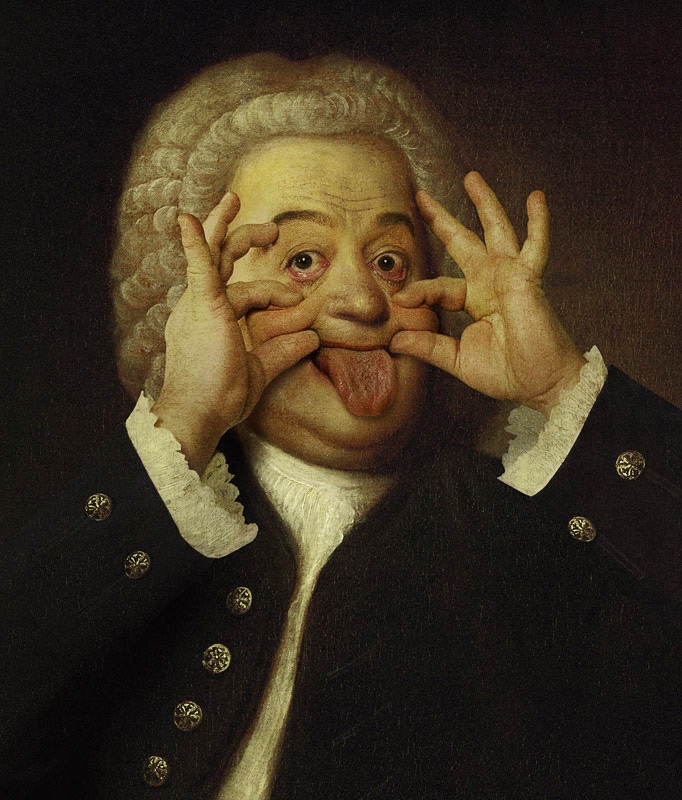
The concert with an almost obligatory title these days where packages are easier to sell Mihai had decided on : “Inspirational Bach.” Johann Sebastian Bach (1685-1750) is unquestionably the most revered figure in the entire history of western classical music, “The Father of Music” , and often being referred to by other composers, like Frédéric Chopin ,Ludwig Van Beethoven and Wolfgang Amadeus Mozart, as a key inspiration.

Born 21 March 1685 (31 March 1685 ) in Eisenach
Died 28 July 1750 (aged 65) in Leipzig
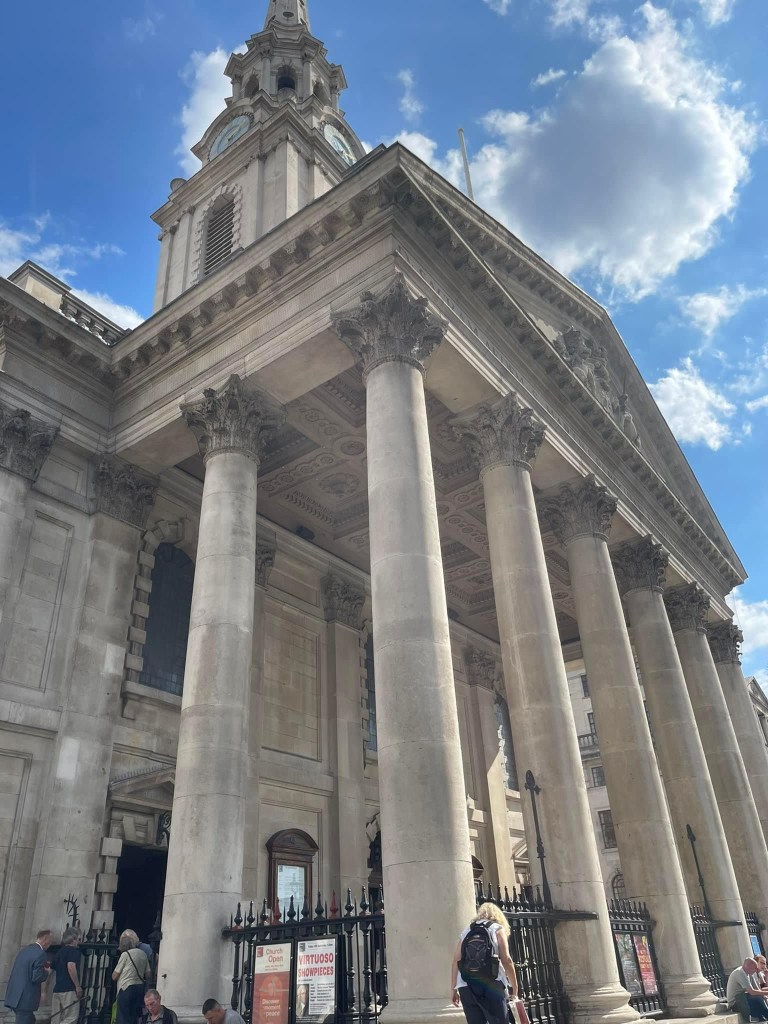
Simple grand Beethoven at St Martins.
I was thinking how proud Joan Havill would be to hear Mihai Ritivoiu blessed by the Gods today as he took us into realms of beauty and mystery that dreams are made of with Beethoven’s penultimate Sonata op110.
A Brahms op 116 n 4 floundering ,perchance to dream on a magic wave of sounds posing questions of unanswerable poignancy.
An artist of quite extraordinary powers of communication.
A musician who thinks more of the music than himself is an artist to cherish indeed these days.
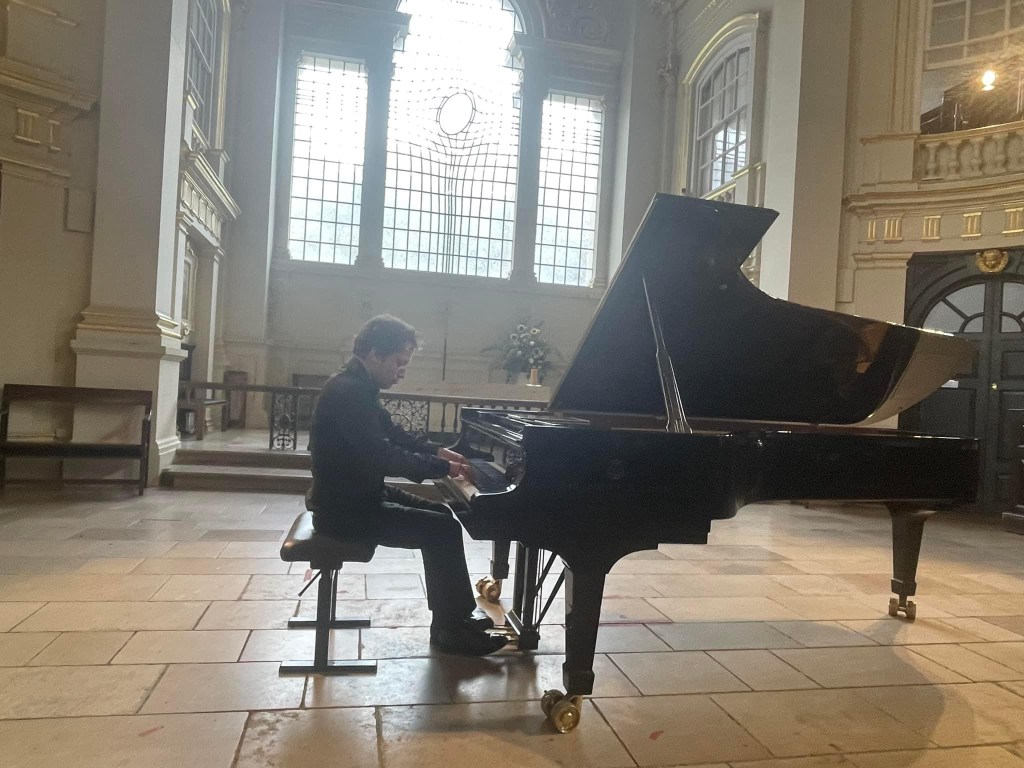
Beginning his recital with one of the most sublime of Busoni’s transcriptions of Bach’s Chorale Preludes BWV 639 ‘ Ich ruf zu dir,Herr Jesu Christ’ and creating an atmosphere of beauty and serenity that was to pervade the whole recital.There was a purity and clarity of sound with a sense of balance that allowed the melodic line to float on a sumptuous cloud of golden sounds created deep in the bass with delicacy and richness of sonority.The final phrases were of a whispered beauty of the revelation of a true believer.With the radiance of the sun shining through the great glass window behind the altar it was indeed a poignant start to a recital of beauty,simplicity and contemplation .’Light is suspended in a veil by the etching of the clear glass with a swirl of flecks; and at dusk, as daylight fades, the central oval glows, mysteriously self-lit.’The painting of The Veil of St Veronicaby Zurbarán is cited by Shirazeh Houshiary as a source for her East Window which was installed in 2008 .Zurbarán’s image of a piece of cloth bearing a likeness of the face of Christ connects with Houshiary’s idea of the veil that underlies her design of the steel grid of the window. Here, abstraction and representation merge into an iconic whole that invites contemplation.’
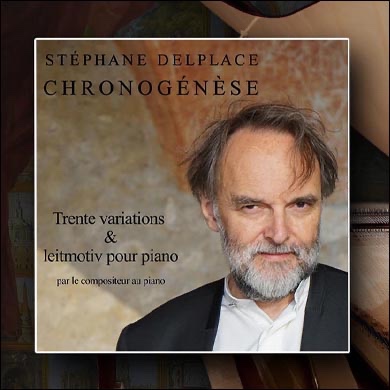
Mihai followed Bach with a fascinating work by Stephane Delplace.There was a recurring leit motif reminiscent of bells chiming out of which emerged Bach like contrapuntal passages of nostalgia and beauty.There was also a mellifluous outpouring of continuous motion of purity and simplicity that was a wash of pastoral innocence.
Stéphane Delplace was born 11th November 1953 (age 69) in Bordeaux France ,and is a composer ,teacher and pianist .He studied piano under Pierre Sancan , as well as Harmony (Alain Bernaud), Counterpoint (Jean-Paul Holstein), Fugue (Michel Merlet ), and Orchestration (Serge Nigg) at the Conservatoire de paris from 1979 to 1984.Delplace began to compose in the mid-1980s, with a firm conviction, though unpopular at the time, that tonal music still hides infinite unexplored territories.Never parting from this ideal, his music finds its roots in that of Bach,Brahms,Faure,Ravel,Prokofiev ….
Bach’s mighty Chromatic Fantasia and Fugue followed with a performance of great authority where Mihai’s vision of line was of a flexibility that made the weaving stream of notes a living and searching sound with recitativi of poignant beauty of searing significance .The beautifully embellished final phrases leading the way to whispered secrets as the fugue subject emerged from the final chord much as Beethoven was to do in his op 110 Sonata that we were to appreciate later in the programme.There was a rhythmic buoyancy to the fugue as it gradually built in fervour with layer upon layer added until the final glorious explosion of arrival at it’s goal with the final note placed with such an aristocratic sense of timing deep in the bass.
Not to be outdone Mihai had written his own variations on the chorale from Bach’s St John Passion:’Herzliebster Jesu,was hast du verbrochen’ (‘Ah, holy Jesus, how hast thou offended?’).Its text is a Passion hymn by J Heermann, famously found in both the St John and St Matthew Passions. A melancholy affect is created by the slow-moving counterpoint, spiced with suspensions and chromatic lines and the final notes of the melody are filled in chromatically, highlighting the poignancy that is at the heart of both the theology and the music of the prelude.The tune has been used many times, including settings by J.S. Bach : one of the Neumeister Chorales for organ, BWV 1093,two movements of the St John Passion, and three of the St Matthew Passion .Brahms used it too for one of his Eleven Chorale Preludes for organ, Op. 122: No. 2.Max Reger’s Passion, No. 4 from his organ pieces op 145 (1915–1916), uses this melody. Mauricio Kagel quoted the hymn, paraphrased as “Herzliebster Johann, was hast du verbrochen”, in his oratorio Sankt- Bach-Passion telling Bach’s life, composed for the tricentenary of Bach’s birth in 1985. Mihai’s variations were very impressive and I was trying to guess the various composers that maybe had inspired each variation. The 2nd was Rachmaninov,3rd Debussy water nymph,4th chiselled beauty of notes being shadowed alla Poulenc or Schumann,5th was certainly De Falla,6th Ravel,7th Debussy -Rachmaninov ,8th was the return of the original chorale this time with comments and the 9th Russian maybe Prokofiev.A fascinating work that just showed what a real thinking musician Mihai is and am sure that my comments on an innocent first hearing will bring a smile to his face but it showed what a rich palette of invention he could bring to his own composition.
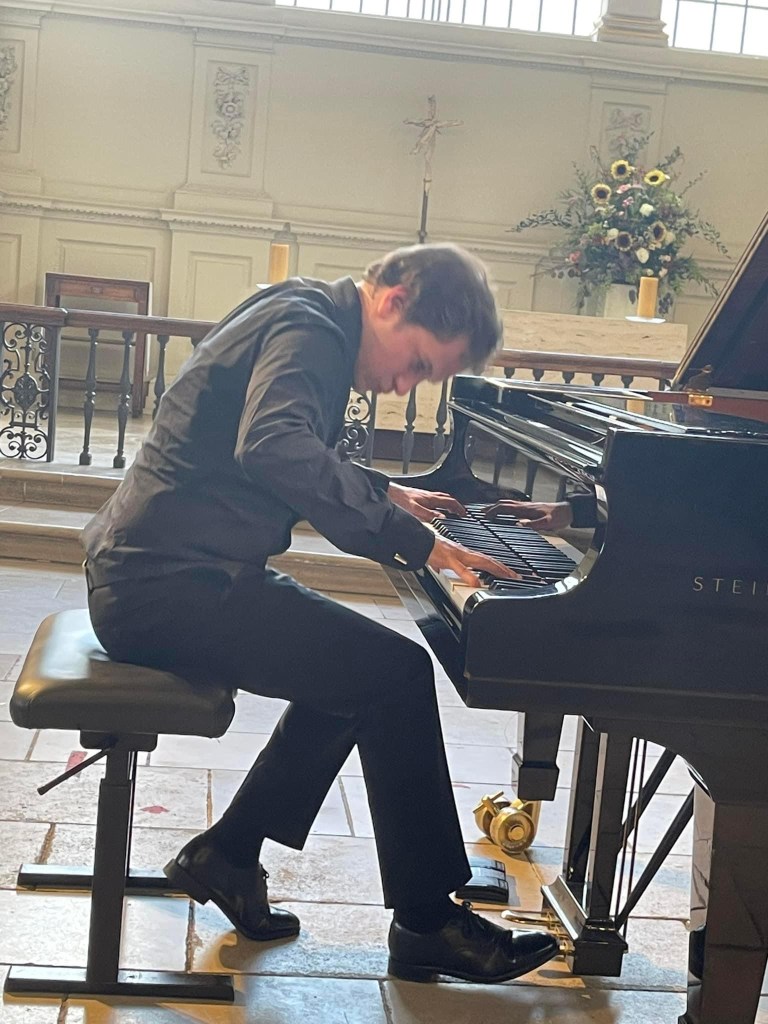
His performance of op 110 by Beethoven was simply one of the most beautiful and convincing that I can remember hearing.As he said Beethoven’s use of the extremes of the keyboard could be considered the search for the infinite in what was to be his penultimate sonata.Op 111 the last of the 32 Sonatas finishes with a glimpse of paradise as the trills take on an etherial significance much as they were to do for Scriabin a century later.The amazing thing was that Beethoven was totally deaf but the sounds that only he could hear in his head he was able to write down with such meticulous care able to share this great testament with eternity.The only sonata without a dedication as it was thought it might be a secret memorial for his ‘Immortal Beloved’.Published without a dedication, there is evidence that Beethoven intended to dedicate Opp. 110 and 111 to Antonie Brentano (Op.111 was eventually dedicated to the Archduke Rudolf) and 110 very significantly left without.Mihai’s was a performance of purity and pastoral innocence with a wondrous musicianship that can say so much with so little effort or personal intervention.There was a great contrast with the Scherzo of almost wild abandon and masterly control in the treacherous Trio where his remarkable restraint made the return of the Scherzo even more of a contrast.Ravishing beauty of the Adagio and a subtle use of the pedal and the bebung effect of allowing a single note to vibrate – not easy on the modern day instruments.It lead to an aria of subtle poetic significance almost as though Beethoven was at last at peace with himself and the world.The great bass entries in the Fugue were every bit as breathtaking as the bass pedal stops of a church organ.The return of the fugue subject in inversion floated in on the vibrations left from the huge sonorities of repeated insistent chords.It was so noticeable too the way that Mihai caressed the keys never hitting but stroking with horizontal movements never vertical.The whole effect both visual and in sound was of luminosity and sublime beauty as Beethoven built the final pages to a colossal climax of passion and the fervent conviction of someone who could see the light that awaited him just six years on.

Programme
Bach/Busoni – Chorale Prelude BWV 639, “Ich ruf zu dir, Herr Jesu Christ”
Stephane Delplace – Sisyphe
Bach – Chromatic Fantasia and Fugue in D minor, BWV 903
M. Ritivoiu – Variations on a Bach Chorale – “Herzliebster Jesu, was hast du verbrochen”
Beethoven – Piano Sonata in A flat major op 110
Mihai Ritivoiu Piano
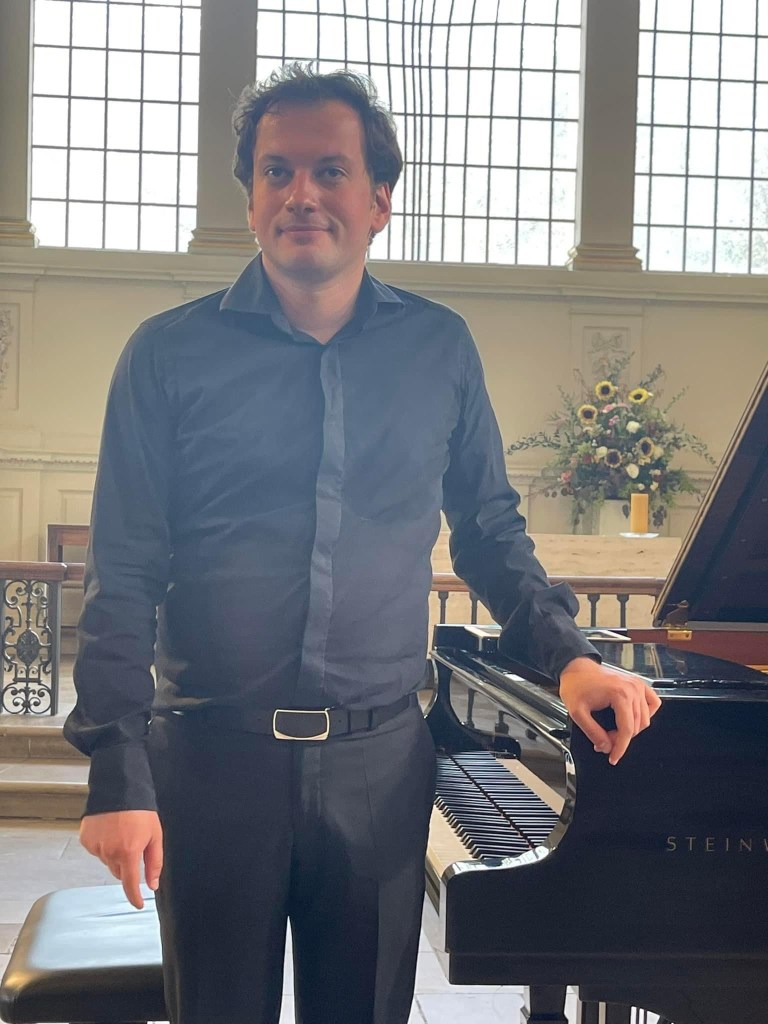
Born in Bucharest, Mihai Ritivoiu is a laureate of numerous national and international competitions, most notably the George Enescu International Competition.
Mihai leads an international career performing solo and chamber music recitals in Europe and Asia, and has played concertos with the George Enescu Philharmonic Orchestra, Lausanne Chamber Orchestra, the English Chamber Orchestra and the MDR Leipzig Radio Orchestra. He collaborated with conductors such as Joshua Weilerstein, Robert Trevino, Michael Collins, Cristian Mandeal, Christian Badea and Horia Andreescu. He has been invited to play at prestigious festivals, including Young Euro Classic in Berlin, George Enescu Festival in Bucharest, St Magnus International Festival, and appeared on stages such as Cadogan Hall, Barbican Centre, Konzerthaus Berlin, Studio Ernest Ansermet Geneva and the Romanian Athenaeum and Radio Hall in Bucharest.
Regularly invited to play on BBC Radio 3’s programme ‘In Tune’, his performances have been broadcast on Radio Romania Muzical, Radio Television Suisse and Medici TV. His debut album “Transcendence” with solo works by Franck, Enescu and Liszt has been praised as “beautifully recorded, handsomely played – a solo recital to cherish” (The Arts Desk).
A graduate with the highest honours from the National University of Music in Bucharest and the Guildhall School of Music & Drama in London, Mihai studied with Professors Viniciu Moroianu and Joan Havill. He has taken part in masterclasses and lessons with Dmitri Bashkirov, Dominique Merlet, Emmanuel Ax, Richard Goode, Jean-Claude Pennetier and has been mentored by Valentin Gheorghiu and Christopher Elton. Most recently, he has pursued directing from the keyboard with Ricardo Castro at the Scuola di Musica di Fiesole.
In addition to his solo recitals and concerto appearances, Mihai has a rich chamber music activity. His partners have included Corina Belcea, Antoine Lederlin, Roland Pidoux, Oleg Kogan and Alexander Sitkovetsky. He forms a duo with the cellist Yoanna Prodanova, with whom he has performed in the United Kingdom, France and The Netherlands. Their first album as a duo, with works for piano and cello by Chopin, Fauré and Janacek was recently released on the Linn Records label.
Mihai is a City Music Foundation artist and a Freeman of the Worshipful Company of Musicians. He has received generous support from the Liliana and Peter Ilica Foundation for the Endowment of the Arts, Erbiceanu Cultural Foundation and Ratiu Family Charitable Foundation.

Mihai Ritivoiu’s triumphant recital signals a musical renaissance at the National Liberal Club

 ChristopherAxworthy-MusicCommentary
