
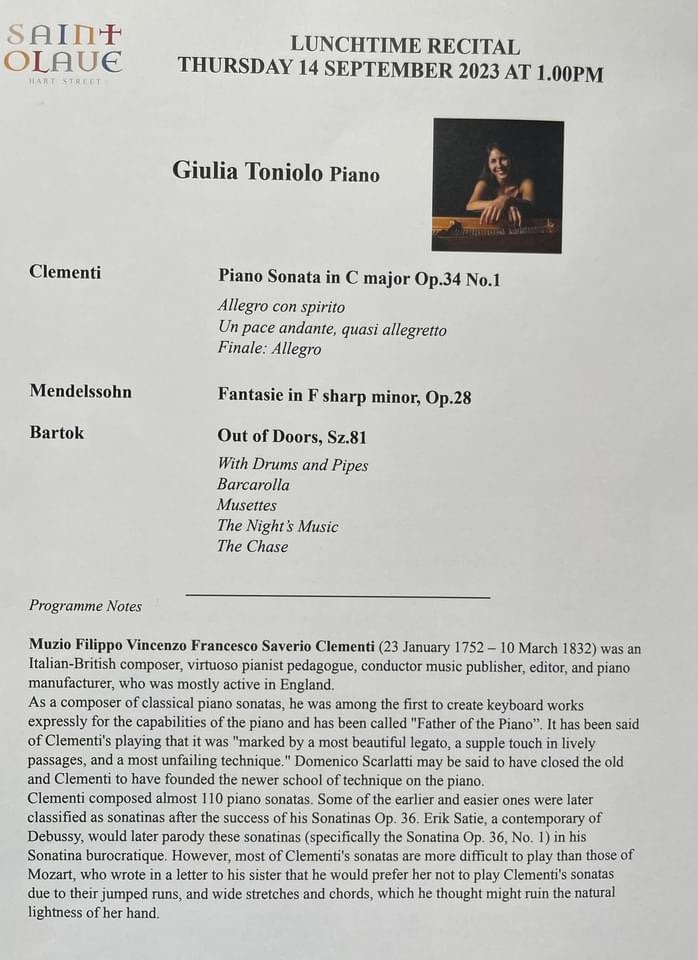
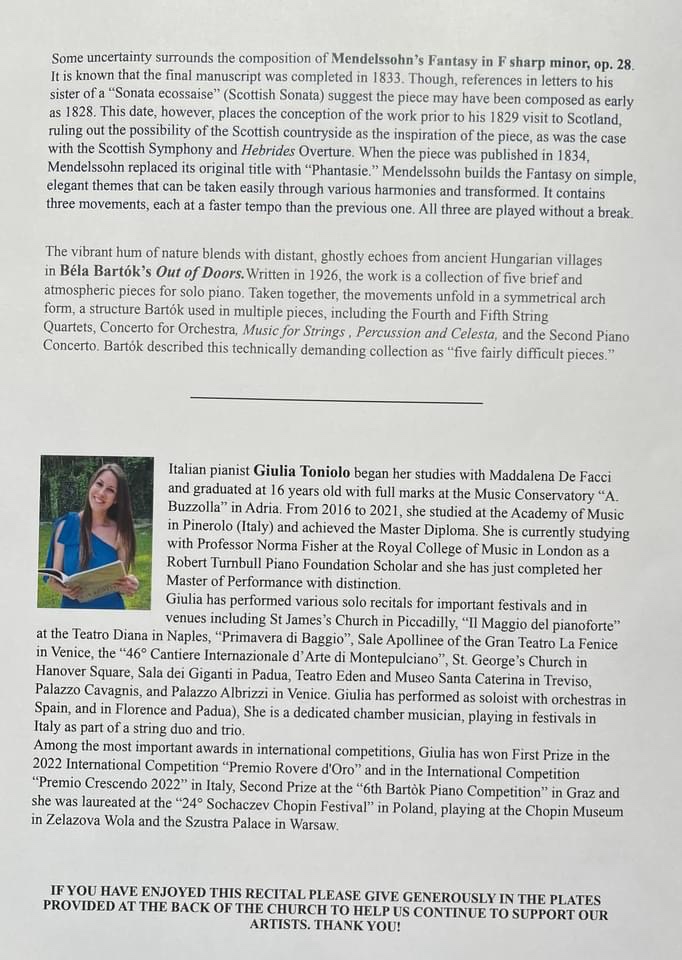
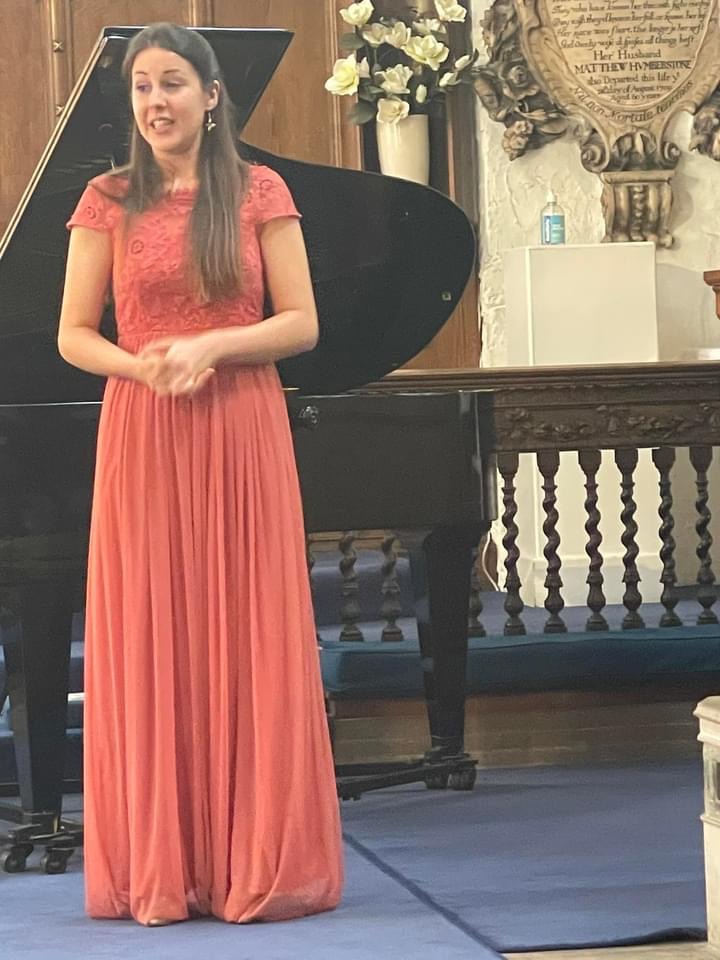
Some superb musicianly playing from Giulia Toniolo as you might expect from the class of Norma Fisher and Maddalena De Facci.St Olave’s an oasis of peace amongst the ever changing landscape that now surrounds the Tower of London.

An old Bosendorfer piano acquired some years ago from Wilfred Parry at the Royal Academy of Music and surrounded by the beautiful historic interior of St Olave’s so cruelly treated during the war but that now what has survived belies the fast moving world on its doorstep.
I had heard Giulia a few years ago in the masterclasses in Siena of Lilia Zilberstein and listening now two years on I am amazed by the authority and technical command she has acquired in these years of intensive study with Norma Fisher.
It is of course a question of musicianship and understanding the very structure of music – the very rock on which it is constructed.It is on this rock that a musician can grow and sow the seeds of interpretations of honesty,integrity and authority. Chopin would describe the word rubato as roots firmly planted in the ground but the branches free to move every way the wind will take them.
I well remember Norma’s playing from when our mutual teacher in our early years,Sidney Harrison,would to take me to listen to his star student as she became a household name in the concert halls of the world.
https://christopheraxworthymusiccommentary.com/2022/05/12/norma-fisher-at-steinway-hall-the-bbc-recordings-on-wings-of-song-the-story-continues/
I remember so vividly a performance of the Brahms Handel variations of a richness of sound and orchestral colour that I had not heard before from other ‘pianists’ and it was the same rich full sound that she found in Chopin’s Berceuse.Sounds that were formed from the bass and gave such a solid foundation to the exquisite sensibility of what floated above.
It was just this solidity that made everything Giulia did speak with such authority and inevitability.There were no frills or thrills but there was transcendental drive and masterly control with an architectural coherence that gave such shape to the edifice that was being constructed before our very eyes.

Her technical command was demonstrated by a performance of Bartok’s Suite Out of Doors that I
have rarely heard played with such authority and drive but also with an exquisite kaleidoscope of sounds that could bring Bartok’s extraordinary Hungarian peasant landscape to life.The barberic attack of the Drums contrasted with the extraordinary fluidity of the Pipes, and the strident final outcry was of devastating effect.A Barcarolle that was a moving plasma of weaving sounds before the delicate pungent dissonances of the Musette.Giulia’s transcendental control of sound brought the Night’s music to life with its desolate atmosphere of total darkness out of which the sound of night animals would hoot,sing or scratch but never interrupt the constant night atmosphere made of liquid pianissimo sounds, whereas the animals were making shrieks in the night.I have heard Radu Lupu play it in the first round of the Leeds that he went on to win.It was the first time that I had been aware of sounds from pianississimo to mezzo forte – Richter was soon to show us what this acute mastery of sound could lead to.
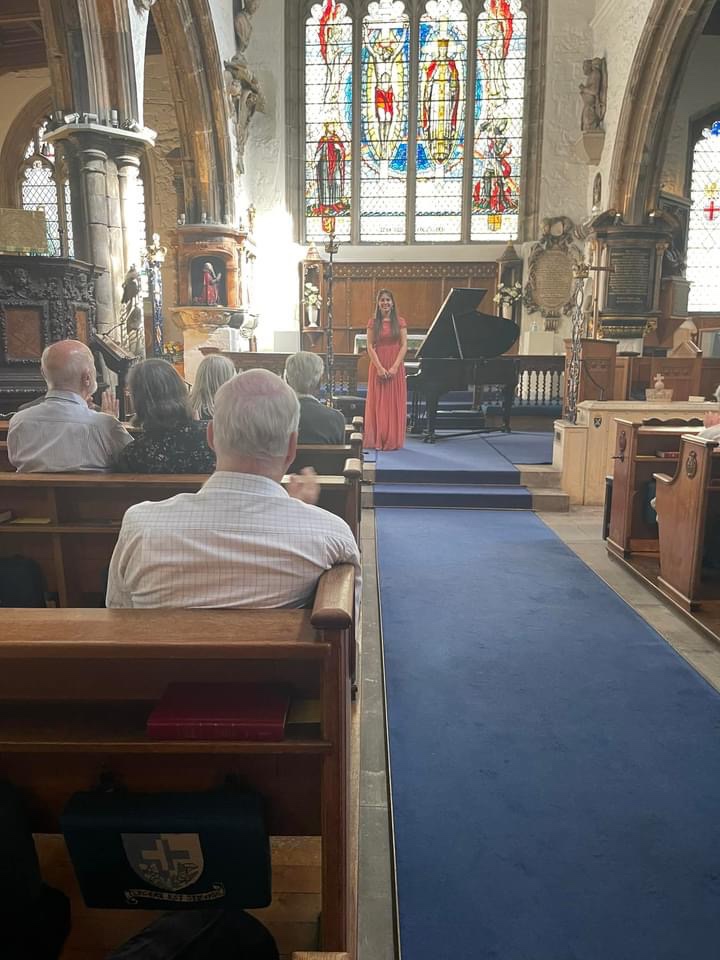
Giulia had a beautiful old but badly regulated piano with a broken string from the Rachmaninov Anniversary concert that another of Norma’s former students had given the day before.It was an even more extraordinary ‘tour de force’ from Giulia because the very roots were so firm not even a broken string could shake them.Her playing of the final Chase was breathtaking for its command and relentless drive .An interrupted impromptu seemed just the right encore to offer in the circumstances !Thank you Debussy!

The concert had begun with one of Clementi’s 110 sonatas of which we very rarely hear any in the concert hall.I think if it was played with the authority and conviction as today we would hear a lot more of a composer who was known as the ‘Father of the Piano ‘ and who was mostly active in England.His music is a mixture of the solidity of Beethoven and the mellifluousness of Mendelssohn.Giulia’s sense of balance allowed the melodic lines to sing unimpeded and her total conviction was quite overpowering in its authority.It was interesting to hear one of Mendelssohn’s major works for piano afterwards and it was the deeply felt sentiments of Mendelssohn without any sentimentality that gave great strength to a performance of colour and great fluidity.The last movement were simply streams of sumptuous sounds that poured with such ease from Giulia’s masterly fingers

 ChristopherAxworthy-MusicCommentary