
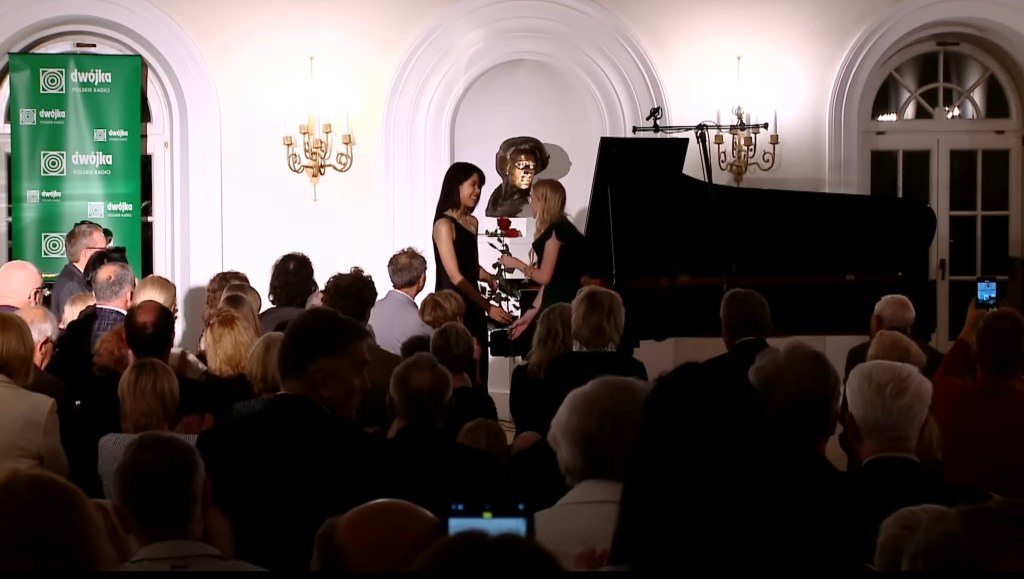
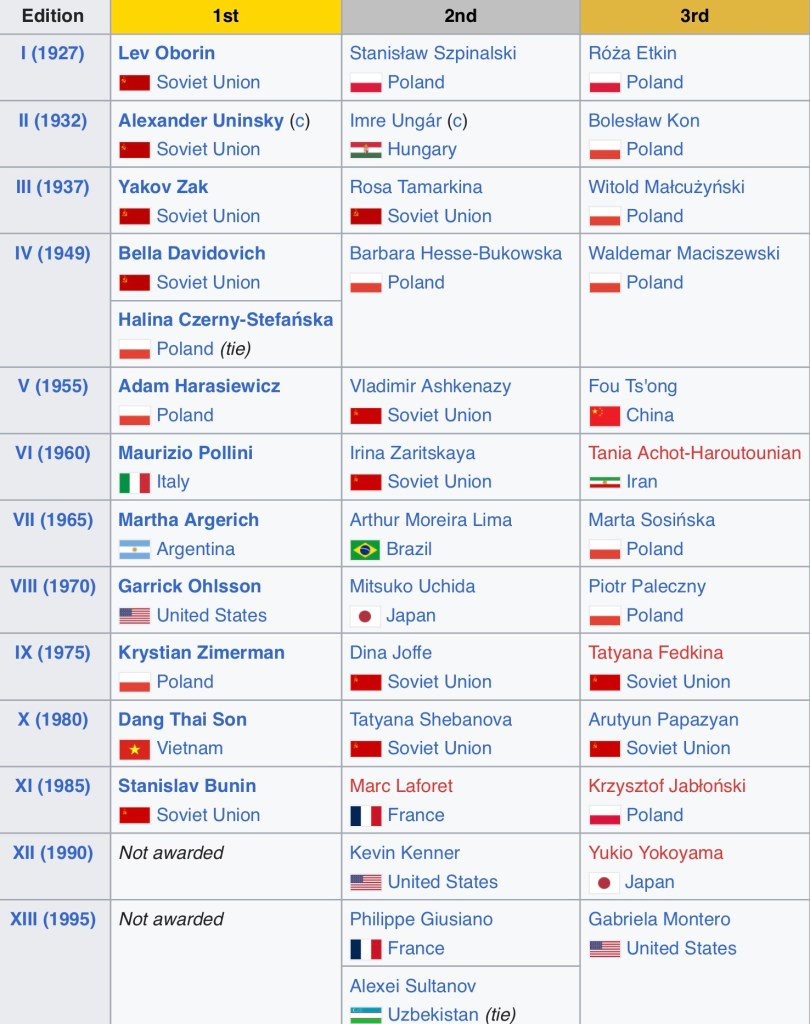
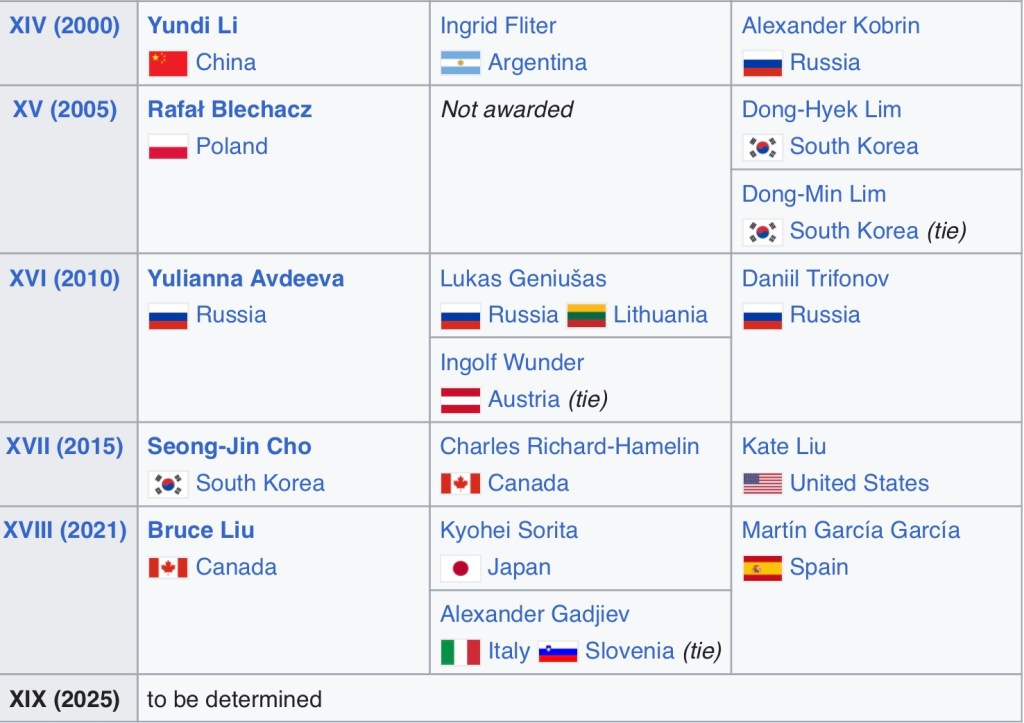
A programme from Kate Liu searching for the inner beauty and subtle sounds in all she played .A series of Mazurkas ,Waltzes and Nocturnes were allowed to unfold as if in a dream with ravishing whispered sounds .Even the Waltz in B minor op 69 n. 2 was played very slowly and beautifully as was the opening nocturne op 27 n.1. Missing the natural flow as she delved deep into sounds of delicacy and beauty.She had been awarded the Mazurka audience prize and Bronze Medal in the Chopin Competition in 2015 .A curious coincidence that a pianist with the same surname Bruce Liu should win first prize in 2021 It had been Fou Ts’ong in 1955 who had astonished the audience in Warsaw when the Mazurka prize was awarded to a non Polish pianist!Kate Liu was also awarded the Mazurka prize forty years later and she showed us why with three Mazurkas of exquisite sensibility and beauty.

It was obviously a moment of reflection for Kate Liu as even in the Schumann Etudes Symphoniques she found more of Eusebius than Florestan within.There was of course technical assurance and mastery and a rhythmic drive that seemed to ignite her playing after the five posthumous studies where she was able reveal the very soul of Schumann with exquisite timeless sounds .Her control and technical prowess ignited her performance with a ‘presto possibile’ of remarkable precision and the drive she brought to the Allegro con energia that followed was breathtaking with the sudden surprise entry of Florestan.Followed by the ravishing beauty and control of the Andante espressivo Chopinesque study leading into the finale played with driving rhythm and dynamic energy.Two encores were both from the world of Eusebius with the exquisite Bagatelle op 126 n. 5 where Beethoven could finally see the paradise that awaited him after a very difficult life full of earthly trials and tribulations.

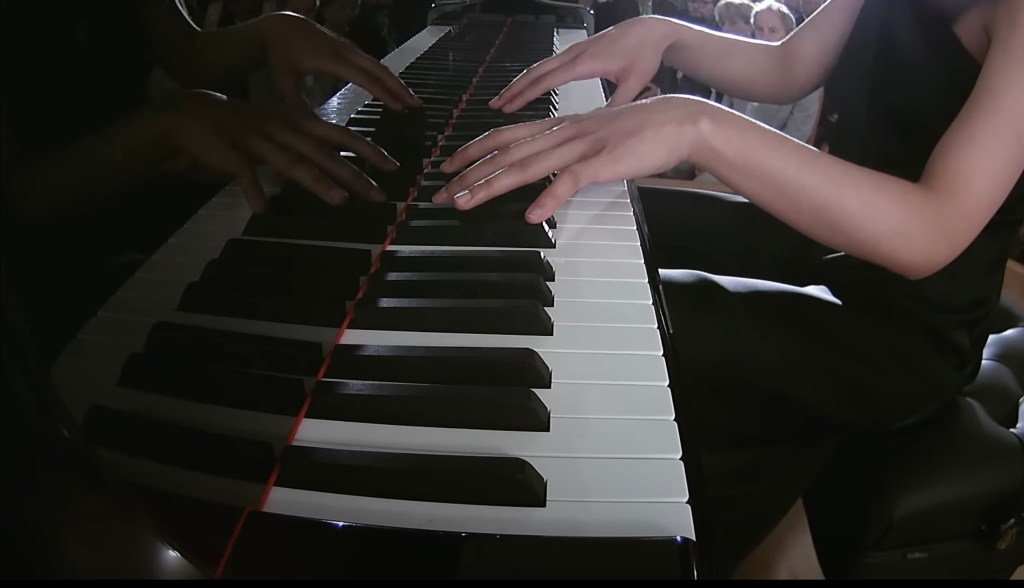
The first edition Schumann’s Etudes Symphoniques in 1837 carried an annotation that the tune was “the composition of an amateur”: this referred to the origin of the theme, which had been sent to Schumann by Baron von Fricken, guardian of Ernestine von Fricken, the Estrella of his Carnaval op. 9. The baron, an amateur musician, had used the melody in a Theme with Variations for flute. Schumann had been engaged to Ernestine in 1834, only to break abruptly with her the year after. An autobiographical element is thus interwoven in the genesis of the Études symphoniques (as in that of many other works of Schumann’s).Of the sixteen variations Schumann composed on Fricken’s theme, only eleven were published by him. (An early version, completed between 1834 and January 1835, contained twelve movements). The final, twelfth, published étude was a variation on the theme from the Romance Du stolzes England freue dich (Proud England, rejoice!), from Heinrich Marschner’s opera Der Templer und die Judin based on Sir Walter Scott’s Ivanhoe (as a tribute to Schumann’s English friend, William Sterndale Bennett to whom it is dedicated )The earlier Fricken theme occasionally appears briefly during this étude. The work was first published in 1837 as XII Études Symphoniques. Only nine of the twelve études were specifically designated as variations. The entire work was dedicated to Schumann’s English friend, the pianist and composer, and Bennett played the piece frequently in England to great acclaim, but Schumann thought it was unsuitable for public performance and advised his wife Clara not to play it.The highly virtuosic demands of the piano writing are frequently aimed not merely at effect but at clarification of the polyphonic complexity and at delving more deeply into keyboard experimentation. The Etudes are considered to be one of the most difficult works for piano by Schumann (together with his Fantasy in C and Toccata) and in Romantic literature as a whole.

Only nine of the twelve études were specifically designated as variations. The sequence was as follows:
- Theme – Andante [C♯ minor]
- Etude I (Variation 1) – Un poco più vivo [C♯ minor]
- Etude II (Variation 2) – Andante [C♯ minor]
- Etude III – Vivace [E Major]
- Etude IV (Variation 3) – Allegro marcato [C♯ minor]
- Etude V (Variation 4) – Scherzando [C♯ minor]
- Etude VI (Variation 5) – Agitato [C♯ minor]
- Etude VII (Variation 6) – Allegro molto [E Major]
- Etude VIII (Variation 7) – Sempre marcatissimo [C♯ minor]
- Etude IX – Presto possibile [C♯ minor]
- Etude X (Variation 8) – Allegro con energia [C♯ minor]
- Etude XI (Variation 9) – Andante espressivo [G♯ minor]
- Etude XII (Finale) – Allegro brillante (based on Marschner’s theme) [D♭ Major]
On republishing the set in 1890, Brahms restored the five variations that had been cut by Schumann. These are now often played, but in positions within the cycle that vary somewhat with each performance; there are now twelve variations and these five so-called “posthumous” variations which exist as a supplement.
The five posthumously published sections (all based on Fricken’s theme) are :
Kate Liu inserted them between Etude VIII and Etude IX
- Variation I – Andante, Tempo del tema
- Variation II – Meno mosso
- Variation III – Allegro
- Variation IV – Allegretto
- Variation V – Moderato.

Beethoven’s Bagatelles Op. 126 were published late in his career, in the year 1825 and dedicated to his brother Nikolaus Johann ( 1776–1848).Beethoven wrote to his publisher, Schott Music that the Opus 126 Bagatelles “are probably the best I’ve written”.In prefatory remarks to his edition of the works, Otto von Irmer notes that Beethoven intended the six bagatelles be played in order as a single work, at least insofar as this can be inferred from a marginal annotation Beethoven made in the manuscript: “Ciclus von Kleinigkeiten” (cycle of little pieces).Another reason to regard the work as a unity rather than a collection: starting with the second Bagatelle, the keys of the pieces fall in a regular succession of descending major thirds a pattern used in Beethoven’s ‘Eroica’Symphony and the String Quartet op 127

Pianist Kate Liu gained international acclaim after winning the Bronze Medal and Best Mazurka Prize at the 17th International Fryderyk Chopin Competition in Warsaw, Poland. She was also awarded the audience favorite prize voted by the Polish public on the Polish National Radio.
As a soloist, Kate has performed in many important venues, such as the Seoul Arts Center, Tokyo Metropolitan Theatre, Carnegie’s Weill Hall, Severance Hall in Cleveland, La Maison Symphonique de Montréal, Warsaw National Philharmonic, Kennedy Center in Washington, D.C., Shanghai Concert Hall, Osaka Symphony Hall, Polish National Radio Symphony Orchestra Hall, Phillip’s Collection, and others. She has collaborated with orchestras including the Cleveland Orchestra, Warsaw Philharmonic Orchestra, Orchestre Symphonique de Montréal, Polish Radio Orchestra, Poznan Philharmonic, Yomiuri Nippon Symphony Orchestra, Daegu Symphony Orchestra, Rochester Philharmonic, Hilton Head Symphony Orchestra, and Evanston Symphony Orchestra. Her debut album of works by Chopin was released on the Fryderyk Chopin Institute label in 2016.
Born in Singapore, Kate began playing the piano when she was four years old and moved to the United States when she was eight. Her private studies then were at the Music Institute of Chicago with Emilio del Rosario, Micah Yui and Alan Chow. Early on in her career, she won 1st Prizes at the Third Asia-Pacific International Chopin Competition and the New York International Piano Competition. She received a Bachelor’s degree from the Curtis Institute of Music studying with Robert McDonald, as well as a Master’s and Artist Diploma degree from The Juilliard School under the tutelage of Robert McDonald and Yoheved Kaplinsky.

photos Szymon Korzuch
 ChristopherAxworthy-MusicCommentary