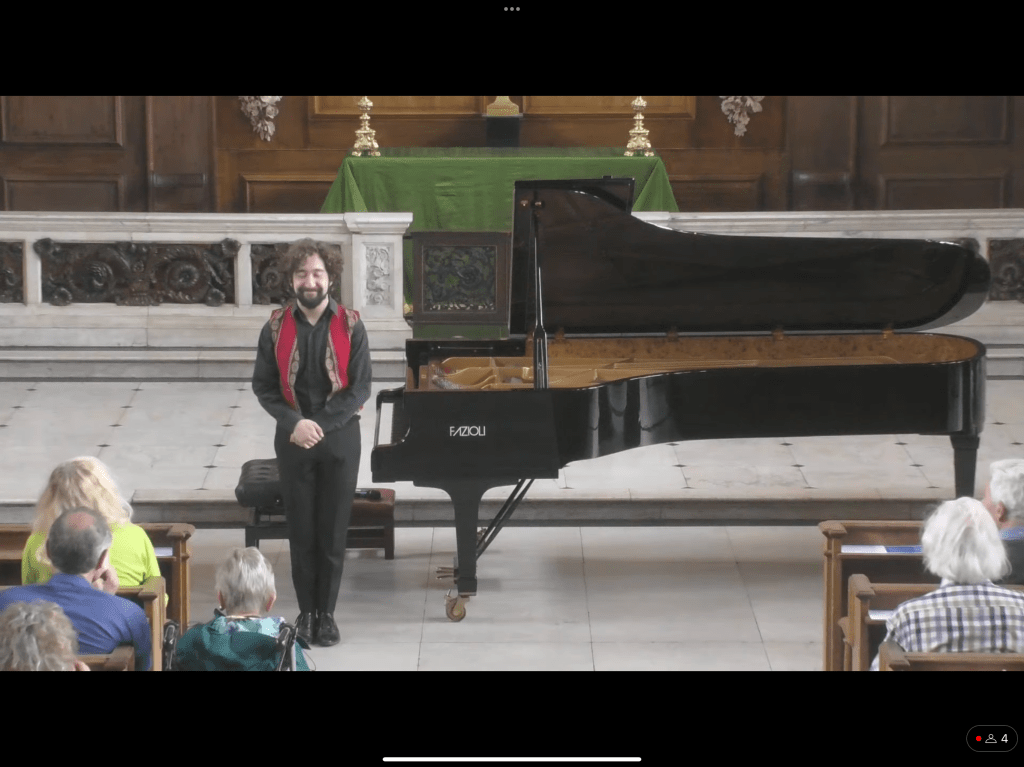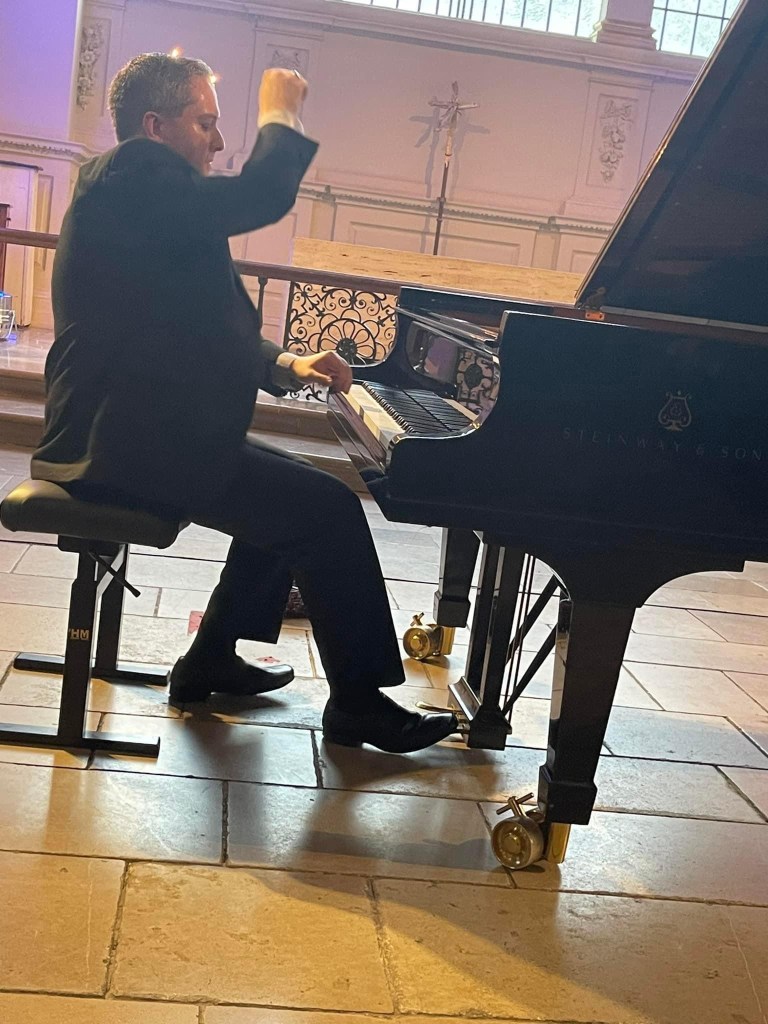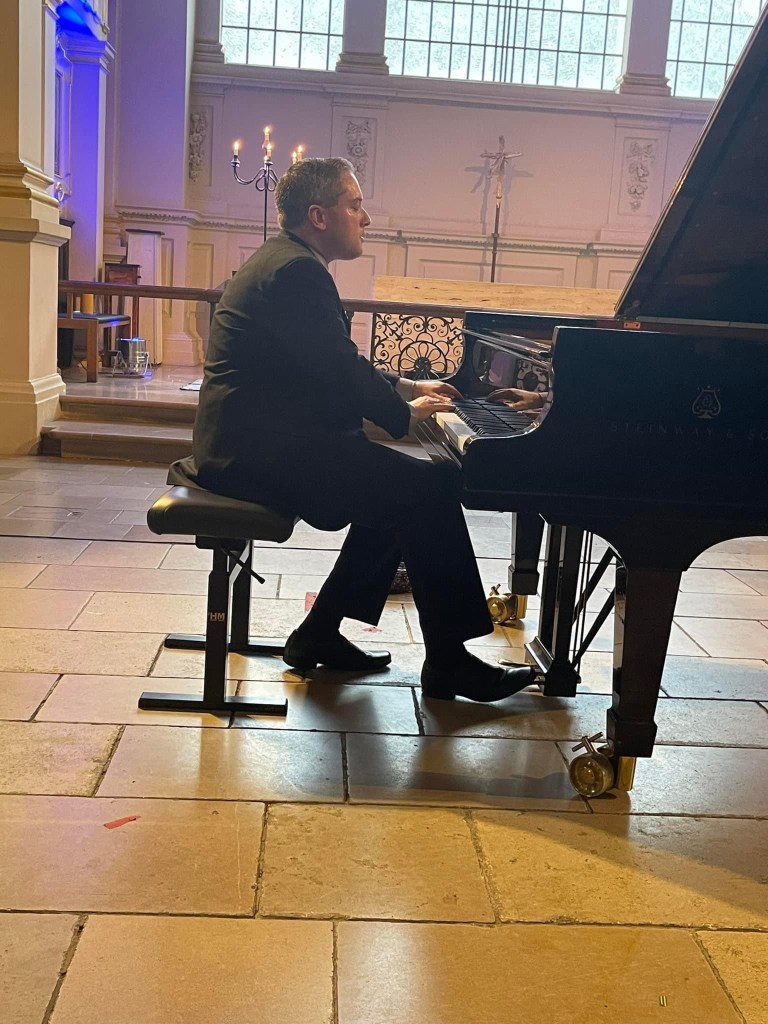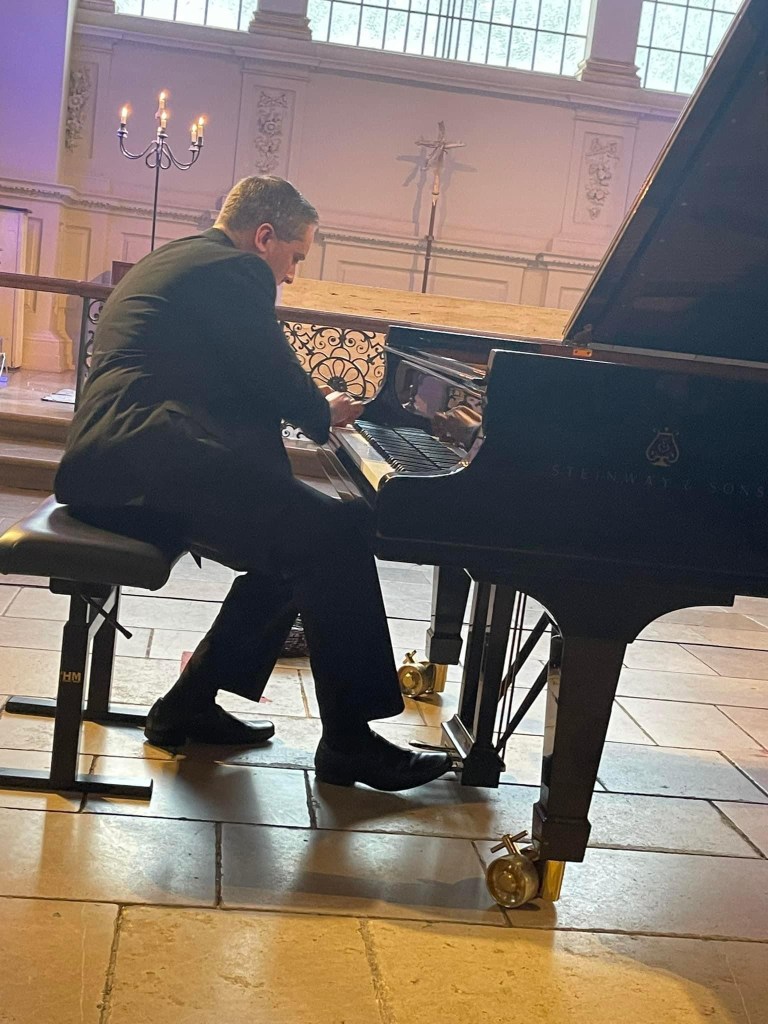
José Andres Navarro at St James’s Piccadilly Temperament,Authority and Musical integrity.

https://youtube.com/live/xaFtU8eiDNQ?feature=share

https://youtube.com/live/xaFtU8eiDNQ?feature=share
Another ‘Pictures’,two within twelve hours must be a record ……………Tyler Hay had played it and got a standing ovation at St Martin’s just a stone’s throw from Piccadilly Circus. But played by two superb musicians they were two completely different visions.
A stimulating rather than a boring coincidence as they are both pianist who I have long admired and tried to follow and in some way help them on their long journey towards finding the public their talent deserves.
It was like watching a prism where the light that shone upon the notes was in continual evolution depending how,when and where the light arrived at its goal.
José is a hot blooded South American and chose to take risks allowing his Latin temperament full reign to astonish and excite the senses.Nothing suits him better than the music of his native land where the seductive melodic lines are captivated in a insinuating mist of ambiguity before erupting into brilliantly energetic and even frenetic dance rhythms.
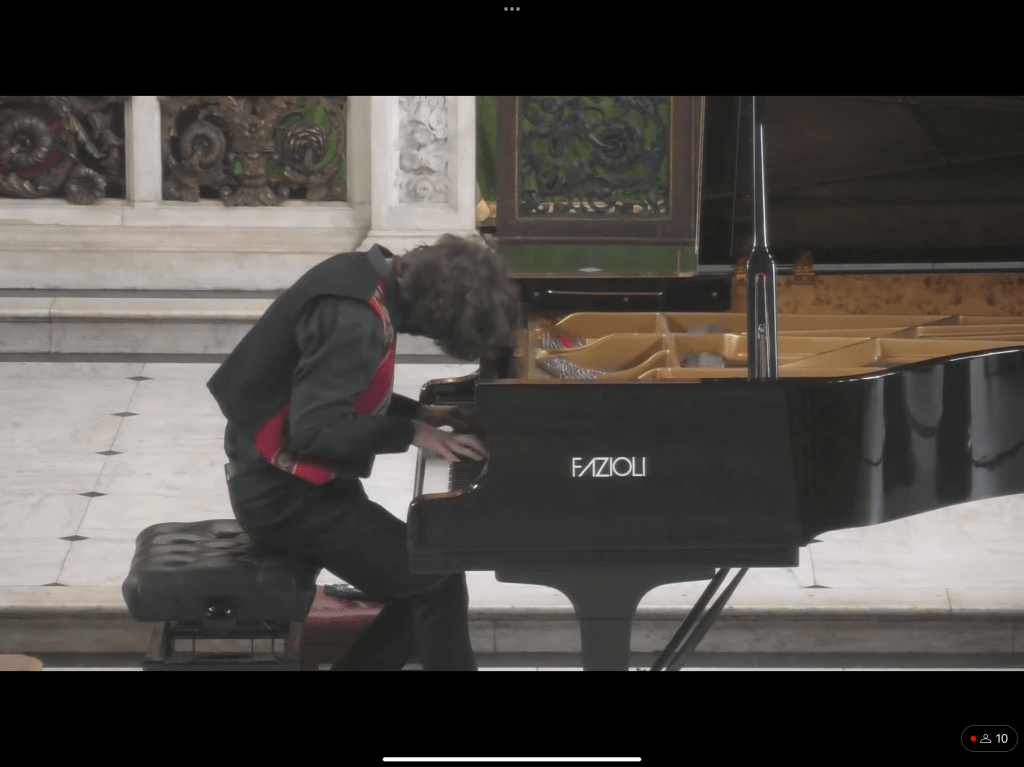
It was a selection of pieces by Ginastera,Sandi and Villa Lobos today that aroused seduced and ravished the senses played as to the manner born He was proudly dressed in his beautiful native Bolivian embroidered jacket.
But Jose Navarro has been studying for the past seven years in Europe having been discovered in Bolivia by a trustee and founder member of the Keyboard Trust.
Moritz von Bredow was on tour with a choir in Bolivia where he was invited to hear a talented young boy play the piano.He immediately arranged some concerts for him in Germany and José remained in Europe to study with the most important teachers of our time and to learn more intensely about the great German tradition of delving deep into the score to extract the composers wishes with honesty and integrity.
Paul Badura Skoda was a great mentor and Jose has been studying with the highly esteemed pianist and pedagogue Claudio Martinez Mehner.For the past year he has perfected his studies with Norma Fisher and Ian Jones obtaining his Artists degree and will now be Artist in Residence at La Chapelle in Belgium working with Frank Braley

I have heard José many times over the past year and have noticed how in such a short space of time his playing has grown in authority and musical integrity.His studies with Norma Fisher and Ian Jones at the Royal College of Music over the past year have given him an even firmer base for his superb musicianship.His playing of his native music of South America has always been impeccable in style with the duel personality of the insinuating seducer and the dynamic conqueror.Just a selection of short pieces today ignited the hall with the final frenetic animal drive of Villa Lobos after the beguiling charm of Ginastera and Sandi.

But it was the Mussorgsky Pictures at an Exhibition that showed off his true extraordinary musicianship as he managed to weld together into one complete picture a work that can too often seem fragmented.It was the collection that he had shown us of the exhibition of the individual paintings by his friend Victor Hartmann struck down so unexpectedly early in life .It showed a tour de force of control and technical authority that allowed him a full palette of colours and at the same time his Latin temperament could have full range but always within a musical framework that could see the overall larger picture.Resonance and clarity of the opening promenade led to the very energetic ‘Gnomus’with its frightening contrasts and startling final cascade of notes.Ease and delicacy led to the next picture of ‘The Old Castle’.It was played in a beautiful flowing ‘two’ that allowed the musical line to float on thin air and to be shaped with natural beauty.Finally blowing itself out with two gentle sighs as the Promenade to the next picture took on a more decisive gait.’Tuileries’ was played at quite a speed but always with the insistent child like pulsation on which filigree work was played with great precision and nonchalant ease .’Bydlo’ came bursting onto the scene with its lumbering insistence building to a mighty climax only to disappear into the distance as the promenade returned this time with luminosity and delicacy.The ‘Unhatched chicks’ was played with remarkable precision and dexterity and the trills were like mere vibrations of sound.There was drama as Samuel Goldenberg entered the scene with his imposing recitativo .Only to be answered by the delicate and intricate sounds of Schmuyle.A passionate discussion follows that was played with superb forward movement until the gentle grief stricken comment dismissed by the dominance of Goldberg.’The Market place in Limoges’ was full of nervous energy and was quite a tour de force of precision and colour.The resonance of the chords of the Catacombs was remarkable for the sumptuous full sounds and startling contrasts between each of the meandering chords.There was great technical control in ‘the Dead in a Dead Language’ with shimmering beauty as it reached for the unspeakable heights.Chased away by ‘Baba Yaga’ who suddenly came bursting onto the scene with such technical command and dynamic energy.The middle section again showed off Jose’s complete mastery of texture as he allowed the right hand to accompany the melodic line in the left hand before Baba Yaga appears on the scene again.A transcendental control of sound meant that the Great Gate of Kiev could be heard in all its many forms from the gentle apparition at the beginning to the mighty dramatic central episode with it’s cascading bells sweeping across the entire keyboard .Dissolving into the calm of a plain chant where the gradual pealing of bells was to build up to the enormous final declamation of a truly great Gate of Kiev.A remarkable performance played with the seriousness and intelligence of a true thinking musician but with a Latin temperament and heart of gold.

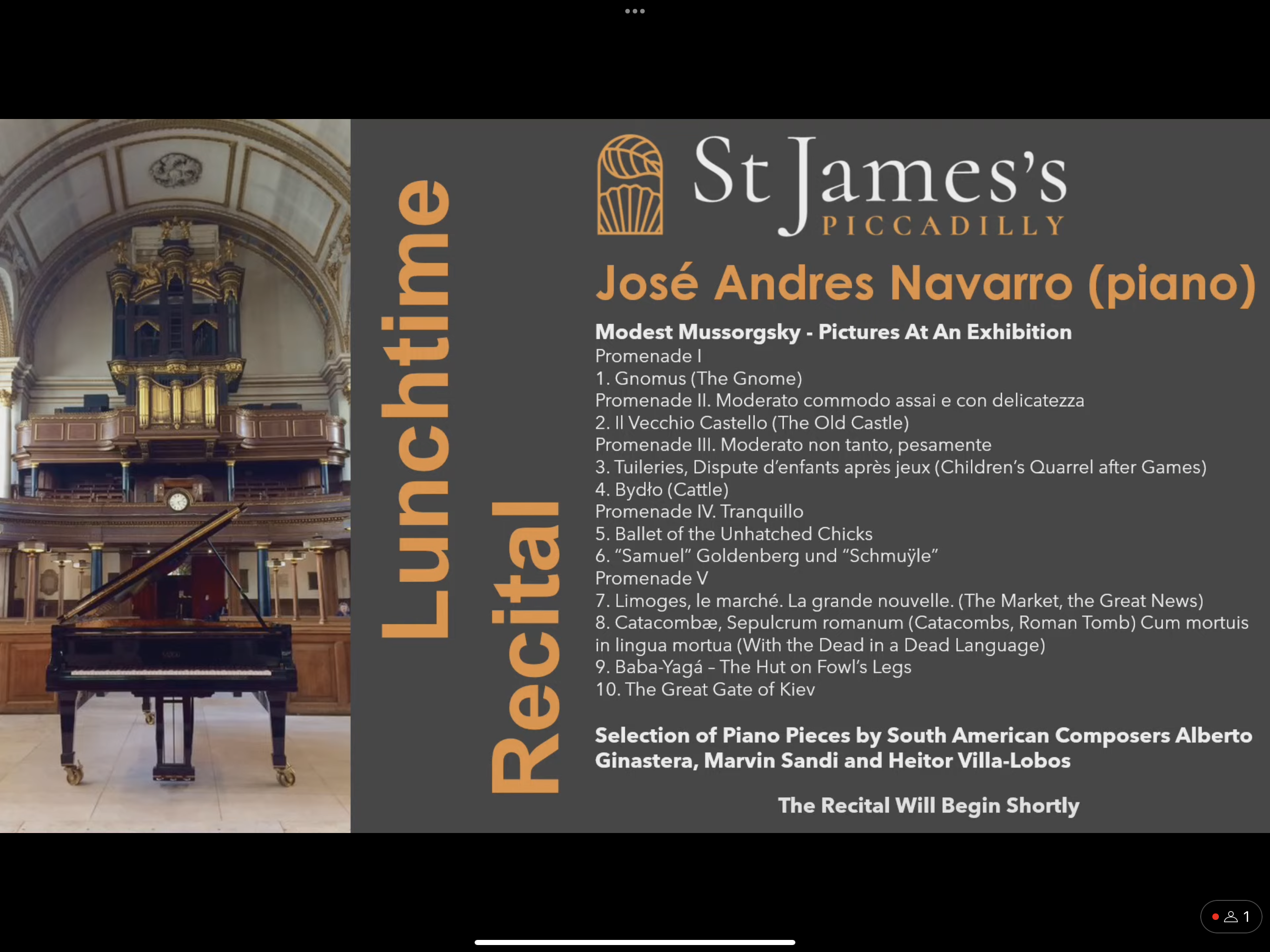
Modest Mussorgsky


Pictures at an exhibition
Promenade I

Gnomus (The Gnome)
Promenade II. Moderato commodo assai e con delicatezza

Il Vecchio Castello (The Old Castle)
Promenade III. Moderato non tanto, pesamente

Tuileries,Disputed’enfantsaprèsjeux (Children’s Quarrel after Games)

Bydło (Cattle)
Promenade IV. Tranquillo

Ballet of the Unhatched Chicks

“Samuel” Goldenberg und “Schmuÿle”
Promenade V

Limoges, le marché. La grande nouvelle. (The Market, the Great News)

Catacombæ, Sepulcrum romanum (Catacombs, Roman Tomb)
Cum mortuis in lingua mortua (With the Dead in a Dead Language)

Baba-Yagá – The Hut on Fowl’s Legs

The Great Gate of Kiev


Selection of Piano Pieces by South American Composers Alberto Ginastera, Marvin Sandi and Heitor Villa-Lobos

José Navarro Silberstein at St James’s A master musician with a heart of gold


Pictures at an Exhibition 
is based on pictures by the artist, architect, and designer Viktor Hartmann. It was probably in 1868 that Mussorgsky first met Hartmann, not long after the latter’s return to Russia from abroad. Both men were devoted to the cause of an intrinsically Russian art and quickly became friends. They met in the home of the influential critic Vladimir Stasov, who followed both of their careers with interest. According to Stasov’s testimony, in 1868, Hartmann gave Mussorgsky two of the pictures that later formed the basis of Pictures at an Exhibition.
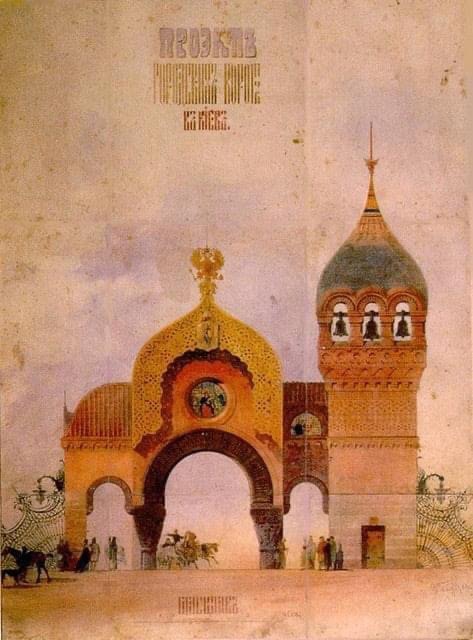
The Great Gate of Kiev

PICTURES AT AN EXHIBITION Promenade l
The Gnomes
Promenade ll
The Old Castle
Promenade lll
The Tuileries: Children’s dispute
after play
Bydlo
Promenade IV
Ballet of the unhatched chicks
Two Polish Jews: Rich and poor
Promenade V
The market at Limoges
Roman Catacombs – With the dead
in a dead language
Baba Yaga: The Witch
The Heroes Gate at Kiev
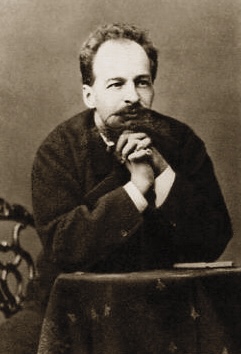
Viktor Hartmann

Hartmann’s sudden death on 4 August 1873 from an aneurysm shook Mussorgsky along with others in Russia’s art world. The loss of the artist, aged only 39, plunged the composer into deep despair. Stasov helped to organize a memorial exhibition of over 400 Hartmann works in the Imperial Academy of Arts in Saint Petersburg in February and March 1874. Mussorgsky lent the exhibition the two pictures Hartmann had given him, and viewed the show in person, inspired to compose Pictures at an Exhibition, quickly completing the score in three weeks (2–22 June 1874).Five days after finishing the composition, he wrote on the title page of the manuscript a tribute to Vladimir Stasov, to whom the work is dedicated.The music depicts his tour of the exhibition, with each of the ten numbers of the suite serving as a musical illustration of an individual work by Hartmann.Although composed very rapidly, during June 1874, the work did not appear in print until 1886, five years after the composer’s death, when a not very accurate edition by the composer’s friend and colleague Nikolai Rimsky-Korsakov was published.
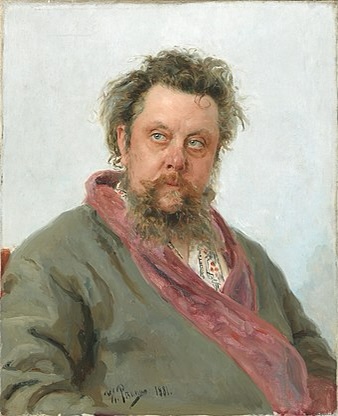
A portrait painted by Ilya Repin a few days before the death of Mussorgsky in 1881

Mussorgsky suffered personally from alcoholism, it was also a behavior pattern considered typical for those of Mussorgsky’s generation who wanted to oppose the establishment and protest through extreme forms of behavior.One contemporary notes, “an intense worship of Bacchus was considered to be almost obligatory for a writer of that period.”Mussorgsky spent day and night in a Saint Petersburg tavern of low repute, the Maly Yaroslavets, accompanied by other bohemian dropouts. He and his fellow drinkers idealized their alcoholism, perhaps seeing it as ethical and aesthetic opposition. This bravado, however, led to little more than isolation and eventual self-destruction.

José Andres Navarro
The young Bolivian pianist has performed in different countries in venues and festivals in Europe, USA, and South America. Halls include the Teatro Municipal “Alberto Saavedra Pérez” in his hometown La Paz till the Musikverein in Vienna. From 2022 he is a Talent Unlimited Artist in London. In September 2023 he will launch his debut CD “Vibrant Rhythms” with GENUIN Classics.
As a soloist, he has performed with the Jena Philharmonic Orchestra, Norddeutsche Philharmonie Rostock, Georgian Philarmonic Orchestra, La Paz Symphony Orchestra, Orquesta de Jóvenes Musicos Bolivianos and Orquesta Sinfónica Juvenil de Santa Cruz de la Sierra under the baton of Timothy Redmond, Markus L. Frank, Wojciech Rajski, Andreas Penninger among others.
He is a prize winner at the Anton Rubinstein Piano Competition in Düsseldorf, Tbilisi International Piano Competition in Georgia, International Competition Young Academy Award in Rome, Claudio Arrau International Piano Competition in Chile among many others. He was a finalist at the Eppan Piano Academy and at the 63rd Ferruccio Busoni International Piano Competition.
In Bolivia he gave masterclasses in La Paz Conservatory, Sucre Conservatory Santa Cruz Fine Arts College and Laredo School in Cochabamba. He served as a jury member in national music competitions.
He was mentored by Paul Badura Skoda, from whom he became a particular interest for period instruments. He studied with Balasz Szokolay at the Franz Liszt University in Weimar and with Claudio Martínez Mehner at the University of Music and Dance in Cologne. At the moment he has just graduated with honours from the Artist Diploma programme at the Royal College of Music in London under the guidance of Norma Fisher and Ian Jones. Her receives scholarships from RCM, Herrmann Foundaiton Liechtenstein-Bolivia, Theo and Petra Lieven Foundation of Hamburg and Elfrun Gabriel Foundation for Young Pianists. He is going to be an Artist in Residence of the Queen Elisabeth Music Chapel from September 2023.

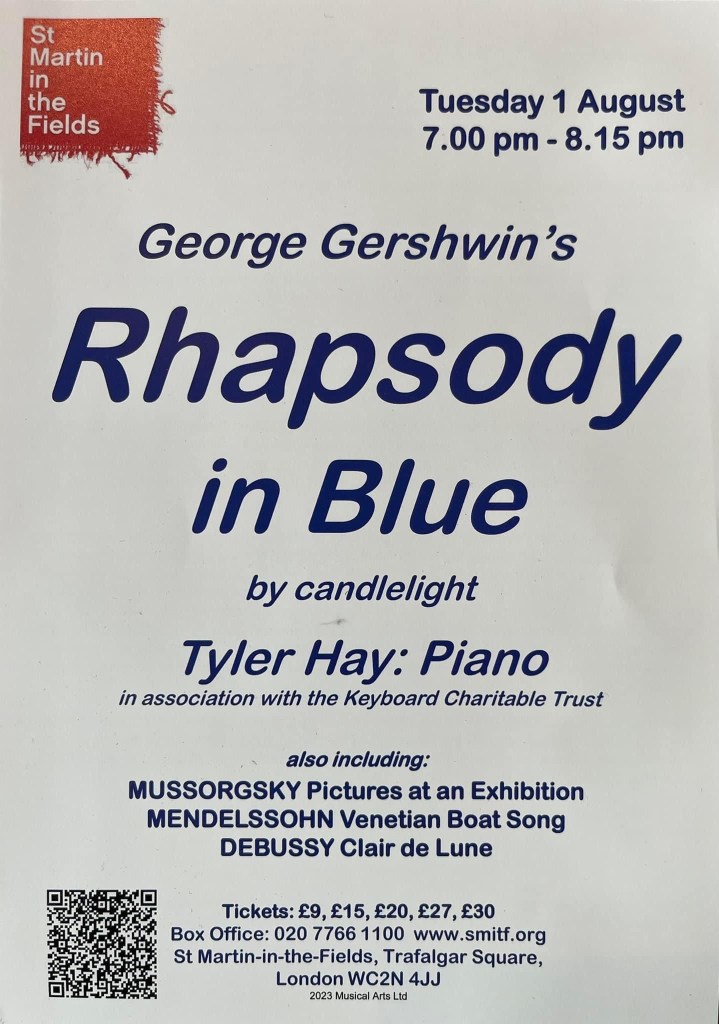
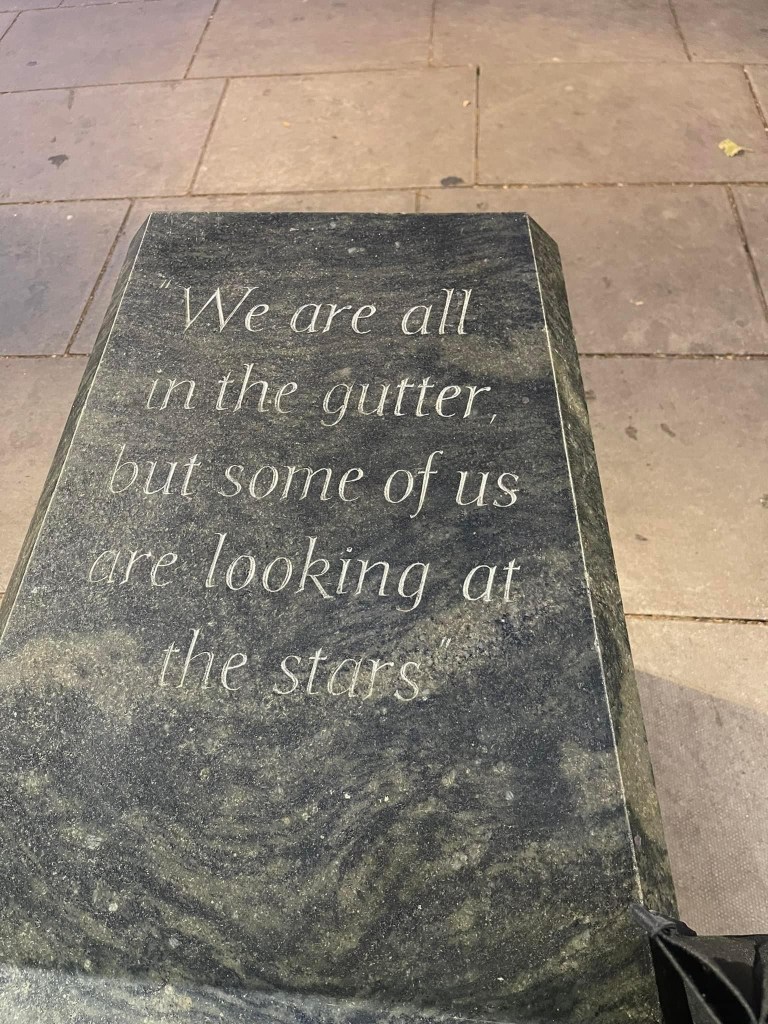
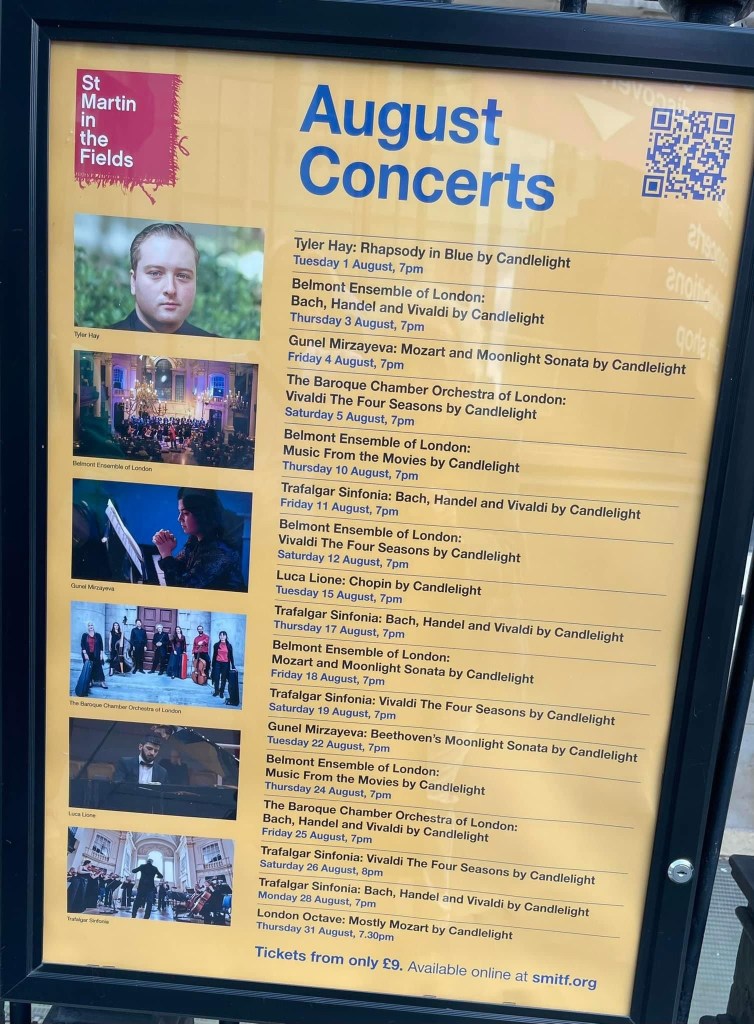
Tyler Hay reaching for the stars.’From candlelight to starlight’.A masterly display of artistry and showmanship at St Martin in the Fields

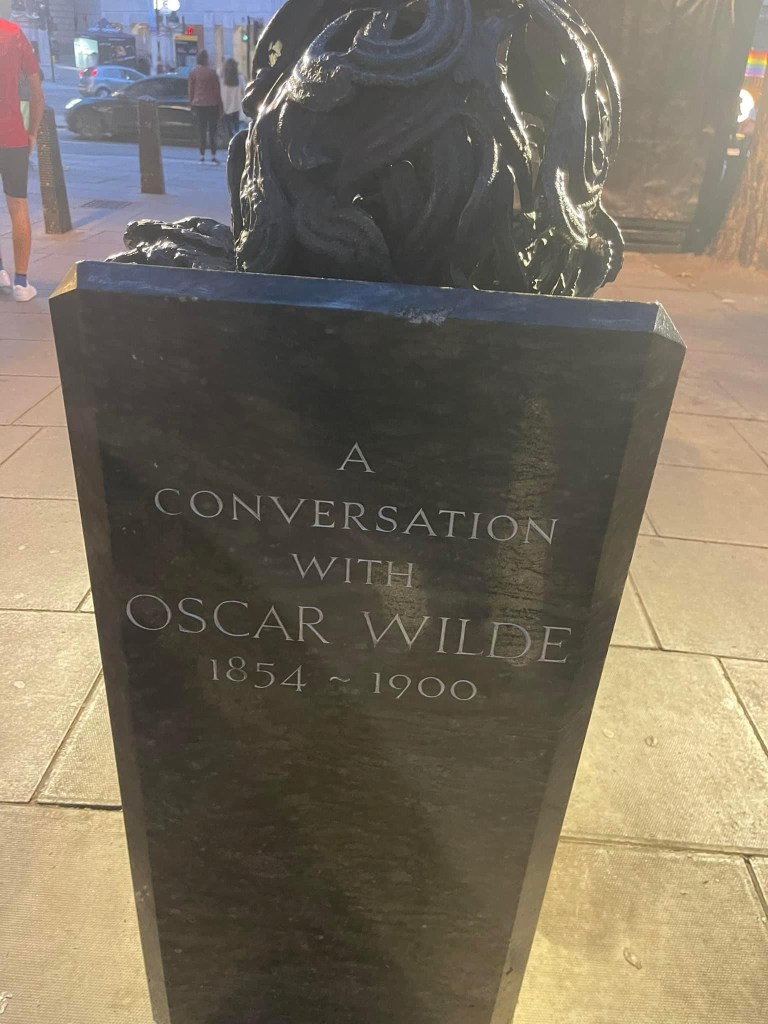
The monument to Oscar Wilde in the shadow of St Martin’s

A standing ovation for Tyler Hay after a masterly recital at St Martin in the Fields of works from Mendelssohn Songs without words to Hoagy Carmichael’s Stardust .
A wondrous journey from the ravishing beauty of five of Mendelssohn best loved ‘Songs without words’ played with disarming simplicity and beauty.
A monumental performance of Mussorgsky’s ‘Pictures’ where each one was painted with a kaleidoscopic palette of colour and an extraordinary sense of characterisation.All leading to the final Great Gate of Kiev which came as a triumphant glorification of freedom and truth.
Bells peeling all over the keyboard as the final glorious outcry filled this magnificent edifice with sounds that reverberated with such significance in every soul present.
A delicate ‘Clair de Lune’ followed of luminosity and fluidity where streams of mellifluous sounds were etched in gold on a seamless silver platter.
Gershwin’s classic ‘Rhapsody in Blue’ ended this short recital in full swing style with beguiling innuendo and teasing rhythmic energy.
Grandeur and nobility united in a scintillating display of unashamed showmanship from an artist who could also reveal the subtle and unique artistry of a composer who Nadia Boulanger refused to teach for fear of contaminating a unique voice.
A voice Tyler had too as he introduced the programme with amusing anecdotes and the ease and charm of a Victor Borge.
An encore was offered by great demand of a transcription by his grandfather John Hay It was he who had sown the seed of music in the six year old Tyler with his jazz transcriptions of which ‘Stardust’ by Hoagy Carmichael was the one that Tyler chose to share with us by candlelight today
A memorable recital that had us on our feet in a spontaneous ovation for an artist who had shared a wondrous journey of uplifting music making with us today.

A new partnership with the distinguished conductor John Landor brought two artists to St Martin’s from the stable of the Keyboard Trust for their sold out candlelight concerts series.
John Landor pictured above with Sarah Biggs the CEO of the Keyboard Trust .
John Landor is conductor and music director of the London Musical Arts Orchestra He studied at Oxford University , the Royal Academy of Music in London and the St Petersburg Conservatory under the legendary conducting teacher Ilya Musin . 1991, he has conducted orchestras, choirs and opera companies in Spain, Italy, Bulgaria, Russia, Germany, France, Romania and South Africa. His recordings include releases for Pickwick Records. He is an Associate of the R.A.M , London and has presented a series at St Martin’s since 1992.John is also a composer, arranger and an experienced and popular presenter of educational concerts for both children and a popular presenter of educational concerts for both children and adults

It was nice to be back in the regal surrounds of St Martin in the Fields just the other side of Trafalgar Square where the Keyboard Trust has given many concerts over the past few years in collaboration with the Brazilian Embassy in the historic Cunard Hall – now rechristened Sala Brasil.https://christopheraxworthymusiccommentary.com/2023/06/16/tyler-hay-and-david-zucchi-celebrate-the-work-of-radames-gnattali-at-the-sala-brasil/

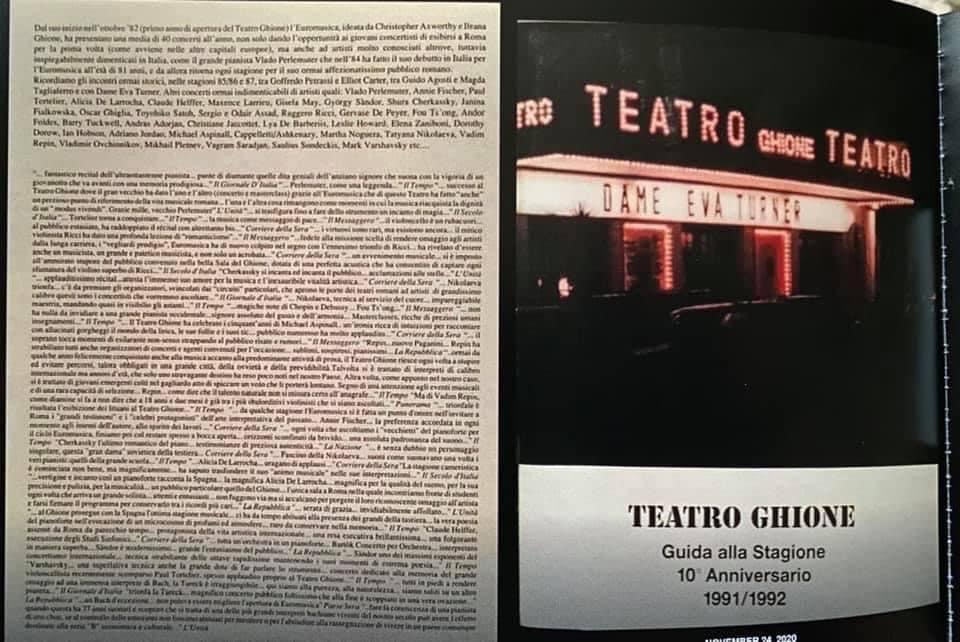
I had given a recital in St Martin’s in 1972 the year I won the Gold Medal at the RAM and I have rarely been back since.A recital that also signalled my swan song as music was to take me to Rome and the life of a concert theatre manager together with my distinguished actress wife Ileana Ghione.

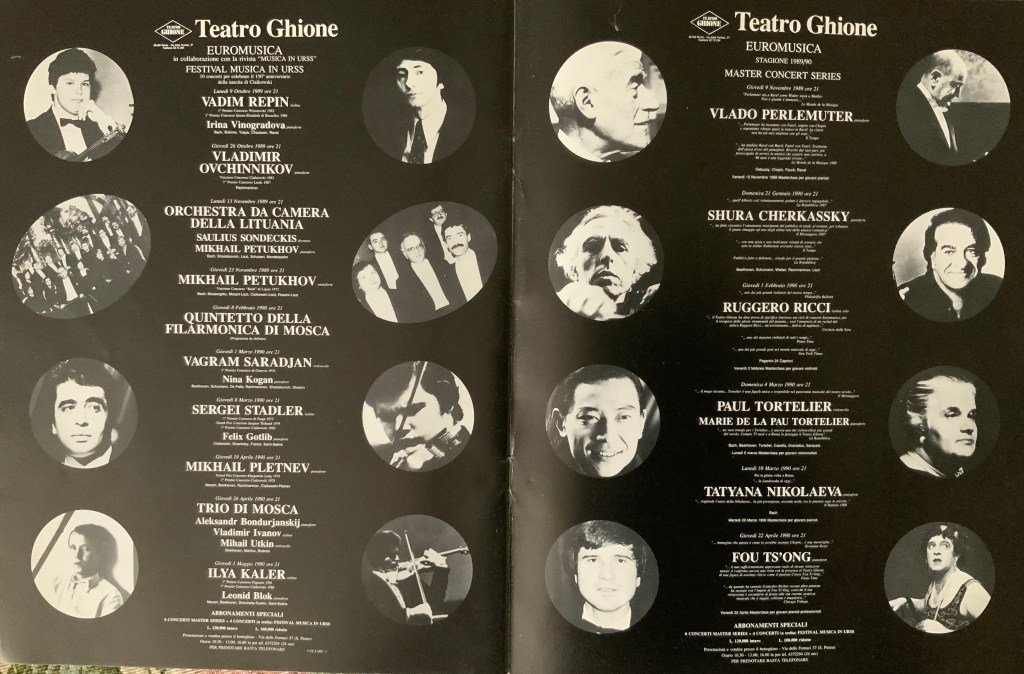
Euromusica/Teatro Ghione with over 40 concerts a year and many more of theatrical productions

Our theatre next to St Peter’s Square became the Wigmore Hall of Rome where we were able not only to produce the plays in the way my wife wanted but also to invite to Rome young aspiring musicians and legendary old one’s strangely overlooked in Italy.Vlado Perlemuter,my teacher ,made his debut in Italy in 1984 as did my other teacher Guido Agosti both in their 80’s.Rosalyn Tureck made her come back to the concert stage at 77.Cherkassky played ten times and together with Fou Ts’ong ,Peter Frankl,Peter Katin ,Moura Lympany and many others became favourites in Rome.Roberto Prosseda,Angela Hewitt and Janina Fialkowska all made the theatre their home too.

I am now split between Rome and London and being a retired gentleman can enjoy both without having to worry about organising the day to day running of a theatre in Rome any more.I remember very well the piano at St Martin’s in 1972 that I had played and had been bequeathed to St Martin’s by Sir Thomas Beecham.It now stands in St Lawrence Jewry and in its place stands a gleaming new Steinway concert grand bequeathed to the church by a wealthy benefactor.It is nice to know that our host John Landor is also an Associate of the RAM like me and the compliments he gave to Tyler after his recital were of a real discerning musician.

Tyler chose five of the best known of Mendelssohn’s much loved ‘Songs without Words’ .In eight volumes, each consisting of six songs that were written at various points throughout Mendelssohn’s life and published separately.
In 2008, the Italian pianist Roberto Prosseda recorded a collection of them for Decca totalling 56 Lieder, some of them never recorded before.
https://christopheraxworthymusiccommentary.com/2021/01/13/roberto-prosseda-pays-tribute-to-the-genius-of-chopin-and-the-inspirational-figure-of-fou-tsong/
Tyler chose the best known and as he very charmingly said he had over the past months fallen in love with them.
It was this love that was so apparent as he caressed the keys of the very first one to have been written.Beautifully shaped as it was allowed to flow so naturally with great sensitivity and ravishing beauty.A true ‘song’ that surely spoke louder that words ever could as it rose in intensity only to end with a whisper of enticing secret thoughts.
There was a Schumannesque rhythmic outpouring to the ‘Hunting’ song played with a ‘joie de vivre’ of clarity and brilliance only to be thrown away at the end with nonchalant teasing ease.
The ‘Venetian Boat ‘ song with it’s beautiful melodic line floated on a continuous wave of sounds.Played with a subtle rubato that added such grace and nobility to its haunting melodic outpouring.
There was not only charm and grace in the famous ‘Spring’ song but much more besides from an artist who knows how to look afresh at such a well known work and make it relive .Not with the usual sentimental rhetoric but with aristocratic style,never sentimental,but noble and beautiful.No rallentando at the end as the music just vanished into thin air as Mendelssohn had asked.Played : piano.pianissimo,dolce,grazioso and leggiero which Tyler did with a technical mastery at the service of the music.
The final ‘Spinning ‘song I had an old 78 rpm record that I used to play as a child where it was called the ‘Bees Wedding’.The golden web that Tyler spun with irresistible charm and style reminded me of the surprise encore from Artur Rubinstein fifty years ago in which the supreme stylist could still surprise as he pulled ever more works out of his musical valise even in his Indian summer.
A monumental performance of Mussorgsky from a real musician. There was refined phrasing from the very first bare notes that rang out as we were guided around the exhibition of paintings of Victor Hartmann.
There was a resonance of nobility and intensity as ‘Gnomus’ became almost unbearable until it dissolved into spindly sounds and a cascade of notes played with a transcendental command and superlative control.
The ‘Old Castle’ was played with clarity as the haunting unrelenting forward movement was resolved with some very interesting underlining of inner counterpoints.A more rumbustuous Promenade after the previous tip toeing one took us to the childish bickering in the ‘Tuileries’ and on to the lumbering cattle that swept onto the scene with energy and evident fatigue!
‘Bydlo’ was played with an astonishing range of sounds and a sumptuous sense of balance that gave great architectural shape to such a lumbering beast.
Glorious etherial sounds from a Promenade whispering on high as we were confronted with the lightweight technical demands of the ‘Unhatched chicks’.A mastery that Tyler had acquired almost twenty years after his first foray into the exhibition.He had played this piece as a teenager to his teacher Andrew Haigh who had exclaimed it was more of an omelette than unhatched chicks!
Superb precision and lightness with impeccable trills show how talented youngsters can turn into accomplished artists under the right guidance!
There was rhetoric to the recitativo of Samuel Goldenberg with the imploring beseeching cry from Schmuyle .A beautiful reconciliation ‘con dolore’ was played with a magical change of colour before Goldenberg just slammed the door shut and would hear no more nonsense!
A grandiose Promenade this time but left on a single resonating B flat which started the Hubble and Bubble of the ‘Market Place at Limoges’ .Cascades of resonant sounds were suddenly silenced by the austerity of the ‘Catacombs.’
A remarkable change of mood and colour with a terrifying series of hammered out chords.Hammered,but in this artists hands with a sense of colour and shape that resounded around this cavernous edifice with extraordinary effect.Dissolving to the mysterious vibrations of the ‘Dead in a Dead language’ that with a magical change of harmony found a final ray of vision and hope.
A remarkable control of sounds that just demonstrates that the great pianists are not those that can play loud and fast but those that can play pianissimo with clarity and control .It this the great lesson that we were to learn from the first appearances of Sviatoslav Richter in the west in the the late sixties and seventies.
There was violence as ‘Baba Yaga’ appeared on the scene with the ‘Hut On Hen’s Legs.’Enormous sumptuous sounds of energy and dynamism before the calming waters of the central episode with it remarkable orchestral colouration and shimmering accompaniment to the bass melodic line.An atomic eruption was suddenly taken away from beneath our feet as the gentle chords of the Great Gate suddenly appeared as we were forced to overhear from the distance a theme we know so well.As we were drawn in to listen suddenly the bells started tolling in every corner of the keyboard in a transcendental display of virtuosity.
A kaleidoscope of sounds and colours with the use of the pedals that could give a technicolour illusion by means of a superlative sense of balance of overwhelming mastery.
Tyler,the true magician who can turn a percussive instrument into a glorious resonant box of wondrous sounds.
There was beautiful simplicity,luminosity and fluidity to Debussy’s much loved ‘Clair de Lune’.The third movement of his Suite bergamasque, L. 75 (1905), inspired by the poem by Paul Verlaine.
A continual stream of mellifluous sounds where the final appearance of the opening melodic line was etched with purity on streams of magical sounds.
Introduced with a charming story of having busked it by request in a ‘pub’ in Scotland.Not having been well received he decided to learn it properly now!
A standing ovation for a pianist who could still pull out all the stops and give a stunning multicoloured performance of Gershwin’s famous Rhapsody in Blue.An amazing series of episodes of scintillating virtuosity and heartrending nostalgia.A technical command that seemed to have no limits as the insinuating opening trill unwound into a box of tricks that had us all on our feet at the end such was the exhilaration and excitement generated by this remarkable young man.
An encore of an arrangement of ‘Stardust’ by Tyler’s much loved grandfather John Hay,who passed away six years ago,was a moving tribute to his inspiration and mentor
A standing ovation from an audience that filled every seat in this magnificent Church in Trafalgar Square

Pictures at an Exhibition is based on pictures by the artist, architect, and designer Viktor Hartmann. It was probably in 1868 that Mussorgsky first met Hartmann, not long after the latter’s return to Russia from abroad. Both men were devoted to the cause of an intrinsically Russian art and quickly became friends. They met in the home of the influential critic Vladimir Stasov, who followed both of their careers with interest. According to Stasov’s testimony, in 1868, Hartmann gave Mussorgsky two of the pictures that later formed the basis of Pictures at an Exhibition.

The Great Gate of Kiev

PICTURES AT AN EXHIBITION Promenade l
The Gnomes
Promenade ll
The Old Castle
Promenade lll
The Tuileries: Children’s dispute
after play
Bydlo
Promenade IV
Ballet of the unhatched chicks
Two Polish Jews: Rich and poor
Promenade V
The market at Limoges
Roman Catacombs – With the dead
in a dead language
Baba Yaga: The Witch
The Heroes Gate at Kiev

Viktor Hartmann

Hartmann’s sudden death on 4 August 1873 from an aneurysm shook Mussorgsky along with others in Russia’s art world. The loss of the artist, aged only 39, plunged the composer into deep despair. Stasov helped to organize a memorial exhibition of over 400 Hartmann works in the Imperial Academy of Arts in Saint Petersburg in February and March 1874. Mussorgsky lent the exhibition the two pictures Hartmann had given him, and viewed the show in person, inspired to compose Pictures at an Exhibition, quickly completing the score in three weeks (2–22 June 1874).Five days after finishing the composition, he wrote on the title page of the manuscript a tribute to Vladimir Stasov, to whom the work is dedicated.The music depicts his tour of the exhibition, with each of the ten numbers of the suite serving as a musical illustration of an individual work by Hartmann.Although composed very rapidly, during June 1874, the work did not appear in print until 1886, five years after the composer’s death, when a not very accurate edition by the composer’s friend and colleague Nikolai Rimsky-Korsakov was published.

A portrait painted by Ilya Repin a few days before the death of Mussorgsky in 1881

Mussorgsky suffered personally from alcoholism, it was also a behavior pattern considered typical for those of Mussorgsky’s generation who wanted to oppose the establishment and protest through extreme forms of behavior.One contemporary notes, “an intense worship of Bacchus was considered to be almost obligatory for a writer of that period.”Mussorgsky spent day and night in a Saint Petersburg tavern of low repute, the Maly Yaroslavets, accompanied by other bohemian dropouts. He and his fellow drinkers idealized their alcoholism, perhaps seeing it as ethical and aesthetic opposition. This bravado, however, led to little more than isolation and eventual self-destruction.

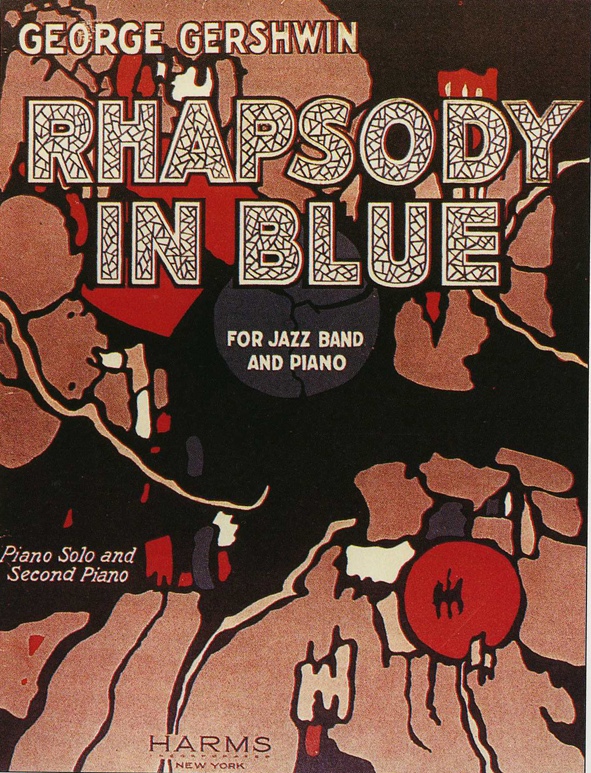
Cover of the original sheet music of Rhapsody in Blue

Rhapsody in Blue was written in 1924 for solo piano and jazz band, which combines elements of classical with jazz influenced effects. Commissioned by bandleader Paul Whiteman , the work premiered in a concert titled “An Experiment in Modern Music” on February 12, 1924, in Aeolian Hall ,New York City.Whiteman’s band performed the rhapsody with Gershwin playing the piano.Whiteman’s arranger Ferde Grofé orchestrated the rhapsody several times including the 1924 original.

With only five weeks remaining until the premiere, Gershwin hurriedly set about composing the work.He later claimed that, while on a train journey to Boston ,the thematic seeds for Rhapsody in Blue began to germinate in his mind.

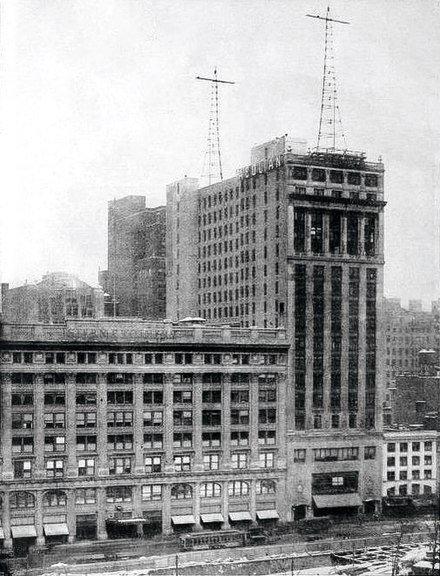
The Rhapsody premiered on a snowy afternoon at Aeolian Hall, Manhattan, pictured here in 1923.

‘It was on the train, with its steely rhythms, its rattle-ty bang, that is so often so stimulating to a composer…. I frequently hear music in the very heart of the noise. And there I suddenly heard—and even saw on paper—the complete construction of the rhapsody, from beginning to end. No new themes came to me, but I worked on the thematic material already in my mind and tried to conceive the composition as a whole. I heard it as a sort of musical kaleidoscope of America, of our vast melting pot of our unduplicated national pep, of our metropolitan madness. By the time I reached Boston I had a definite plot of the piece, as distinguished from its actual substance.

Hoagy Carmichael ‘Stardust’

https://youtube.com/watch?v=j2fbOAyNOpM&feature=share

Carmichael wrote the song with inspiration from the end of his love affair with Kathryn Moore, who would later marry Art Baker, the trumpet player in Carmichael’s Collegians.One night after leaving the Book Nook, a university hangout, Carmichael whistled what would become the opening of the song. The composer later declared that he felt that the tune “had something very strange and different”Carmichael did not want to reveal the details of the night he worked on the song with the family’s piano, saying “the public likes to think these sweet songs are conceived under the moonlight, amid roses and soft breezes”.

https://christopheraxworthymusiccommentary.com/2022/07/01/luca-lione-in-london-23rd-june-2022/
https://christopheraxworthymusiccommentary.com/2023/06/02/the-gift-of-music-the-keyboard-trust-at-30/
John Landor with Tyler Hay
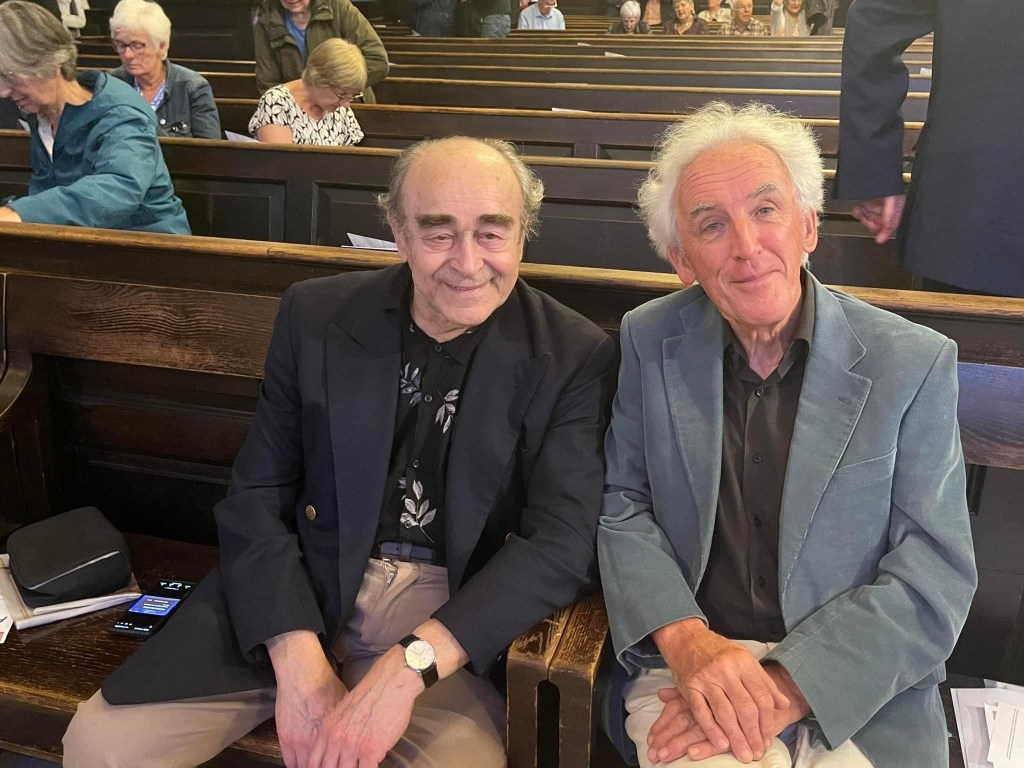
Alberto Portugheis with Tyler
https://christopheraxworthymusiccommentary.com/2023/02/23/alberto-portugheis-a-renaissance-man-goes-posk-to-celebrate-the-213th-birthday-of-fryderyk-franciszek-chopin/
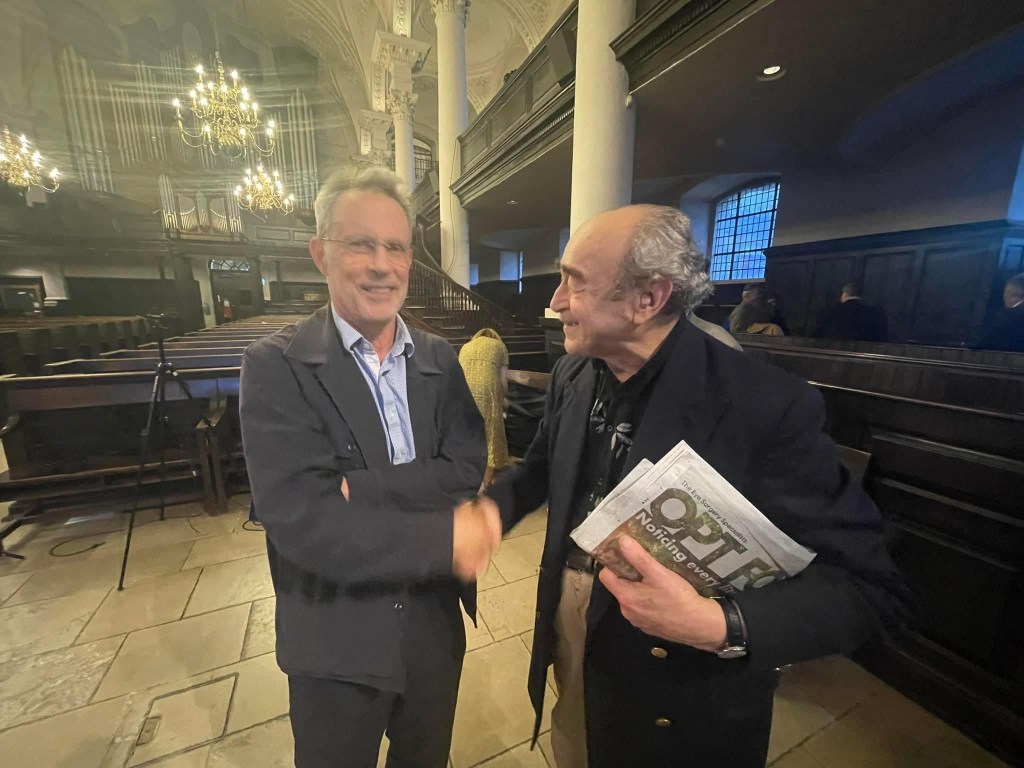
Alberto Portugheis with John Landor
Alberto with CA
Sarah and Phil with Alberto
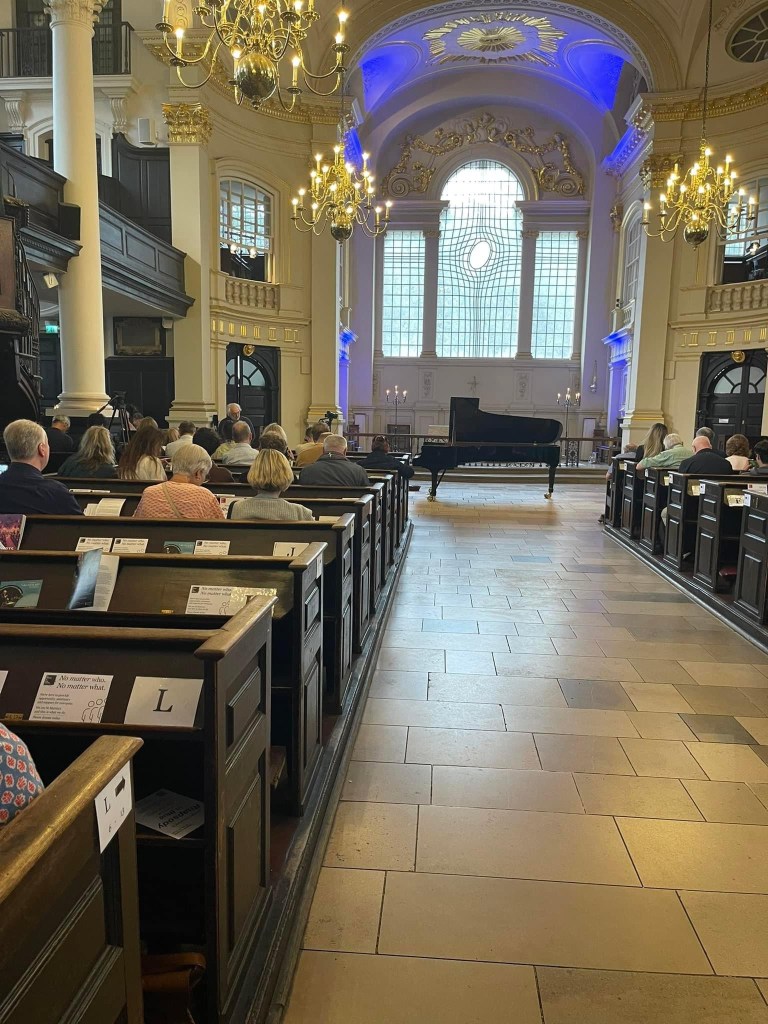
The magnificence that is St Martin in the Fields