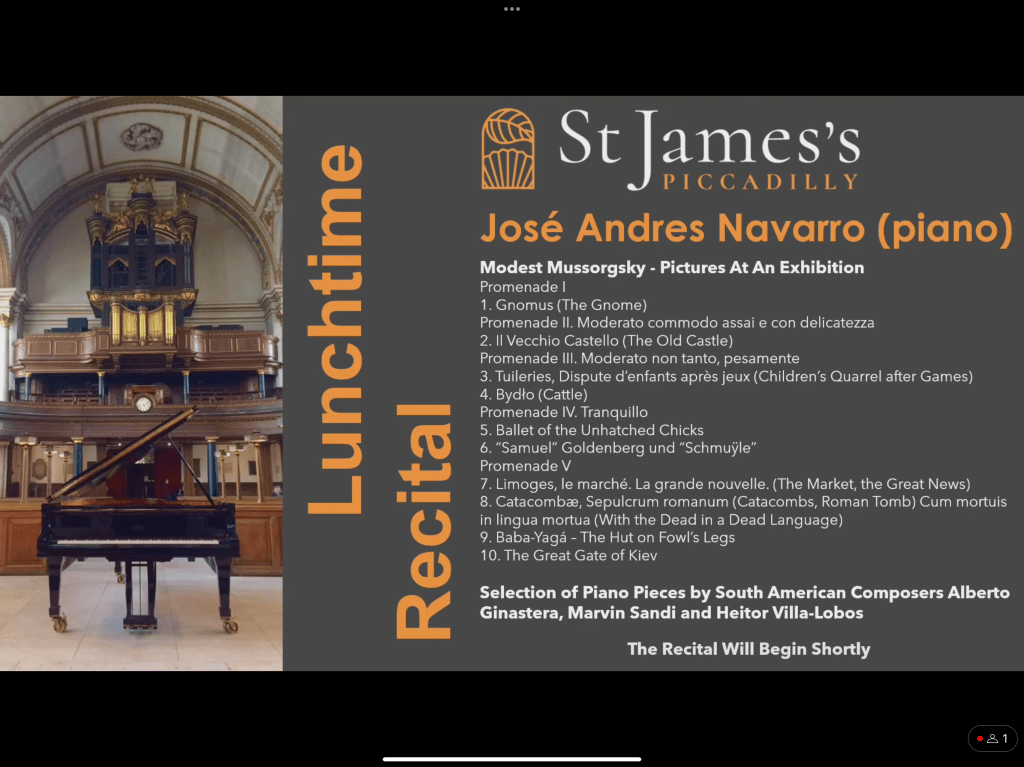

https://youtube.com/live/xaFtU8eiDNQ?feature=share
Another ‘Pictures’,two within twelve hours must be a record ……………Tyler Hay had played it and got a standing ovation at St Martin’s just a stone’s throw from Piccadilly Circus. But played by two superb musicians they were two completely different visions.
A stimulating rather than a boring coincidence as they are both pianist who I have long admired and tried to follow and in some way help them on their long journey towards finding the public their talent deserves.
It was like watching a prism where the light that shone upon the notes was in continual evolution depending how,when and where the light arrived at its goal.
José is a hot blooded South American and chose to take risks allowing his Latin temperament full reign to astonish and excite the senses.Nothing suits him better than the music of his native land where the seductive melodic lines are captivated in a insinuating mist of ambiguity before erupting into brilliantly energetic and even frenetic dance rhythms.
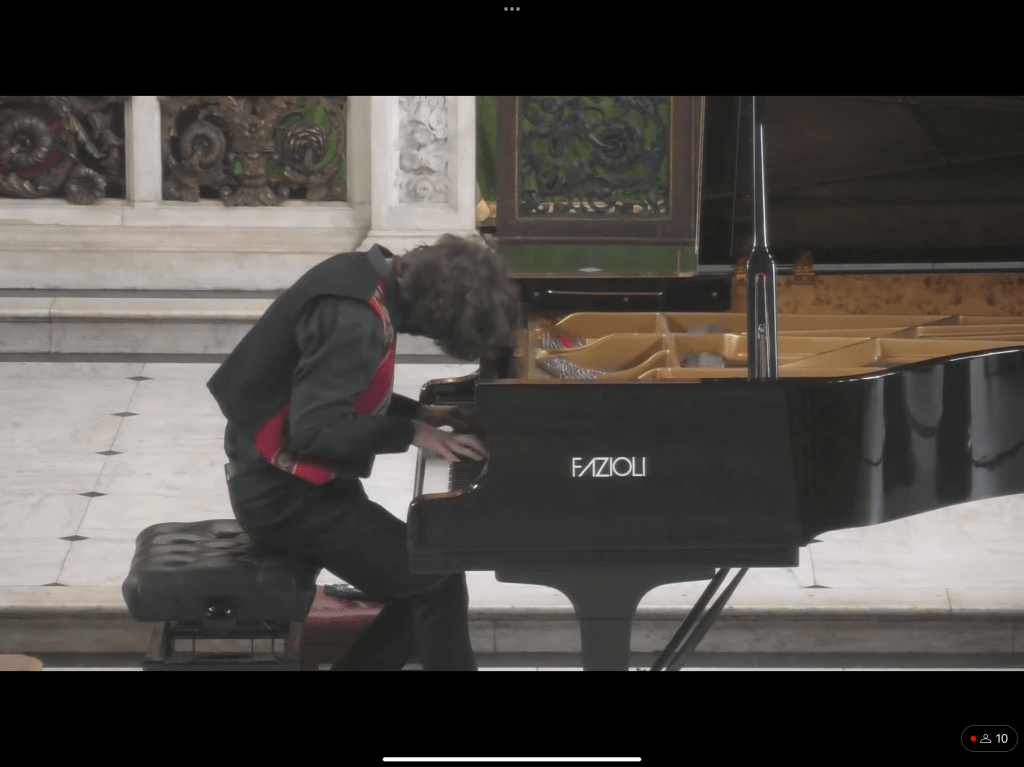
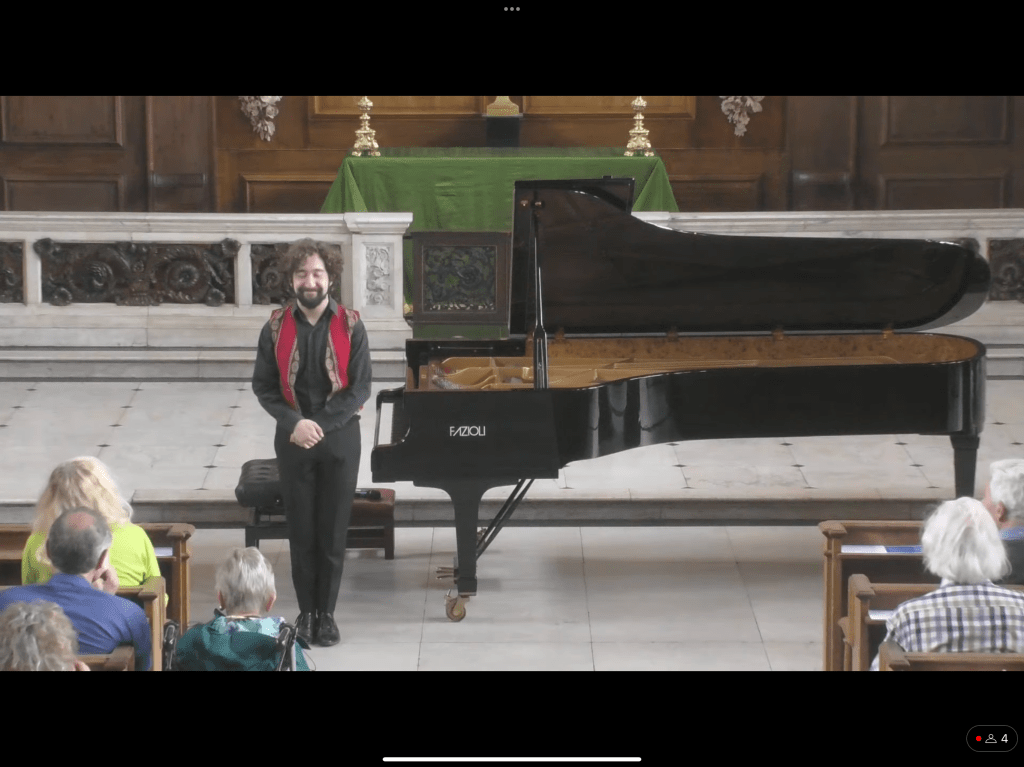
It was a selection of pieces by Ginastera,Sandi and Villa Lobos today that aroused seduced and ravished the senses played as to the manner born He was proudly dressed in his beautiful native Bolivian embroidered jacket.
But Jose Navarro has been studying for the past seven years in Europe having been discovered in Bolivia by a trustee and founder member of the Keyboard Trust.
Moritz von Bredow was on tour with a choir in Bolivia where he was invited to hear a talented young boy play the piano.He immediately arranged some concerts for him in Germany and José remained in Europe to study with the most important teachers of our time and to learn more intensely about the great German tradition of delving deep into the score to extract the composers wishes with honesty and integrity.
Paul Badura Skoda was a great mentor and Jose has been studying with the highly esteemed pianist and pedagogue Claudio Martinez Mehner.For the past year he has perfected his studies with Norma Fisher and Ian Jones obtaining his Artists degree and will now be Artist in Residence at La Chapelle in Belgium working with Frank Braley
I have heard José many times over the past year and have noticed how in such a short space of time his playing has grown in authority and musical integrity.His studies with Norma Fisher and Ian Jones at the Royal College of Music over the past year have given him an even firmer base for his superb musicianship.His playing of his native music of South America has always been impeccable in style with the duel personality of the insinuating seducer and the dynamic conqueror.Just a selection of short pieces today ignited the hall with the final frenetic animal drive of Villa Lobos after the beguiling charm of Ginastera and Sandi.

But it was the Mussorgsky Pictures at an Exhibition that showed off his true extraordinary musicianship as he managed to weld together into one complete picture a work that can too often seem fragmented.It was the collection that he had shown us of the exhibition of the individual paintings by his friend Victor Hartmann struck down so unexpectedly early in life .It showed a tour de force of control and technical authority that allowed him a full palette of colours and at the same time his Latin temperament could have full range but always within a musical framework that could see the overall larger picture.Resonance and clarity of the opening promenade led to the very energetic ‘Gnomus’with its frightening contrasts and startling final cascade of notes.Ease and delicacy led to the next picture of ‘The Old Castle’.It was played in a beautiful flowing ‘two’ that allowed the musical line to float on thin air and to be shaped with natural beauty.Finally blowing itself out with two gentle sighs as the Promenade to the next picture took on a more decisive gait.’Tuileries’ was played at quite a speed but always with the insistent child like pulsation on which filigree work was played with great precision and nonchalant ease .’Bydlo’ came bursting onto the scene with its lumbering insistence building to a mighty climax only to disappear into the distance as the promenade returned this time with luminosity and delicacy.The ‘Unhatched chicks’ was played with remarkable precision and dexterity and the trills were like mere vibrations of sound.There was drama as Samuel Goldenberg entered the scene with his imposing recitativo .Only to be answered by the delicate and intricate sounds of Schmuyle.A passionate discussion follows that was played with superb forward movement until the gentle grief stricken comment dismissed by the dominance of Goldberg.’The Market place in Limoges’ was full of nervous energy and was quite a tour de force of precision and colour.The resonance of the chords of the Catacombs was remarkable for the sumptuous full sounds and startling contrasts between each of the meandering chords.There was great technical control in ‘the Dead in a Dead Language’ with shimmering beauty as it reached for the unspeakable heights.Chased away by ‘Baba Yaga’ who suddenly came bursting onto the scene with such technical command and dynamic energy.The middle section again showed off Jose’s complete mastery of texture as he allowed the right hand to accompany the melodic line in the left hand before Baba Yaga appears on the scene again.A transcendental control of sound meant that the Great Gate of Kiev could be heard in all its many forms from the gentle apparition at the beginning to the mighty dramatic central episode with it’s cascading bells sweeping across the entire keyboard .Dissolving into the calm of a plain chant where the gradual pealing of bells was to build up to the enormous final declamation of a truly great Gate of Kiev.A remarkable performance played with the seriousness and intelligence of a true thinking musician but with a Latin temperament and heart of gold.
Modest Mussorgsky
Pictures at an exhibition
Promenade I
Gnomus (The Gnome)
Promenade II. Moderato commodo assai e con delicatezza
Il Vecchio Castello (The Old Castle)
Promenade III. Moderato non tanto, pesamente
Tuileries,Disputed’enfantsaprèsjeux (Children’s Quarrel after Games)
Bydło (Cattle)
Promenade IV. Tranquillo
Ballet of the Unhatched Chicks
“Samuel” Goldenberg und “Schmuÿle”
Promenade V
Limoges, le marché. La grande nouvelle. (The Market, the Great News)
Catacombæ, Sepulcrum romanum (Catacombs, Roman Tomb)
Cum mortuis in lingua mortua (With the Dead in a Dead Language)
Baba-Yagá – The Hut on Fowl’s Legs
The Great Gate of Kiev

Selection of Piano Pieces by South American Composers Alberto Ginastera, Marvin Sandi and Heitor Villa-Lobos
José Navarro Silberstein at St James’s A master musician with a heart of gold

Pictures at an Exhibition is based on pictures by the artist, architect, and designer Viktor Hartmann. It was probably in 1868 that Mussorgsky first met Hartmann, not long after the latter’s return to Russia from abroad. Both men were devoted to the cause of an intrinsically Russian art and quickly became friends. They met in the home of the influential critic Vladimir Stasov, who followed both of their careers with interest. According to Stasov’s testimony, in 1868, Hartmann gave Mussorgsky two of the pictures that later formed the basis of Pictures at an Exhibition.
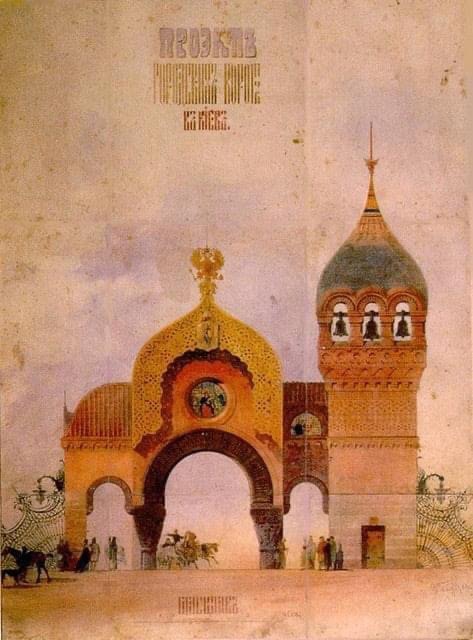
PICTURES AT AN EXHIBITION Promenade l
The Gnomes
Promenade ll
The Old Castle
Promenade lll
The Tuileries: Children’s dispute
after play
Bydlo
Promenade IV
Ballet of the unhatched chicks
Two Polish Jews: Rich and poor
Promenade V
The market at Limoges
Roman Catacombs – With the dead
in a dead language
Baba Yaga: The Witch
The Heroes Gate at Kiev
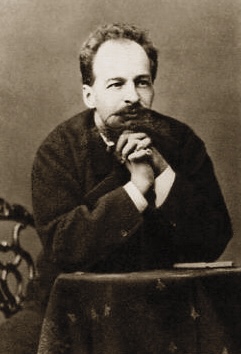
Hartmann’s sudden death on 4 August 1873 from an aneurysm shook Mussorgsky along with others in Russia’s art world. The loss of the artist, aged only 39, plunged the composer into deep despair. Stasov helped to organize a memorial exhibition of over 400 Hartmann works in the Imperial Academy of Arts in Saint Petersburg in February and March 1874. Mussorgsky lent the exhibition the two pictures Hartmann had given him, and viewed the show in person, inspired to compose Pictures at an Exhibition, quickly completing the score in three weeks (2–22 June 1874).Five days after finishing the composition, he wrote on the title page of the manuscript a tribute to Vladimir Stasov, to whom the work is dedicated.The music depicts his tour of the exhibition, with each of the ten numbers of the suite serving as a musical illustration of an individual work by Hartmann.Although composed very rapidly, during June 1874, the work did not appear in print until 1886, five years after the composer’s death, when a not very accurate edition by the composer’s friend and colleague Nikolai Rimsky-Korsakov was published.
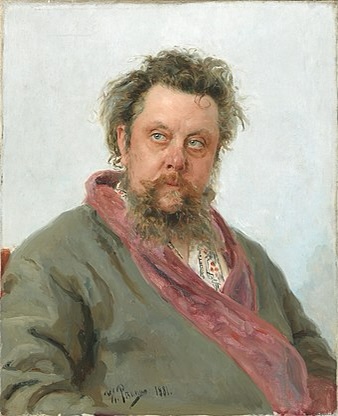
Mussorgsky suffered personally from alcoholism, it was also a behavior pattern considered typical for those of Mussorgsky’s generation who wanted to oppose the establishment and protest through extreme forms of behavior.One contemporary notes, “an intense worship of Bacchus was considered to be almost obligatory for a writer of that period.”Mussorgsky spent day and night in a Saint Petersburg tavern of low repute, the Maly Yaroslavets, accompanied by other bohemian dropouts. He and his fellow drinkers idealized their alcoholism, perhaps seeing it as ethical and aesthetic opposition. This bravado, however, led to little more than isolation and eventual self-destruction.

José Andres Navarro
The young Bolivian pianist has performed in different countries in venues and festivals in Europe, USA, and South America. Halls include the Teatro Municipal “Alberto Saavedra Pérez” in his hometown La Paz till the Musikverein in Vienna. From 2022 he is a Talent Unlimited Artist in London. In September 2023 he will launch his debut CD “Vibrant Rhythms” with GENUIN Classics.
As a soloist, he has performed with the Jena Philharmonic Orchestra, Norddeutsche Philharmonie Rostock, Georgian Philarmonic Orchestra, La Paz Symphony Orchestra, Orquesta de Jóvenes Musicos Bolivianos and Orquesta Sinfónica Juvenil de Santa Cruz de la Sierra under the baton of Timothy Redmond, Markus L. Frank, Wojciech Rajski, Andreas Penninger among others.
He is a prize winner at the Anton Rubinstein Piano Competition in Düsseldorf, Tbilisi International Piano Competition in Georgia, International Competition Young Academy Award in Rome, Claudio Arrau International Piano Competition in Chile among many others. He was a finalist at the Eppan Piano Academy and at the 63rd Ferruccio Busoni International Piano Competition.
In Bolivia he gave masterclasses in La Paz Conservatory, Sucre Conservatory Santa Cruz Fine Arts College and Laredo School in Cochabamba. He served as a jury member in national music competitions.
He was mentored by Paul Badura Skoda, from whom he became a particular interest for period instruments. He studied with Balasz Szokolay at the Franz Liszt University in Weimar and with Claudio Martínez Mehner at the University of Music and Dance in Cologne. At the moment he has just graduated with honours from the Artist Diploma programme at the Royal College of Music in London under the guidance of Norma Fisher and Ian Jones. Her receives scholarships from RCM, Herrmann Foundaiton Liechtenstein-Bolivia, Theo and Petra Lieven Foundation of Hamburg and Elfrun Gabriel Foundation for Young Pianists. He is going to be an Artist in Residence of the Queen Elisabeth Music Chapel from September 2023.

 ChristopherAxworthy-MusicCommentary