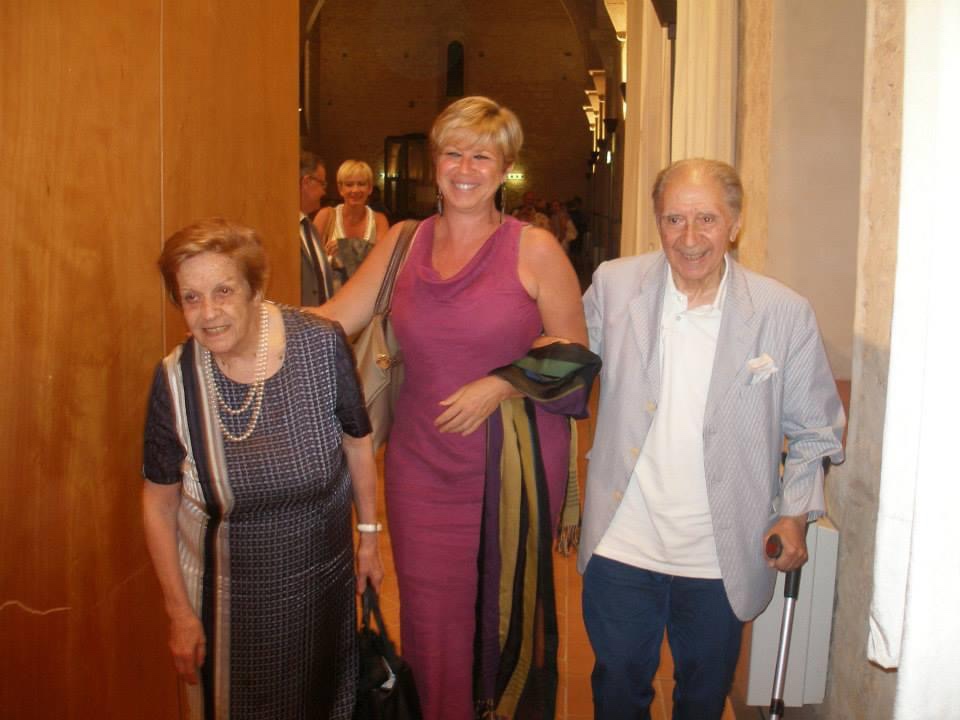
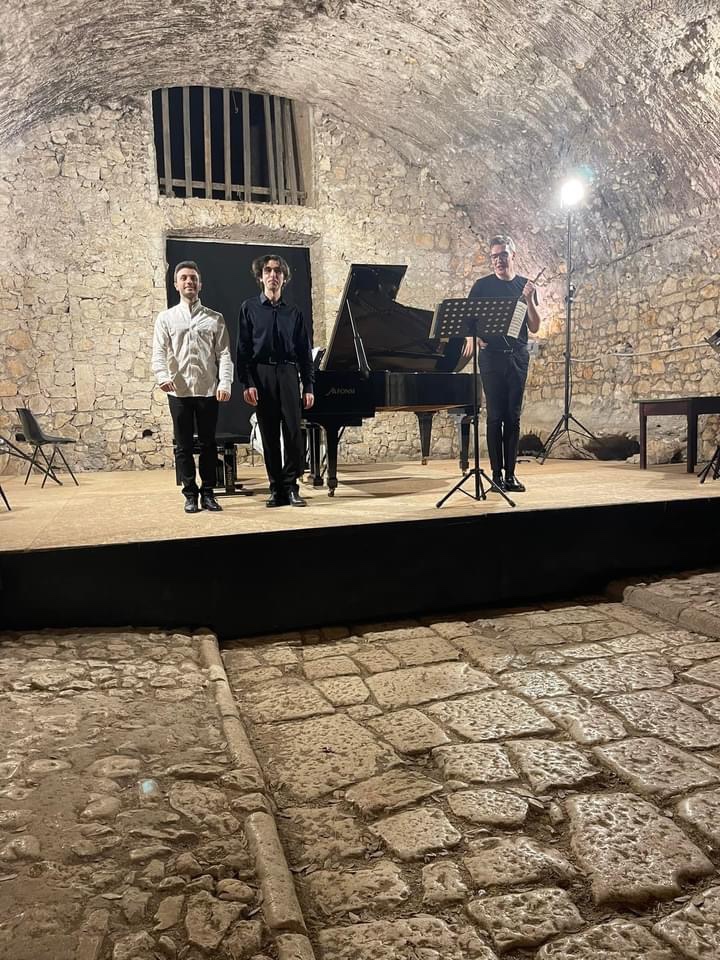
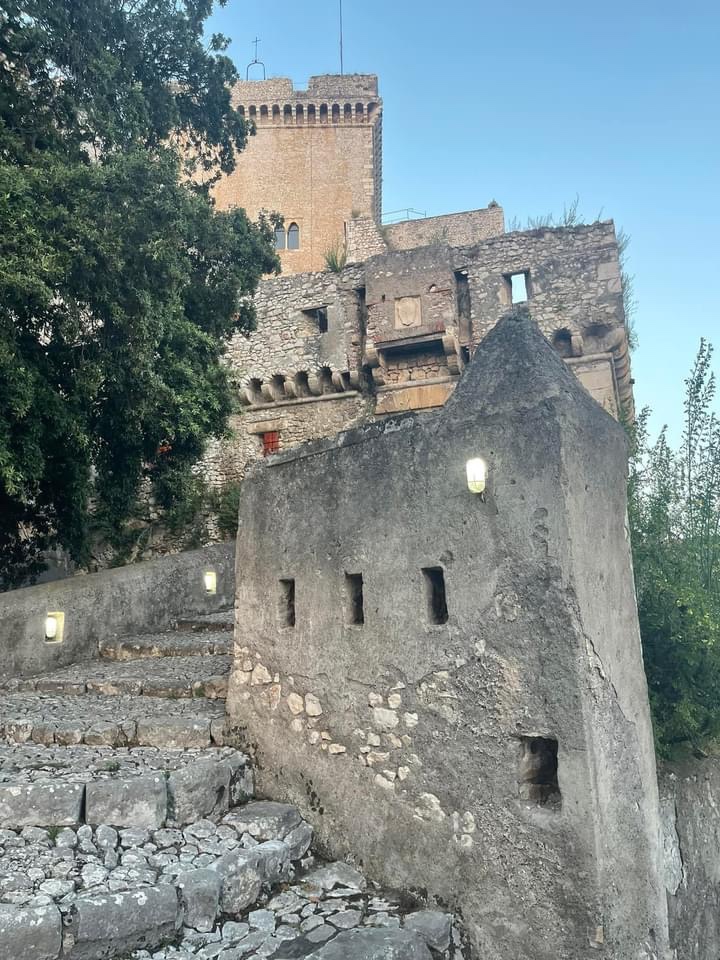
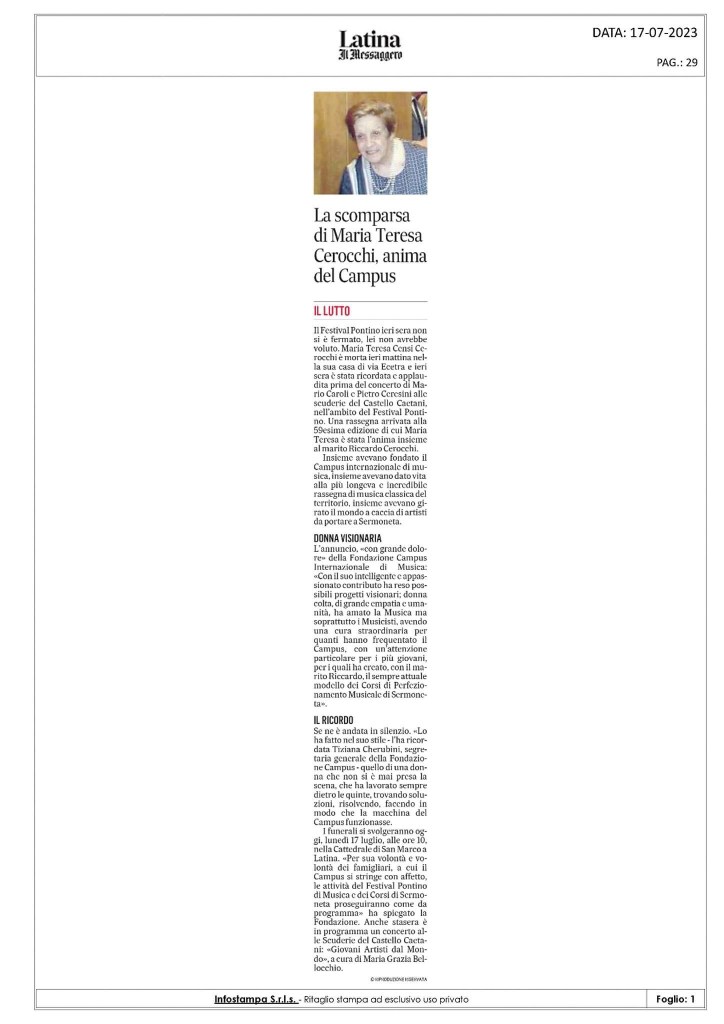
Concerto dedicated to Maria Teresa Cerocchi in the castle of Sermoneta last night.Mario Caroli and Pietro Ceresini flute and piano joined by Samuel Casale in Petrassi’s Dialogo Angelico for two solo flutes.As always this castle has resounded to the sound of music since the time of Szigeti and Menuhin.A tradition continued by the Cerocchi family whose impeccable musical taste has been the guiding light for these past 50 years
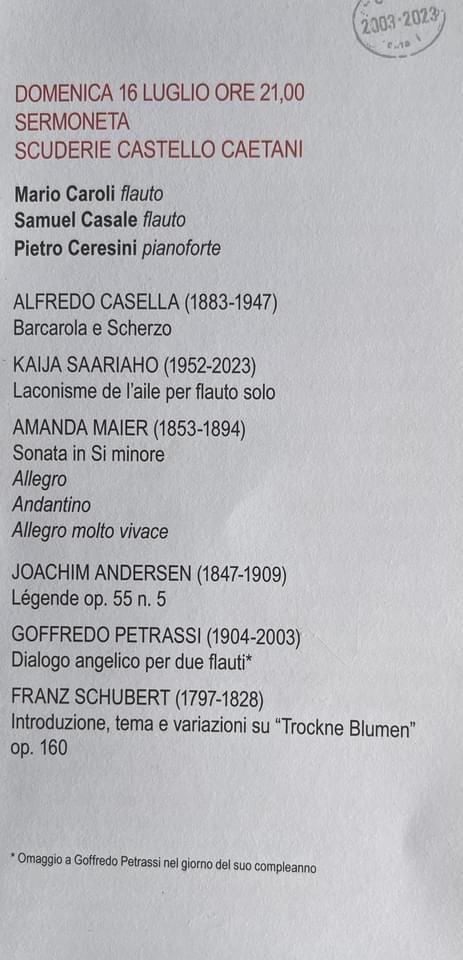
A fascinating programme with a discovery of a composer Amanda Maier with a sonata that could have been by Schumann or Mendelssohn but with an individual voice all her own.
Played by Caroli with his magic flute that became part of his being as they swayed together and moved like a wondrous ballet dancer bringing to life with vivid imagination a score that has lain dormant for too long .A pianist too that was very much his equal from the school of Perticaroli and Cappello weaving in and out of a musical discourse that was hypnotic and intoxicating.
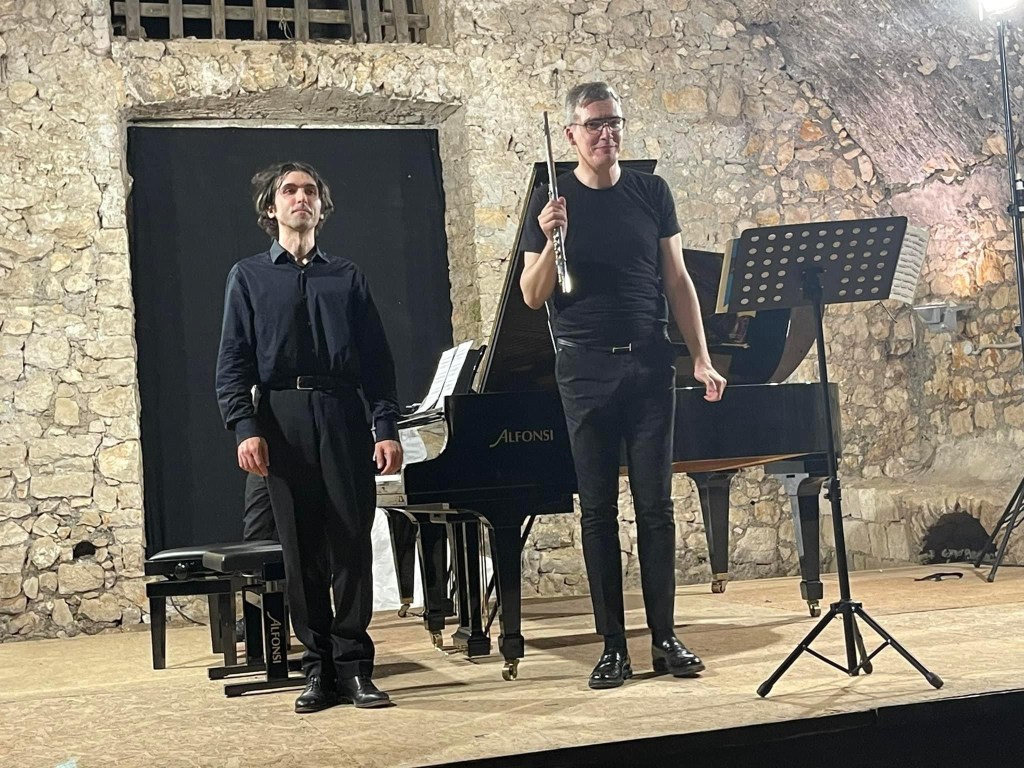
A solo work too by Saariaho where sounds of every sort from an opening whispered. chant to which were added the sound of wind being blown into the flute before actual notes were allowed to appear and were used to create a special atmosphere from a composer who died only a short time ago.Of course the variations on ‘Trockne Blumen’ were played with brilliance and virtuosity by a duo that played as one such was their complete musical understanding with an extraordinary transcendental control of their instruments.The pianist playing with the piano lid wide open which gave great resonance without ever overpowering the flute.On the contrary it provided a shell in which the music could Iive and breathe with sublime beauty and harmony.A beautiful Barcarolle by Casella was another discovery of a work of lyrical beauty that contrasted with its partnered Scherzo of whirlwind energy.Another composer unjustly overlooked these days.Of course as one would expect from Casella there was a luxuriant piano part that was played with a subtle brilliance and colour that created a golden shell in which the live wire of a scherzo could weave its magic web undisturbed.
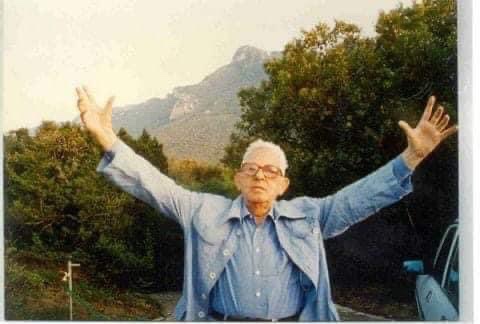
Petrassi ‘s twentieth anniversary celebrations this year included his ‘Dialogo angelico’ for two flutes.Not at all like the diabolical staircase by Ligeti that can regularly tie even the finest pianists in knots.
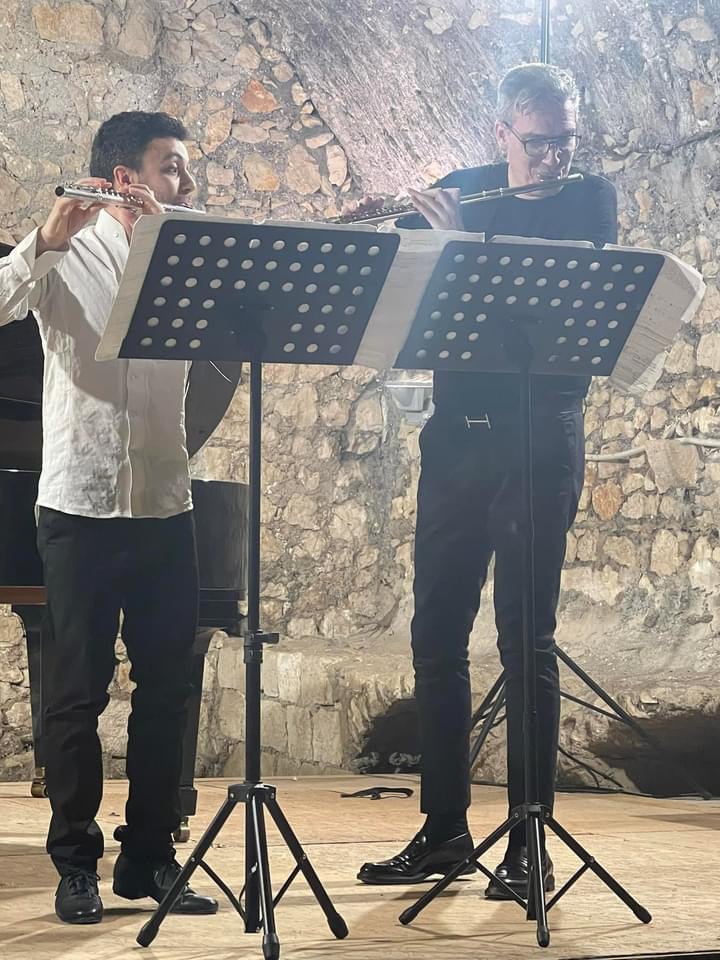
Here was a work of great beauty for two flutes starting on the left of two stands and working towards the right in such harmony and elegance that their final emergence into ‘fresh air’ came as a complete surprise as we watched them almost dance their way through the score with such florid shapes and movements.
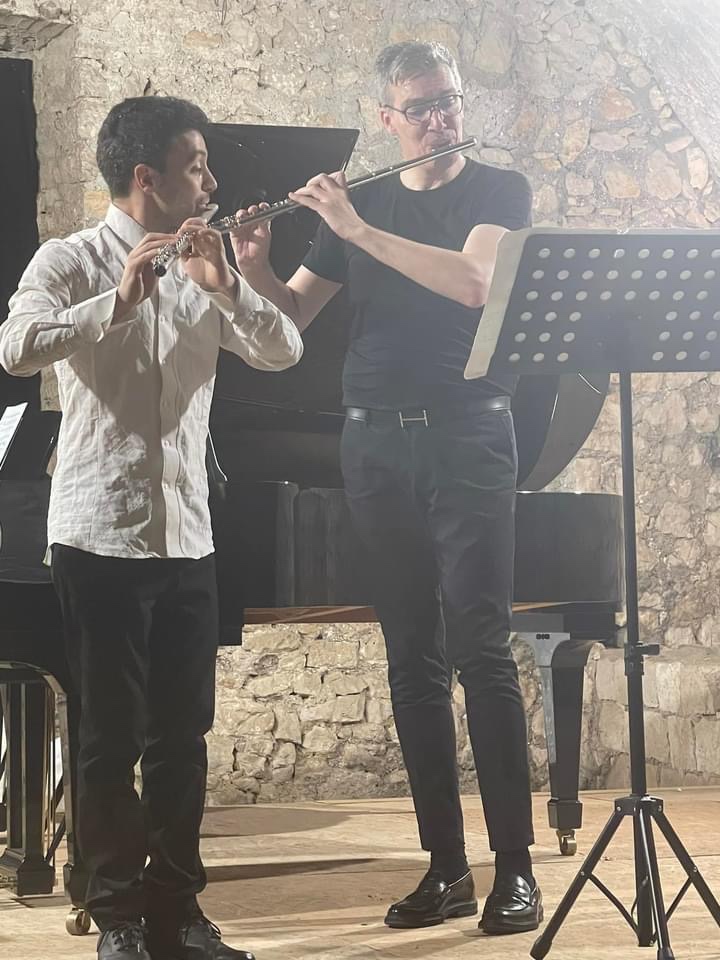
Samuel Casale not only turned pages for the concert ,played in duo with Caroli but also the next morning played so beautifully at the funeral of Madam Cerocchi.
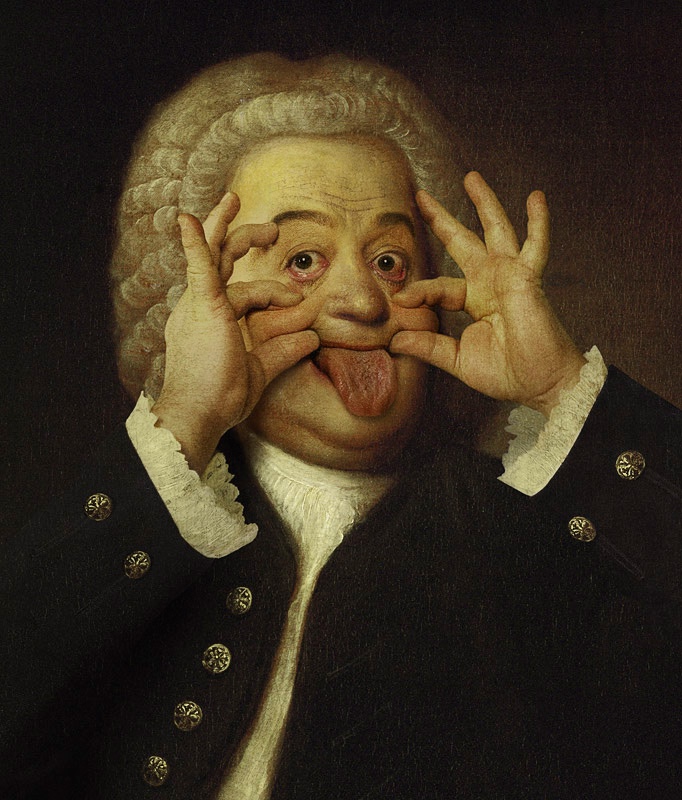
The priest had said that a church was for prayer not music (Bach would be very surprised to hear that) but did allow Samuel with his flute to enchant and enhance the rather dull performance by the priest!
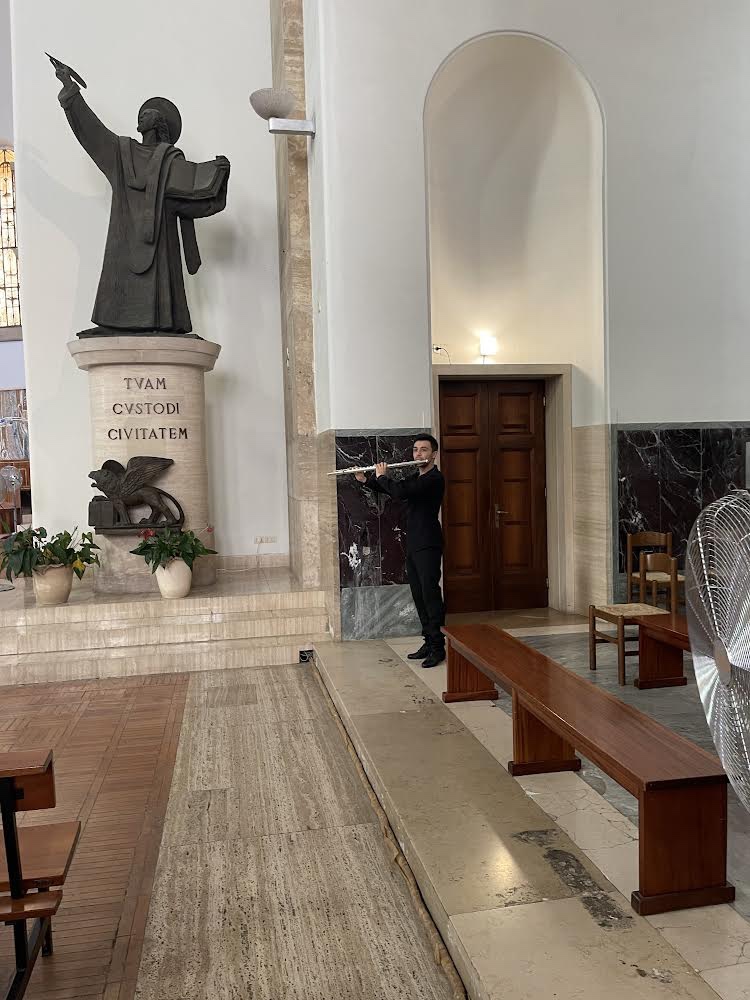
I was not expecting to be so moved or entranced as I had come to pay hommage to a dear person that I have known for a lifetime.
But like everything in Sermoneta the hills are resounding to the sound of music …..and what music!
If music be the food of love ………and it will play on in the hands of Elisa Cerocchi the true spiritual heir to her extraordinary pioneering parents.Her spiritual heirs Tiziana Cherubini and family will ensure that the daily running of the Campus will go from strength to strength on such solid foundations of musical integrity and honesty.
Alfonso Alberti celebrations- The shadow of Dante in the magic garden of Ninfa
50th Anniversary of the Pontine Festival Foundation streamed live from Sermoneta and Ninfa
Mario Caroli has nearly superhuman skill, paired with extraordinary musical intelligence.” — American Record Guide
“He made a sound you wanted to drink in.” — New York Times
“A musician whose possibilities are boundless.” — Le Monde de la Musique
“The range of colour and texture that this outstanding soloist obtains is hauntingly beautiful.” — The Guardian
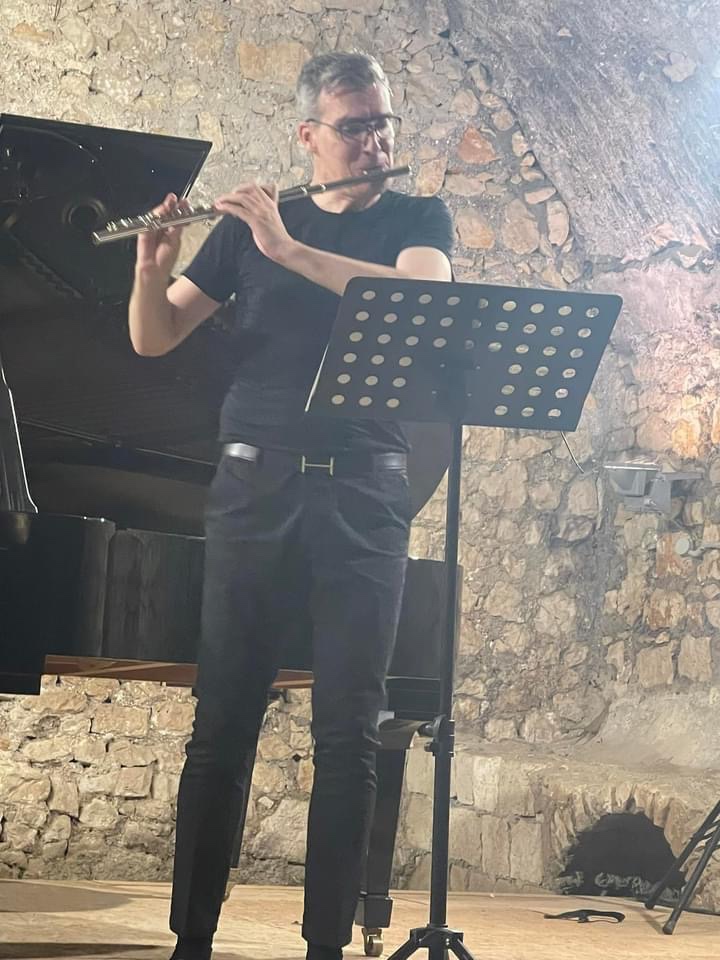
At the occasion of one of Mario Caroli’s recitals at the Société Philarmonique of Bruxelles, a critic remarked: “the audience was literally amazed by his technique, his power, his poetry and his musicality”, whereas his first recital at the Théâtre du Châtelet in Paris was called to be “of an amazing evocative power.”Mario Caroli appears regularly in the greatest concert halls of the world including the Philharmonic Halls of Berlin and Cologne, the Vienna Konzerthaus, the Royal Festival Hall in London, the Théâtre du Châtelet and the Opéra Garnier in Paris, the New York Lincoln Center (in the cycle of “Great Performers”), Oji Hall, Suntory Hall and Opera City House of Tokyo, the Parco della Musica in Rome, the Palais des Beaux Arts in Bruxelles, the Amsterdam Muziekgebouw.He plays flute concertos – from Vivaldi to Sciarrino, as well as Mercadante, Ibert or Jolivet – with the Orchestra Sinfonica Nazionale della RAI, the Philharmonia Orchestra (London), the National Orchestra of Belgium, the Orchestra of Radio Cologne (WDR), the Orchestra of the Stuttgart Opera Theatre, the Orchestra of the Rouen Opera, the Philharmonic Orchestra of Stockholm, Les Percussions de Strasbourg, the Ensemble Contrechamps of Geneva, the Neue Vocalsolisten Stuttgart, the Schola Heidelberg with conductors like Pierre Boulez, Peter Eötvös, Heinz Holliger, Christian Mandeal, Kazushi Ono, Pascal Rophé, Oswald Sallaberger.Mario Caroli also obtained a university degree in philosophy (summa cum laude, with a thesis on Nietzsche’s “Der Antichrist”) and has a passion for poetry, cinema and psychology. This cultural interest supports his attempts to renew and revitalise the traditional views on the instrument and its repertoire. Going beyond the great canon of the historical flute repertoire, Mario Caroli became a preferred soloist for some of the greatest composers of today. He is the only contemporary flutist having performed on monographic concerts the complete works for the flute by Sciarrino, Ferneyhough and Jolivet. Interpretations of a stunning virtuosity, phantasy and energy which made critics call him a “phenomenon”.His scenic appearance was often a subject of critics: “Tall and elegant, he seems to be a figure by El Greco, with a total mastery of his instrument” (Muzsika, Budapest). Others wrote: “He played fairly rocking out in ecstasy, and one could only look in an incredulous stupor” (Musicweb international, New York), “A musical gesture elegant as well as sensual, he gave a concert which doesn’t allow any objection” (Diario Basco, San Sebastian).His discography contains approximately twenty titles. The recent recordings of works for flute by Jolivet (“one of the best performances heard in recent months – maybe even in a few years”, American Record Guide) and by Sciarrino were received with the highest possible acclaim: “Diapason d’or” (Diapason), “Recommandé” (Répertoire), “Coup de Coeur de l’Académie Charles Cros”, “A!” (Anaclase), “Eccezionale!” (Musica), “Best recording of the year” (Musicweb international), “Best CD of the month” (Amadeus and CD Classics). His recordings and concerts have been broadcasted by radio and TV stations thoughout the whole world.Concerning his didactic activities, Mario Caroli has given masterclasses and worked as an artist in residence at prestigious institutions like Harvard University (where he was invited to hold the FROMM-residency between 2007 and 2008), Toho College (Tokyo), the Sibelius Academy (Helsinki), the Centre Acanthes (Paris, Metz) or the Conservatoire Superieur of Geneva. After having been teaching for 17 years at the Académie Supérieure de Musique de Strasbourg, the city where he still lives, Mario is holds the chair of flute at the Hochschule für Musik in Freiburg (Germany), whose prestigious fluteclass is recognized worldwide. At the occasion of one of his recitals at the Société Philarmonique of Bruxelles, a critic remarked: “the audience was litterally amazed by his technique, his power, his poetry and his musicality”, whereas his first recital at the Théâtre du Châtelet in Paris was called to be “of an amazing evocative power.” A cosmopolitan and polyglot artist, Mario speaks fluently in six languages.
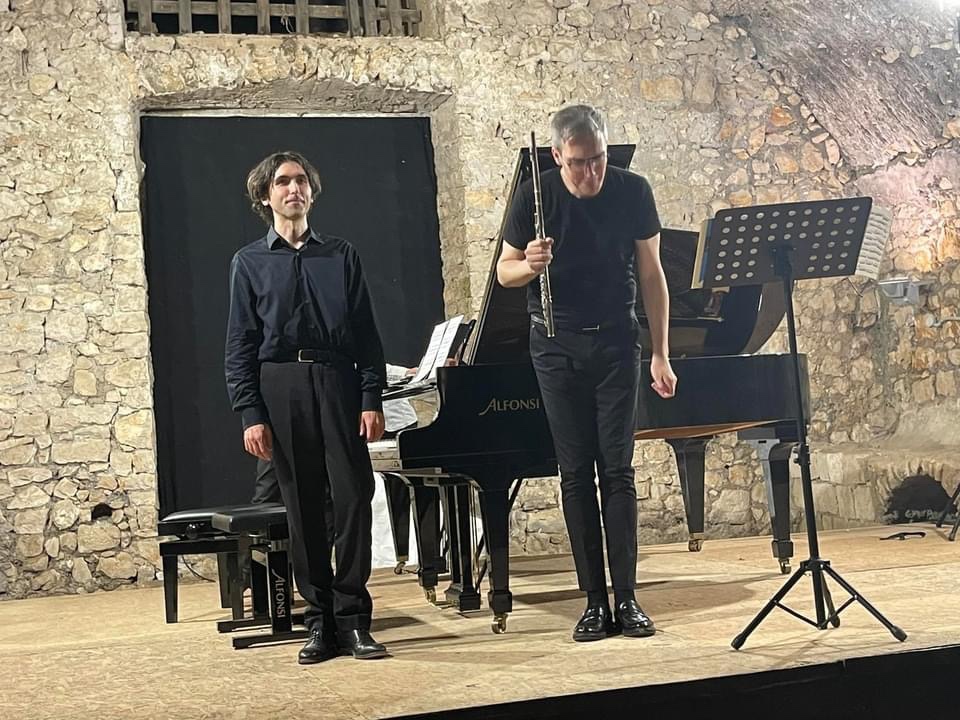
Pietro Ceresini graduated from Conservatorio di Parma (Prof. R. Capello), Accademia di Santa Cecilia (Prof. S. Perticaroli) and Musikhochschule Lübeck (Prof. Sischka). He performed numerous recitals and concerts.Prizes: J. S. Bach Geneve (2004); A. M. A. Calabria (2006).Pietro Ceresini inizia lo studio del pianoforte all’età di sei anni e a sette si esibisce già presso il Teatro della sua città. Dopo gli studi con R. Cappello presso il Conservatorio A. Boito di Parma, in cui si diploma con il massimo dei voti, lode e menzione d’onore e laurea con indirizzo musicale, si diploma a Roma all’Accademia di Santa Cecilia con S. Perticaroli e si perfeziona con P. Bordoni e F. Gamba. Nel 2009 consegue a pieni voti il diploma di Composizione, prima di trasferirsi in Germania dove intraprende il corso Master a Lubecca nella classe della Prof. K. Eickhorst e successivamente a Friburgo, in cui conclude lo studio post-laurea con eccellenza nella classe del Prof. C. Sischka. Vincitore di concorsi nazionali e internazionali si è esibito presso istituzioni prestigiose come l’Auditorium della Conciliazione a Roma, il Teatro Farnese di Parma, La Casa della Musica a Parma, i festival pianistici di Spoleto (Teatro Caio Melisso), Misano Adriatico, il Festival Pontino di Musica, al Centro de musica de Belem a Lisbona e presso la sala concerti dell’Istituto Italiano di cultura di Strasburgo. Ha suonato il Concerto in re minore di Mozart KV 466, a Lübeck si è esibito nell’ambito del Festival “Kunst am Kai” nella Fantasia per coro e Orchestra op. 80 di Beethoven. Ha tenuto concerti con l’Orchestra Sinfonica Nacional in Perù a Lima con il Concerto n. 5 di Beethoven, con l’Orchestra Filarmonica Arturo Toscanini con il Concerto n. 2 di Liszt, a Lamezia Terme presso il Teatro Grandinetti con la Filarmonica Mihail Jora; con l’Orchestra della Musikhochschule di Friburgo è stato protagonista di un’applaudita esecuzione del Concerto n. 1 di Čajkovskij. Nel 2021 ha eseguito il Concerto di Grieg con l’Orchestra A. Vivaldi al Teatro Filarmonico di Verona e al Teatro Sociale di Sondrio. In Germania è ospite in veste di solista e in formazioni cameristiche di diverse istituzioni concertistiche, quali Gesellschaft der Musikfreunde Bremen, Neckar Musik Festival, Jahrhundertswende Gesellschaft presso Kammermusiksaal der Musikhochschule Köln, Mendelssohn Institut Berlin, Villa Eschenburg Lübeck, Brigitte Feldman Saal Schwerin, Theater Kiel, Kongresshaus Heidelberg. Ha effettuato numerose registrazioni radiofoniche in diversi paesi (Antena 2 Portugal, Radio 3 e Radio Classica Italia, NDR Podium der Jungen Amburgo e Kiel, Germania). Attualmente detiene una cattedra di pianoforte presso la Musikhochschule di Freiburg (Germania) e il Tiroler Landeskonservatorium Innsbruck (Austria).
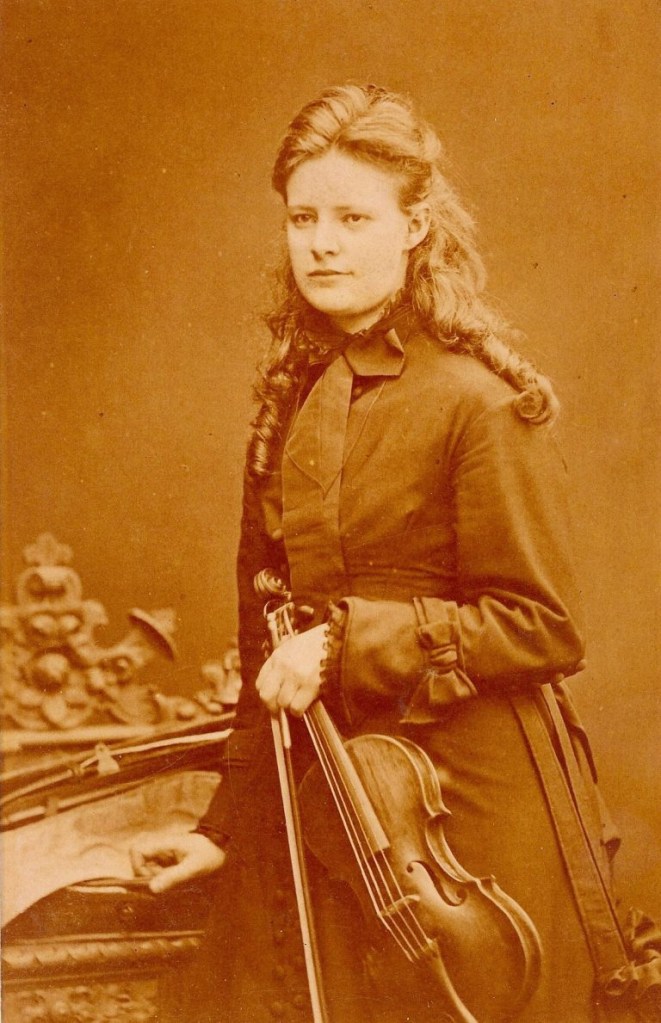
If you have not heard of Amanda Maier (1853-1894), you are not alone. A celebrated violin soloist and composer during her lifetime, Maier was all but forgotten in death. (This was a common, if unjust fate among women musicians, who were largely ignored by music scholars for most of the twentieth century.) Today, however, Maier’s popularity is making a comeback, and rightfully so! Researchers and performers, predominantly in Sweden and the Netherlands, have become enamored with Maier, resulting in new publications and performances of her music, and renewed efforts to find her lost manuscripts. There have been only a few performances of her works in North America, where Maier remains a relative unknown.
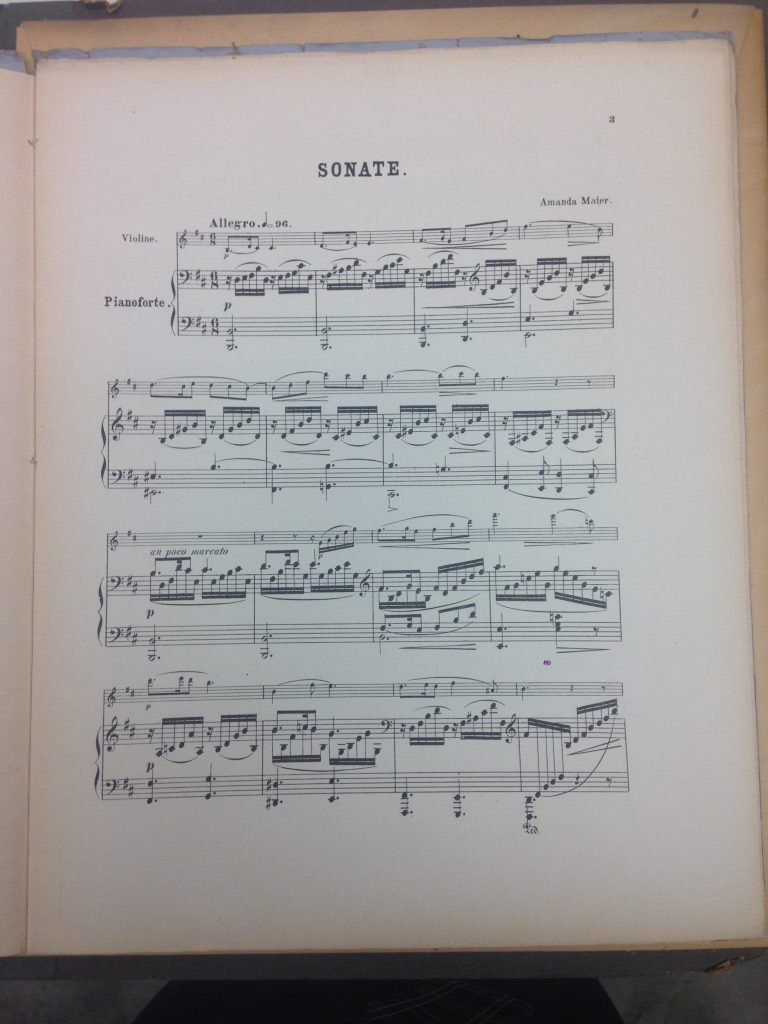
The Library of Congress Music Division holds published scores of two works by Swedish composer Amanda Maier (1853-1894): Sonata for violin and piano in B minor (Musikaliska Konstföreningen 1878) and piano Quartet in E minor (Donemus 2010).
Amanda Maier was born in Landskrona, Sweden, on February 20, 1853. Her father taught her violin and piano when she was a child and, showing great musical promise, she enrolled at the Kungliga Musikaliska Akademien in Stockholm at age sixteen. In Stockholm her principal instrument was the organ, but she also studied cello, piano, violin, elementary singing, composition, counterpoint, harmony, instrumentation, and history and aesthetics of music. When Maier graduated with top grades in 1873, she became the first woman ever to earn the title of Musikdirektor (Director of Music) from the institution.
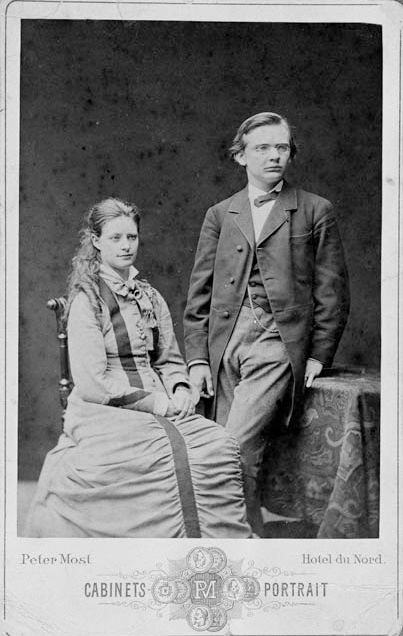
In 1873 Maier moved to Leipzig to pursue further studies in violin and composition. Among her teachers were Engelbert Röntgen (concertmaster of the Gewandhaus orchestra), Carl Reinecke (director of the Gewandhaus orchestra) and Ernst Friedrich Richter (professor of harmony and counterpoint at the Hochschule für Musik and cantor of the Thomasschule). In Leipzig Maier spent her time studying, composing, and performing, and nearly every evening she participated in some sort of musical activity. She attended many concerts, sat in on rehearsals of the Gewandhaus orchestra, and frequently participated in musical soirées, where she socialized and collaborated with the city’s finest musicians.
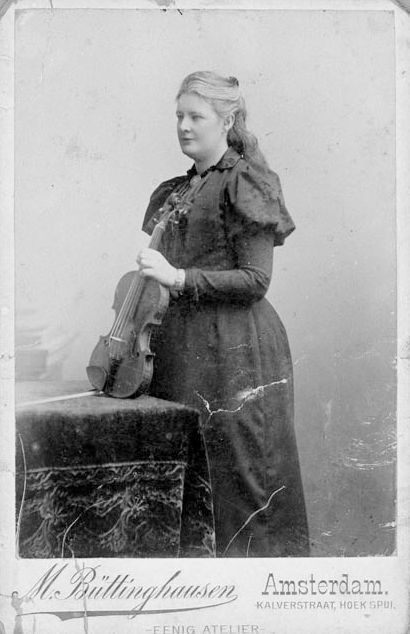
Maier’s career as both violinist and composer flourished in the 1870s. Most of her compositions were written during this decade, and she performed frequently in both Germany and Sweden. Some of her most notable performances include those of her own violin concerto: with the Gewandhaus orchestra in Leipzig, for King Oscar II in Malmö, and at the Royal Theatre in Stockholm, all in 1876. In the summers of 1874 and 1876 Maier and her colleague, soprano Louise Pyk, performed many concerts in southern Sweden. In 1878 and 1879 they were joined by pianist Augusta Kjellander for much more ambitious tours that took them farther north and into Norway in 1878, and to St. Petersburg and Finland in 1879. Maier’s performances were well received. Reviews were positive, and in her diaries she often wrote of numerous curtain calls, dozens of bouquets of flowers, and requests for future performances. Maier was a celebrity in the Swedish press, which followed her whereabouts and reported rumours about forthcoming compositions in addition to concert advertisements and reviews. It was reported that in 1878 Maier declined an offer of an extensive tour in the United States.In Leipzig, Maier grew close to her violin teacher’s son, the pianist and composer Julius Röntgen .Maier and Röntgen spent many evenings playing music together, including each other’s works-in-progress. They were engaged in 1876 and were married in Landskrona in 1880. The pair settled in Amsterdam, where Röntgen had been teaching for two years, and where he later led a number of musical organizations. Maier’s career, in contrast, declined significantly. She very rarely performed in public, and composed much less. She did however continue to participate in social musical evenings, where she had the opportunity to collaborate not only with local musicians, but guests to the city, such as Brahms,Grieg and Anton Rubinstein.Maier suffered a series of health problems that undoubtedly contributed to the decline in her musical activities. Throughout her adult life, she suffered from difficulty with her eyes, often leaving her bedridden for days at a time. Between the birth of her two sons (Julius in 1881 and Engelbert in 1886), Maier suffered three difficult miscarriages, and shortly after Engelbert’s birth, she fell ill with pleurisy, the first encounter with the illness that would eventually take her life. Despite several rest cures in France and Switzerland, and tranquil summers spent in Norway and Denmark, she never fully recovered. Maier died in her sleep on June 15, 1894.
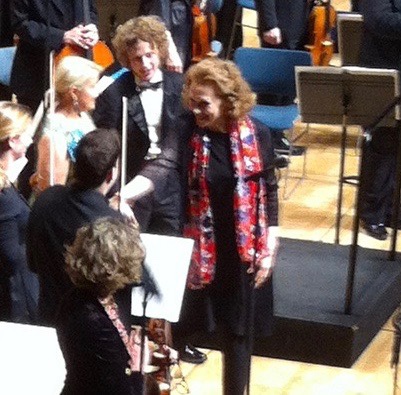
Kaija Anneli Saariaho néeLaakkonen; 14 October 1952 – 2 June 2023) was a Finnish composer based in Paris, France. During the course of her career, Saariaho received commissions from the Lincoln Center for the Kronos Quartet and from IRCAM for the Ensemble Intercontemporain, the BBC, the New York Philharmonic, the Salzburg Music Festival, the Théâtre du Châtelet in Paris, and the Finnish National Opera, among others.[1] In a 2019 composers’ poll by BBC Music Magazine, Saariaho was ranked the greatest living composer.[2]
Saariaho studied composition in Helsinki, Freiburg and Paris, where she also lived since 1982. Her research at the IRCAM marked a turning point in her music away from strict serialism towards spectralism.Her characteristically rich, polyphonic textures are often created by combining live music and electronics.
She found her teachers’ emphasis on strict serialism and mathematical structures stifling, saying in an interview:
You were not allowed to have pulse, or tonally oriented harmonies, or melodies. I don’t want to write music through negations. Everything is permissible as long as it’s done in good taste.[3]
 ChristopherAxworthy-MusicCommentary