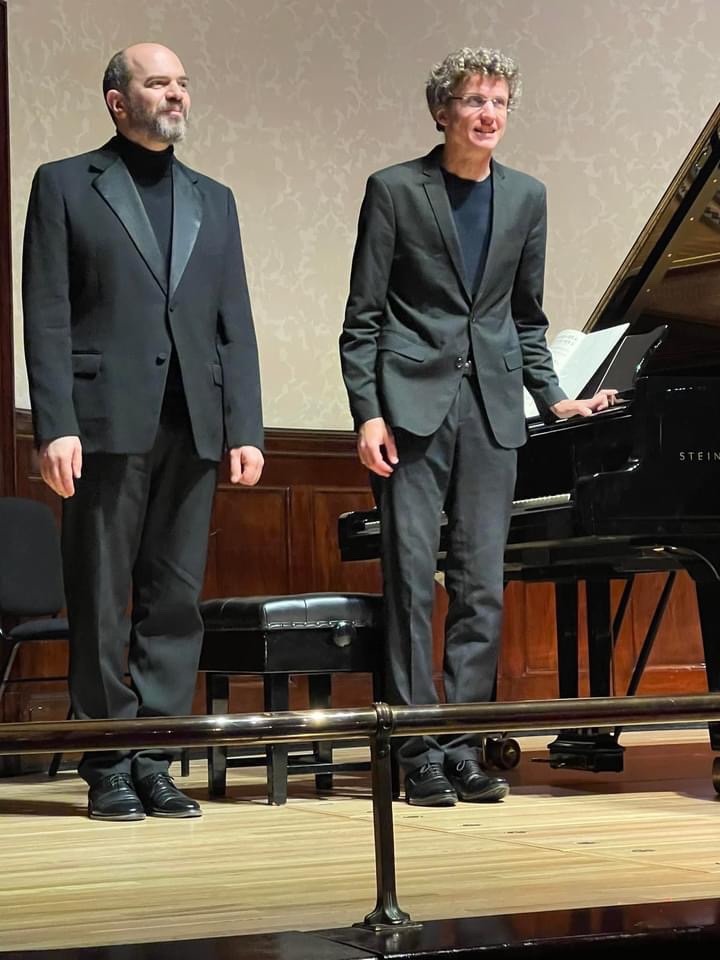
Kirill Gerstein piano
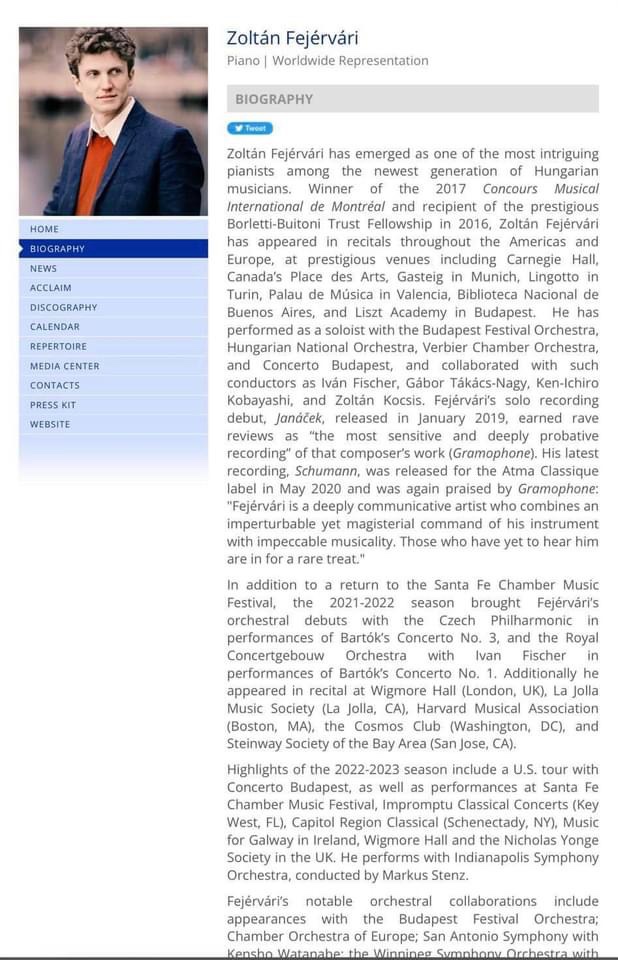
Zoltán Fejérvári piano
Wolfgang Amadeus Mozart (1756-1791)
Ferruccio Busoni (1866-1924) Wolfgang Amadeus Mozart
Ferruccio Busoni
Sonata in D for 2 pianos K448 (1781)
I. Allegro con spirito • II. Andante • III. Allegro molto
Improvisation on JS Bach’s Chorale Wie wohl ist mir, o Freund der Seele BV271 (1916)

Interval
Fantasia in F minor for mechanical organ K608 (1791) arranged by Ferruccio Busoni
Duettino concertante after the finale of Mozart’s Piano Concerto No. 19 in F K459 BVB88 (1919)
Fantasia contrappuntistica for 2 pianos BV256b (1921)
- Choral-Variationen (Einleitung – Choral und Variationen – Übergang) – 2. Fuga I – 3. Fuga II – 4. Fuga III – 5. Intermezzo – 6. Variato I –
- Variato II – 8. Variato III – 9. Cadenza – 10. Fuga IV – 11. Corale – 12. Stretta

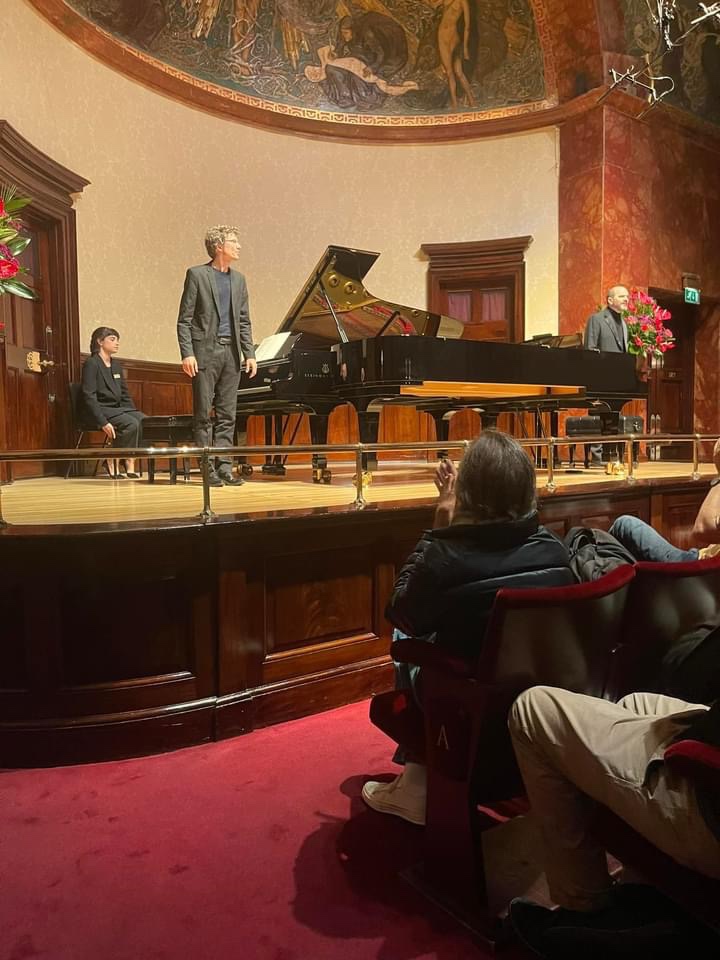
On 18 February 1922, Busoni and Egon Petri performed a two-piano afternoon matinee recital at Wigmore Hall that contained many of the pieces featured on tonight’s programme, all then receiving their first performances in England. This followed soon after a similar two-piano recital in Berlin at the Beethoven-Saal on 16 November 1921. There were only slight variations in the programming. Where the 1922 Wigmore Hall recital began with Busoni’s arrangement of Mozart’s Fantasia in F minor for mechanical organ K608, the 1921 Berlin recital instead opened with Busoni’s arrangement of Mozart’s Sonata in D for two pianos K448. Both recitals also featured Busoni’s Improvisation on JS Bach’s Chorale Wie wohl ist mir, o Freund der Seele BV271, the Duettino concertante after the finale of Mozart’s Piano Concerto No. 19 in F K459 (BVB88), and the two-piano version of the Fantasia contrappuntistica, BV256b. Kirill Gerstein and Zoltán Fejérvári re-create these historic recitals for us.
Busoni had previously collaborated with several soloists or chamber ensembles, such as the Belgian violinist Eugène Ysaÿe, the Australian soprano Nellie Melba, and the US-based Kneisel Quartet. However, the majority of his performing career focused on solo repertoire and solo recitals. Busoni’s interest in composing, transcribing, arranging and performing two-piano literature only emerged in the late 1910s and the early 1920s. This interest might have been partly inspired by his Berlin composition masterclasses (1921- 4), where, as Tamara Levitz has documented, there were frequent performances of new compositions in two-piano arrangements. He also played two-piano literature with Ernst Lochbrunner in Switzerland while in exile during World War I. Edward Joseph Dent surmises, however, that the Berlin and London recitals mentioned above were probably specifically motivated by an interest in promoting the career of Busoni’s closest protégé, Petri.
The two-piano literature featured in this recital reflects Busoni’s lifelong interest in the music of both Bach and Mozart. All of the pieces on this programme are, at least partially, transcriptions or arrangements of their music. Composed in 1916, Busoni’s Improvisation represents his musical musings on a chorale melody used earlier by Bach in a setting for solo soprano over basso continuo (BV517) from the Notebook for Anna Magdalena Bach. Busoni first performed his Improvisation with Lochbrunner at the Zürich Tonhalle on 18 December 1917. Less than two weeks later, on 1 January 1918, Busoni wrote to Lochbrunner, expressing gratitude for his companionship during Busoni‘s exile in Switzerland during World War I. The piece itself is a radical reworking of the final movement of Busoni’s Sonata No. 2 for violin and piano BV244 (1898). One of the most significant changes in the two-piano version is that the chorale melody appears in the middle of the piece, rather than at the beginning. This is especially striking, because the piece is a set of variations
displaying a breadth of technical approaches. Thus the chorale melody emerges after the variations have already begun. This recital also includes the better- known Fantasia contrappuntistica, which Busoni originally composed for solo piano in 1910, then revised in 1912 and reworked yet again in 1921 for two pianos. The Fantasia contrappuntistica contains 12 sections: a chorale prelude, four fugues, three variations, an Intermezzo, a Cadenza, a chorale and a Stretta. Like the Improvisation, the Fantasia contrappuntistica is based partly on chorale music set earlier by Bach, Allein Gott in der Höh sei Ehr. In addition, Busoni reworked the main theme of the Contrapunctus I and Contrapunctus XIX from Bach’s Die Kunst der Fuge BWV1080. Busoni also reused material from his own piano Elegy No. 3.
If Busoni’s two-piano works based on Bach are primarily new compositions, the two-piano works based on Mozart are mainly arrangements or transcriptions. Although Dent and Jürgen Kindermann reference an arrangement (1921) of Mozart’s three-movement two- piano sonata in D major (originally composed in 1781 for a performance by Mozart and Josepha Barbara Auernhammer), all that survives is a marked up performance score with numerous annotations and suggested textual alterations. There is also a cadenza handwritten in the back of the score. Busoni’s transcription of the F minor Fantasia for mechanical organ, by contrast, is fully notated, and consists of a first section in the style of an Italian Overture, an allegro (fugue), an andante, and a final allegro (double fugue). This is one of Busoni’s most faithful transcriptions, with no major compositional changes up to the andante. However, he extended the cadenza leading back to tempo I, cut 11 bars of the fugue, and added ornamentation and chromaticism. Moreover, he had to consider how to translate it pianistically, because the piece was originally composed for a mechanical organ or Flotenühr, a musical clock with a built-in organ. Busoni transcribed the piece specifically for his two- piano recital at Wigmore Hall, completing it on 23 January 1922. Busoni envisioned it as preceding the Duettino concertante, so that the two together could form a musical structure resembling a great sonata for two pianos, with the Duettino concertante providing the finale. Busoni had initially transcribed the Duettino concertante in 1919 fairly literally from the ending of Mozart‘s Piano Concerto, even if he infused the work with interplay between the pianos, shortened the second fugato, and streamlined fugal sections while adding a newly composed concert ending. He wrote in a letter to Hugo Leichtentritt of 25 May 1920 that the Duettino concertante was initially inspired by a two- piano recital given by Philipp Jarnach and Lochbrunner. Jarnach, who performed the Duettino concertante on 1 December 1919 with Lochbrunner in a recital that also featured works by Reger, Mozart, Schumann and Saint- Saëns, described Busoni’s piece as ‘magical’ in a letter of 29 January 1920, and that word might be aptly used to describe much of the repertoire on this programme.
© Erinn Knyt 2023

Kirill Gerstein – Busoni is alive and well and returned to the Wigmore Hall
 ChristopherAxworthy-MusicCommentary