
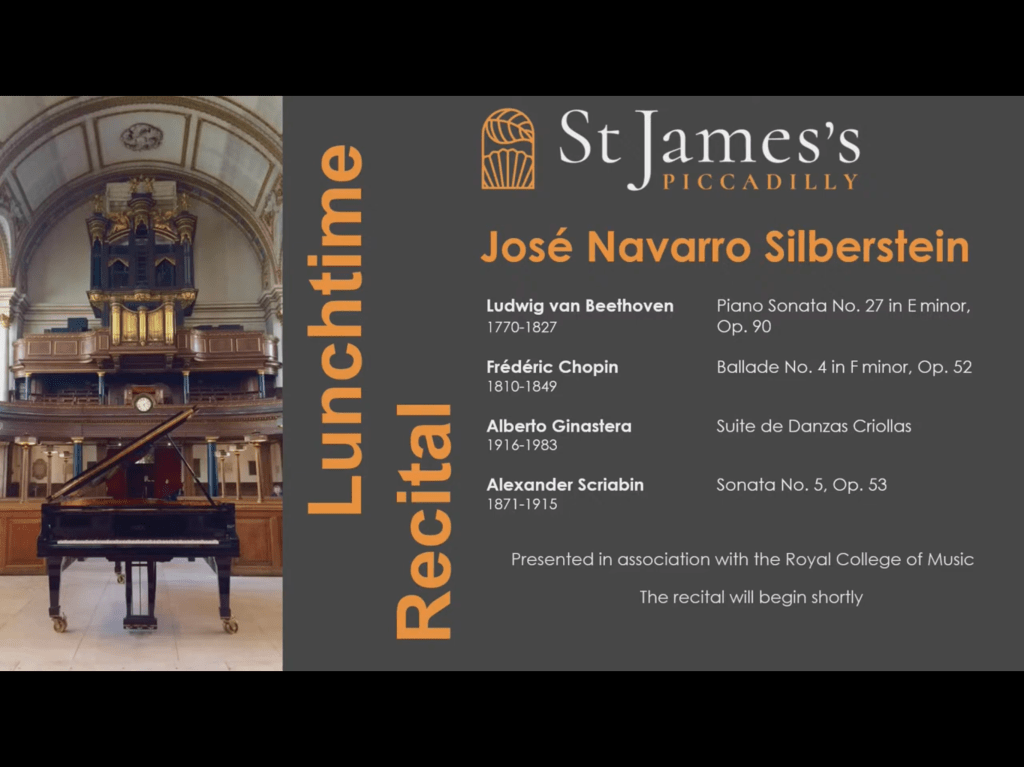
Ludwig van Beethoven – Piano Sonata No. 27in E minor, Op. 90
Frédéric Chopin – Ballade No. 4 in F minor, Op. 52
Alberto Ginastera – Suite de Danzas Criollas
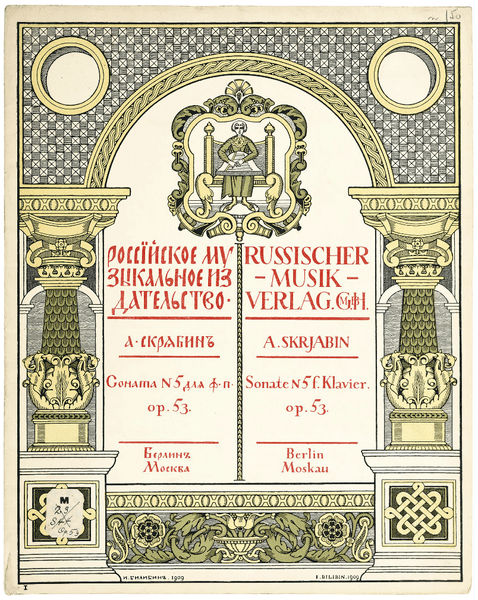
Alexander Scriabin – Sonata No. 5, Op. 53
Presented in association with the Royal College of Music
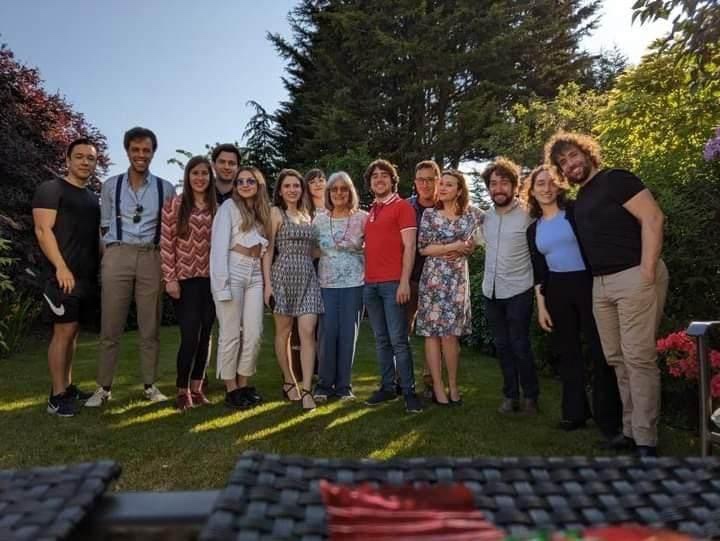
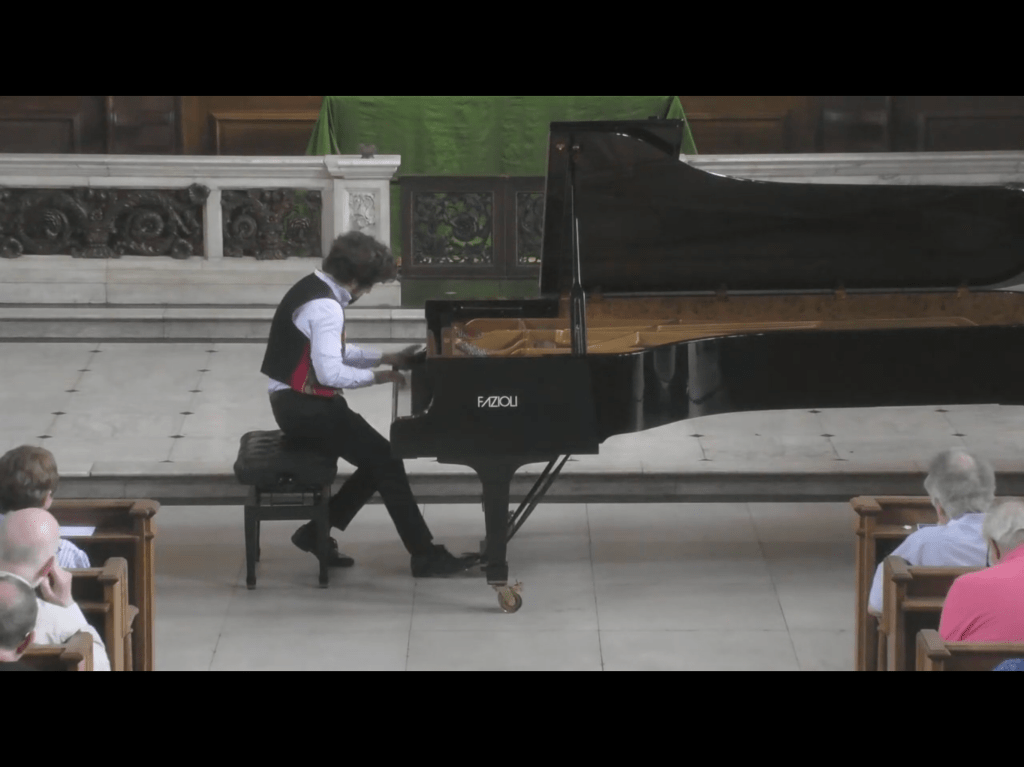
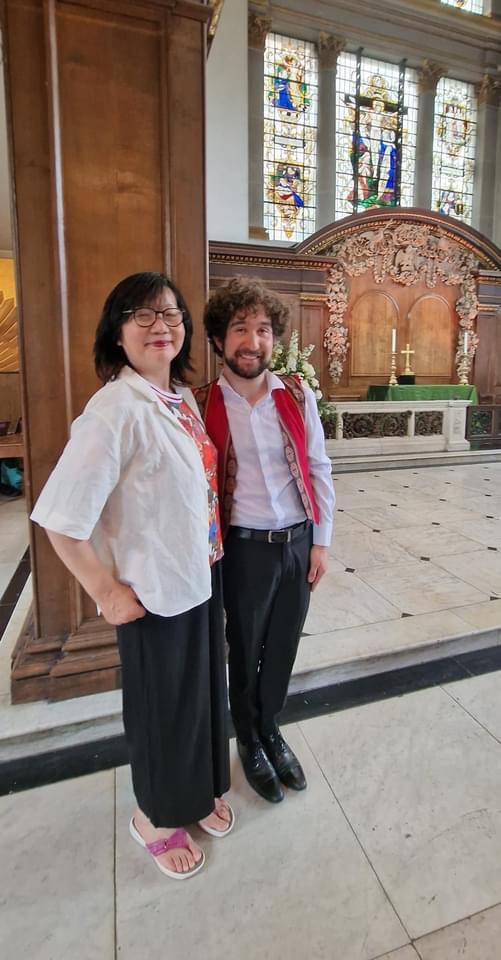
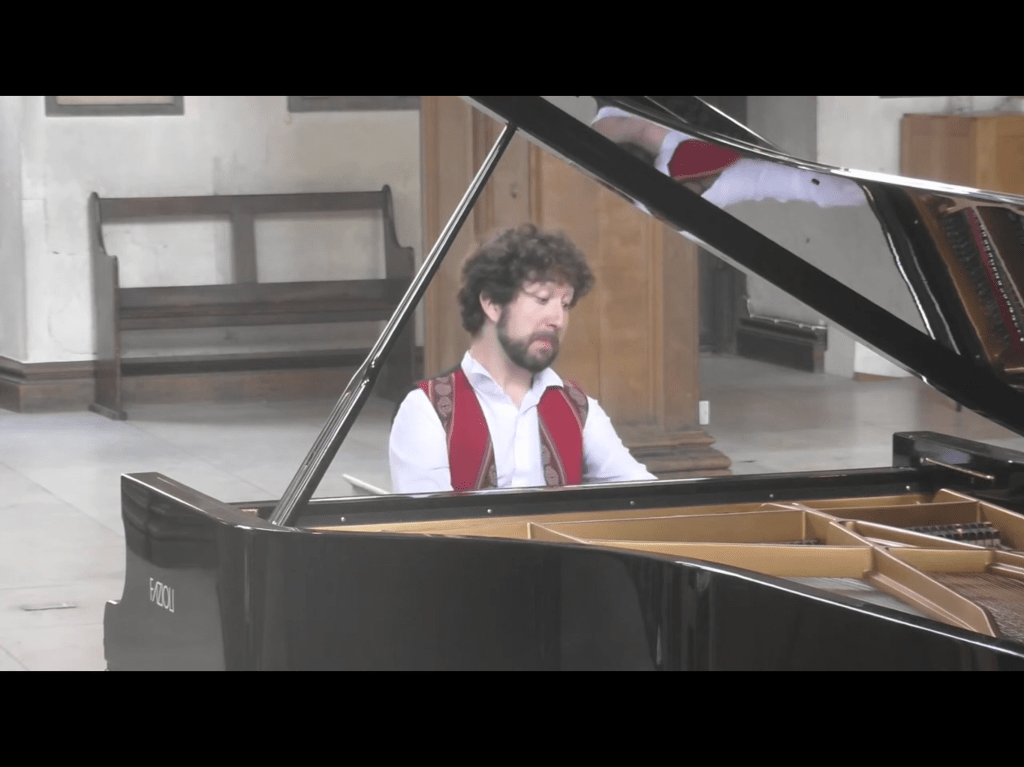
I have heard José play many times – it was unavoidable as he was living for six months in my house!I thought I had heard all his recent repertoire so it came as a complete surprise to see the programme that he presented under the auspices of the Royal College of Music.I had heard recently his final concert at the Royal College where he has been working for the past year with Norma Fisher and even heard some of his programmes for competitions and concerts he had been preparing throughout this past year.
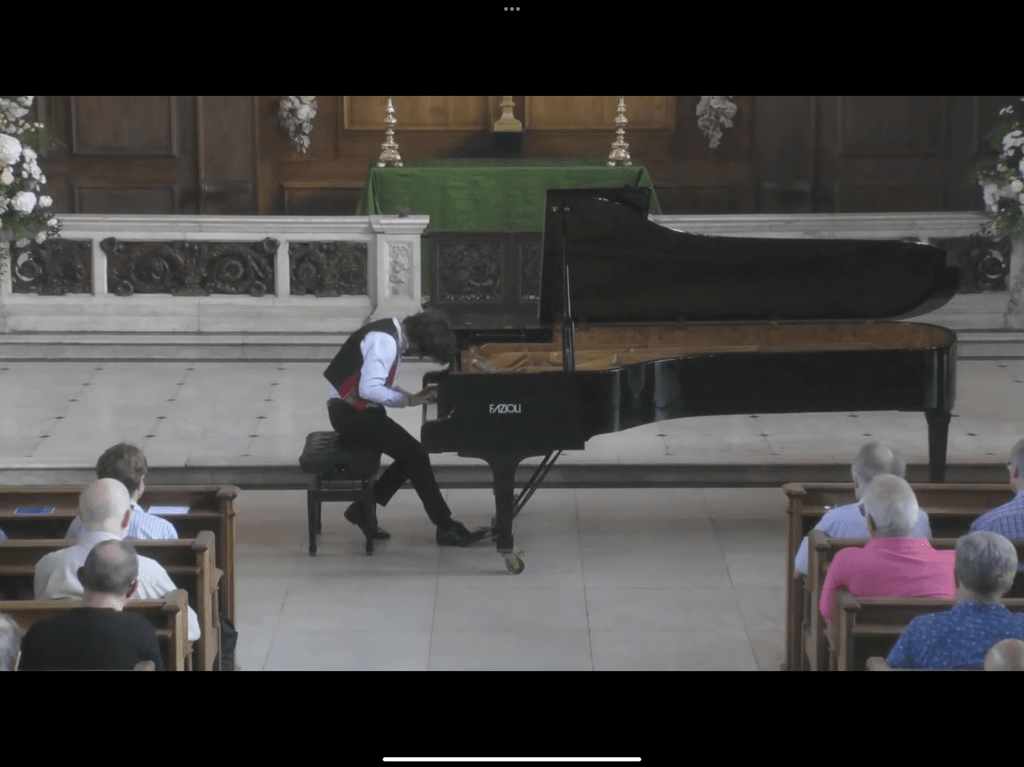
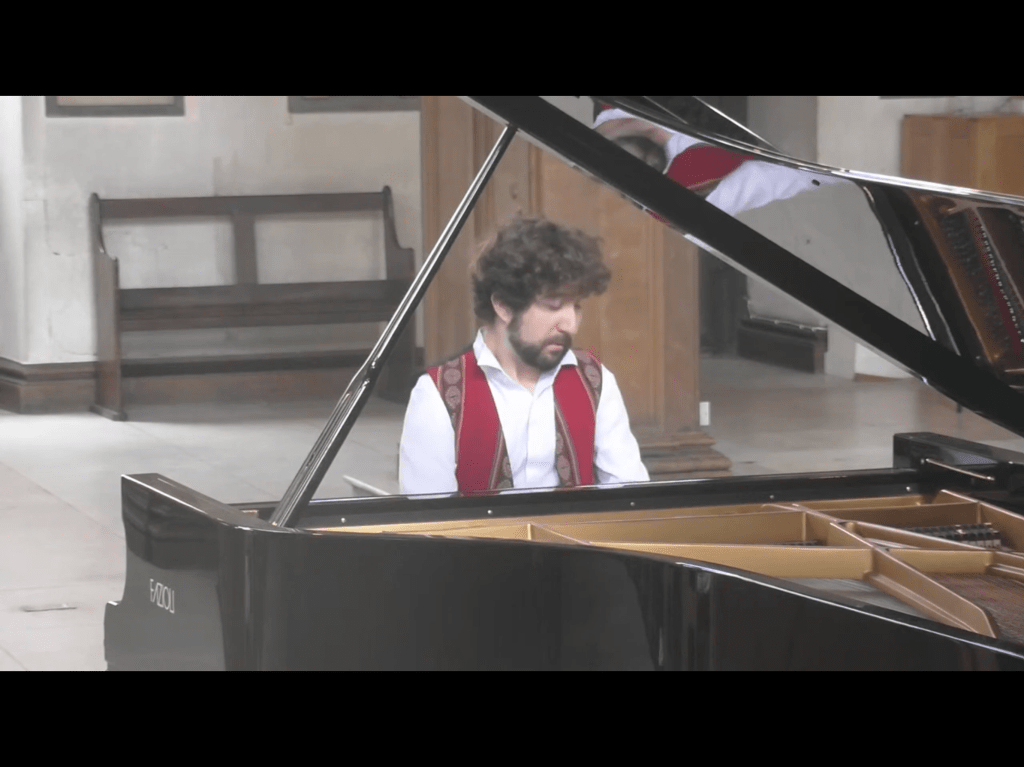
Jose Navarro Silberstein – masterly performances of red hot intensity
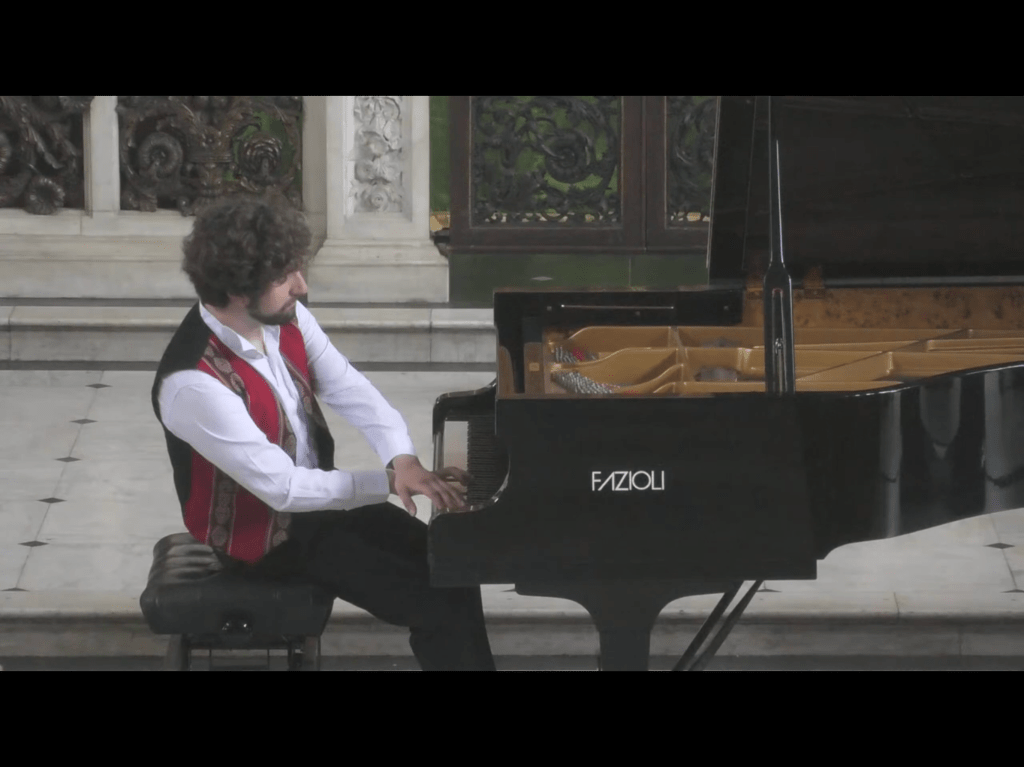
José had been discovered in Bolivia by one of the Keyboard Trust Trustees – Dr Moritz von Bredow – who was with a choir on a tour from Germany at the time .He was so impressed when he heard the very young José that he invited him to give some concerts in Germany.From there he went on to study for seven years in Cologne with the renowned pianist and pedagogue Claudio Martinez Mehner.This past year he was invited to study at the RCM and to complete his studies in London with Norma Fisher.
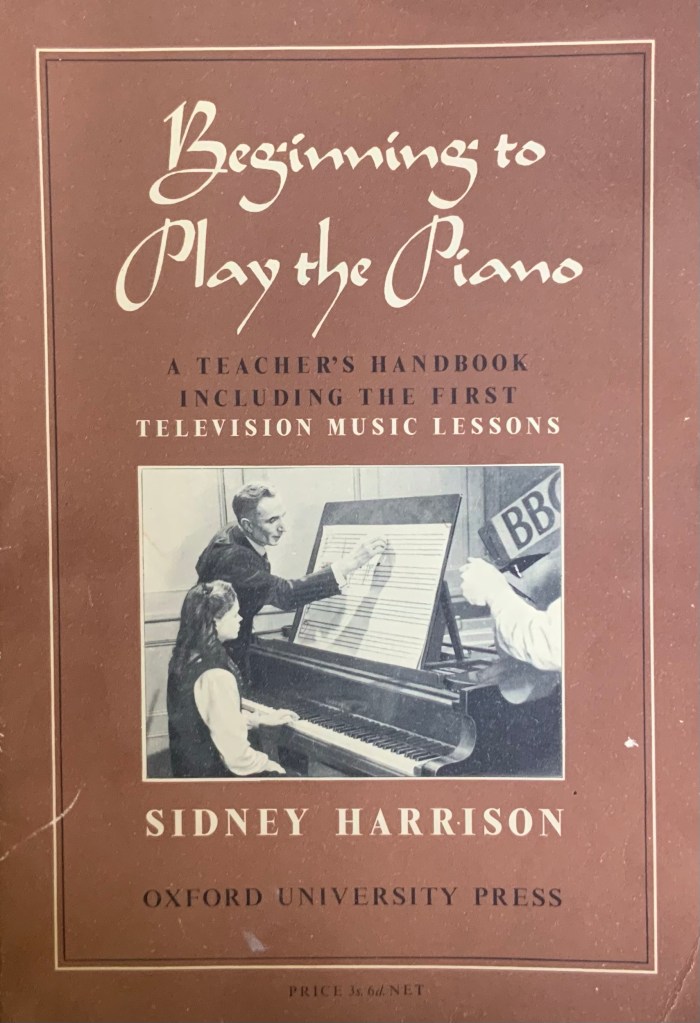
Norma and I had the same piano ‘daddy’ Sidney Harrison when we were schoolchildren.Norma was later taken under the wing by Gina Bachauer who took her to her own teacher Ilona Kabos.Norma fast made a name and important career for herself until she was struck down by a cruel muscular disease that curtailed her playing career.
Norma Fisher at Steinway Hall The BBC recordings -On wings of song- the story continues
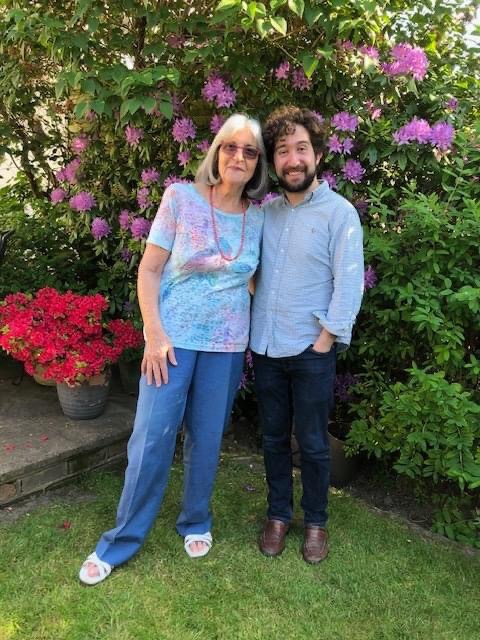
She is one of the finest musicians I know with impeccable good taste and like Chopin ( or even Shenker – call it what you will!) she believes that the root of music should be firmly planted in the ground and it is only then that the music above is free to move and take flight.A freedom within a certain framework that does not disturb the essential river like undercurrent.It was exactly this that was so apparent in José’s masterly performances today.The same solidity that was so much part of the playing of Gilels (or Solomon ) who was one of Norma’s favorite colleagues.It was the solidity that I remember hearing from Norma when Sidney Harrison took me back stage and proudly presented me as the Liszt Scholar at the Royal Academy to his former star student who was giving a recital at the Wigmore Hall.I have never forgotten the solidity of her Brahms Handel Variations or the beauty combined with strength of Chopin’s Berceuse.

The performance of the Fourth Ballade today had a solidity and beauty that had something of the monumental about it.Gone were the whispered asides and distortions that this work so often suffers in the name of tradition.In it’s place was a driving energy like a great wave the enveloped us as we experienced a journey where we were ravished,seduced,astonished and finally overwhelmed by a torrential passionate outpouring of seemless ease.But it all took place under the same roof in a unique sound world where all these wonders belonged with such unflinching certainty and beauty.Aristocratic might be a name for it,and that was certainly how one could have described Arthur Rubinstein’s inimitable performances during his glorious Indian Summer.But words are superfluous in trying to describe a monument of such originality and searing beauty as this Pinnacle of the Romantic piano repertoire.
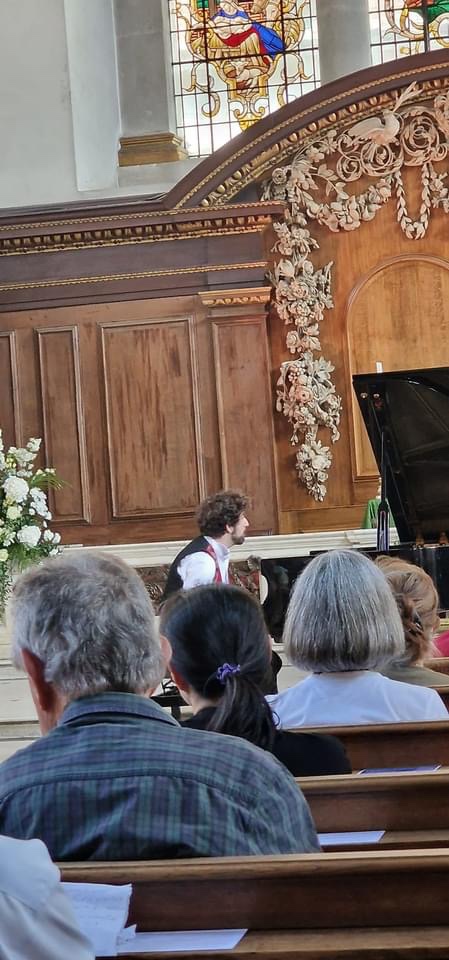
The concert had opened with Beethoven’s ‘little’ Sonata op 90.The most Schubertian of Beethoven’s Sonatas with a second movement that is a continuous outpouring of mellifluous simplicity.The first movement had an inner intensity from the very first chords.A forward movement that did not exclude beauty and delicacy though.Scrupulous attention to detail had me searching the score for things that I had not been aware of.The sudden pauses and change of dynamics gave such authority and weight to this seemingly innocent two movement work that was the be the prelude to Beethoven’s final visionary works for piano.Masterpieces where Beethoven’s tumultuous existence was at last to find celestial peace.No ritardando at the end of this first movement but beautifully curtailed leaving a question mark that was to find a reply in the beautiful fluidity of the second movement.’I found this a little too fast at the beginning for Beethoven’s ‘nicht zu geschwind ‘ marking to exclude any forcing of phrasing or external interference.It linked up though with the question and answer of the following episode superbly characterised without any exaggeration.Leading,like in Schubert, to a seemingly endless stream of melodic invention and in José masterly hands I realised what a masterpiece of art that conceals art this work really is.Beethoven writing so precisely his indications and followed by José not with cold precision but with full blooded understanding of the duel character of this universal genius.The last five bars marked ‘accelerando -crescendo -piano -a tempo -pianissimo’ and José almost made it but it was not as convincing as the end of the first movement had been.It is more charming than capricious and it was the only blemish in a performance that was a jewel shining so brightly nurtured with loving sensibility and intelligence.
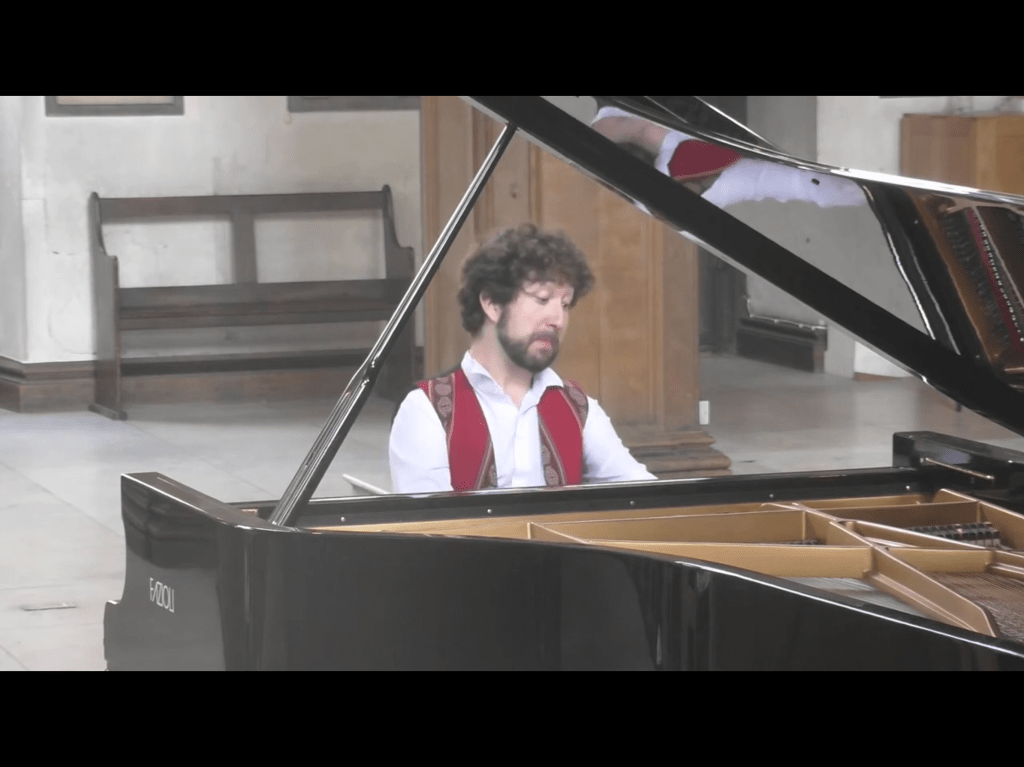
The Ginastera was given a performance of brilliance and with a kaleidoscope of sounds and a total command of a world that is after all José’s birthright.Ravishing,piecing delicacy of the ‘Adagietto pianissimo’was followed by the dynamic animal rhythms of the ‘Allegro rustico’.The delightfully flowing ‘Allegretto cantabile’ with its seductively beautiful tenor voice.The radiance of the doubling of the melodic line bathed in a mist of pedal was indeed ‘Calmo e poetico’ and was thanks to his wonderfully sensitive sense of balance.José took us by the scruff of the neck with his animal like attack in the last ‘Scherzando’ where it was astonishing to see with what speed and precision his hands and arms were wading in an imaginary fluid stream as these unexpectedly savage sounds filled the hallowed air of this most beautiful edifice.It was a good preparation for Scriabin’s demonic fifth sonata.
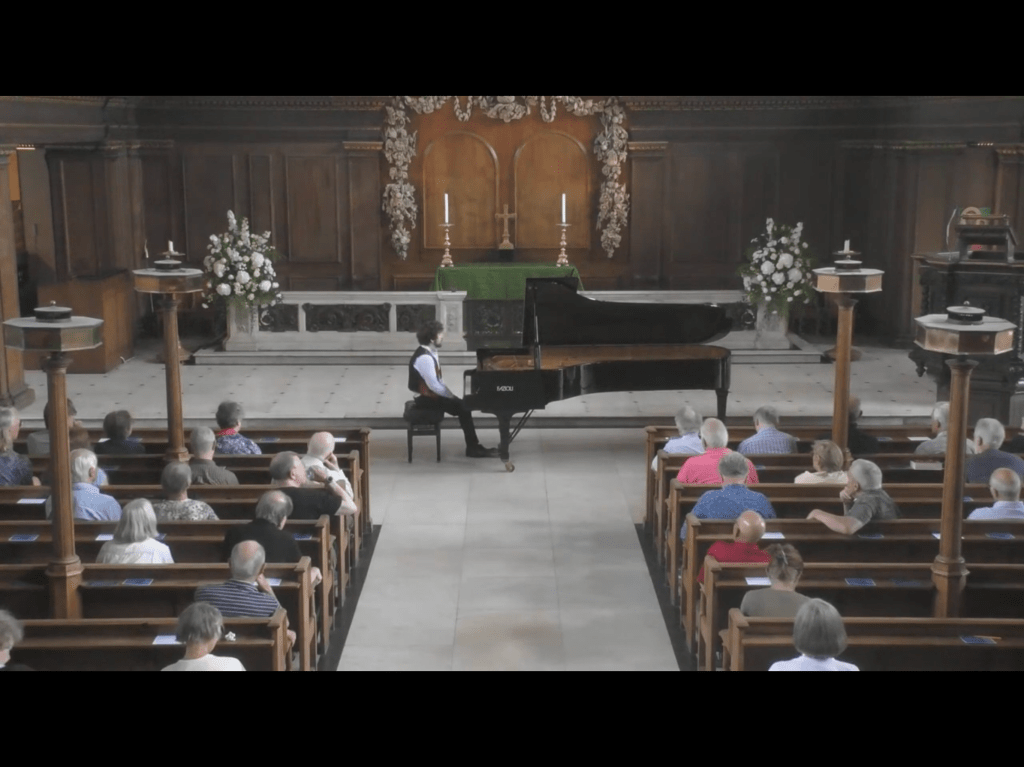
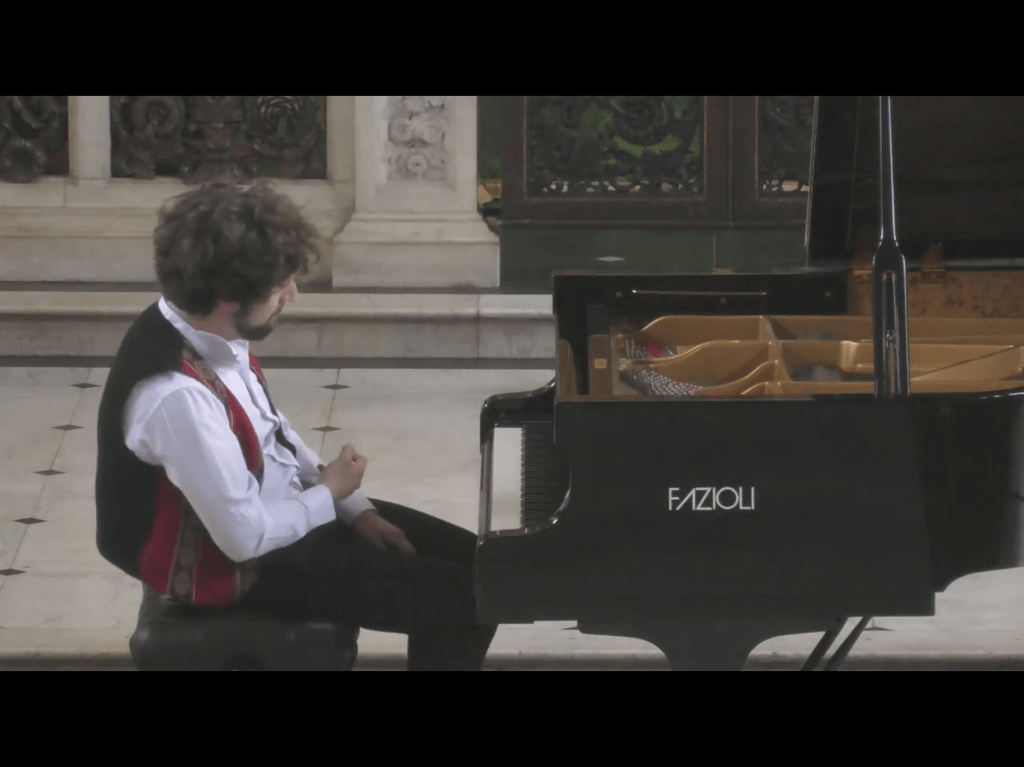
A feast both diabolical and sensual but played with a sense of architectural shape that was breathtaking in its mastery of the complexity involved.The three great notes ringing out throughout the cauldron of red hot sounds like blazing laser beams of Scriabin’s meteor and that finally unite as the ‘star’ shining in a final explosion of ecstatic excitement.I have heard José practicing it in my house but I never imagined that he would master its complexities with such overwhelming authority and take such breathtaking risks that had us on the edge of our seats.It brought the audience spontaneously to their feet at the end with the final release of tension as he shot from one end of the piano to the other.A star indeed in every sense!
Beethoven’s previous piano sonata, popularly known as Les Adieux ,was composed almost five years before Op. 90. Beethoven’s autograph survives and is dated August 16 but it was published almost a year later, in June 1815, by S. A. Steiner, after Beethoven made a few corrections.Beethoven’s letter to Prince Moritz von Lichnowsky, sent in September 1814, explains the dedication:
‘I had a delightful walk yesterday with a friend in the Brühl, and in the course of our friendly chat you were particularly mentioned, and lo! and behold! on my return I found your kind letter. I see you are resolved to continue to load me with benefits. As I am unwilling you should suppose that a step I have already taken is prompted by your recent favors, or by any motive of the sort, I must tell you that a sonata of mine is about to appear, dedicated to you. I wished to give you a surprise, as this dedication has been long designed for you, but your letter of yesterday induces me to name the fact. I required no new motive thus publicly to testify my sense of your friendship and kindness.’
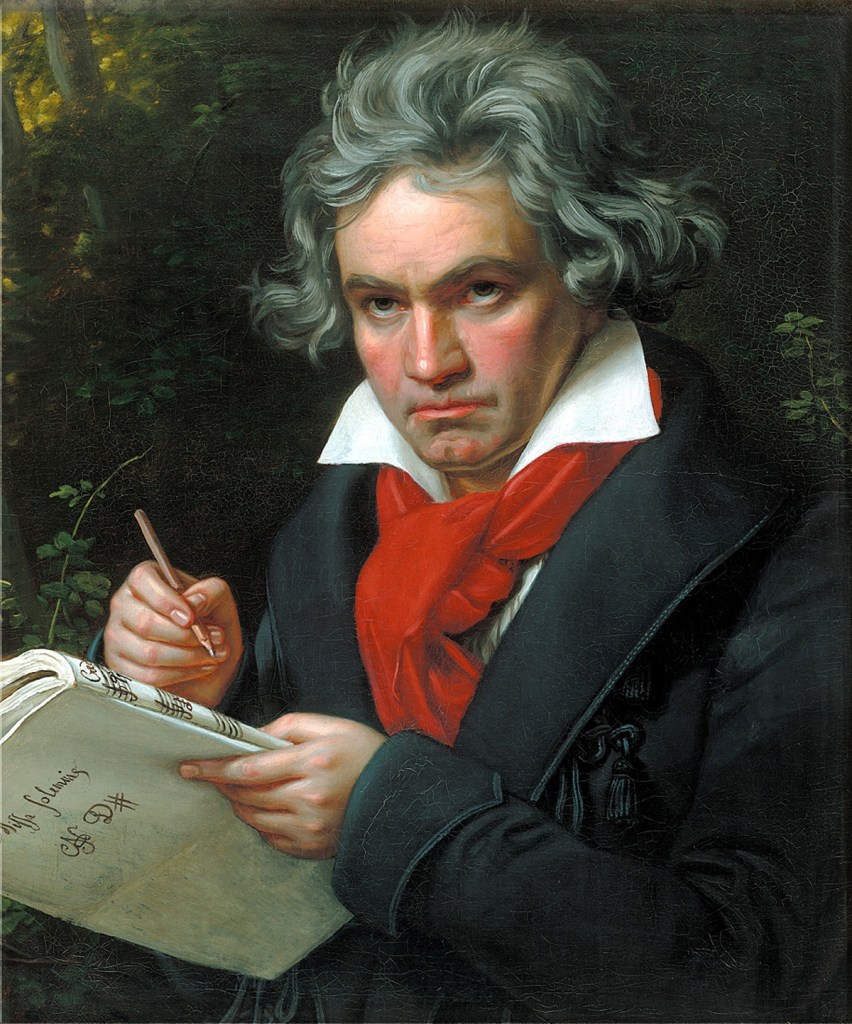
Beethoven’s friend and biographer Anton Schindler reported that the sonata’s two movements were to be titled Kampf zwischen Kopf und Herz (“A Contest Between Head and Heart”) and Conversation mit der Geliebten (“Conversation with the Beloved”), respectively, and that the sonata as a whole referred to Moritz’s romance with a woman he was thinking of marrying.Schindler’s explanation first appeared in his 1842 book Beethoven in Paris and has been repeated in several other books. Later studies showed that the story was almost certainly invented by Schindler, at least in part, and that he went so far as to forge an entry in one of Beethoven’s conversation books to validate the anecdoteMost of Beethoven’s piano sonatas are in three or four movements, but this one has only two. Both are provided with performance instructions in German. A few of Beethoven’s works of this period carried similar instructions in place of the traditional Italian tempo markings:
Mit Lebhaftigkeit und durchaus mit Empfindung und Ausdruck (“With liveliness and with feeling and expression throughout”)
Nicht zu geschwind und sehr singbar vorgetragen (“Not too swiftly and conveyed in a singing manner”)
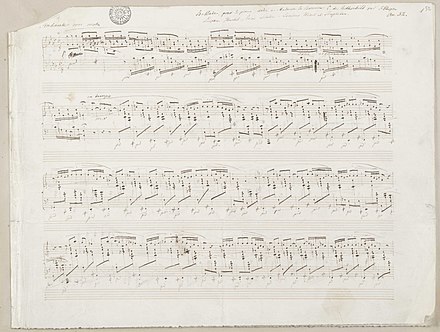
The Ballade No. 4 in F minor, Op. 52 was completed in 1842 in Paris and is considered not only one of Chopin’s masterpieces, but one of the masterpieces of 19th-century piano music.john Ogdon described it as “ the most exalted, intense and sublimely powerful of all Chopin’s compositions… It is unbelievable that it lasts only twelve minutes, for it contains the experience of a lifetime.”
Dedicated to Baroness Rothschild ,wife of Nathaniel de Rothschild,who had invited Chopin to play in her Parisian residence, where she introduced him to the aristocracy and nobility.
Alfred Cortot claims that the inspiration for this ballade is Adam Mickiewicz’s poem The Three Budrys, which tells of three brothers sent away by their father to seek treasures, and the story of their return with three Polish brides.

- Suite de Danzas Criollas op 15 (1946) Alberto Ginastera
- I. Adagietto pianissimo
- II. Allegro rustico
- III. Allegretto cantabile
- IV. Calmo e poetico
- V. Scherzando: Coda
Scriabin’s Sonata No 5, Op 53, was written as an offshoot of the orchestral ‘Poem of Ecstasy’ in 1907; its composition took only three to four days. Scriabin provided a text, a few lines from the poem written for the orchestral work:
I call you to life, mysterious forces!
Drowned in the obscure depths
of the creative spirit, timid
Embryos of life, to you I bring audacity!
—a vivid description of the release of material from the unconscious mind necessary for the creation of such a complex and innovative work in such a short space of time. Like the Fourth, the Fifth Sonata belongs to the middle period of Scriabin’s music where harmony relates directly and clearly to the tonal system, but many features point already to the final phase.
Scriabin decided to go to live in Lausanne with his pregnant wife Tatyana,since he found the place to be cheaper, quieter, and healthier, and only 7 hours away from Paris. On 8 December 1907 Tatyana wrote to a friend:
‘We go out a little, having caught up on our sleep. We begin to look normal again. Sasha even has begun to compose – 5th Sonata!!! I cannot believe my ears. It is incredible! That sonata pours from him like a fountain. Everything you have heard up to now is as nothing. You cannot even tell it is a sonata. Nothing compares to it. He has played it through several times, and all he has to do is to write it down …’
In late December, Scriabin wrote to Morozova about the imminent completion of his new work:
‘The Poem of Ecstasy took much of my strength and taxed my patience. … Today I have almost finished my 5th Sonata. It is a big poem for piano and I deem it the best composition I have ever written. I do not know by what miracle I accomplished it …’
 ChristopherAxworthy-MusicCommentary
3 risposte a "José Navarro Silberstein at St James’s A master musician with a heart of gold"