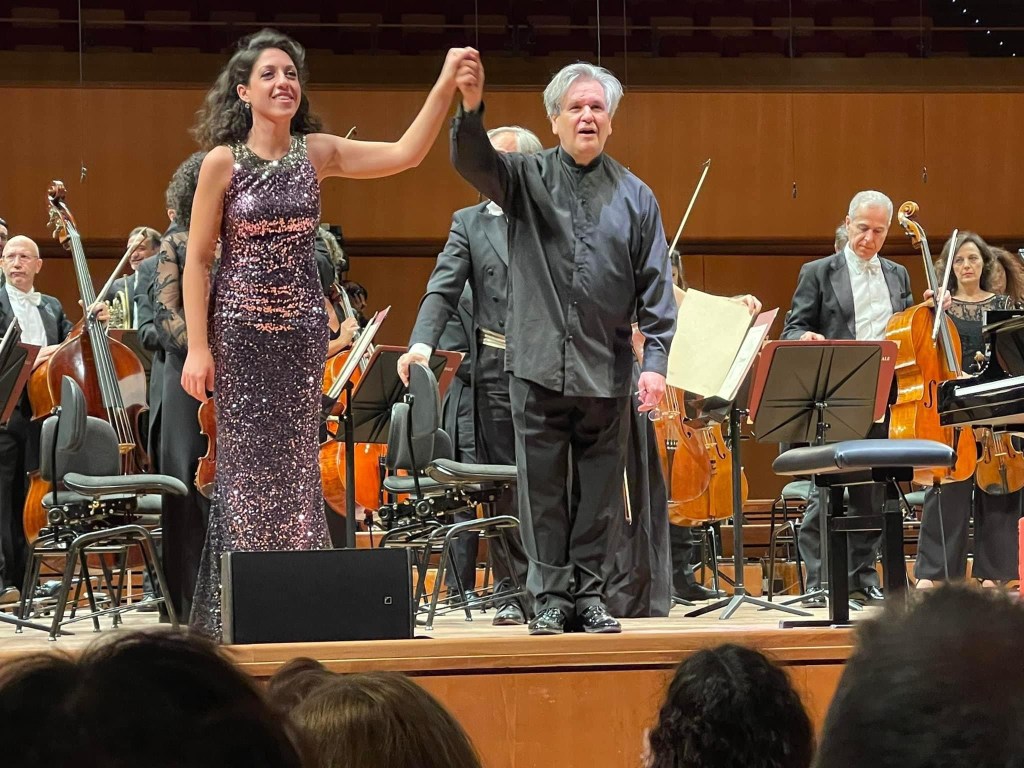
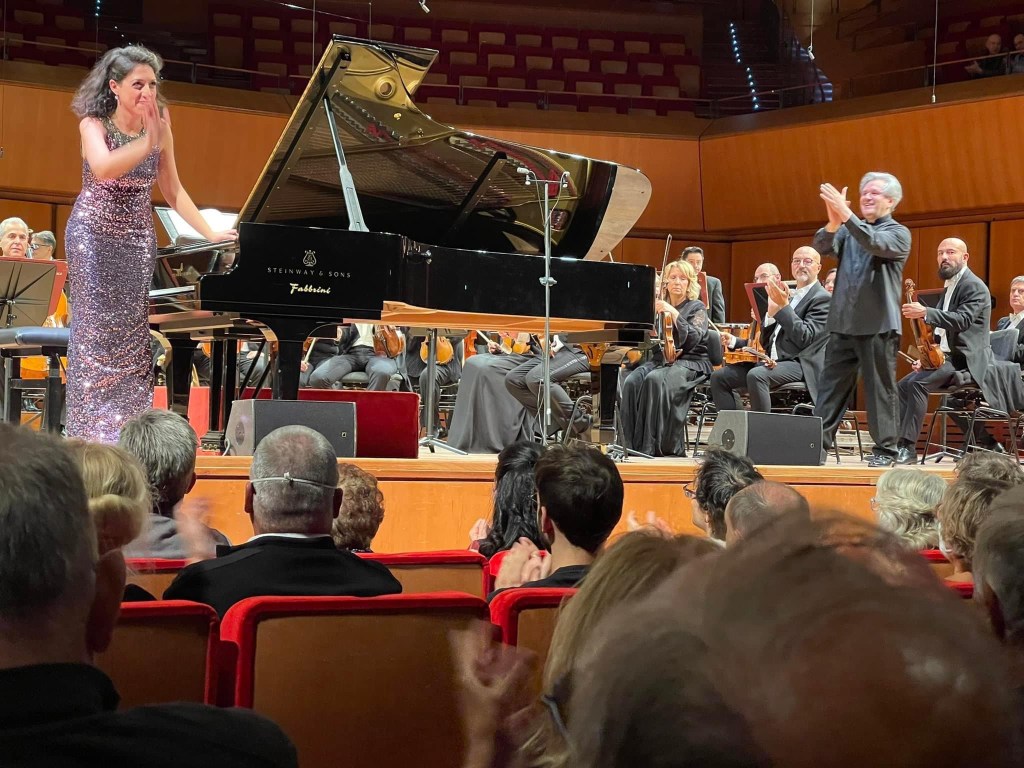
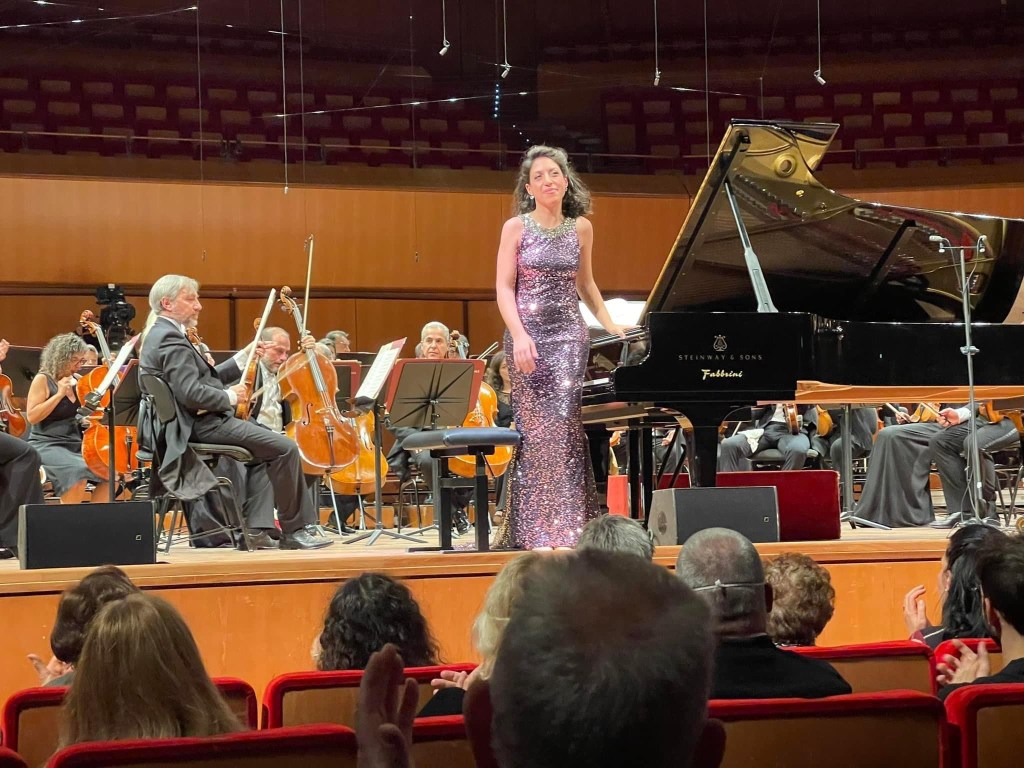
It was in the little Romance in F sharp op 28 by Robert Schumann played as an encore by Beatrice Rana that shone a light on a genius.Such exquisite playing of whispered beauty,not playing out to the audience but drawing them in to her secret world of ravishing beauty. Clara Schumann’s A minor piano concerto paled into the distance as try as she could Beatrice Rana could not turn a mere bauble into a gem.Some exquisite playing of rather empty uninspired music that seemed to be without any architectural shape or even a memorable melodic line. Some beautiful chamber music passages when she communed with the superb cello of Diego Romano or the filigree accompaniment of delicious delicacy as Pappano drew his forces to play with consumate style and passion.A finale to say bland would be too little but injected with the lifeblood of great artists Pappano and Beatrice did their best to inject some life into an empty vessel.Historically interesting,of course,to be reminded of the first woman virtuoso pianist writing her own concerto at only 16 .To discover an international performing career of over 61 years while breeding eight children.Amazing but do we really think we have struck gold?………..the only gold and silver streamed from the hands of one of the finest young pianists of her generation.
It is the first performance for the Accademy of the concerto whereas there is a list of almost three pages for the performances of the Unfinished Symphony since 1900.I think that says it all !
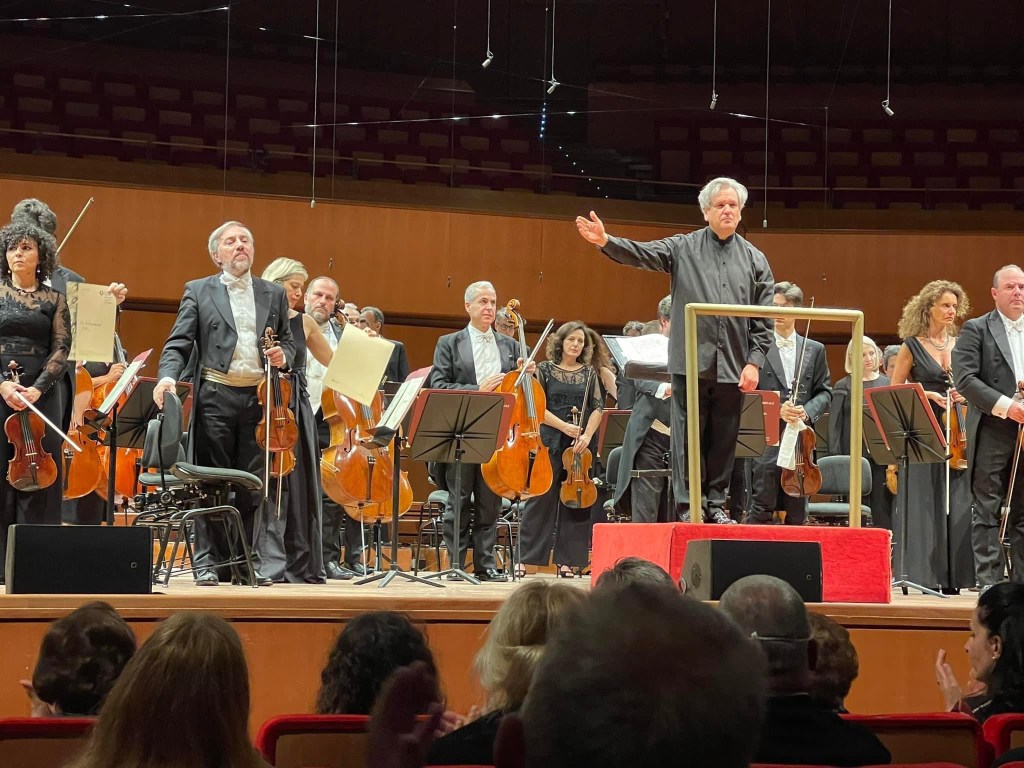
Wonderful sensitivity of an orchestra who have learnt in the past 20 years under Pappano to listen to each other.An orchestra that listens to itself is a force to be reckoned with as the superb performances of Schubert Unfinished and Schumann Second Symphony demonstrated. Pappano will be much missed when after almost 20 years he moves permanently to London next year to guide the LSO following in the footsteps of Abbado.
Clara power 🔥💕 Souvenir of a memorable week with The Philadelphia Orchestra and Yannick Nezet-Seguin! 📸 @jennifertaylorphotographyClara power 🔥💕 Souvenir of a memorable week with The Philadelphia Orchestra and Yannick Nezet-Seguin! 📸 @jennifertaylorphotographyClara power 🔥💕 Souvenir of a memorable week in New York and Philadelphia with The Philadelphia Orchestra and Yannick Nezet-Seguin! 📸 @jennifertaylorphotographyPortrait by Franz von Lenbach, 1838 Born Clara Josephine Wieck
13 September 1819 Leipzig Died 20 May 1896 (aged 76) Frankfurt Occupation Pianist Composer Piano teacher Organization Dr Hoch’s Konservatorium Spouse Robert Schumann
(m. 1840; died 1856) Children 8, including Eugenie Parents Friedrich Wieck (father) Mariane Bargiel (mother)
The Piano Concerto in A minor op.7, was composed by Clara Wieck, better known as Clara Schumann after her marriage to Robert Schumann. She completed her only finished piano concerto in 1835, and played it first that year with the Leipzig Gewandhaus Orchestra conducted by Felix Mendelssohn.
Clara Wieck was an accomplished concert pianist, trained by her father Friedrich Wieck.She was already making international tours at age eleven and composed piano pieces for her recitals.Regarded as one of the most distinguished pianists of the Romantic era, she exerted her influence over the course of a 61-year concert career, changing the format and repertoire of the piano recital by lessening the importance of purely virtuosic works She started receiving basic piano instruction from her mother at the age of four but after her mother moved out, she began taking daily one-hour lessons from her father. They included subjects such as piano, violin, singing, theory, harmony, composition, and counterpoint.She then had to practice for two hours every day. Her father followed the methods in his own book, Wiecks pianistische Erziehung zum schönen Anschlag und zum singenden Ton (“Wieck’s Piano Education for a Delicate Touch and a Singing Sound.”)Clara Wieck made her official debut on 28 October 1828 at the Gewandhaus in Leipzig, aged nine.The same year, she performed at the Leipzig home of Ernst Carus, director of the mental hospital at Colditz Castle.There, she met another gifted young pianist who had been invited to the musical evening, Robert Schumann , who was nine years older. Schumann admired Clara’s playing so much that he asked permission from his mother to stop studying law, which had never interested him much, and take music lessons with Clara’s father. While taking lessons, he rented a room in the Wieck household and stayed about a year.From December 1837 to April 1838, at the age of 18, Wieck performed a series of recitals in Vienna She performed to sell-out crowds to great critical acclaim; Chopin described her playing to Franz Liszt and a music critic, describing her Vienna recitals, said: “The appearance of this artist can be regarded as epoch-making… In her creative hands, the most ordinary passage, the most routine motive acquires a significant meaning, a colour, which only those with the most consummate artistry can give.”Clara Schumann first toured England in April 1856, while her husband was still living but unable to travel. She was invited to play in a London Philharmonic Society concert by conductor William Sterndale Bennett, a good friend of Robert’s to whom he had dedicated the Etudes Symphoniques op 13.In May 1856, she played Schumann’s Piano Concerto with the New Philharmonic Society conducted by Dr Wylde, who as she said had “led a dreadful rehearsal” and “could not grasp the rhythm of the last movement”.Still, she returned to London the following year and continued to perform in Britain for the next 15 years.
It was in January 1833, at age 13, she began composing a Piano Concerto in , completing it in November a single-movement Konzertsatz that she orchestrated herself. In February 1834, her future husband Robert revised the orchestration,and the 14-year-old prodigy then performed it in several concerts.She then expanded the work by adding two more movements, using the Konzertsatz as the finale. The new first movement was completed in June 1834, and the slow second movement “Romance” with its extended cello solo was finished the following year. She again orchestrated the work herself, including undoing Robert’s revisions of the original Konzertsatz, completing her new three-movement Piano Concerto on 1 September 1835, twelve days before her 16th birthday.Clara premiered the full concerto on 9 November 1835 as soloist with the Leipzig Gewandhaus Orchestra, conducted by Mendelssohn
Her life was punctuated by tragedy Not only did her husband predecease her, but so did four of their children.Their first son, Emil, died in 1847, aged only 1.Their daughter Julie died in 1872, leaving two small children aged only 2 and 7, then raised by their grandmother.In 1879, their son Felix died aged 24.In 1891, their son Ferdinand died at the age of 41, leaving his children to her care.In 1878, she was appointed the first piano teacher of the new Dr Hoch’s Knservatorium in Frankfurt.Among her 68 known students who made a musical career were Natalia Janotha, Fanny Davies, Nanette Falk, Amina Goodwin, Carl Friedberg, Leonard Borwick, Ilona Eibenschütz, Adelina de Lara, Marie Olson and Mary Wurm.She played her last public concert in Frankfurt on 12 March 1891. The last work she played was Brahms’s Haydn Variations , in a version for two pianos, with James Kwast.
Clara and Robert Schumann had eight children:
Marie (1841–1929)
Elise (1843–1928)
Julie (1845–1872)
Emil (1846–1847)
Ludwig (1848–1899)
Ferdinand (1849–1891)
Eugenie (1851–1938)
Felix (1854–1879).
Robert and Clara Schumann’s children (photo taken in 1853 or 1854); from left to right: Ludwig, Marie, Felix, Elise, Ferdinand and Eugenie
The Haydn Sonata XV1 n.12 in A first appeared as a Divertimento in A and was written around 1767.It is thought the first movement may have been by C.P.E Bach.According to Grove Music, this is in the list of “early harpsichord sonatas attributed to Haydn”, but has the comment ‘I doubtful’ which may mean that the 1st movement is considered doubtful.
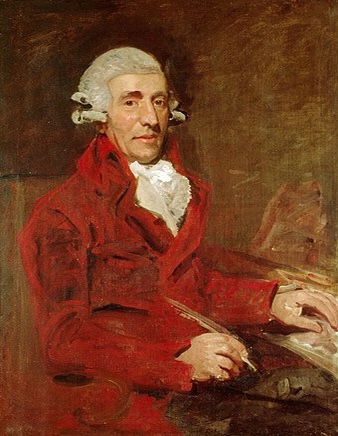
Portrait of Haydn in London 1791 by John Hoppner
Franz Joseph Haydn,31st March 1732 – 31st May 1809,was one of the most prolific and prominent composers of the Classical period. He is often called the “Father of the Symphony” and “Father of the String Quartet” because of his important contributions to these forms. He was also instrumental in the development of the piano trio and in the evolution of sonata form. A lifelong resident of Austria, Haydn spent much of his career as a court musician for the wealthy Esterházy family on their remote estate. Isolated from other composers and trends in music until the later part of his long life, he was, as he put it, “forced to become original”. At the time of his death, he was one of the most celebrated composers in Europe.
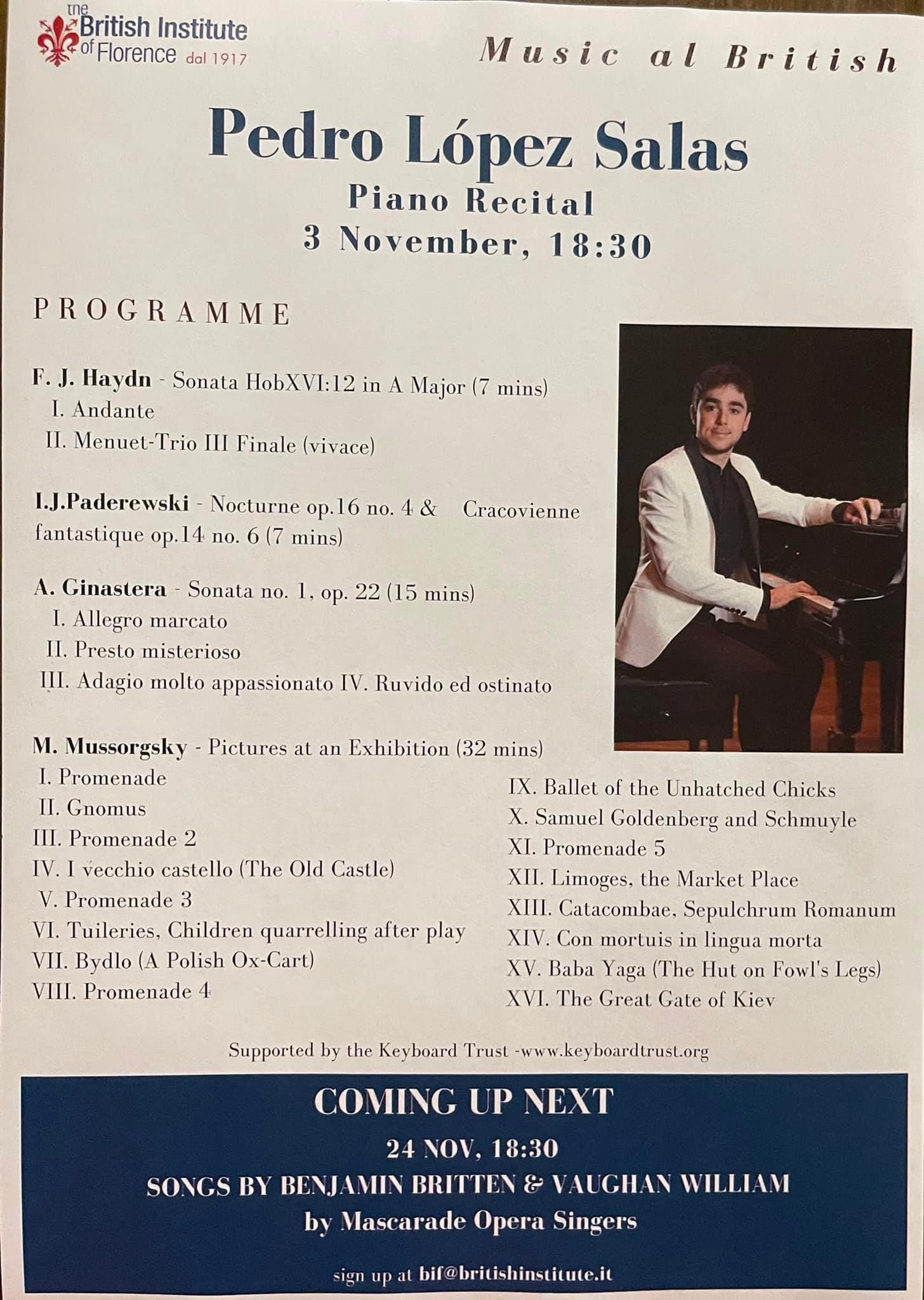
From the very first notes Pedro showed us that we were in for something very special tonight as everything he played was brought to life with such musicianship.Every phrase,every passage was given a life of its own in a musical conversation that is rare indeed.There was such delicacy in the opening Andante with jewel like ornaments that just sprang from his fingers with spring like brilliance.Sparkling and glowing with ever more meaning as he shaped the phrases with beauty and rhythmic drive.The Menuet was very simple and beautifully shaped contrasting with the music box sounds of the Trio played on the surface of the keys with long held pedals as Haydn himself had indicated.A similar effect to the later C major Sonata Hob XV1:50 written more that 30 years later in 1795/5 and one of Haydn’s four famous London Sonatas which are the distillation of the composer’s entire sonata-writing output .They were,though,written for an instrument of greater tonal range than the Viennese instruments of the day, with a wider palette of specified dynamic possibilities and pedal effects.The return of the simple black and white elegance of the Menuet was like reopening a window, having been taken on a magic dream world of make believe.The Finale was scintillating and exhilarating bursting with youthful energy but in Pedro’s masterly hands always given such shape and character .
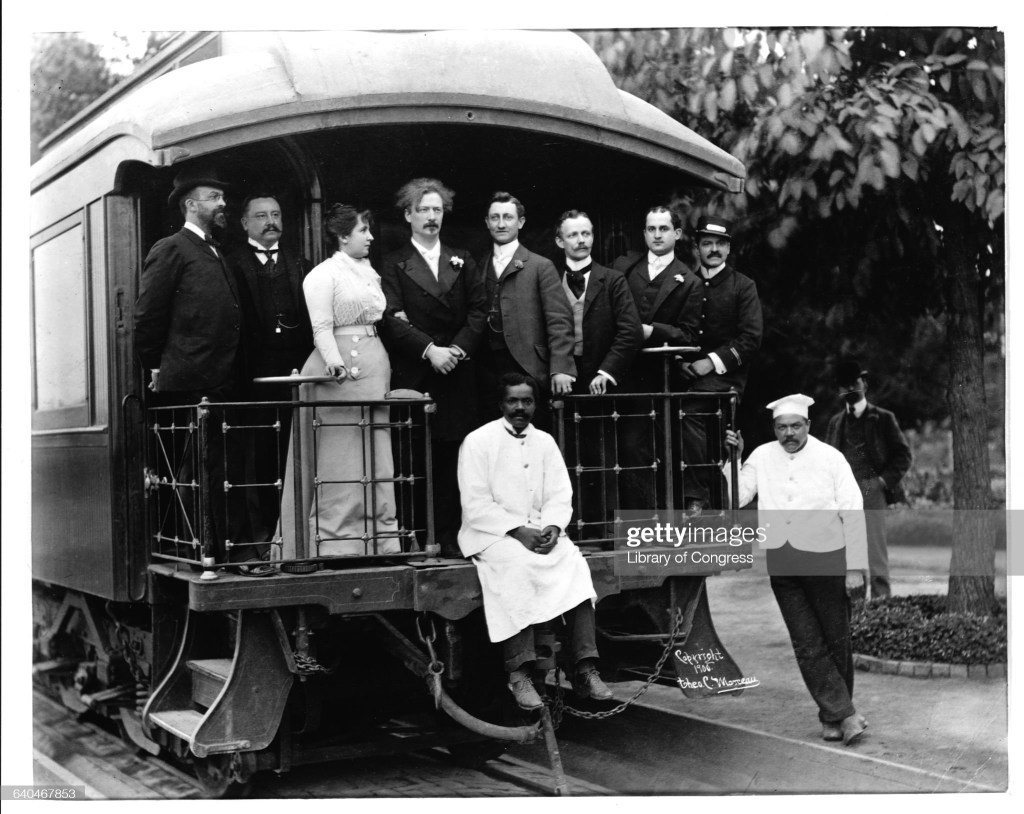
Ignacy Jan Paderewski (18 November 1860 – 29 June 1941) was a Polish pianist and composer who became a spokesman for Polish independence. In 1919, he was the new nation’s Prime Minister and foreign minister during which he signed the Treaty of Versailles, which ended World War 1.A favorite of concert audiences around the world, his musical fame opened access to diplomacy and the media.During World War I, Paderewski advocated an independent Poland, including touring the United States, where he met with President Woodrow Wilson who came to support the creation of an independent Poland at the Paris Peace Conference in 1919, which led to the Treaty of Versailles.
His piano miniatures became especially popular; the Minuet in G Op. 14 No. 1, written in the style of Mozart, became one of the most recognized piano tunes of all time. Despite his relentless touring schedule and his political and charitable engagements, Paderewski left a legacy of over 70 orchestral, instrumental, and vocal works.All of his works evoke a romantic image of Poland. They incorporate references to Polish dances (polonaise, krakowiak, and mazurka) and highlander music (Tatra album [Album tatrzańskie], op. 12, Polish Dances [Tańce polskie], op. 5.
The two short pieces that Pedro chose were beautifully played and although they were obviously salon pieces written for Paderewski’s own tours he almost turned ‘baubles into gems’.His extraordinary sense of balance allowed the touching ‘bitter sweet’ melody to sing in an enchanting way that was of great effect.The Cracovienne fantastique on the other hand where the Gopak type dance was played with great energy and character.There was also scintillating jeux perlé effects that were ravishing and would have obviously thrilled the thousands of fans that flocked to hear the ‘greatest virtuoso of all time’.Pedro’s fingerfertigkeit was extraordinary in the way the notes just seemed to flow from his fingers with such charm and ease.Let us not forget that Paderewski was the first pianist to give a solo recital in the newly opened 3000 seat Carnegie Hall and 20000 people flocked to hear him in Madison Square Garden.A modern day Lang Lang one might say who like Paderewski has also put his quite considerable fortune amassed from his concert career to philanthropical use.
Paderewski’s private touring coach
After the invasion of Poland in 1939, Paderewski returned to public life. In 1940, he became the head of the National Council of Poland , a Polish sejm (parliament) in exile in London. He again turned to America for help and his broadcast was carried by over 100 radio stations in the United States and Canada. He advocated in person for European aid and to defeat Nazism. In 1941, Paderewski witnessed a touching tribute to his artistry and humanitarianism as US cities celebrated the 50th anniversary of his first American tour by putting on a Paderewski Week, with over 6000 concerts in his honour. In 1992, after the end of communism in Poland, his remains were transferred to Warsaw and placed in St.John’s Archcathedral. His heart is encased in a bronze sculpture in the National Shrine of Our Lady of Częstochowa near Doylestown,Pennsylvania.
Piano Sonata No. 1, Op. 22 by Ginastera is in four movements.It was commissioned by the Carnegie Institute and the Pennsylvania College for Women writing a piano sonata for the Pittsburgh International Contemporary Music Festival. The first performance in 1952 was given by pianist Johana Harris, wife of American composer Roy Harris, and Ginastera’s intention for the piece was to capture the spirit of Argentine folk music without relying on explicit quotations from existing folk songs.Ginastera was born in Buenos Aires (April 11, 1916 – June 25, 1983) and is considered to be one of the most important 20th century classical composers of the Americas.He studied at the Williams Conservatory in Buenos Aires, graduating in 1938 and as a young professor, he taught at the Liceo Militar General San Martín. After a visit to the United States in 1945–47, where he studied with Aaron Copland at Tanglewood, he returned to Buenos Aires. Ginastera grouped his music into three periods: “Objective Nationalism” (1934–1948), “Subjective Nationalism” (1948–1958), and “Neo-Expressionism” (1958–1983). Among other distinguishing features, these periods vary in their use of traditional Argentine musical elements. His Objective Nationalistic works often integrate Argentine folk themes in a straightforward fashion, while works in the later periods incorporate traditional elements in increasingly abstracted forms.
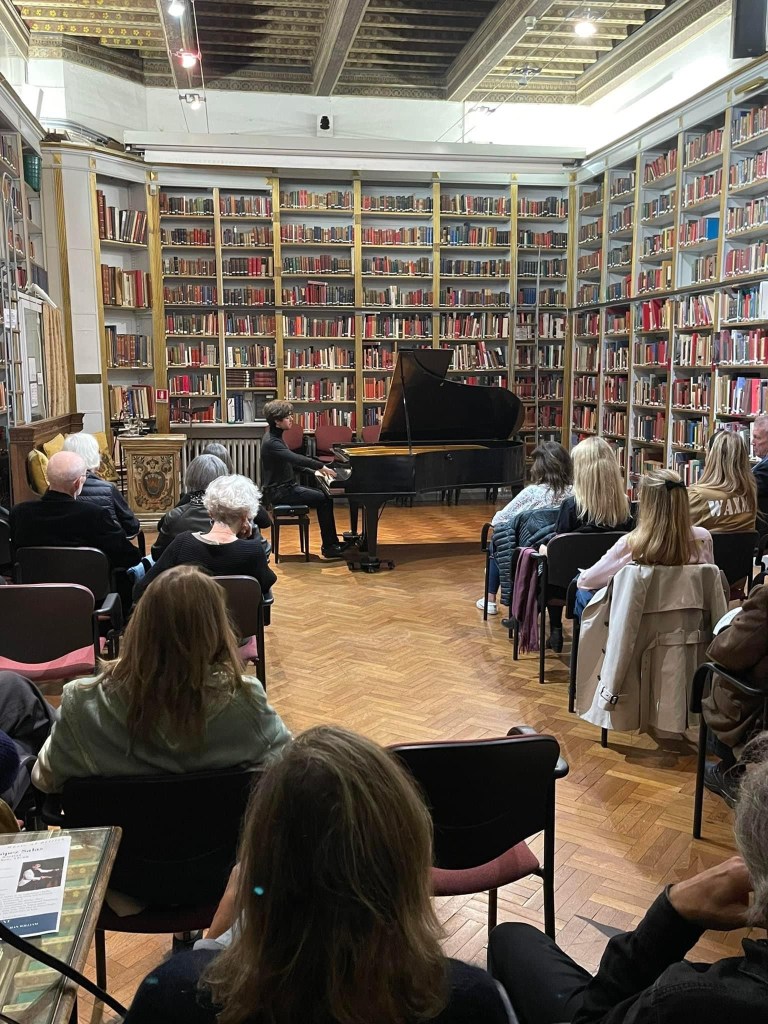
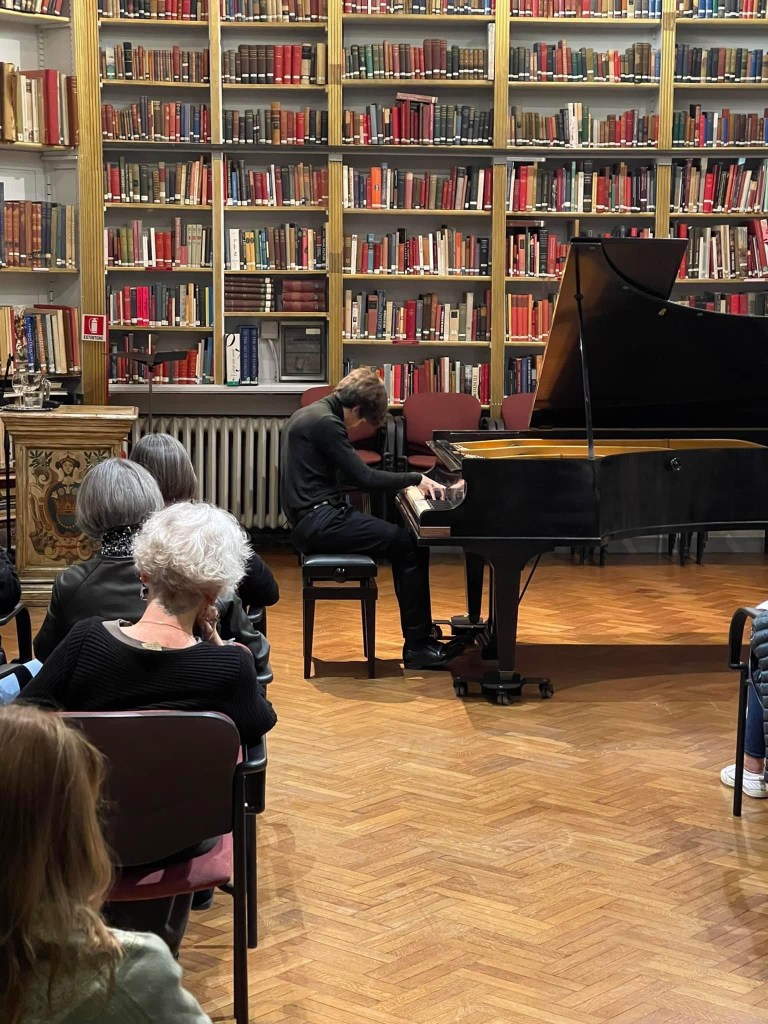
There was playing of rhythmic precision and driving Latin fever mixed with episodes of ravishing colour.The legato meanderings of the second movement were of Chopinesque whispered mystery until sudden ferocious outbursts erupted before dissolving back to its atmospheric beginnings.There was startling intensity in the Adagio with its calm and crystalline melodic interruptions over exotic luxuriant arpeggiando chords.The final toccata was played with a ferocious outpouring of savage rhythms that were of great effect and brought this showcase work to a brilliant conclusion.Much to the relief of the director Simon Gammell who feared that his 1898 instrument might have collapsed in a heap at his feet!But Pedro is an artist who can feel the limits and possibilities of the instrument he is playing and can gage his passion with extraordinary sensitivity.
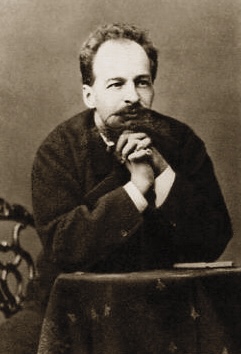
Pictures at an Exhibition is based on pictures by the artist, architect, and designer Viktor Hartmann. It was probably in 1868 that Mussorgsky first met Hartmann, not long after the latter’s return to Russia from abroad. Both men were devoted to the cause of an intrinsically Russian art and quickly became friends. They met in the home of the influential critic Vladimir Stasov, who followed both of their careers with interest. According to Stasov’s testimony, in 1868, Hartmann gave Mussorgsky two of the pictures that later formed the basis of Pictures at an Exhibition.
Viktor Hartmann
Hartmann’s sudden death on 4 August 1873 from an aneurysm shook Mussorgsky along with others in Russia’s art world. The loss of the artist, aged only 39, plunged the composer into deep despair. Stasov helped to organize a memorial exhibition of over 400 Hartmann works in the Imperial Academy of Arts in Saint Petersburg in February and March 1874. Mussorgsky lent the exhibition the two pictures Hartmann had given him, and viewed the show in person, inspired to compose Pictures at an Exhibition, quickly completing the score in three weeks (2–22 June 1874).Five days after finishing the composition, he wrote on the title page of the manuscript a tribute to Vladimir Stasov, to whom the work is dedicated.The music depicts his tour of the exhibition, with each of the ten numbers of the suite serving as a musical illustration of an individual work by Hartmann.Although composed very rapidly, during June 1874, the work did not appear in print until 1886, five years after the composer’s death, when a not very accurate edition by the composer’s friend and colleague Nikolai Rimsky-Korsakov was published.
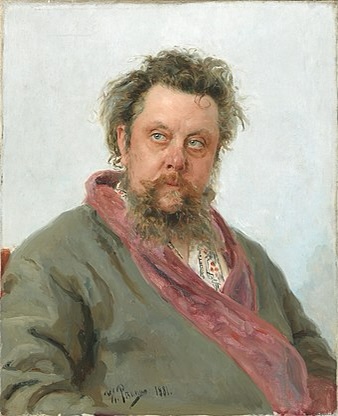
A portrait painted by Ilya Repin a few days before the death of Mussorgsky in 1881
Mussorgsky suffered personally from alcoholism, it was also a behavior pattern considered typical for those of Mussorgsky’s generation who wanted to oppose the establishment and protest through extreme forms of behavior.One contemporary notes, “an intense worship of Bacchus was considered to be almost obligatory for a writer of that period.”Mussorgsky spent day and night in a Saint Petersburg tavern of low repute, the Maly Yaroslavets, accompanied by other bohemian dropouts. He and his fellow drinkers idealized their alcoholism, perhaps seeing it as ethical and aesthetic opposition. This bravado, however, led to little more than isolation and eventual self-destruction.
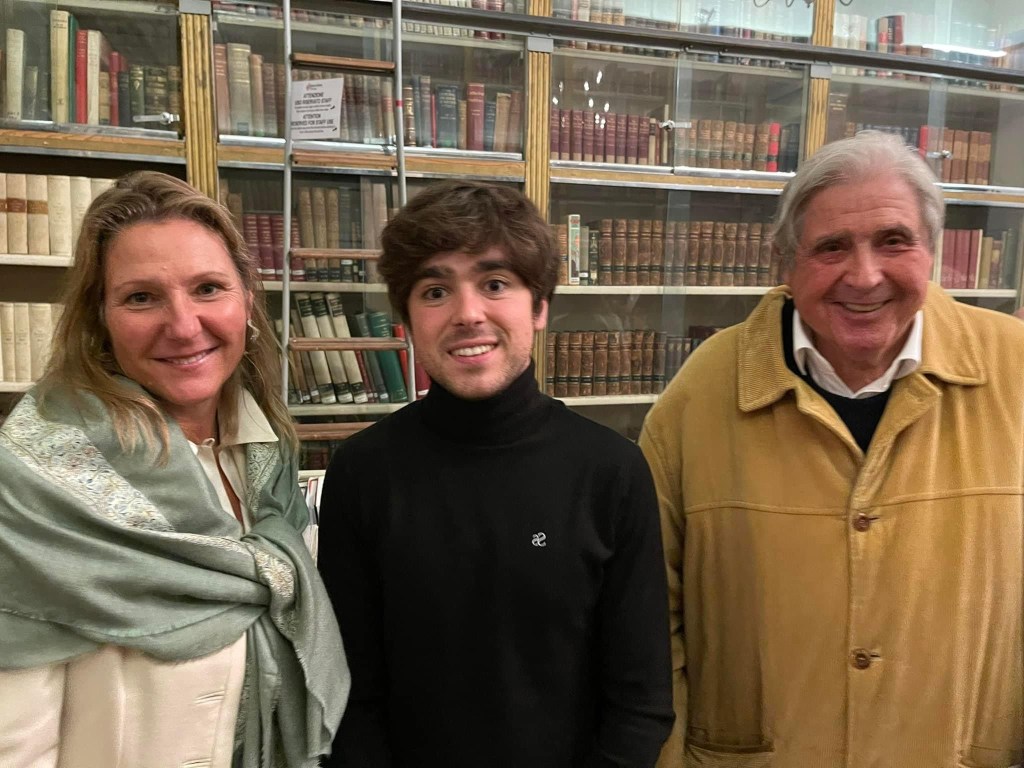
Pedro with a very enthusiastic Sir David Scholey and daughter who had also heard this week in Florence Martha Argerich in the Schumann Concerto with Charles Dutoit and Maurizio Pollini with Zubin Mehta in Mozart K.595 !
I have heard Pedro before,encouraged to listen to a very talented student by his teacher at the RCM Norma Fisher. https://christopheraxworthymusiccommentary.com/2022/05/12/norma-fisher-at-steinway-hall-the-bbc-recordings-on-wings-of-song-the-story-continues/. I could never have imagined that he would mature into an artist of such stature .Such weight and sensitivity where every note had a meaning in an overall architectural structure of remarkable maturity.Could it have been the times we are living as Semyon Bychkov said introducing Ma Vlast – My fatherland with the Czech Philharmonic?Maybe we listen in these terrible times to the music we have known for a life time in a different way.The Great Gate of Kiev we certainly listened in a different way today not only because of the terrible news from the Ukraine but also because this young man played it with such a sense of style and colour with real physical elan.An old much abused war horse was truly reborn as we hope a miracle might occur in real life to curb the zealous evil of a despot.
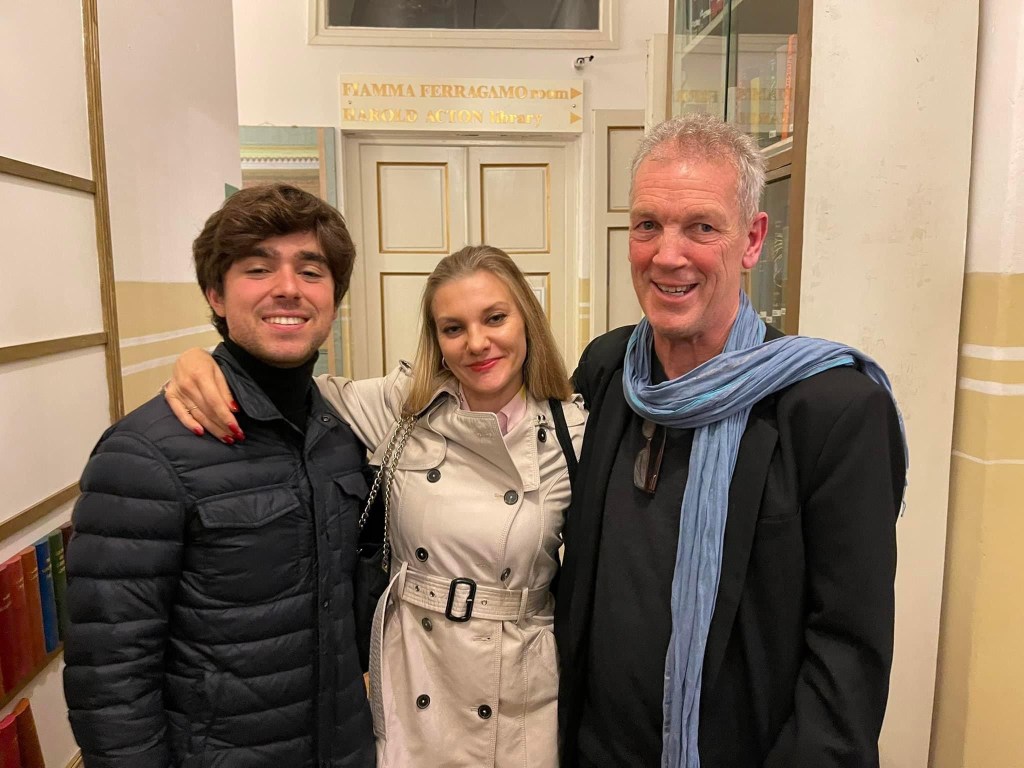
Pedro and Margarita with Simon Gammell O.B.E director of the British Institute
It had been from the very first luminous notes of the Promenade of Mussorgsky’s Pictures that our attention was immediately caught and we were held very much under the spell of the authority and extraordinary musicianship of this young artist.The character he brought to Gnomus was captivating as was the sublime beauty of the promenade 2 before the gentle flow of the Old Castle .It was played with such subtle colouring and a sumptuous sense of balance of utmost sensitivity.A promenade 3 of weight and determination led to the irresistible insistence of children quarrelling in the Tuileries only to be interrupted by the grandeur of Bydlo.Such delicacy and luminosity in the promenade 4 was followed by the rhythmic pointing and delight of the unhatched chicks pleasantly surprised to find such fingerfertigkeit!Has Samuel Goldenberg ever sounded so pompous and serious and Schmuyle so beseechingly humble?The dexterity in the market place was astonishing for the breath control at such a pace.His sense of colour in catacombae was truly kaleidoscopic where every note of every chord had such meaning.The sheer physical urgency of Baba Yaga was overpowering with an absolutely hypnotic energy that swept all before it.The contrast with the whispered terror of the central section sent a scriver down our backs and to any pianists present a lesson of control in pianissimo!
The Great Gate of Kiev
There was such grandeur in the opening statement of the Great Gate and a serenity and complete change of colour that was deeply moving for the two chorale episodes.The gradual tolling of the bells showed a quite extraordinary sense of balance and control without ever loosing the inner tension and energy.It demonstrated the total immersion of this young artist in his magic sound world that he was able to share so magnificently with us today.
A spontaneous standing ovation and insistence brought Pedro back with his castanets ,clicking his heels in an an absolutely scintillating performance of El Pelele by Granados .I never expected to hear it played with such charm and style again since Alicia de Larrocha used to seduce us with it in Rome.He could have played all night but with three quarters of a century still before him this is just the beginning of a long and illustrious career.What better after such a concert than a wine tasting organised by Simon and Jennifer Gammell of an excellent IGT merlot “Le Redini” from their partners Tenuta degli Dei.
“Perfect blend of musicality, personality, and brilliantly polished technique” (La Tribuna).
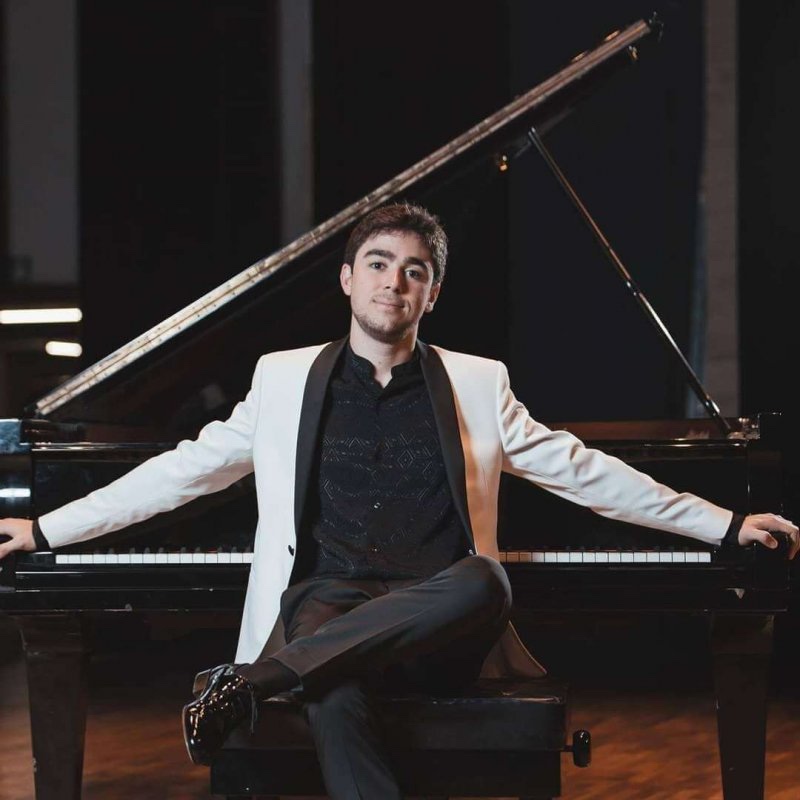
Born in 1997, Pedro is a Spanish pianist who is currently studying the Master of Performance Degree with Prof. Norma Fisher at the “Royal College of Music” of London (RCM), awarded with full scholarship and the title of the “Leverhulme Honorary Arts Scholarships”. He is a “Keyboard Trust” artist, as well as a “Talent Unlimited” artist, both from the UK.He has been awarded with more than 40 prizes at International and National piano competitions, among them, the First Prizes at the Malta International Piano Competition; “Composers of Spain” CIPCE International Piano Competition (Las Rozas, Madrid); “Joan Chisell” Schumann Prize of the RCM (London); César Franck” International Piano Competition (Bruxelles), Second Prize and four special Prizes at the Ferrol International Piano Competition, etc.He has also received crucial inspiration from internationally renowned masters such as Dmitri Baskirov, Dmitri Alexeev, Alexander Kobrin, Pavel Nerssesian, Pascal Nemirovsky, Pavel Gililov, Marianna Aivazova, Mariana Gurkova and Ludmil Angelov.He has performed throughout Spain and Europe in prestigious concert halls, such as the “Palau de la Música” of Valencia, “Teatro de la Maestranza” of Seville, “Miguel Delibes” Concert Hall of Valladolid, Ferrol Concert Hall, “Manuel de Falla” of Granada, “Teatro Circo” of Albacete, Theater of Aachen, “Wiener Saal” of Salzburg, among many others. He has performed as a soloist with the highest quality spanish orchestras, as the “Orquesta Sinfónica de Galicia”, “Orquesta Sinfónica de Castilla y León”, “Orquesta de Valencia”, “Real Orquesta Sinfónica de Sevilla”, etc.He has offered numerous interviews for international and national press, radio and television. “Three encores, standing audience and a long line of spectators lined up to congratulate the young Spanish pianist. Pedro López Salas brightened up the evening in Milan” (Cultura di Milano). “More than an excellent pianist, he is a soloist and almost a conductor, judging by his scenic development” (Ritmo magazine). “Enormous security and great capacity of the young pianist to endow Liszt’s concerto number 2 with expressiveness and poetry” (El correo de Sevilla).
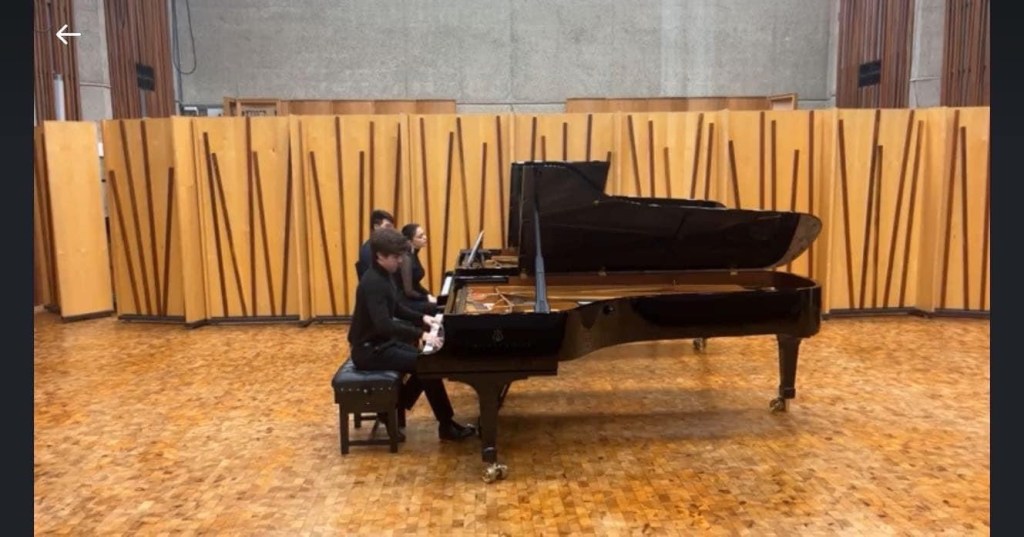
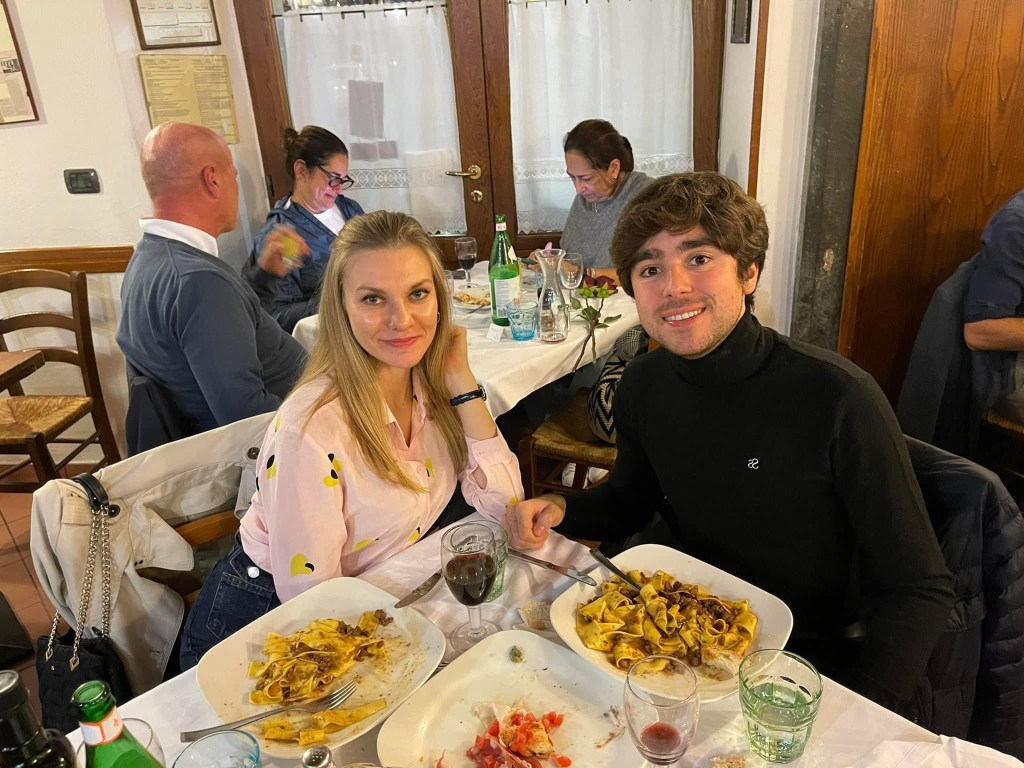
Pedro writes: ‘A lovely afternoon last Saturday performing a livestream concert, playing Mozart 21 and Liszt 1 piano concerti accompanied by great friends Yu-Chieh Lin and Vusala Babayeva. Thanks so much to Tchaikovsky International Piano Competition Online – TIPCO for organising it and to Aidan Chan for the technical matters!’You can still watch it here https://fb.watch/guPDpKhB5V/Enthusiastic audience member thanking Pedro And a well deserved post concert dinner at Del Carmine just around the corner.I remember it from my student days in Florence – some things never change!And a well deserved after dinner drink too for our piano technician/composer Michele PadovanoA room with a view indeed


















 ChristopherAxworthy-MusicCommentary
