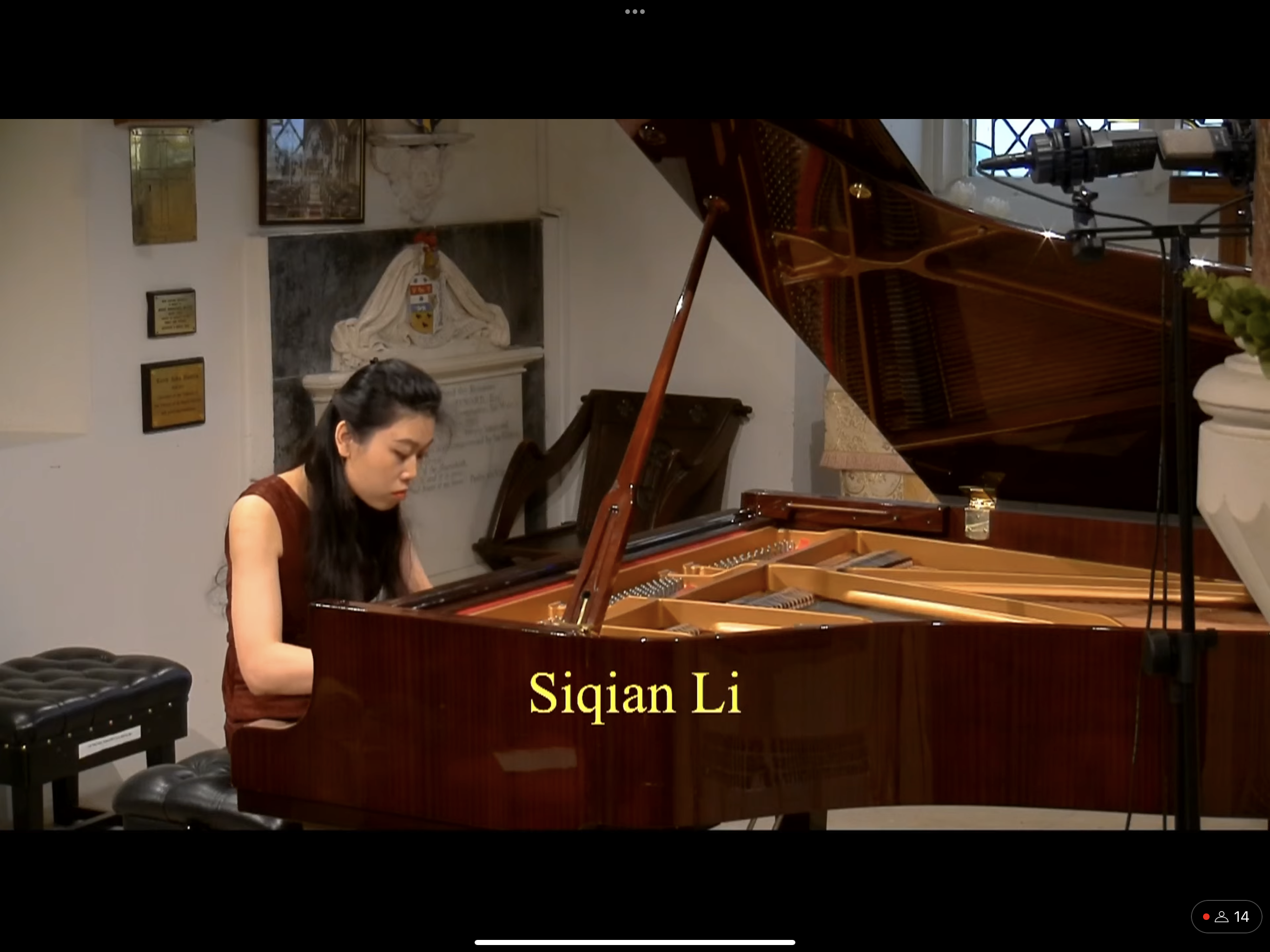
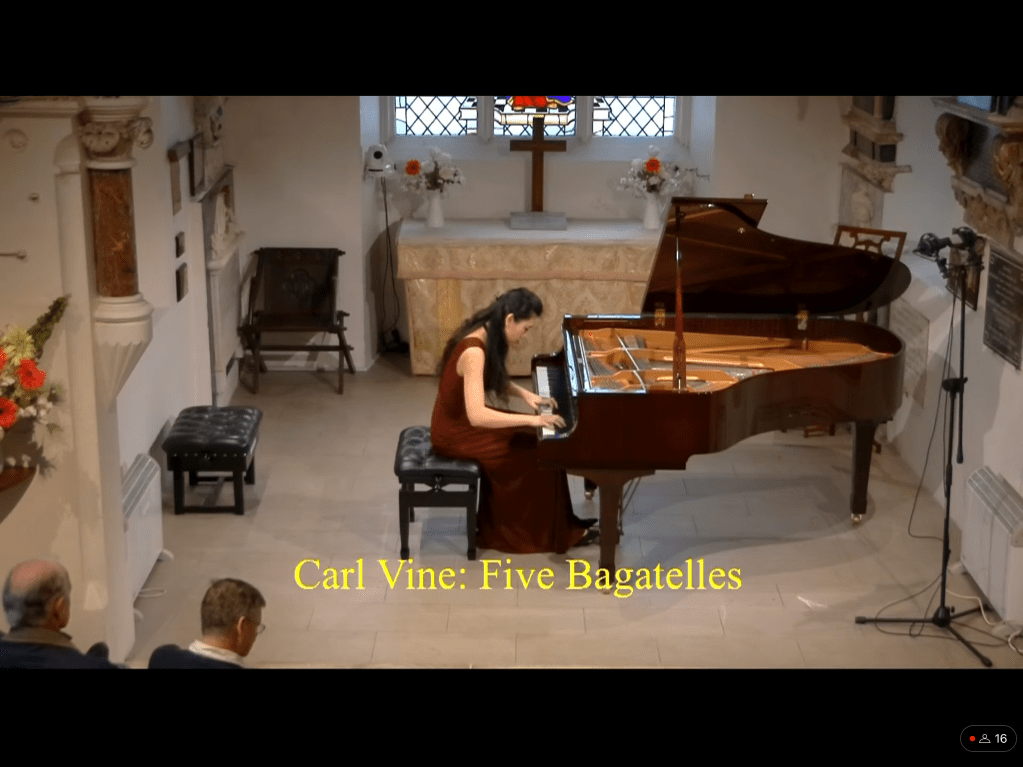
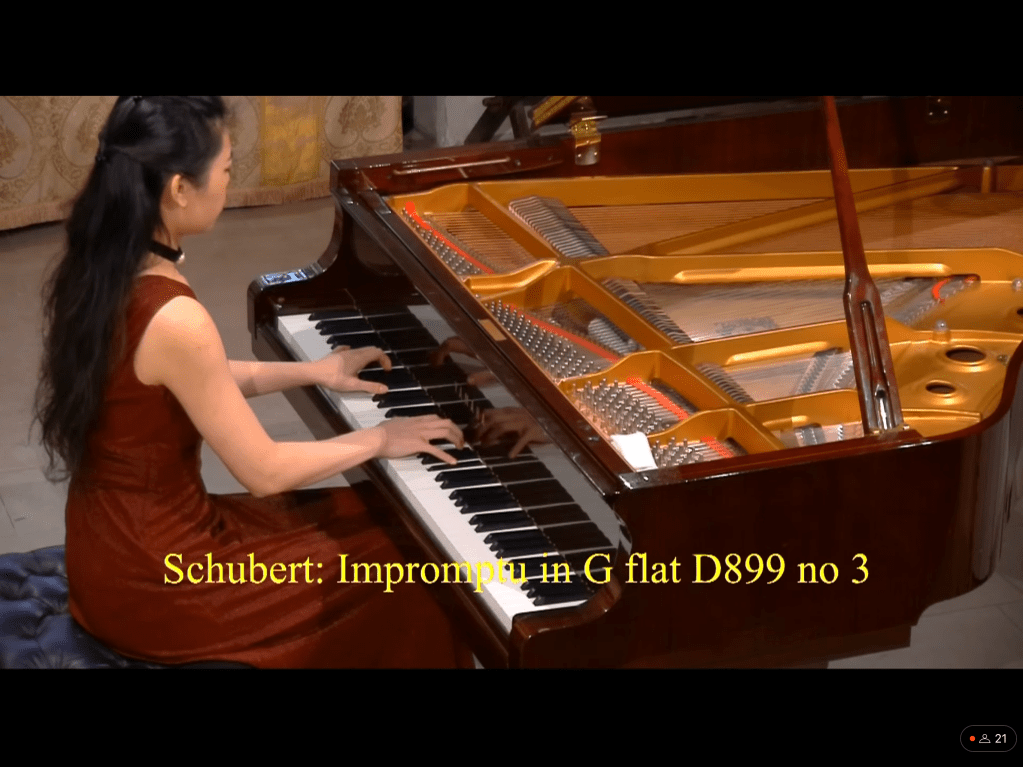
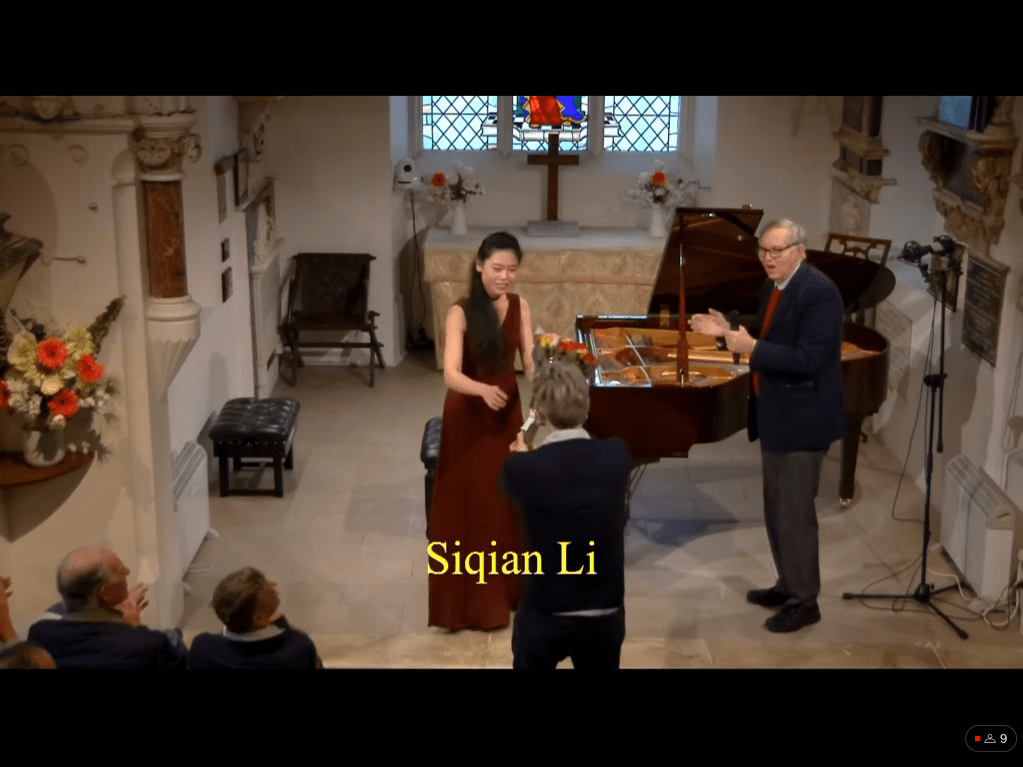
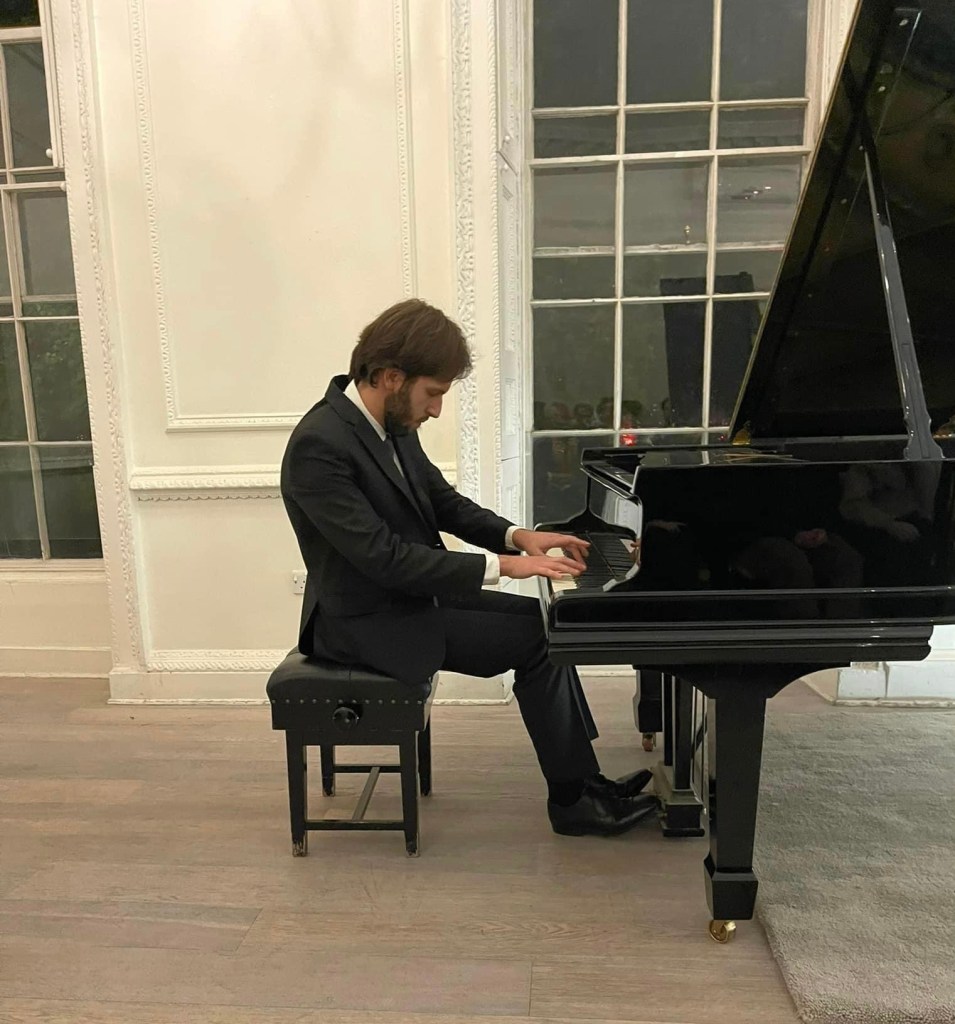
Some superb playing from Siquian Li not only a magnificent technical command but the intelligence from the class of Norma Fisher that gave such weight to all that she did .From the sparkling multi coloured bagatelles of Carl Vine through the impatient improvisations of Beethoven’s rarely heard Fantasia op 77 where his irascible character had much in common with Schumann’s dual personality.Schubert’s G flat impromptu calmed the ruffled waters with simplicity and sublime beauty.Liszt’s monumental B minor Sonata was given a reading where intelligence and technical prowess went hand in hand with passion and beauty.Her authority and ability to think always from the bass gave an architectural strength and character to one of the greatest masterpieces of the piano repertoire
Carl Edward Vine,born 8 October 1954 and is an Australian composer From 1975 he worked as a freelance pianist and composer with a variety of theatre and dance companies, and ensembles. Vine’s catalogue includes eight symphonies, twelve concertos, music for film, television and theatre, electronic music and numerous chamber works. From 2000 until 2019 Carl was the Artistic Director of Musica Viva Australia and was also Artistic Director of the Huntington Estate Music Festival from 2006, and of the Musica Viva Festival (Sydney) from 2008. In 2005 he was awarded the Don Banks Music Award and in the 2014 Queen’s Birthday Honours List, Vine was appointed as an Officer of the Order of Australia (AO), “for distinguished service to the performing arts as a composer, conductor, academic and artistic director, and to the support and mentoring of emerging performers.” Vine currently lectures in composition and orchestration at the Sydney Conservatorium of Music. His Bagatelles are from 1994 and are five very contrasting pieces that were played with great fantasy and also in the toccata with transcendental virtuosity obviously inspired by Ravel.There was even a prelude Gershwin inspired in which Siqian managed to play a few notes with her elbow!But it was her artistry in the more atmospheric preludes that was quite extraordinary.A use of the pedals that could create waves of fluid sounds and even sounds like raindrops falling onto the keys.It was a ravishing performance of superlative artistry that brought these preludes vividly to life and made one wonder why they are not played more often in the concert hall.Czerny recalled of Beethoven’s early improvisational skills:’His improvisation was most brilliant and striking. In whatever company he might chance to be, he knew how to produce such an effect upon every hearer that frequently not an eye remained dry, while many would break out into loud sobs; for there was something wonderful in his expression in addition to the beauty and originality of his ideas and his spirited style of rendering them. After ending an improvisation of this kind he would burst into loud laughter and mock his listeners for the emotion he had caused in them. ‘You are fools!’, he would say.The Choral’ Fantasy Op 80, itself began with a piano improvisation which Beethoven wrote down only when the piece was published.Rarely played in the concert hall – the last time I heard the Fantasy op 77 was with Rudolf Serkin whose fiery temperament it suited ideally.It needs a very special pianist who can change mood even more quixotically than with Schumann’s dual personality of Florestan and Eusebius.Beethoven was much more irascible and the impatience with which he strides up and down the keyboard contrasts so vividly with the childlike innocence of the cantabile episodes.Transcendental difficulty combined with intelligent musicianship were the hallmark of Siqian’s performance.Her considerable technical command and artistry demonstrated the true character of Beethoven.He was only later to control himself as he lost his hearing and entered the world of the Gods.In his final great trilogy of sonatas with variation or fugue forms but loosing himself in a world of wondrous beauty.The first half presents a bewildering succession of musical fragments in contrasting moods, punctuated by rushing scales or arpeggios—almost as though the individual pages of music were being violently torn off.The Fantasy’s latter half is a set of variations on a short theme in B major and the final variation introduces descending scale-fragments like the opening giving an overall form to this great improvisation.Another extraordinary performance from Siqian restoring this work to the concert hall where it truly belongs.There was sublime simplicity and sumptuous sounds in Siqian’s performance created by giving such weight to the accompaniment.It in no way stopped the melodic line from being shaped with ravishing beauty.Instead of melody and accompaniment she produced a glorious whole sound of string quartet quality that brought this well worn impromptu back to life with a freshness and beauty of exquisite musicianship .The Sonata in B minor was dedicated to Schumann in return for Schumann’s dedication of his Fantasie op 17.It was Schumann’s contribution to the monument that Liszt intended to dedicate to Beethoven in Bonn .Mendelssohn had donated his Variations Serieuses. A copy of the Sonata was delivered to Schumann’s house in May 1854, when he was already in a sanatorium.His wife Clara found it “merely a blind noise” and never performed it.It was attacked by the critics of the day who said “anyone who has heard it and finds it beautiful is beyond help”.Even Brahms reputedly fell asleep when Liszt performed the work in 1853.It has since been recognised as the pinnacle of the Romantic repertoire and so advanced for its age with the transformation of themes that Schubert had inspired in Liszt with his Wanderer fantasy.Of course Liszt was in turn to inspire Wagner and point the way for the revolutionary form that was to grow out of these first seeds.The genius of Liszt knew no bounds and although the virtuoso Liszt was used to astonishing and ravishing his audiences with his showmanship and improvisations of the popular operatic themes of the day in the Sonata he had written with absolute precision exactly what he intended.He had even found time to edit the 32 Sonatas of his master Beethoven.It was exactly this precision and musicianship that Siqian brought to this often misunderstood sonata.The precision with which Liszt marks the score are as clear and essential as those of Beethoven.The differences between forte and fortissimo ,mezzo forte and piano or piano and pianissimo are essential ingredients for an interpreter that dares to bring this masterpiece to life.Siqian brought simplicity and sumptuous sound, intelligence and drama that together with her technical command gave great weight and architectural shape to this monumental work.It could have had a little more freedom in the slower passages where she tended to loose the tension that she had so magnificently created with the more tempestuous episodes.But her attention to detail and overall understanding were remarkable and an antidote to the air in Perivale that was still thick with Chopin after their extraordinary festival only two days before. https://christopheraxworthymusiccommentary.com/2022/10/02/chopin-alive-and-well-in-perivale-the-octoberfest-at-st-marys/
A ‘rising star of the piano’, Chinese pianist Siqian Li brings elegance, dynamism and exceptional musical quality to her performances. Commended for her ‘virtuosity and talent’ (Annecy Classic Festival), her ‘huge emotional range and effortless pianistic control’ (Paul Lewis CBE), and her ‘graceful and touching’ (Emanuel Ax) approach, Siqian has appeared in concerts and recitals around the world. Dedicated to the musical arts and connecting with audiences, Siqian is equally content on intimate stages as she is on the major stages. She has performed at international concert halls including the Bridgewater Hall, Beijing Forbidden City Concert Hall, Tokyo Ginza Yamaha Concert Hall, Cairo’s Arabic Music Institute and Boston’s Jordan Hall, and in more unusual settings, with recitals at London’s 1901 Arts Club, the ever-charming Fidelio Cafe and Luke Jerram’s breathtaking GAIA The Earth Exhibition.Consistently active on the festival circuit, Siqian has given recitals at Annecy Classic Festival, Festival d’Auvers sur-Oise, Dinard Festival International de Musique, Lancaster Music Festival, Shanghai International Music Festival, and BNP Paribas Rising Star Piano Festival, amongst others. A keen collaborator, Siqian actively seeks out opportunities to work with inspiring international artists. In 2021, Siqian collaborated with Latvian violinist Roberts Balanas on his debut album, which was released on Linn Records and has surpassed 150k plays on Apple Music. Elsewhere, Siqian has collaborated with a wide range of musicians worldwide, from the principals of the China National Symphony Orchestra to violinist Jack Liebeck. The level of depth Siqian brings to her musical exploration, coupled with her shining pianism, has led to her winning numerous awards, including the top prize of the Chappell Medal Piano Competition, the Imola International Piano Competition, Krainev International Piano Competition, and the Yamaha China Piano Competition Conservatoire. Siqian was also a semi-finalist of the Leeds International Piano Competition in 2018.Siqian has performed live on BBC Radio 3 – In Tune and appeared on BBC Radio London – The Scene . Passionate about sharing thoughts and ideas in writing, Siqian’s articles have been featured on various publishers and websites including Classical Music UK and Piano Addict Blog . An enthusiastic teacher, Siqian teaches privately in London and has given masterclasses internationally, in institutions ranging from Yamaha Music China to Lancashire’s Rossall School. Siqian is a Yamaha Young Artist. She studied at the Central Conservatory of Music in Beijing with Professor Huiqiao Bao, then went on to obtain a Master of Music Degree and a Graduate Diploma at the New England Conservatory in Boston in the class of Professor Alexander Korsantia, before receiving an Artist Diploma at the Royal College of Music in 2020 under the tutelage of Professor Norma Fisher.
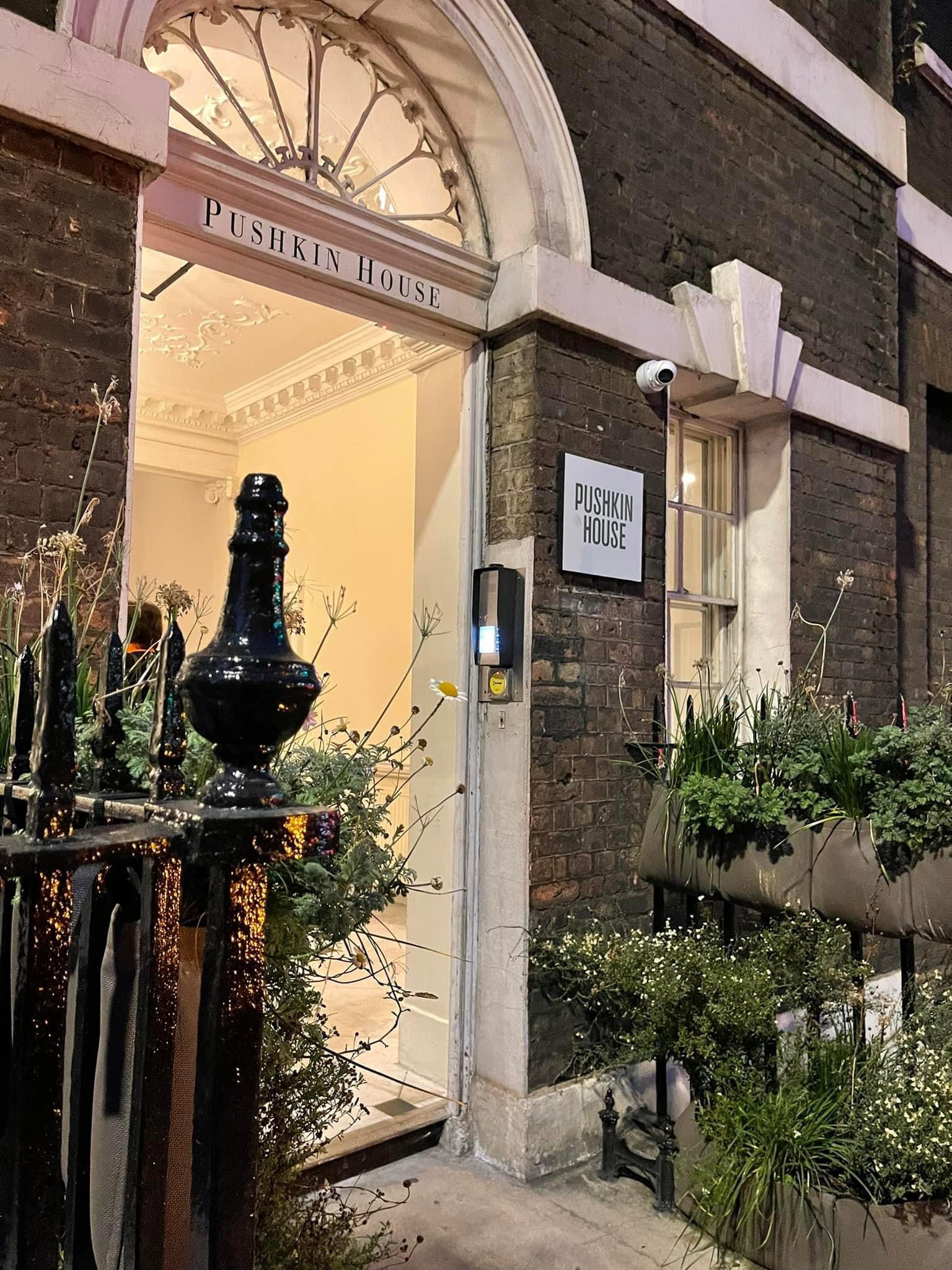
Damir Duramovic at Pushkin House with a refined performance of 19th century Slavic piano music .
Performances of aristocratic style with a refined kaleidoscopic palette of sounds.Culminating in a complete performance of Rachmaninov Preludes op 23 where the volcanic eruptions of the B flat and C minor preludes were followed by the rhythmic drive of the fifth in performances of breathtaking depth and drive.
It was in the study by Scriabin op 2 offered as encore that the true Slavic soul was revealed with playing of great weight and sentiment.Not a trace of the sickly sentimentality that we hear from lesser mortals who do not understand the real poetic soul of a people who were free to express their feelings of a true heart that beats always in the Slavic soul.
A group of rarely heard preludes by turn of the century Russian/Ukrainian composers.Blumenthal is well known to be the first teacher of Horowitz but his own piano music has still to be discovered.A kaleidoscope of subtle sounds of great naturalness.The nuances and colours created a magic atmosphere in a beautiful but sparsely furnished room where the atmosphere was created solely by the streams of beautiful sounds that Damir coaxed from an old but friendly Steinway.There was passion too and a technical command totally at the service of the music.A discovery of a world of a different era with music written by and for the performers themselves.Today we are gradually finding interpreters like Damir or Mark Viner that can make it relive.It needs a great sense of style but above all a sense of colour and polyphony where music is caressed rather than hammered out on the piano .An illusion that with great artistry a box of strings with hammers can be transformed into a celestial harp.An artist that can create the impression that the piano can sing as beautifully as the greatest of bel canto singers.A world that looks back to the world of Chopin rather than to the new world of Stravinsky and Prokofiev.
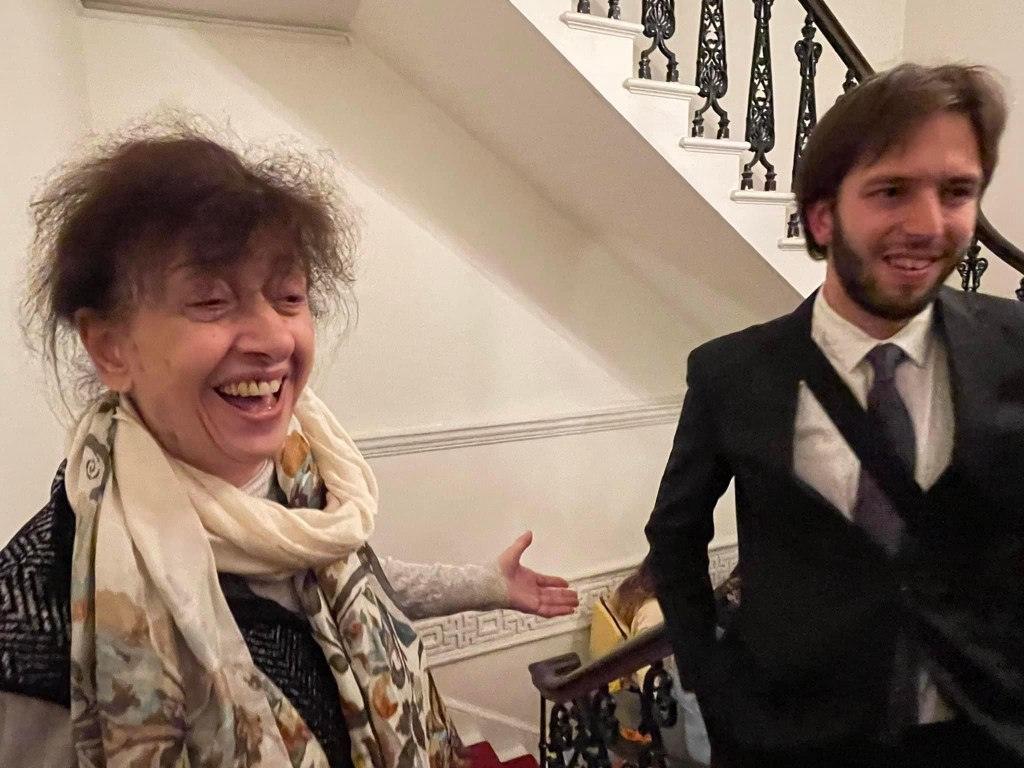
Tatyana Sarkisova ,the wife of Dmitri Alexeev,former teacher of Damir at the Royal College of Music
Damir is a remarkable musician brought up by musical parents who are used to improvising in Bosnia and Herzegovina where traditional music is heard and performed spontaneously everywhere rather than concert performances.Damir came to the Menuhin school at an early age where he received a unique musical education from artists such as Marcel Baudet and Robert Levin.So it was no surprise that deciding to play the complete Preludes op,23 by Rachmaninov he chose to play them in an order that each one was the dominant of the next.
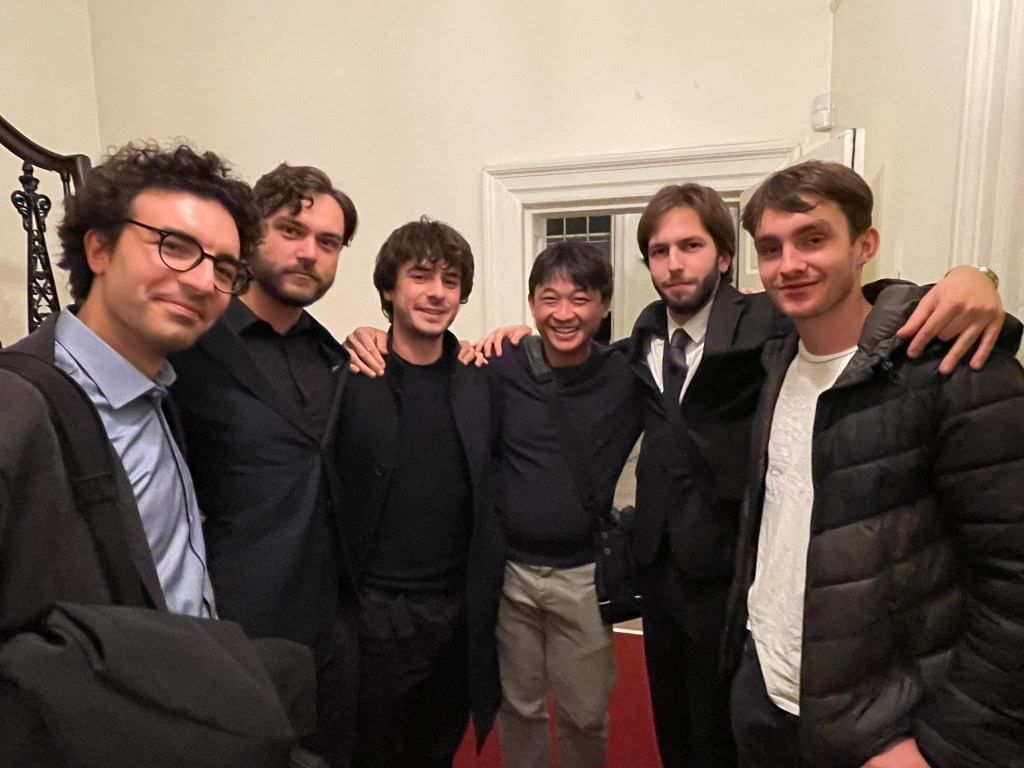
Friends and colleagues who have come to listen to Damir’s performances at Pushkin House Tolga Antaly Un,Petar Dimov,Can Arisoy,Bobby Chen,DD,Matthew McLachlan
Starting with the hauntingly beautiful prelude in F sharp minor with its brooding left hand so reminiscent of the second of Chopin’s preludes op 28 and the final repeated chords each one played so differently as it dies away to a murmur just like so many of Chopin’s Preludes and Studies.
I will keep to the printed order just for clarity and so to the mighty B flat Prelude which Damir ended with.A tour de force of sumptuous sounds with the wonderful tenor melody in the central section just revealed rather than hammered out as is so often heard in lesser hands.A flurry of notes like rush hour leading to the triumphant return of the opening and the excitement and transcendental difficulty of the coda.Fearlessly played chords that carried us on a wave of exhilaration to the final heroic cadence.The quixotic questioning of the third in D minor was answered by the robust beauty of the fourth in D major.A sumptuous string orchestra of Philadelphian richness and beauty,the gentle embroidered meanderings never interfering with the flowing melodic line.The G minor fifth Prelude was played with rhythmic drive and energy that was startling and at times overwhelming.The ending thrown off with nonchalant ease just like his Paganini Rhapsody or the G sharp minor prelude op 32.Rachmaninov was after all one of the greatest virtuosi of his day and he obviously knew how to tease and beguile his audiences as much as ravish and seduce them.Vlado Perlemuter often used to recount the pianist who came on stage looking as though he had swallowed a knife but then would produce the most beautiful sounds he had ever heard.The most romantic of Preludes in E flat was followed by a transcendental performance of the west wind puffing and blowing in the C minor that followed.The romantic meanderings of the eighth were followed by the feux follets difficulties of the ninth in E flat minor.Damir played this most difficult of Preludes with astonishing ease concentrating solely on the musical shape and colour with breathtaking audacity.Surely the haunting beauty of the tenth in G flat is so similar to the sixth of Chopin’s Preludes.It is however imbued with a voice that is uniquely Slavic ,full of nostalgia and brooding.
Can Arisoy and Bobby Chen remarkable pianists from the Menuhin School – Can was a student with Damir studying with Marcel Baudet and Bobby is a distinguished visiting professor.
An hour of real music making from a poet of the piano.A true illusionist who can transform this old black box creating an intimate atmosphere in a rather cold room.Making us believe for a moment that we are in the most sumptuous of salons in one of the great pre revolutionary palaces.
The first pieces in the concert are by the Russian Romantic composer Anatoly Lyadov (1855-1914), known for his piano miniatures, a number of orchestral works and folksong arrangements. In 1870 he entered the St. Petersburg Conservatoire to study composition with Nikolay Rimsky-Korsakov. On graduating, Lyadov became a professor, teaching composition for more than three decades, his students including Sergei Prokofiev, Nikolai Myaskovsky and other notable figures.
A young member of the audience in discussion with Damir about his eclectic programme
Next in the programme, the Preludes from 1931 by one of Lyadov’s students, Sergei Bortkiewicz (1877-1952) – a Ukrainian Romantic composer and pianist of Polish ancestry, born in Kharkov, then a part of the Russian Empire. After studying in St. Petersburg and Leipzig, from 1904 he spent ten years in Berlin. When the First World War began, he was deported back to Russia. Soon after, the Bolsheviks occupied his family estate, and later took Kharkov. In 1920 Bortkiewicz and his wife fled the country. Spending time in Istanbul and in Belgrade, they finally settled in Vienna. The music of Bortkiewicz is influenced by Chopin and Liszt, as well as Tchaikovsky and early Scriabin. In an interview from 1948 he said, “Today, one is probably inclined to dismiss all melodicists as epigones. Certainly, very often wrongly. As far as I am concerned, romanticism is not the bloodless intellectual commitment to a program, but the expression of my most profound mind and soul.“
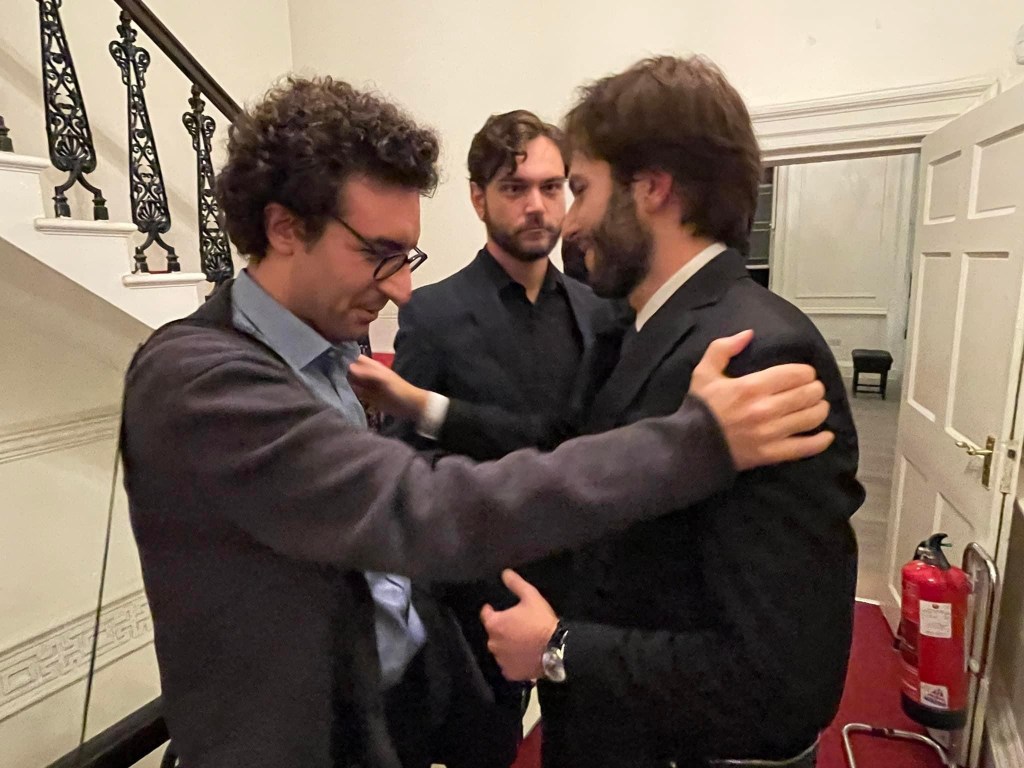
Tolga congratulating Damir as Petar looks on. They are all guests at the Kew Academy
The concert will continue with the 1890s pieces by Felix Blumenfeld (1863-1931). He was born into a family of Polish and Austrian Jewish origin, in Yelysavethrad (present-day Kropyvnytskyi city in Ukraine), in Kherson Governorate of then the Russian Empire. Some time after Lyadov, he was a student of Rimsky-Korsakov at the St. Petersburg Conservatoire. Alongside his composition practice, Blumenfeld was a conductor and a prominent pianist. From 1918 to 1922, he was the director of the Lysenko Music and Drama School in Kyiv, before he moved to Moscow, where, until the end of his life, he taught in the Conservatoire, having an influential role as a piano teacher.
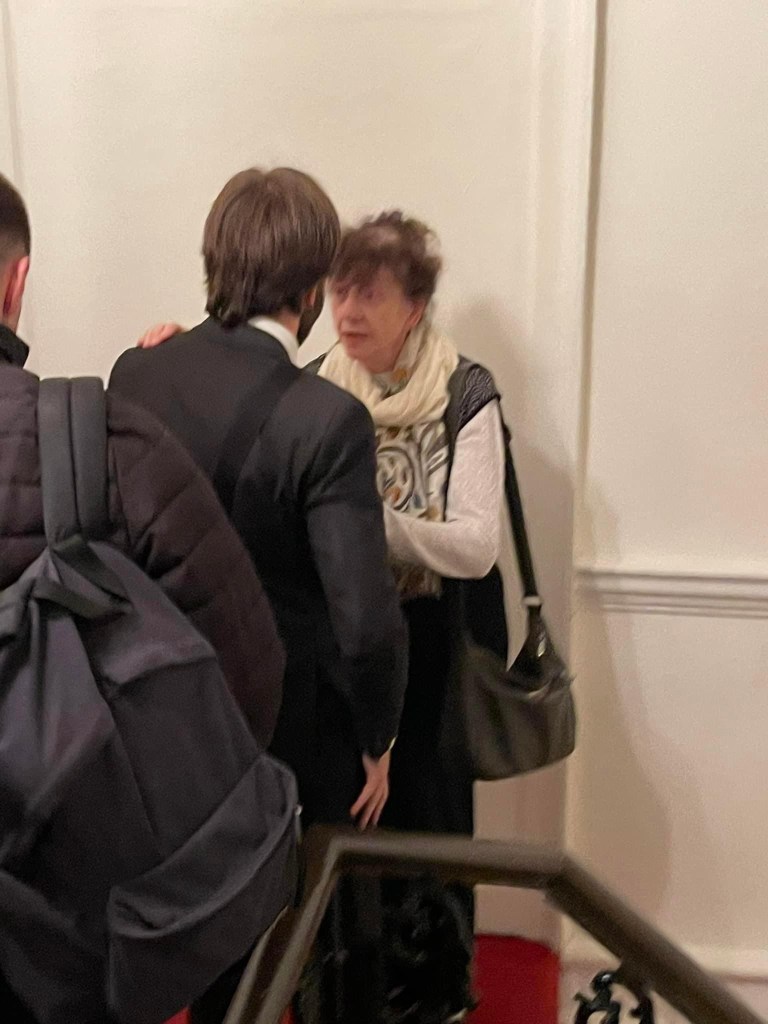
Post concert discussion with the distinguished pianist and teacher Tatyana Sarkisova
The complete set of Preludes Op. 23 by Sergei Rachmaninoff (1873-1943) will close the concert. Composer, pianist and conductor, Rachmaninoff was born into Russian aristocracy in the Novgorod Governorate. He studied in the Moscow Conservatoire with A. Siloti (piano), A. Arensky (composition) and S. Taneyev (counterpoint). Being a famous pianist, throughout his life Rachmaninoff was often travelling abroad on tours. Soon after the 1917 Revolution in Russia, his estate was confiscated by the communists. By chance, granted a tour to Scandinavia, he and his family left Russia, and never returned. For the rest of his life he was living between the United States and Switzerland, focusing most of his professional activity on piano performance.
PROGRAMME
Anatoly Lyadov
Three Piano Pieces Op. 57 (1900-05):
I. Prelude
II. Valse
III. Mazurka
Sergei Bortkiewicz
Preludes Op. 40 (1931):
No. 3 Con moto
No. 4 Sostenuto
No. 6 Andantino dolente
No. 7 Appassionato
Felix Blumenfeld
Preludes Op.17 (1892):
No.10 in c-sharp minor
No.15 in D-flat major
Etude de concert Op. 24 (1897)
Sergei Rachmaninoff
Preludes Op. 23 (1901-03), the complete set.
Damir Durmanovicis an internationally sought-after performer, who has performed at venues and festivals across Europe and the UK. He has won prizes in numerous international competitions, including the Beethoven Intercollegiate Junior Competition in London, Adilia Alieva International Piano Competition in Geneva and Isidor Bajic International Piano Competition in Novi Sad. Durmanovic is a scholar at the International Academy of Music in Liechtenstein and regularly participates in the courses organised by the academy.
Durmanovic began his studies at age of eight in his home country, Bosnia and Herzegovina, with Maja Azabagic before continuing his studies at the Yehudi Menuhin School where he studied with professor Marcel Baudet. He is a graduate from the Royal College of Music where he studied with Dmitri Alexeev. He is supported by the Keyboard Charitable Trust, as well as the Talent Unlimited Scheme.
St John’s Smith Square was in party mood with a concert to celebrate the 50th Anniversary of China-UK Ambassadorial Diplomatic Relations and the 73 anniversary of the People’s Republic of China.A concert in which the young pianist/composer Yuanfan Yang played movements from his third and fourth concertos also performing solo piano pieces and accompanying Yue Guo with his extraordinary Chinese bamboo ‘Di-Zi’ flutes.
Yue Guo and his extraordinarily expressive ‘Di-Zi’ flutes
Two choirs performed firstly a work by John Rutter ‘For the Beauty of the Earth’in which Yuanfan added some magic sounds on the piano.Yuanfan’s own work ‘Hometown Far Away’ was performed by joint choirs and orchestra in a final triumphant outpouring of joyous music making.
The beauty of Yuanfan’s playing was mirrored in the joyous atmosphere that was created by the Berlin Metropolitan Orchestra under George Hlawiczka and the two choirs seated in the gallery above the orchestra.Apollo Premadasa at only eight years old is not only a composer but also a cellist,trombonist,percussionist and pianist too.As the programme said far more poetically than I could ever do :’Apollo’s soul belongs to music and shares his passion for this art form and the feelings towards the world we live in via his performing and composing’
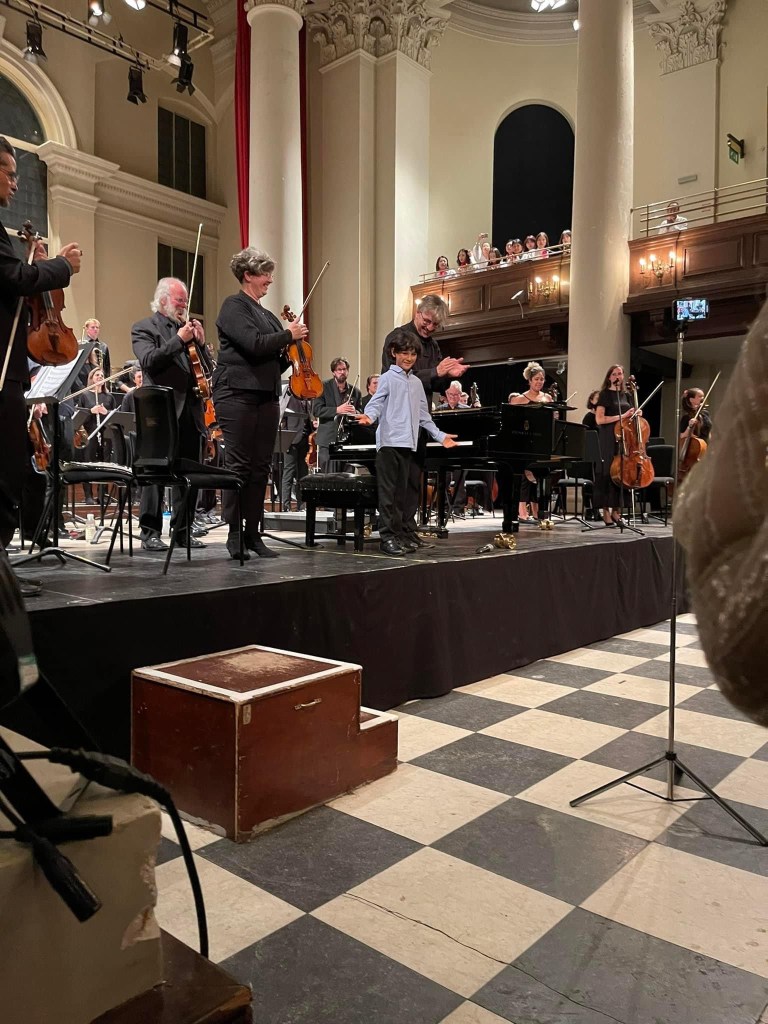
Apollo Premadasa ,eight years old ,receiving an ovation from public and orchestra after the performance of his Symphony 1 War Child
Yuanfan too showed his remarkable gifts at a very early age.His mother tells me of being complimented by another mother ,at a children six year old birthday party, on how well her son played the piano and wanted the name of his teacher for her child too.’But he does not play the piano’ she exclaimed ‘and we do not have a piano in the house!’ Genius shows itself in many mysterious ways .Yuanfan now is receiving accolades world wide for his superlatively intelligent and sensitive artistry as a pianist and also as a creative artist.Yuanfan lives in a world of his own ,a world of wondrous beauty and discovery.
The distinguished speaker extolling music as the Universal language that can unite all nations
Disputes and politics are not part of this Eutopia and as the distinguished speaker said today:’It is music that will draw us all together .It is the universal language ‘
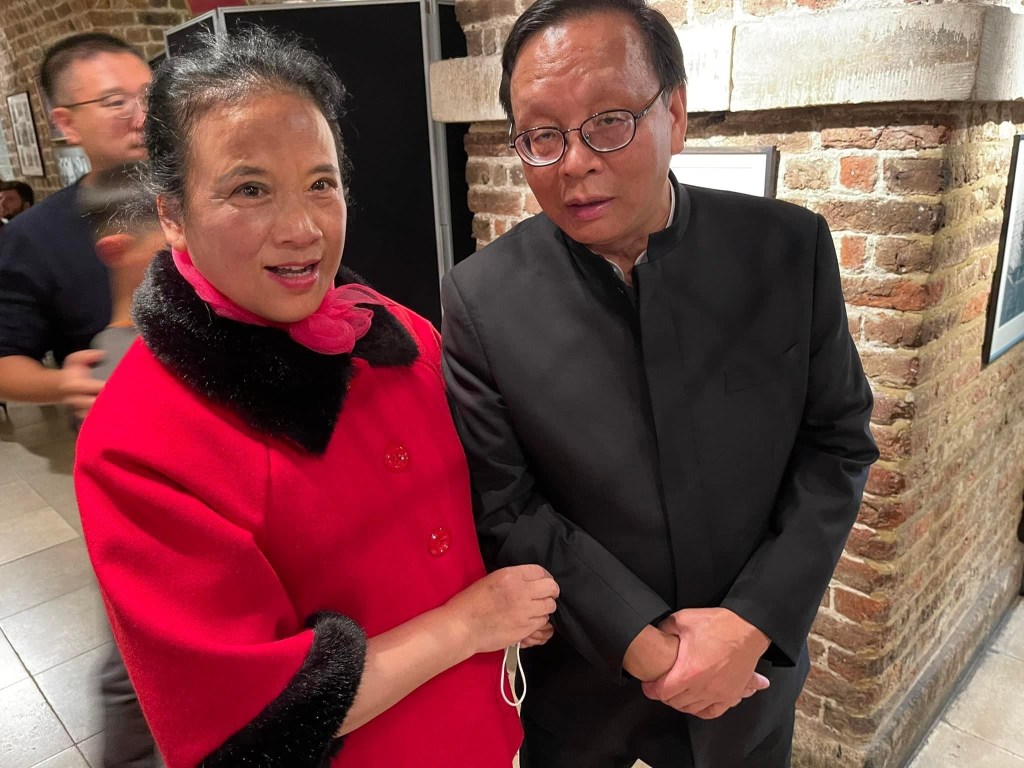
Yuanfan’s mother with the distinguished speaker
Words are dangerous because they cannot express the real soul and understanding that can exist only in sounds.Fou Ts’ong ,the great Chinese pianist,surprised everyone in Warsaw when he won the top prize for his performances of the Mazurkas,the national dance of Poland.’But it is the same soul and feeling expressed in Chinese poetry’ ……the heart of Chopin is universal and beats with the same warmth and understanding in every soul.One just has to try to share the universal message captured within to realise it is this sentiment which will unite us in the end.
Some superlative playing of great authority from Yuanfan playing his fourth concerto.A beautifully melodic work that Yuanfan embellished with arabesques over the entire range of the keyboard.Yuanfan’s own work ‘Waves’ was played with great virtuosity and a kaleidoscopic sense of colour.Strangely enough his third concerto was much more complex and less melodic than the fourth.The splendid orchestra also performed the secondmovement of the Symphony 1 War Child written by the eight year old Apollo Premadasa.
Mention should be made of Yuanfan’s extraordinary improvisatory skills.Asking the audience for a melody and also a style they would like to chose he proceeded to astonish with a improvised virtuoso performance that astonished and amazed .
Friday-Sunday 30 Sept to 2 October ST MARY’S PERIVALE CHOPIN FESTIVAL 2022. 20 pianists play solo recitals over 5 sessions.
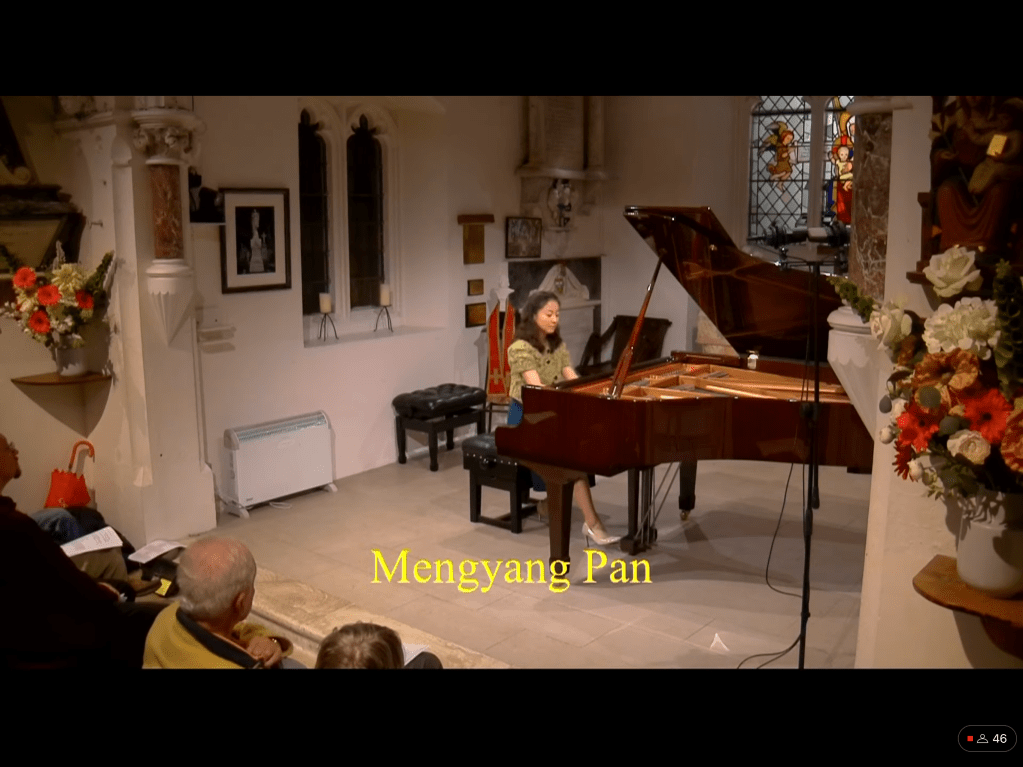
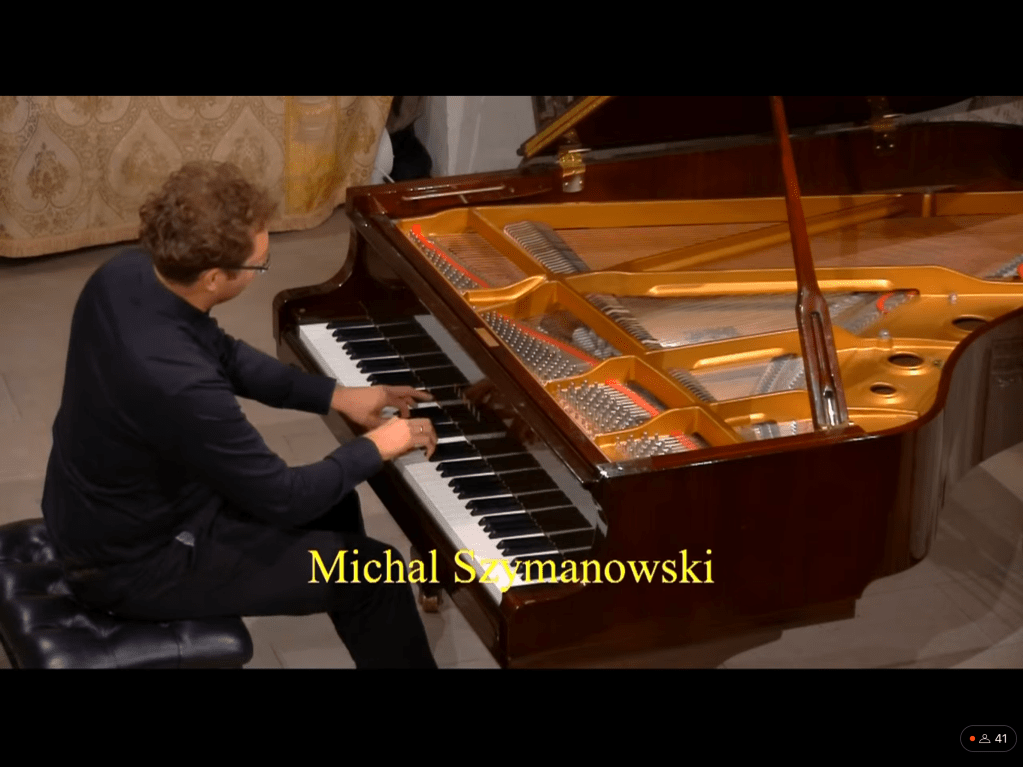
Friday 30 September 7 pm Chopin Festival Session 1 :7.00 Viv McLean Largo in E flat, Nocturne in E minor Op 72 no 1, Mazurkas Op 7 nos 1-3, Nocturne in F Op 15 no 1, Polonaise in A Op 40 no 1, Ballade no 3 in A flat Op 47, Scherzo no 3 in C sharp minor Op 39, Nocturne in C sharp minor Op Posth 7.55 Mengyang Pan Grande Valse brillante in E flat Op 18, Waltz in E minor Op Posth, Waltzes Op 69 nos 1&2, Variations on ‘Là ci darem la mano’ Op 2 8.25 Michal Szymanowski Mazurkas Op 6, Nocturne in G minor Op 37 no 1, Impromptu no 3 in G flat Op 51, Nocturne in F minor Op 55 no 1, Waltz in A flat Op 42
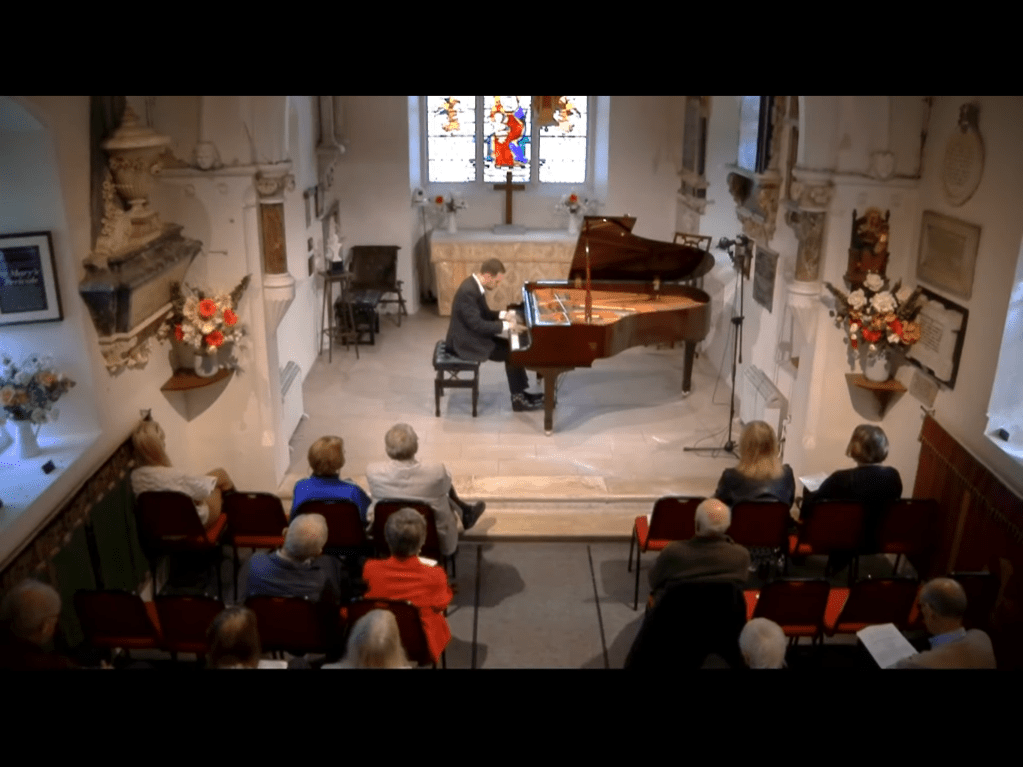
What a wonder the start of a three day Chopin festival with some of the finest pianists imaginable. St Mary’s has never been so full and on a bleak wintery day there was no stopping a public just longing to hear three mini Chopin recitals.There must be hundreds listening in on line too as I was and what a joy it was to hear not only the better known works of Chopin but also some of the rarities too.
On hearing Chopin himself playing in the Paris salons of the day the variations on La ci darem la Mano op 2 Schumann announced the arrival of a star in their midst with ‘Hats off gentlemen a genius’ and that was only one of his early showpieces.And a show piece it was tonight with a brilliant performance by Menyang Pan.Playing not only with brilliance and breathtaking jeux perlé there was the aristocratic style that she gave to all she played.Some of Chopin’s waltzes were played with such character and colour that was quite breathtaking in its refined beauty and charm.
Michal Szymanowski flying in especially from Poland to play a series of Mazurkas that were so full of the zest and spirit of his native land. Nocturnes too played with such nobility of sentiment ,the same he brought to the G flat impromptu.Playing with the same ravishing colour and charm that Rubinstein used to beguile us with on his much awaited yearly visits to London.The famous waltz in A flat with cross rhythms was played with a sense of line and irresistible rhythmic drive but the astonishing thing was the way he just threw of the final bar with impish nonchalance.
The opening honours were given to a St Mary’s favourite:Viv McLean who started with an almost unknown Largo in E flat that for me was quite a discovery.Finishing though with a ravishing performance of one of Chopin’s best known nocturnes in C sharp minor op.posth. In between were sandwiched fine performances of the third Ballade and Scherzo and the famous Military A major Polonaise where his sterling musicianship allowed him to steer us so clearly through these well know waters with great artistry.But his performance of the nocturne op 72 n.2 is what will remain with me for a long time for its heartrending simplicity and aristocratic poise. Two sessions tomorrow and two on Sunday add up to 12 hours of absolute bliss . I never thought I would enjoy listening to Chopin’s music as much as I did tonight ………..but I missed the wine, the joie de vivre and infectious enthusiasm of Hugh Mather and all his ‘family’ of music lovers in this beautiful deconsecrated church just 20 minutes from the heart of the great metropolis.
Felicity and friends adding to the intimate family atmosphere of this unique concert hall.
Saturday 1 October 2 pm Chopin Festival Session 2 : 2.00 Ashley Fripp Mazurkas Op 24, Impromptu no 1 in A flat Op 29, Nocturnes Op 9 nos 1&2, Barcarolle Op 60 2.45 Amit Yahav Prelude in C sharp minor Op 45, Waltzes Op 64 nos 1&2, Nocturne in G minor Op 15 no 3, Mazurkas Op 56, Scherzo no 4 in E Op 54 3.30 Joanna Kacperek Nocturne in C minor (1837) Waltz in A flat Op 64 no 3, Polonaise in E flat minor Op 26 no 2, Rondo à la mazur Op 5, Scherzo no 2 in B flat minor Op 31 4.00 tea interval 4.30 Andrew Yiangou Nocturne in G Op 37 no 2, Trois Nouvelle Études, Waltzes Op 70 nos 1-3, Andante Spianato and Grande Polonaise Op 22 5.15 Callum McLachlan Waltzes Op 34 nos 1-3, Mazurkas Op 63, Nocturne in E Op 62 no 2, Scherzo no 1 in B minor Op 20
Ashley Fripp
More superb playing from Perivale on the second day of their Chopin Festival .Opening with Ashley Fripp only a few days after his superb solo recital with a scintillatingly subtle jeux perlé account of the first impromptu just thrown off with the charm and ease of another era .Mazurkas and Nocturnes just flowed from his hands with streams of golden sounds and subtle colours but it was the Barcarolle that stood on its own as a true monument and played even more beautifully than the other day.There was an ease and flow but with an aristocratic control that was quite memorable. https://christopheraxworthymusiccommentary.com/2022/09/21/ashley-fripp-at-st-marys-poetry-and-intelligence-of-a-great-musician/
Amit Yahav
There was such subtle poetry from Amit Yahav with Chopin’s late Prelude op 45 where the layers of sound just flowed in a non stop stream of magic sounds.The mazurkas were played with true understanding but the fourth Scherzo stood out for its nobility and fleeting beauty of one of the most elusive but surely one of the greatest of Chopin’s creations.
And what a revelation was Joanna Kacperek recently married to Andrew Yiangou .
Married five weeks ago – a golden couple indeed
All that she played was gold in impeccable performances of rare beauty from the Nocturne in C minor 1837 to the deep brooding of the E flat minor Polonaise .The grace and charm of the Rondo à la mazur to the mighty sturm und drang of the famous B flat minor Scherzo.It was a ravishing display of born musicianship …..what a wonderfully talented couple she and Andrew are and they are from Ealing ….there is something about the air over that way that is full of the sound of music
And to the last two performances before the supper break .Andrew Yiangou the local boy and now distinguished artist of great authority.The three novelles Etudes written in 1839, as a contribution to “Méthode des méthodes de piano”, a piano instruction book by Ignaz Moscheles and François-Joseph Fétis.Two against three,staccato against legato,three against four a conundrum of technical and mental difficulties that just disappear with the sheer beauty of creation.Andrew played them with great authority shaping these gems into perfect miniatures that Chopin was to develop into his truly masterly op 25 studies that we eagerly await tonight from Patrick Hemmerlé.There was grace and charm that he brought to the waltzes op 70 with ornaments that glistened with oiled brilliance.But it was the Andante spianato and grande Polonaise that Andrew showed us his mastery and authority but not before he had entranced us with the perfumed succulence of the spianato …a term that Chopin was to use only once.
Callum McLachlan
The artistry of Callum McLachlan was breathtaking in its old style grace and charm.The grandiloquence of op 34 n.1 was followed by the heart rending yearning of the op 34 n.2.It was the so called cat waltz that Callum let his hair down and put caution to the wind as this poor cat was treated to a speedy Gonzales romp of youthful verve and audacity.The beauty of his mazurkas were only outdone by the ravishing tone and aristocratic poise of the late nocturne op 62.If his virtuosity and passion were breathtaking in the first scherzo it was the slow Christmas melody that Chopin quotes as an antidote that showed off his true artistry.Such wondrous sounds and colours and a rubato that was of a mature artist way above his 22 years. A great artist in the making and part of a remarkable family of superb musicians .
Chopin Festival Session 3 : 7.00 pm Julian Trevelyan Mazurkas Op 41, Impromptu no 2 in F sharp Op 36, Nocturne in B Op 9 no 3, Polonaise-Fantaisie in A flat Op 61 7.45 Patrick Hemmerlé Allegro de concert Op 46, Tarantelle Op 43, Études Op 25 8.30 interval 8.45 Thomas Kelly Rondo in E flat Op 16, Mazurkas Op 50, Mazurkas Op 67, Nocturne in E flat Op 55 no 2, Ballade no 1 in G minor Op 23
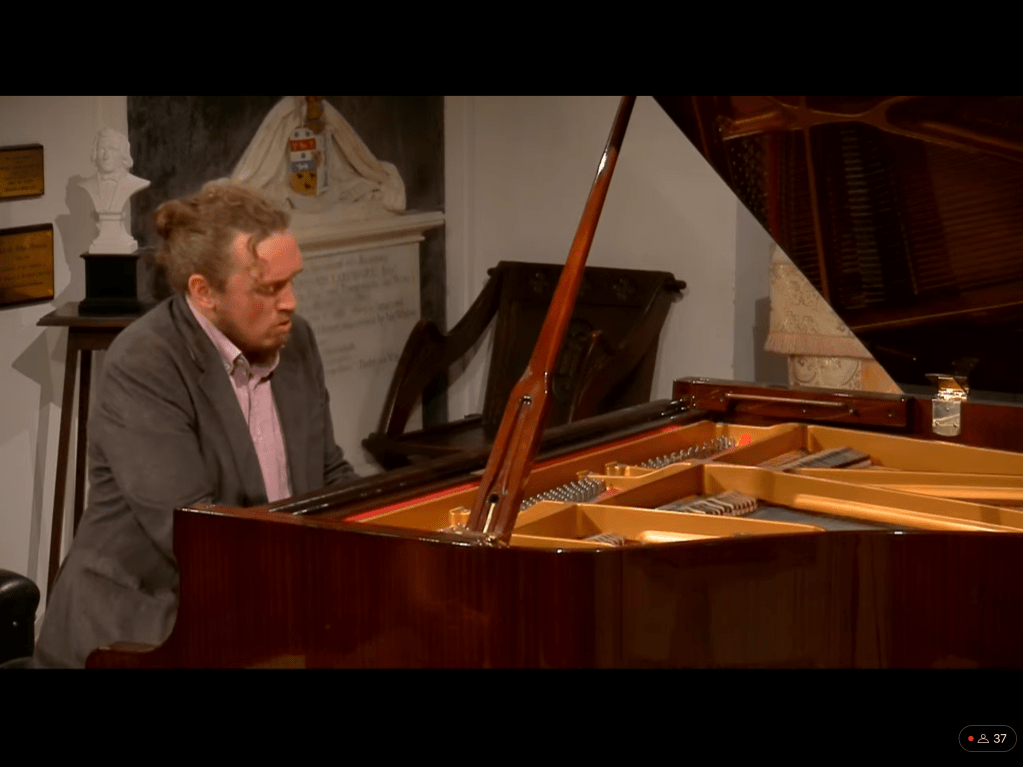
What an opening to the evening session of this Chopin Festival .I knew Julian was good but I did not realise how good ( as Serkin exclaimed on hearing Perahia for the first time )until he started his recital tonight.I have heard him give magnificent performances of the Hammerklavier or Diabelli variations that were absorbing and some times even controversial but today from the very first notes of the four Mazurkas he played there was a sound that was like a daguerreotype photo in its veiled beauty.Like an improvisation and even if the second one almost skidded off the tarmac it was breathtaking in its audacity.The melancholic nostalgia mixed with the dance rhythms in the last one was extraordinary.The pastoral serenity he brought to the opening of the F sharp Impromptu made me think of the similarity to the Barcarolle,that was to come in the last years of Chopin’s life with its outpouring of song and aristocratic climax dying to a mere whisper.The Nocturne op 9 n.3 had all the whimsical beauty of Lhevinne’s historic performance with unbelievably ravishing ornamentation that was truly breathtaking .The Polonaise Fantasie was one of the most moving performances I have ever heard .I remember the first time I heard it was from the hands of Perlemuter with his weight and limpet like legato that I never thought I would hear again until tonight .Even if he split the hands in the opening wave of notes it was done with the beauty of a Volodos and a feeling that this was indeed a great wave of sound moving inexorably ahead.If the right hand did not sometimes wait for the left it was so overwhelmingly convincing.I was surprised by his capricious left hand staccato accompaniment just before the middle episode but it was a prelude to chords of such intensity that followed and that I can only thank God that I lived to hear ( as Curzon said of Lupu’s Beethoven 3.) All these wonderful pianists but with Julian at the fore like a beacon shining brightly amongst the stars.
Talking of stars there followed immediately after this performance the recital of the remarkable Pollini type figure of Patrick Hemerlé. They are colleagues who frequent each other’s performances and share a mutual discovery of music together.Patrick I have heard many times before but today the poetry he found in Chopin’s studies op 25 left me breathless in admiration.Above all moved by the ravishing sounds and deeply personal character he brought to each of these perfect gems.Patrick is a musician who believes deeply in following the composers wishes and like Pollini it is to Patrick that one turns to hear a score come alive in performance before turning maybe to other performers for a more individual interpretation.He has revealed works as far apart as Villa Lobos Rudepoema or as today the Allegro de concert by Chopin.The score brought to life with superlative musicianship and technical mastery.But today there was even more .Chopin had unleashed in Patrick his soul that he normally keeps hidden behind his superlatively inquisitive mind.It was evident from the opening Allegro de concert ,which is the first movement of a third piano concerto that Chopin never completed.If the opening was surprisingly coquettish it grandually built in sonority and passionate involvement that I have rarely noted in Patrick’s alway masterly performances.The Tarantelle too was thrown off with all the ease and charm that obviously Chopin wanted to convey to the ladies of the Paris Salons. I have heard Patrick play all 24 Chooin studies in public in a remarkable tour de force of musicianship and resilience.But today was different.Patrick allowed us to look into his soul with a reading of the slow 7th study that was emotionally so moving.Already the tenor counterpoints in the A flat first study had given an idea there was something special in the air.The magnificence of the last study where the waves of sound grew to fever pitch of overwhelming emotion brought a spontaneous standing ovation from the usually warm but shy audience at St Mary’s.
Well they say miracles don’t occur in the same place once but in St Mary’s they certainly happen three times !
Thomas Kelly brought tears to my eyes as I realised that this very talented young pianist that I had spotted five years ago has now become an artist of towering stature.I would go to say after what he shared with us tonight the finest pianist of his generation. The Mazurkas that he played op 50 and op 67 opened up a sound world and a natural flow of musical invention that I have not heard since Smeterlin or Perlemuter.The ravishing beauty of the C sharp minor op 50 was breathtaking in its beauty and the meaning he dug from deep within the notes …..he found the very soul of Chopin that is hidden deep inside the Mazukas.The wondrous colours of the G major op 67 or the dance like melancholy of the G minor or the deeply contemplative A flat .Thomas revealed a whole world as he found the very soul of Chopin with his limpet like fingers that dug ever deeper into the very heart of the notes.The scintillating Rondo op 16 I had not heard since Magaloff .Thomas played with the same aristocratic style but with ravishing sounds of such radiance and fluidity.The notes just flew from his fingers with the oiled brilliance and consummate ease of a past era.The nocturne op 55 n.2 was played with bewitching sounds that seemed to sparkle in the distance as the melodic line flowed with a constant flow of ravishing sounds. I have never heard the old G minor war horse open with such beauty and restraint .Thomas restored the G minor Ballade to us in a new costume.All the inevitably traditional rhetoric was gone and instead there were breathtaking moments of discovery.Sounds that took me by surprise as one realised that this young man truly loves the piano and is sharing his great love affair with us.Intimate secrets,canons covered in flowers but above all an aristocratic musicianship that marks him out like Benjamin Grosvenor born into another world …..the world of fantasy and wonder …..the world that only the greatest artists can reach.Exciting because Thomas’s is a voyage of discovery that is always evolving and who knows to,what heights it might lead! Unbelievably moving performances and indeed an evening that will long be remembered and that luckily was recorded so my words are not only a mere memory as Mitsuko Uchida would say.Thank you Hugh and your team for sharing this world with us ….a truly magic carpet in Perivale
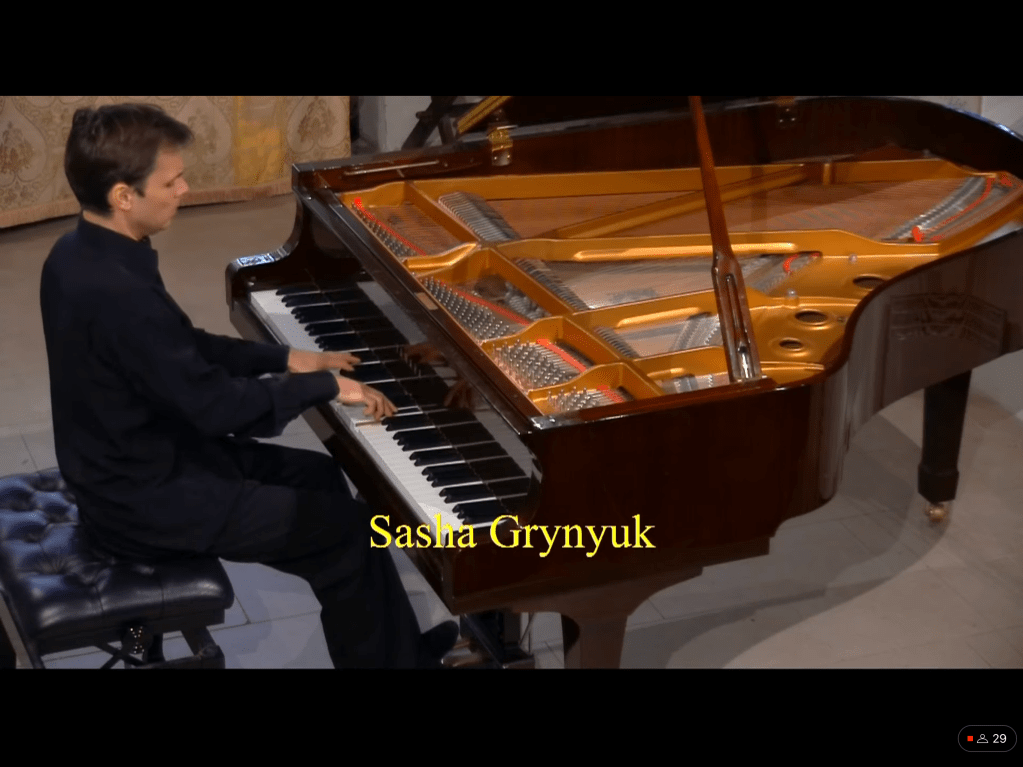
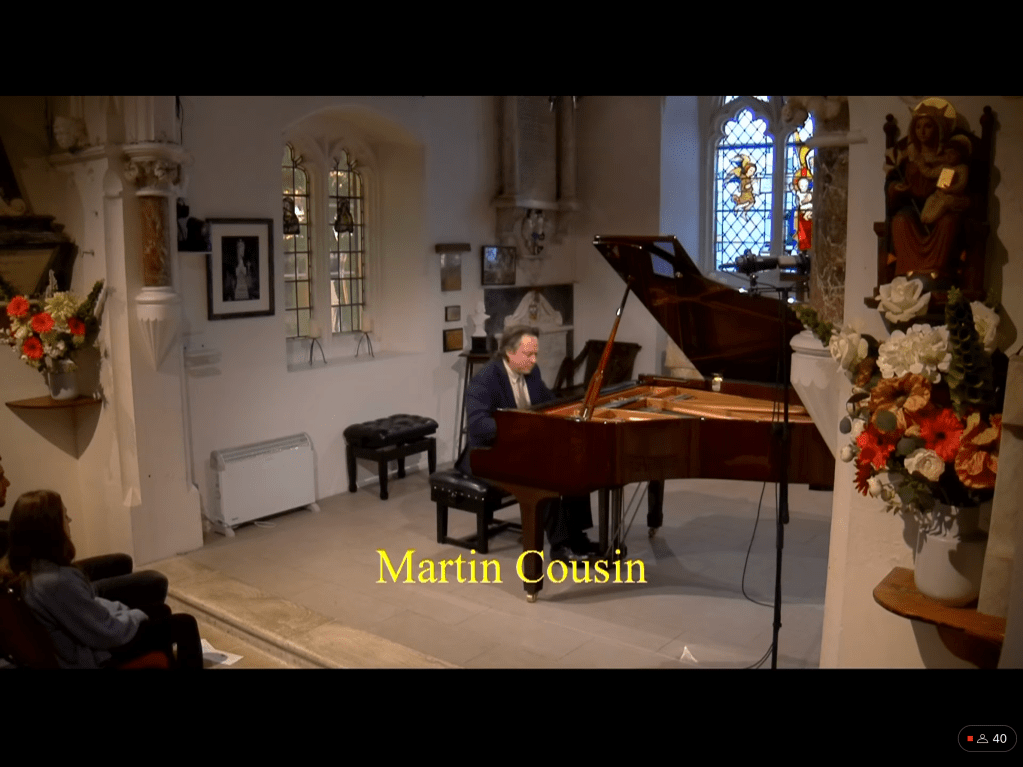
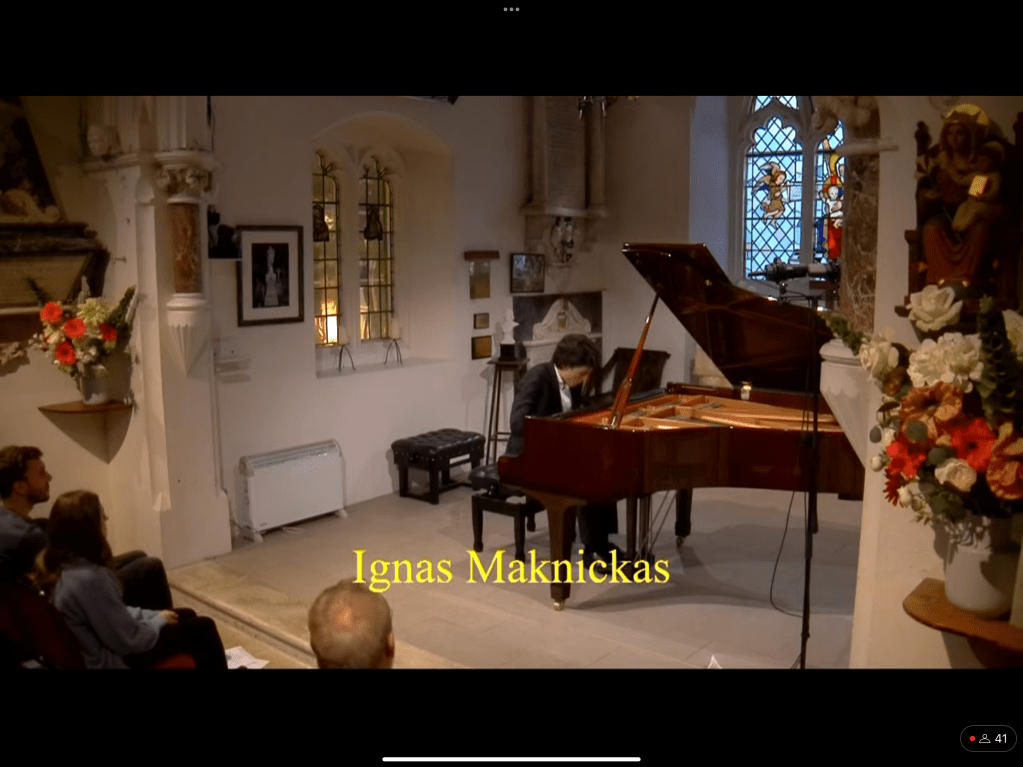
Sunday 2 October 2 pm Chopin Festival Session 4 : 2.00 Dinara Klinton Nocturne in F sharp minor Op 48 no 2, Mazurka in A minor Op 68 no 2, Sonata no 2 in B flat minor Op 35 2.45 Sasha Grynyuk Fantasy in F minor Op 49, Mazurkas Op 30, Waltz in A minor (1843), Waltz in E flat (1840), Waltz in A flat (1827), Waltz in E flat (1830) 3.30 Yuanfan Yang 24 Preludes Op 28 4.15 tea interval 4.45 Martin Cousin Nocturnes Op 37 nos 1&2, Bolero Op 19, Berceuse Op 57, Polonaise in A flat Op 53 5.25 Ignas Maknickas Mazurkas Op 59, Nocturnes Op 27 nos 1&2, Ballade no 4 in F minor Op 52
Another extraordinary line up of pianists for the final day of the Chopin Festival. Dinara Klinton one of the finest pianists of her generation was so disturbed by events in her native Ukraine that she did not know if she would be able to concentrate today.Persuaded by the ever caring Hugh Mather she played even better than ever .A Nocturne in F sharp minor of such depth of sound and profound beauty followed by the haunting message of the Mazurka in A minor. But it was Chopin’s great masterpiece of the Funeral March sonata that showed off her aristocratic musicianship and an unerring sense of style that allowed such shape and colour and a ‘rubato ma non troppo’ ( to quote the title of Tito Aprea’s fascinating book).As Hugh commented afterwards there was such an electric atmosphere in the Trio of the Funeral March that you could have heard a pin drop in a hall full to the rafters for this wonderful series .The wind blowing over the graves with Dinara’s superb fingers was a wind of great dynamic force finding refuge only in the mighty final chords.
Sasha Grynyuk gave a performance of the F minor Fantasy of such authority and passion where the transcendental arpeggiando chords were of burning intensity.Fearless almost reckless they took our breath away with their audacity.There was great weight to the melodic line of the central episode that just grew so naturally out of its surrounding.The Mazurkas op 30 were played with ravishing colours and sense of style and three little known waltzes were thrown off with irresistible charm and style.The last in E flat (1830) was a favourite encore of Peter Frankl whose 87th birthday is today.Sasha has much in common with Peter for his intelligent musicianship and sense of style .A technical command of the keyboard at the service always of the music.He like Peter is music’s servant.
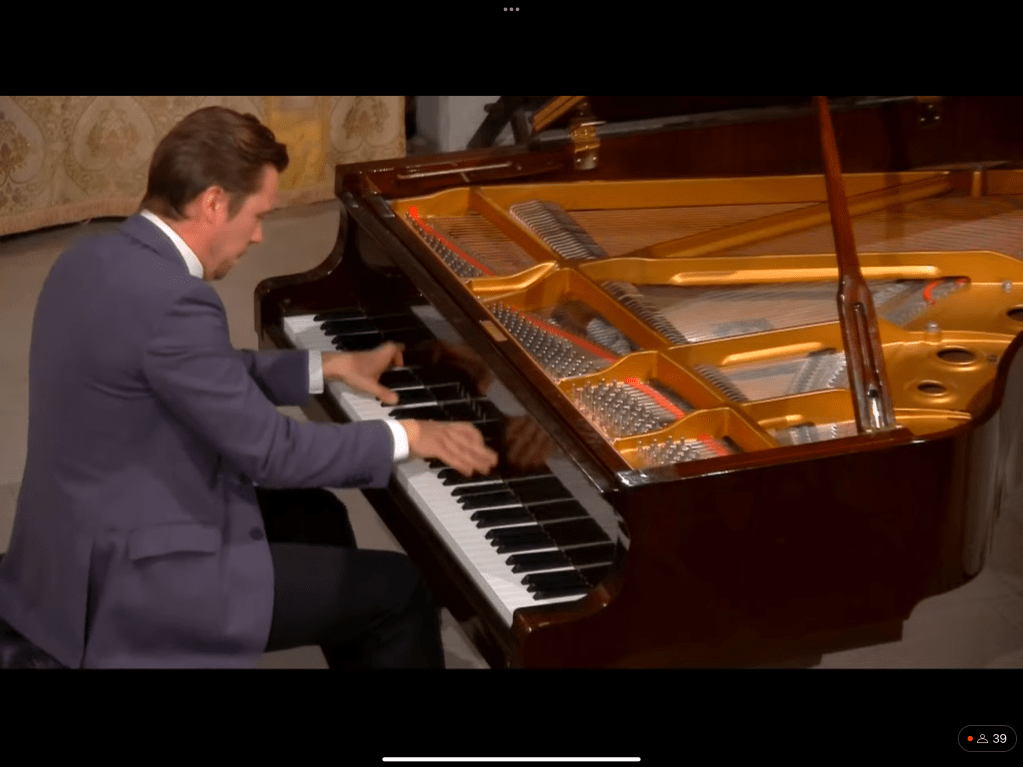
I had heard Yuanfan Yang yesterday in an evening dedicated to him by the Chinese community in London in St Johns Smith Square.He played movements from his third and fourth concertos plus one of his solo pieces and improvising on themes given by the audience.His fourth concerto owes more to Hollywood than to Ades but for a musician still only in his mid twenties it was a remarkable display of musicianship.https://christopheraxworthymusiccommentary.com/2022/10/04/yuanfan-yang-a-celebration-in-music-the-universal-language-of-all-nations/ Gold Prize winner a month ago of the Casagrande competition that could in the past boast Perlemuter and Badura Skoda on the jury Yuanfan showed the other side of his remarkable music personality.It was the side he shared with us today with a magnificent account of the 24 Chopin Preludes .Playing now with even more authority than a year ago when I heard him play them in Rome .Yuanfan inhabits a world of his own,the world of music.Anything else is secondary to the message that he carries in his own music and in his music making .A remarkable musician and man whose performance of the Preludes today must surely rank with the greatest of performances that we could hear on the concert platform today.
The final two recitals this afternoon started with a fascinating performance of the rarely heard Bolero played with great panash and infectious rhythmic verve.It was the same grandiosity that Martin Cousins brought to the famous Polonaise Héroique.If the cavalry were a little hard footed it may have been because he was tied to the score and this is one piece where as Rubinstein had shown us so often showmanship and freedom are essential ingredients for this the most majestic of Chopin’s compositions.The two nocturnes however were given intimate performances of great beauty with the solidity and musicianship of consummate artistry.
Ignas Macknickas is a young musician who I heard four years ago playing Mozart double concerto with Alim Baesembayev (the winner of the last Leeds Competition)I had noticed his natural technique long fingers and relaxed arms that gave such fluidity and luminosity to all he did.A natural talent that has at last realised that playing the piano is 90% hard work and 10% God given talent.So it was wonderful to see this young man now flowering into an artist of stature with a performance of one of the greatest works of the Romatic era – the fourth ballade.Together with the Liszt Sonata and Schumann Fantasy these are the very pinnacle of inspiration. His performance was of great fluidity and authority.Beautiful luminous sounds and a naturalness of movement that was mirrored in the ravishing beauty of the sound he produced .The treacherous coda was played with great excitement but shaped with artistry.The same artistry he had brought to the two nocturnes op 27 with the penombre of the first and the radiant luminosity of the second .The mazurkas too were played with that youthful spirit and sense of ‘joie de vivre’ that was a hallmark of all he did.
Chopin Festival Session 5: 7.00 Julian Jacobson Polonaise in C sharp minor Op 26 no 1, Mazurkas Op 33, Polonaise in C minor Op 40 no 2, Mazurka in F minor Op 68 no 4, Polonaise in F sharp minor Op 44 7.50 Roman Kosyakov Fantasy-Impromptu Op 66, Mazurkas Op 17, Nocturne in C minor Op 48 no 1, Ballade no 2 in F Op 38, 8.30 interval 8.45 Cristian Sandrin Nocturne in B Op 62 no 1, Sonata no 3 in B minor Op 58 9.25 Rokas Valuntonis Nocturne in F sharp Op 15 no 2, Études Op 10
Julian Jacobson
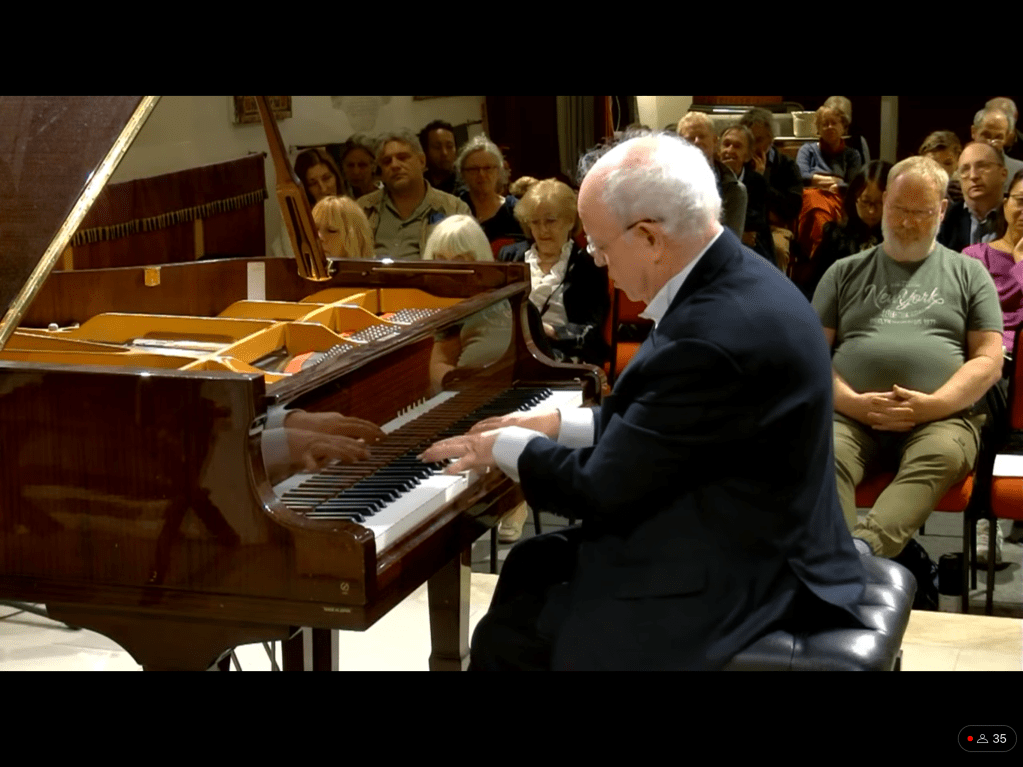
And so to the final session of this extraordinary festival. It was Julian Jacobson who had pondered through the night of how to making a really fitting contribution to this extraordinary event .He had recently found in the Fontana archives the missing page to the Mazurka in F minor op 68 n.4.A page that Chopin had written on his death bed and had only just the strength to write the bare notes.But notes of such chromaticism that pointed to the future even in his final hours.He prepared it during the morning of the concert as a surprise gift from an extraordinary musicologist. Julian is also a very fine pianist who plays the entire piano repertoire.He will be playing the 32 Beethoven Sonatas soon from memory in Central London.Starting at 10 am with op 2 and finishing at 10 pm with op 111. He recently played 7,45 minute recitals on a cruise ship in the Americas as his duo partner was indisposed at the last minute.An amazing musical mind that could contemplate such a tour de force. Adding three polonaises and the mazurkas op 33 to his programme he gave performances where music just seemed to pour from him so naturally .The Mazukas in particular were played with such live wire colours and rhythms that they seemed almost improvised such was their freshness .The great C minor Polonaise op 40 was played with heartrending nobility and op 26 with its youthful call to arms and joyously innocent dance rhythms.The great F sharp minor Polonaise was played with aristocratic nobility and the complex middle mazurka episode was allowed to flow with a compelling natural forward movement .
Roman Korsyakov’s agile fingers allowed the Fantasie Impromptu to weave its magic web with beguiling colours and passion.The beautiful middle episode sang with pleading sincerity.Roman’s superb sense of balance allowing the melodic line to sing with such subtle colouring which was the hallmark of his remarkable performance of the C minor nocturne that followed A miniature tone poem and one of the greatest of nocturnes played with a remarkable sense of grandeur and poetic beauty.The same beauty he brought to the second ballade but where also his transcendental control of the piano allowed the tempestuous interruptions to astonish and excite before dying away to a mere whisper. Roman winner of the 2019 Hastings Competition gave him a triumphant London debut with the Royal Philharmonic Orchestra and he has recently ignited the enthusiasm of the audiences on Cyprus in a recital for the Keyboard Trust of which he is a distinguished artist.
CrIstian Sandrin by coincidence was to be the duo partner on Julian’s cruise but was called to his father’s bedside in Bucharest at the last minute .His father is a distinguished Rumanian pianist who I hope was well enough to watch his son’s remarkably poetic performance of the B minor Sonata ._ An Allegro Maestoso of rare beauty where he took all the time to allow the poetry to be revealed in a timeless flood of song.CrIstian,an Ashkenazy look alike,is born to sit before the keyboard and is a very natural pianist where his movements from on high follow the movement of the music with the same beauty as a Volodos or Giulini.The middle episode of the Scherzo too revealed such poetic truths and contrasted with the scintillating outer episodes played with true jeux perlé of great brilliance.The rondo final movement was paced like a master growing ever more in sound and excitement until the bubble burst with extraordinary virtuosity and brilliance.The nocturne in B too was unraveled in a timeless stream of poignant sounds with trills that were just reverberations from on high adding to the magic atmosphere that he created.
Rokas Valuntonis
It was Rokas Valuntonis who closed the festival late on Sunday evening.A performance of the F sharp nocturne op 15 that Rubinstein used to play with timeless ease and beauty.Rokas unravelled the beautiful middle episode with the same ease and with a enviable liquid sound .It was the oiled ease of his playing and radiant sound that reminded me of Geza Anda.A technical command of the keyboard and its secret colours that often astonishes .His studies op 10 may not have been the perfection that had astonished a while back in Perivale but it was of such brilliance and style that it was quite unique.The ravishing beauty of the slow third and sixth studies were of a radiance and poetic meaning that had made his Kinderscenen also in Perivale a while back so extraordinarily moving.The opening study was played with a brilliance and ease that was astonishing as was the famous black key study.Just thrown off with an ease but also a musicality that shaped the music in a ravishingly enticing way.If there were moments of doubt ,due to the late hour ,there were none where the music was concerned and I have rarely heard the arpeggio study n.11 played with such jewel like beauty.The passion and virtuosity of the Revolutionary study was a fitting ending to this festival of having the privilege to listening to 12 hours of Chopin’s genius played by such remarkable artists. It also allowed some of the finest young musicians a platform to share their music with music lovers world wide thanks to the superb streamig facilities that Dr Hugh Mather and his team have created with passion and expertise in this beautiful historic venue.




















 ChristopherAxworthy-MusicCommentary