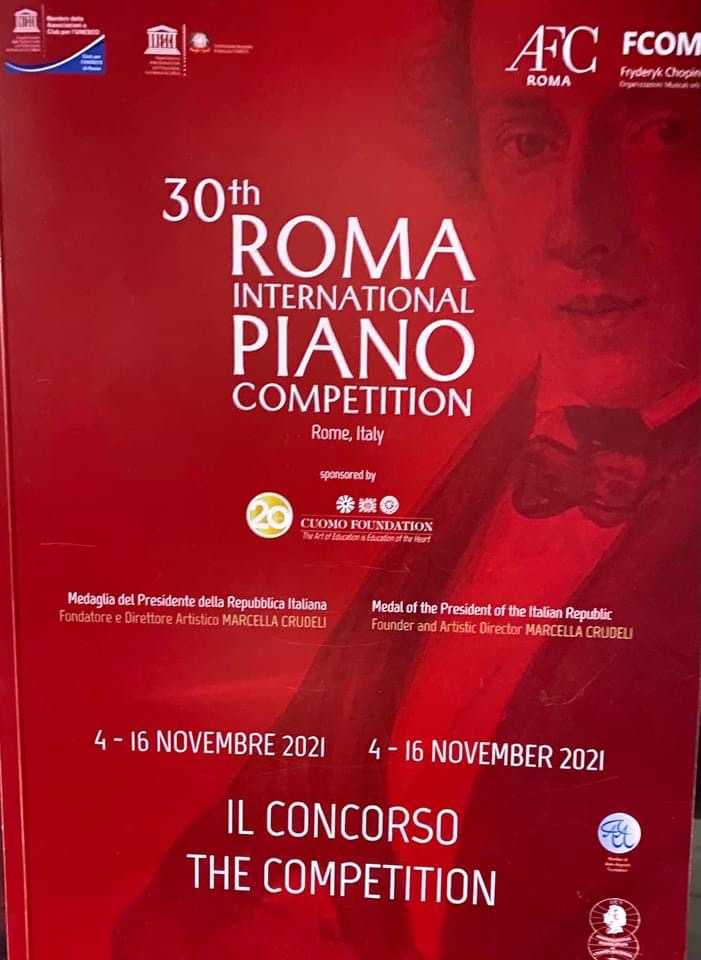
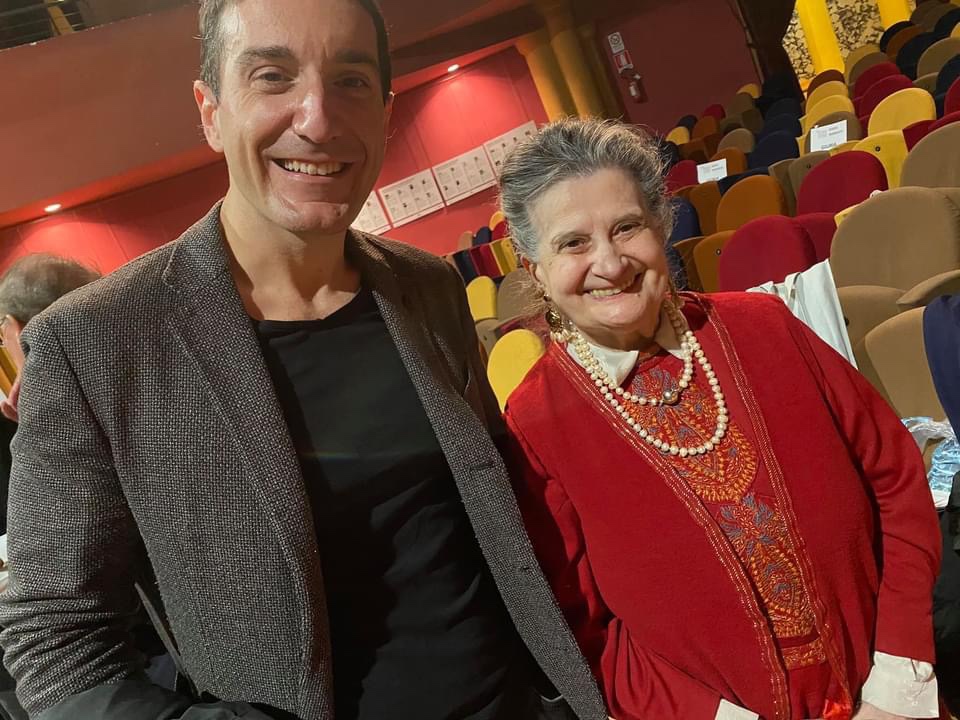
Hats off to Marcella Crudeli who in her 80th year is still very much at the helm of the competition she created for Rome thirty years ago. Teaming up with that other tireless supporter of young talent Valerio Vicari of Roma 3 Orchestra.
Valerio Vicari with Marcella Crudeli
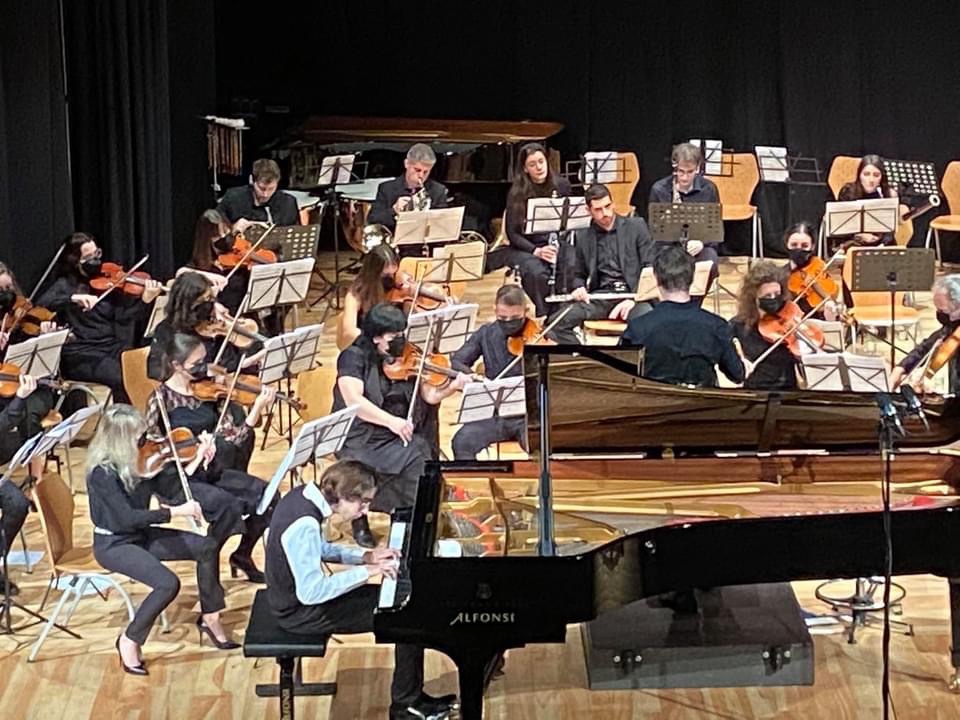
An orchestra that he had founded over 15 years ago to give a much needed platform to young highly qualified musicians recently graduated from major conservatories. It is not so much the competition result that counts as much as the competing itself and the amount of enthusiasm it generates. Bringing the excitement and exhilaration that only a competition atmosphere can create. In the past thirty years the competition has seen participants from 80 different countries with a jury from 25! And this morning after performances of Tchaikowsky,Mozart and Beethoven concerti we discover that the jury had gone more for flamboyance than subtlety.
Yulia Lin Beethoven 4 op 58
The very shy Chinese contestant Yijia Lin gave a superb performance of Beethoven Fourth Concerto full of refined phrasing,delicacy and crystal clear sounds.But she was so shy she hid behind a great shroud of hair that made her look more like the black widow than the angelic messenger sharing with us the glory of Beethoven’s most perfect creation.
Ivan Basic Tchaikowsky op 23
She was voted in third prize as the two young men from Serbia and France swept caution and intellect to the wind in return for performances of playing to the ‘Gods’with Tchaikowsky’s old B flat minor war horse and Mozart’s most loved concerto K488 in A.
Slava Guerchivitch Mozart K.488
In fact it was to Mozart and the young French contestant that the Premio Chopin was awarded: Slava Guerchivitch. Runner up was the young Serbian Ivan Basic for his heroic performance of Tchaikowsky at 11 in the morning!
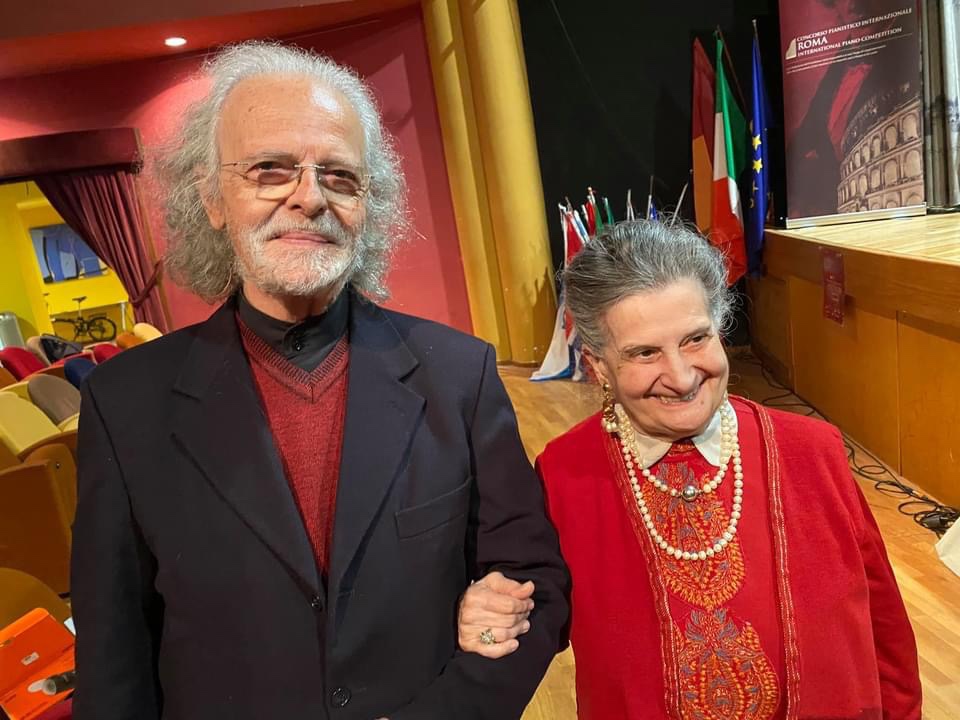
Marcella Crudeli with Prof.Franco Ricci
Tonight the indefatigable Marcella Crudeli will delight in awarding prizes to all the various categories as well as letting us share in part of the prize winning performances that we were treated to this morning. A special thanks must go to the Roma 3 ,their superb orchestra and in particular Valerio Vicari for looking after Madam Crudeli with such affection and professionalism and overseeing the quite considerable organisation needed.Thanks too to Pawel Gorajski,the very fine but totally exhausted conductor after uniting all the inexperienced strands before him into as near perfect whole as his excellent musicianship would allow.
The President Patrick Dheur and jury members announcing the result
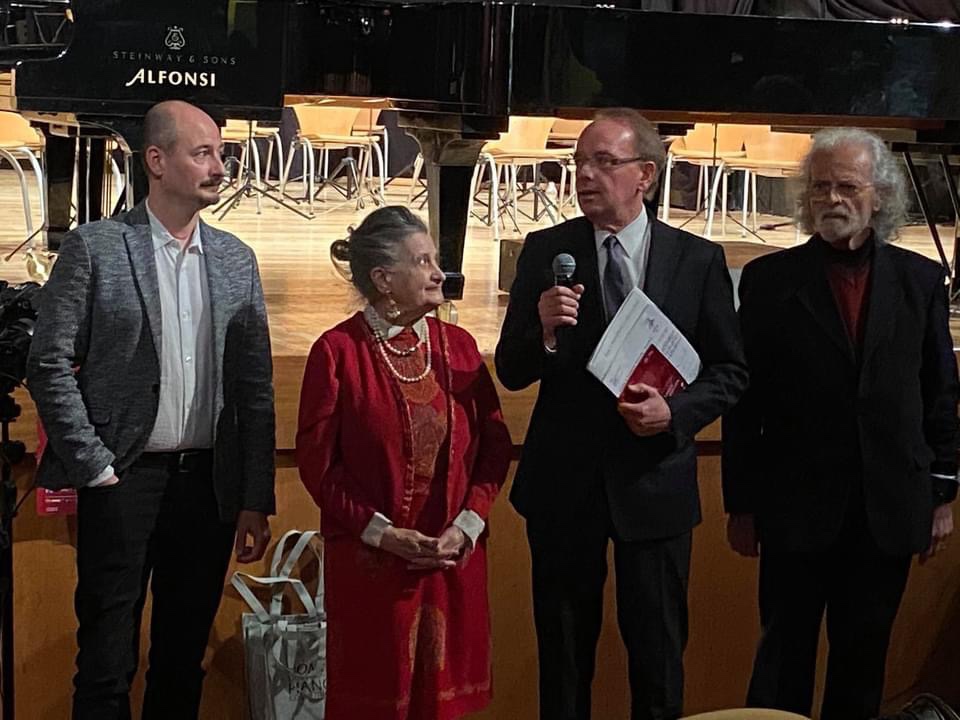
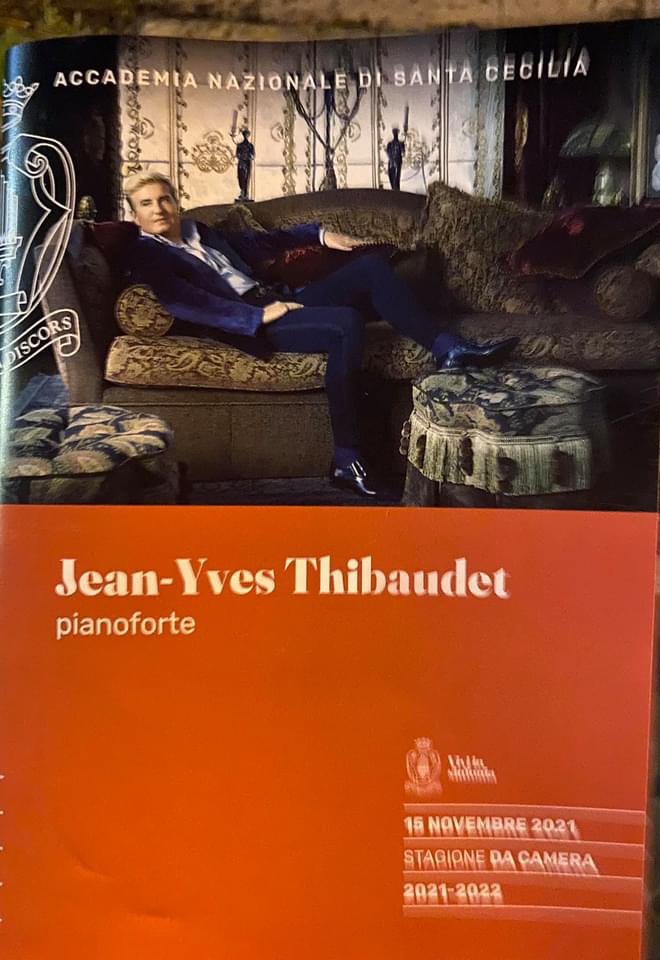
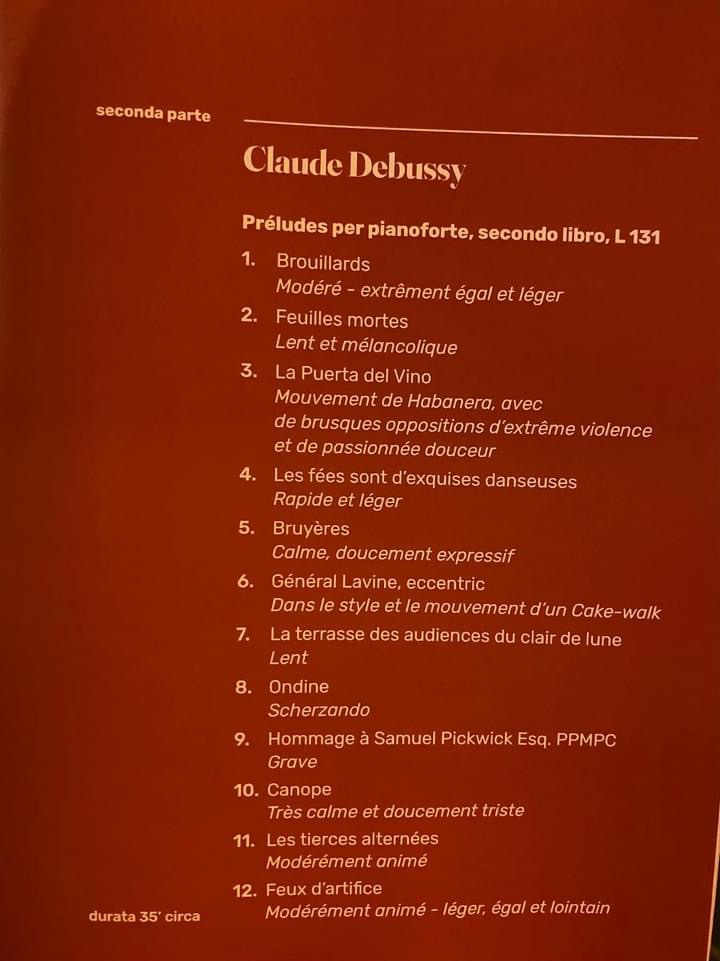
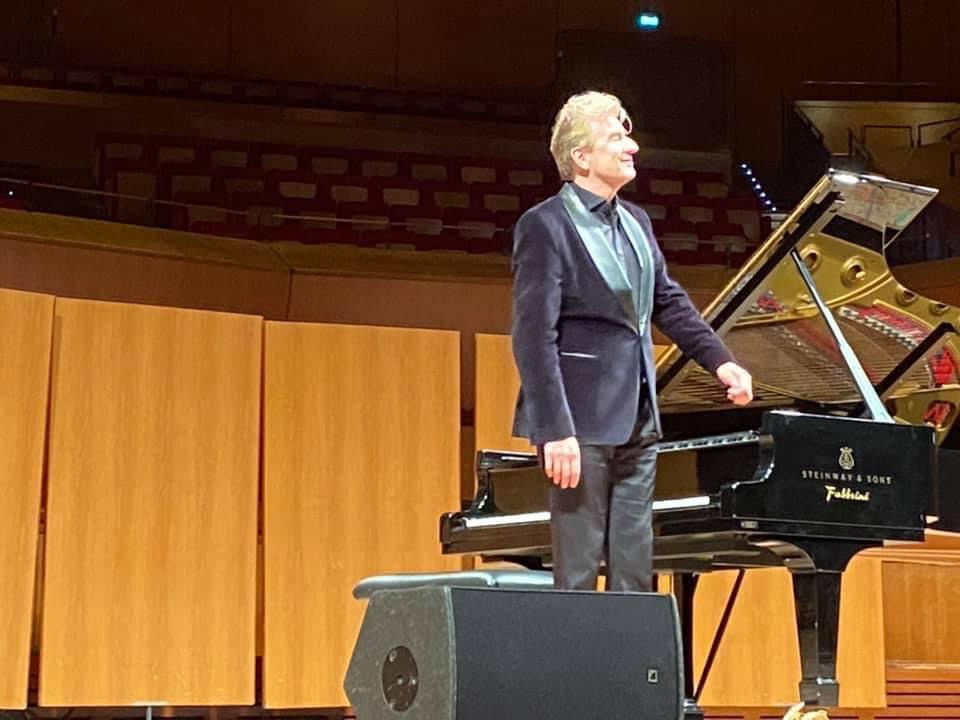
Jean-Yves Thibaudet in Rome Ravishing playing and a tour de force of transcendental control of sound and colour.Twenty four Preludes by Debussy are 24 problems as Fou Ts’ong used to say about the Chopin Preludes.
I would say even bigger problems as each one is a miniature tone poem with a quite unique way of touching the keys and using the pedals.
A golden glissando in diminuendo in Feux d’artifice was astonishing as it was ravishing. The layers of sound in Voiles was the stuff that legends are made of. The subtle projection of Des pas sur la neige was breathtaking. The monumental performance of La Cathédrale engloutie I have never been so overwhelmed since Cortot’s memorable account What fun he had with Général Lavine and the tongue in cheek Hommage à Samuel Pickwick Esq. I remember a documentary of Fou Ts’ong once where the camera was silently roaming about his big house in Hermitage Lane while he was playing Canope that he loved so much for its total feeling of desolation.The same atmosphere that Thibaudet captured in this far from full Symphony Hall. Les tierces alternées like his late studies were a lesson in how an exercise can be turned into a magic atmosphere of invention and imagination.
Astonishing virtuosity in ‘Ce qu’a vu le vent d’ovest’ and ‘La Puerta Del Vino.’’Ondine’was every bit as beautiful as it was in Rubinstein’s hands although played with much more mystery and scintillating colours.The same magical sounds that he brought to ‘La terrasse des audiences du Clair de lune.’’Brouillards’and ‘Bruyères’were bathed in subtle murmurs from an etherial world.But ‘La fille aux cheveux de lin’was made of streams of gold.To ‘Feuilles mortes’he brought such an extraordinary sense of subtle emptiness immediately interrupted by the explosive ‘La Puerta Del Vino.’
A continual voyage of discovery shared secretly with us with a kaleidoscopic range of colour.It was a much more luminous sound that he brought to Elgar’s ‘Salut d’Amour’ played with that aristocratic elegance and style that is never weak or sentimental.This was the nobility of sound and elegance of Paris of the 30’s that we had been treated to today as we had been in the past by Rubinstein or Ciccolini with their inimitable performances of Poulenc.
A small but very enthusiastic audience greeted each book with cheers. Obviously the handful of connoisseurs that abound in our great cities were not going to miss a pianist that even Perlemuter admired when he heard him playing Ravel as a teenager. Looking ever more like his teacher Aldo Ciccolini. After 75 minutes of absolute perfection and total concentration he played ‘Salut d’Amour’ Ciccolini’s favourite encore. What better tribute could there be from one great artist to another and indeed to his much missed mentor?
Many more great performances to look forward to in Rome
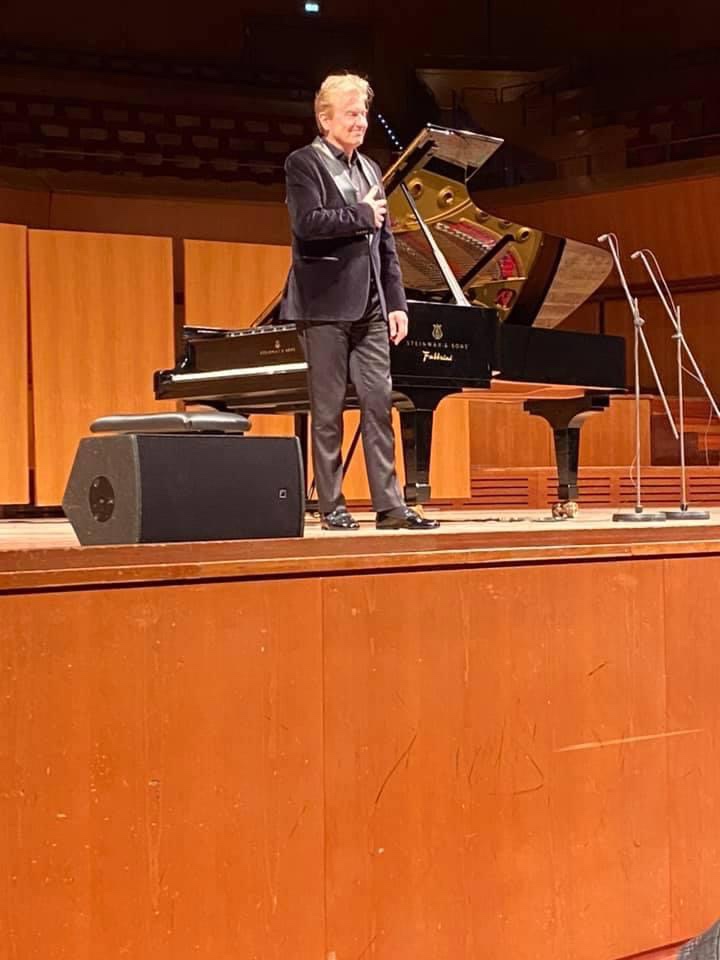
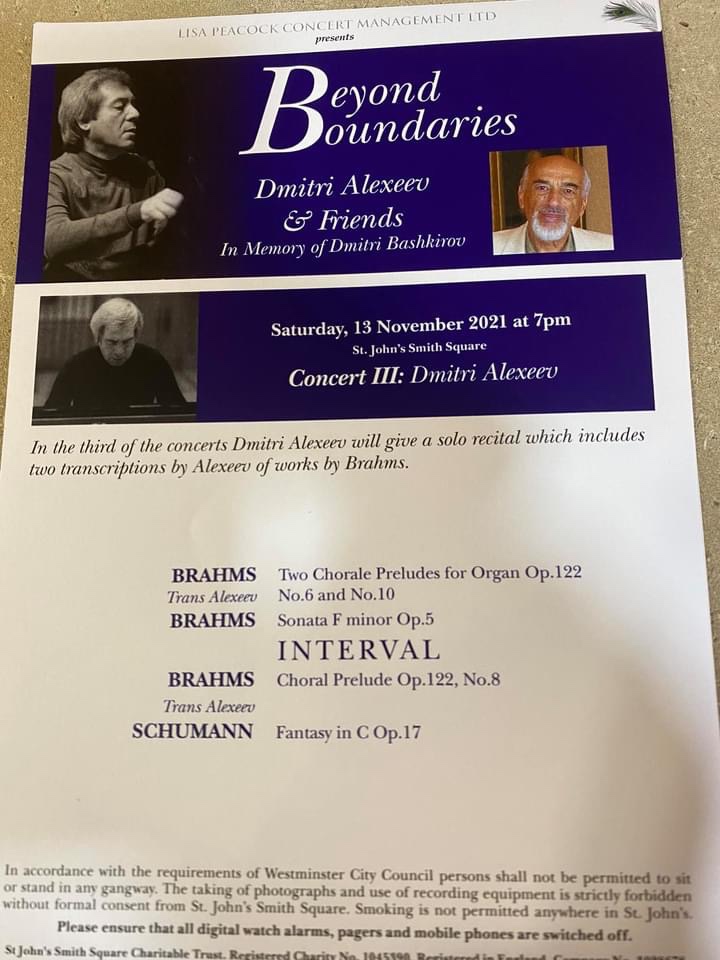
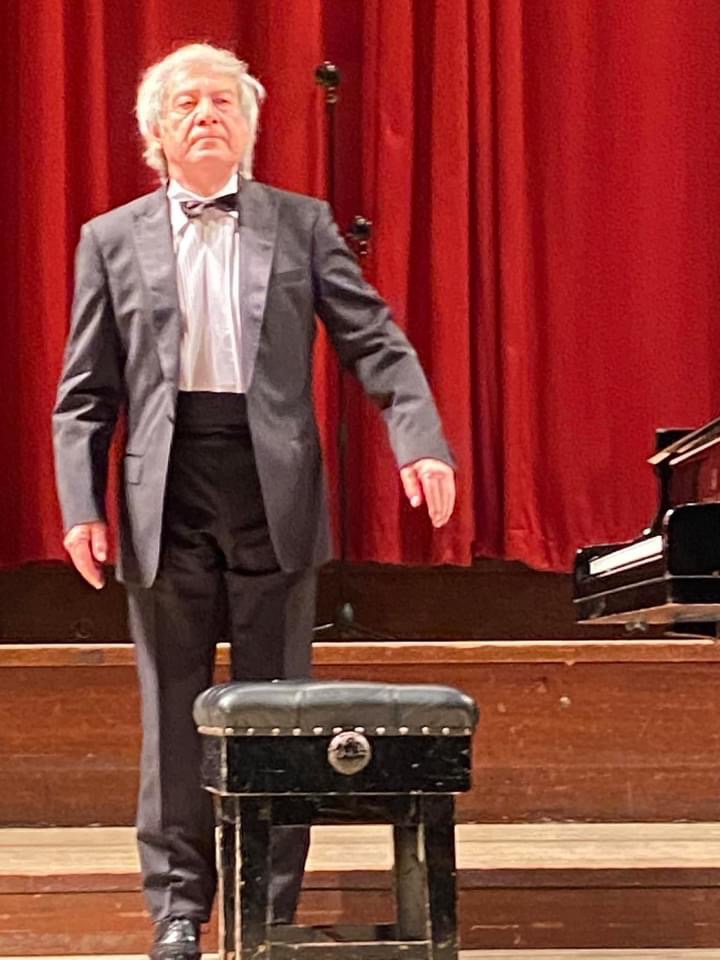
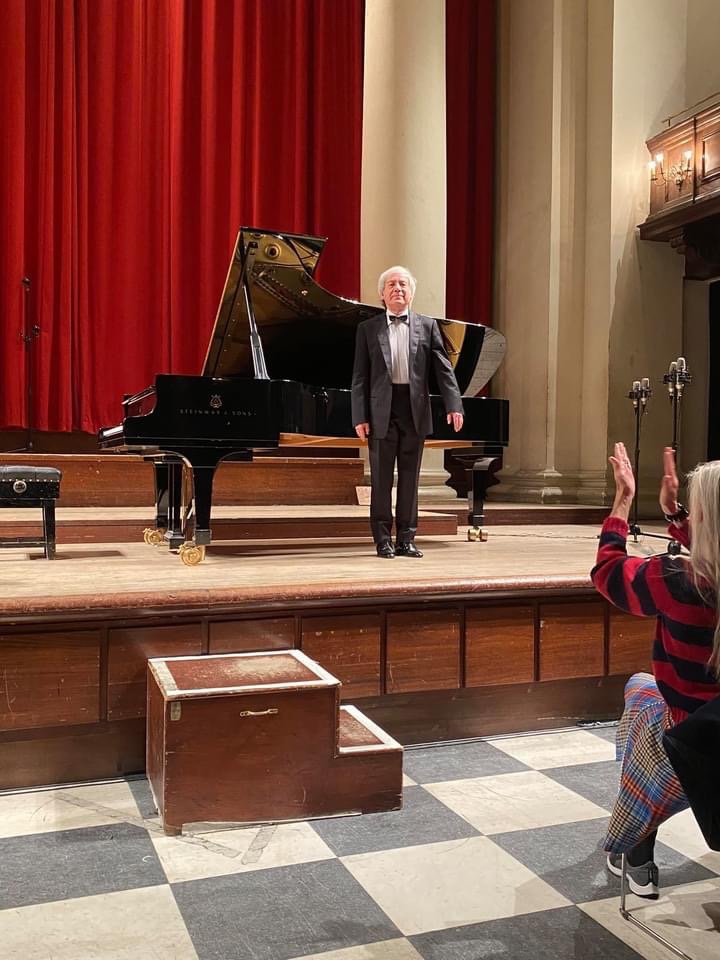
A great evening with Dmitri Alexeev tonight. Celebrations after unforgettable performances by one of the great pianists of our time. Brahms F minor Sonata and Schumann Fantasie played with the authority and weight that we have not heard since Arrau. Six encores for a packed audience overwhelmed by performances that are sadly lacking these days from our concert halls.Performances so often today where solid reliability has taken the place of the artist ready to risk everything on a journey of discovery with the audience. The melody of the first of two Bunte blatter encores was what Schumann claimed was sent to him by the angels. Later used by Brahms in his homage to Schumann as the master himself was to use it in his violin concerto that was discovered only by chance after his death.
After such emotionally overpowering performances of Brahms op 5 and Schumann op 17 what more subtle choice could there be from an artist where every note and rhythm had such a noble inevitability. In crucial emotional moments the right hand would help the left in creating even more sonority from the bass. Always rich Philadelphian sounds that Stokowski would draw from his orchestra and that so beguiled Rachmaninov that he wrote everything with their sound in mind. There was the weight of sound even in the most tender passages. Where the Russian school,of which the master was Richter,has often shown us with their extreme attention to the sounds from pianissimo to mezzo piano sacrificing in lesser hands forte and fortissimo that can become ungratefully hard and abusive. It was Gilels in particular who showed how playing with weight could produce golden sounds throughout the range creating a complete orchestra. Allowing the architectural line to evolve naturally as with the great German conductors like Klemperer or Furtwangler where the brass were kept rigorously under control. Six encores just poured out of this great artist’s hands. Two supremely characterised Albumblatter op 124 by Schumann following on from the two Bunte blatter op 99 and a fleetingly beguiling Mendelssohn song without words in F sharp minor op 67. A passionately savage Intermezzo from Carnaval jest of Vienna op 26 was followed by Chopin’s Mazurka in C sharp minor played with heartbreaking nostalgia but also rumbustous rhythmic stamping of feet as rarely we hear so authentically played.
Flowers,cheers and a hall on their feet with the adrenaline entering into all that were privileged to be present. Brahms F minor Sonata and Schumann Fantasie,words just fail me as I was so overcome by such powerful performances ………however for the pure pleasure of reliving such an experience I will try my best to describe some of the marvels that will remain ingrained for a long time to come ………………Mention too must be made of his own truly magical transcriptions of three of Brahms’ Chorale Preludes played as a luxurious ‘hors d’oevre’ to the main course! The one op 122 n.8 played before the Schumann Fantasie even sounded from the same world of Schumann. An artist in conflict within himself with the delicate Eusebius contrasted with the rumbustuous Florestan ………the conflict of all true artists that some might give a name to………. ‘soul’. Just what we were so unexpectedly treated to tonight! I had flown in especially from Rome where a few years ago Alexeev gave two recitals for us. Not having heard of him playing Brahms F minor or Schumann op 17 before I had a feeling that this was something not to miss. Indeed it was a very special evening and it was ‘a far far better thing that I have done than I have ever done before ‘ to quote Dickens. In the 60’s we used to wait anxiously in June for the annual visit of Artur Rubinstein who would show us just what it meant to be a legendary virtuoso …a true inspiration to all aspiring young pianists. Alexeev showed us and many of his students ,that he very generously divides his time with, just what they should be striving for too.
The third recital in a series of four that Alexeev wanted to dedicate to his mentor Dmitri Bashkirov.Under the title Beyond Boundaries over the last month St John’s Smith Square has been resounding with the sort of presence that Artur Rubinstein used to offer us annually during the month of June.
From the very first notes of Alexeev’s own transcriptions of two of Brahms’ Chorale Preludes for Organ op.122 n.6 there was a luminosity of sound as this deeply felt religious prayer unfolded.Op 122 n.10 slipped in so unobtrusively with its deeply moving tenor melody allowed to sing with such subtle inflections surrounded by a golden halo of sumptuous sounds.This was the preparation for the monumental opening of the F minor Sonata !
There were glorious golden sounds created from the outset with Alexeev’s wonderful attention to the bass knowing that without this anchor there would be only immaculate details and no real sense of line .The fiendishly difficult jumps were just thrown off as he leapt up to them ,with such vehemence,from deep in the bass.There was an overwhelming authority and a wonderful flexibility all coming from the sumptuous sounds that he had carved deep in the piano from the very first notes.The deliberate and rhythmic pointing was played with an orchestral fullness of tone where it seemed there was time for every detail.The meltingly beautiful ‘con espressione’ was played with subtle beauty only matched by the sublime heights he touched with the cello melody in the D flat episode.To watch his expression as he played the final alternating loud and then quiet chords was a lesson in itself.Like the menacing glances that Toscanini must have shot at his long suffering orchestral players!Reaching deep down with both hands for the final earth shattering chord the scene was set with an audience now very much on the edge of their seats.
‘Through evening’s shade, the pale moon gleams While rapt in love’s ecstatic dreams Two hearts are fondly beating.’ Is the poem that Brahms prefaces his Andante espressivo that Alexeev played with such subtle luminous sounds of rare beauty.It was here that one could really feel the weight of a great artist as he conjured up magical sounds of pure velvet richness.The ‘poco più lento’ was indeed dolcissimo as it led so naturally to a build up of passionate longing,the ornaments never getting in the way but an integral part of the melodic line just adding more intensity.The coda also marked Andante molto espressivo just grew out of the opening melodic line but which is so often slowed down as a separate episode instead of returning to the original tempo.This gave a great sense of line to the passionate build up and it was the Adagio that became the true climax of this movement with the quite ravishing ‘con molto espressione’ falling phrases reaching truly sublime heights as the chords spread over the whole keyboard gradually dying to less than a mere whisper.Catapulting himself into the Scherzo with the animal like intensity of someone just waiting to pounce,I have never known the syncopated rhythms to be so poignant and crystal clear.There was some beautiful doubling with the thumb in the trio before returning to the hypnotic animal intensity of the Scherzo.Menace too in the Intermezzo with the rhythmic insistence of the bass notes reaching unbearable intensity gradually disintegrating to the three final heart beat chords played with absolute perfection of colour and shape demonstrating,yet again,his amazing tour de force of transcendental control.The Finale was played very deliberately and allowed the syncopated chords to really have great impact.There was warmth in the chorale melody, played so simply as it gradually grew in intensity.Brahms stopping seemingly to search for his way and which Alexeev treated in such a wonderfully improvisatory manner.The ‘più mosso’ was played very deliberately as the melody was interwoven into this knotty twine that was so clearly played.Saving the full impact for the Presto and the passionate build up to the climax of the whole Sonata .The final five chords were played with a monumental sense of colour and effort that kept the unbearable tension until the very last vibrations had died away
In conversation afterwards with Dina Parakhina both having studied at the Central Music School in Moscow with Tamara Bobovich
The Schumann Fantasie was preceded by Brahms’ Choral Prelude op 122 n.8 with some very Schumannesque turn of phrase and a magical doubling of octaves before bursting into the red hot passion of the Schumann Fantasie.Written as an outpouring of love for his future wife Clara Wieck Alexeev plunged in with a passion and savage rhythmic intensity that was quite overwhelming .The burning passion and unrelentless forward movement found momentary respite in the ‘Im legendenton’ played with such a mellifluous freedom that the bar lines ceased to exist as it built in tension to the true climax of this movement. The right hand once again found itself in foreign territory as it added to the enormous sonority being created.Schumann’s quote from Beethoven’s ‘An die ferne Geliebte ’ was played with great liberty and I wonder if Alexeev knows something more than is just printed in the score as the movement moved to it’s magical conclusion
The original title of Schumann’s work was “Obolen auf Beethovens Monument: Ruinen, Trophaen, Palmen, Grosse Sonate f.d. Piano f. Für Beethovens Denkmal”. The movements’ subtitles (Ruins, Trophies, Palms) became Ruins, Triumphal Arch, and Constellation, and were then removed altogether before Breitkopf & Härtel eventually issued the Fantasie in May 1839.Dedicated to Franz Liszt , who replied in a letter dated June 5, 1839: “The Fantaisie dedicated to me is a work of the highest kind – and I am really proud of the honour you have done me in dedicating to me so grand a composition” Liszt in return dedicated his B minor Sonata to Schumann – two pinnacles of the Romantic piano repertoire .The piece has its origin in early 1836, when Schumann composed a piece entitled Ruines expressing his distress at being parted from his beloved Clara Wieck (later to become his wife). This later became the first movement of the Fantasy adding later that year two more movements to create a work intended as a contribution to the appeal for funds to erect a monument to Beethoven in his birthplace of Bonn.
Tatiana Sarkissova- Alexeev with renowned concert promoter Lisa Peacock
So it was hardly surprising the imperious opening of Alexeev’s second movement – Triumphal Arch indeed .Although written mezzo forte in the score it was of truly orchestral proportions building unbelievably in sonority each time it reappeared.The beauty of the ‘etwas langsamer’came as a true relief from the relentless rhythmic drive and enormous sounds that Alexeev coaxed out of this beautiful instrument.
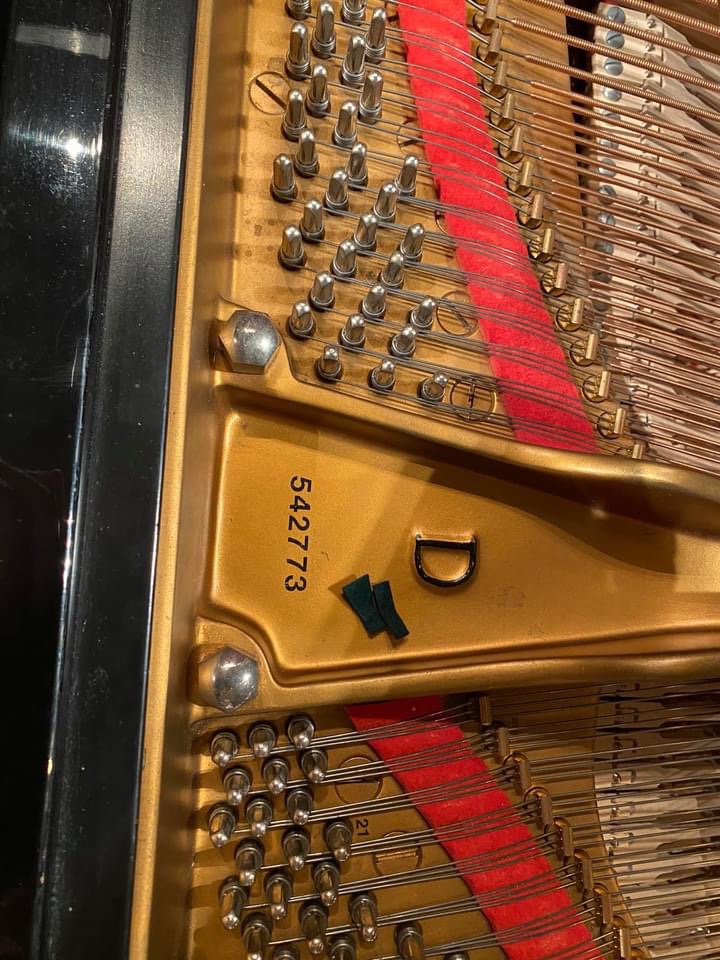
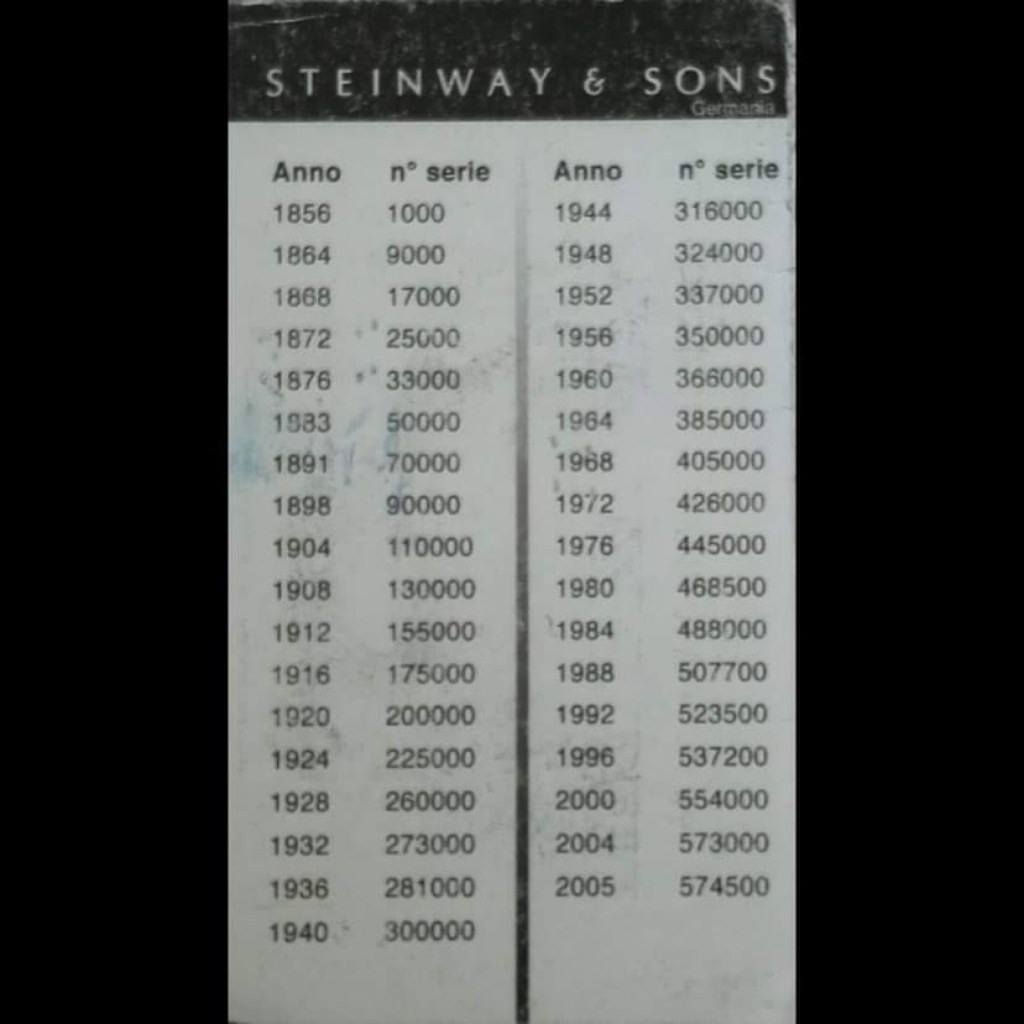
The beautiful,Steinway ‘D’ concert grand at St John’sSteinway serial numbers with year of manufacture an invaluable guide kept in the pocket of that master piano technician Zanta in Padua
An even greater relief was the pianissimo scherzando before the mighty build up to the infamous leaps that Schumann demands in the ‘più animato’coda.Even here there was a total command and authority that the transcendental difficulties just disappeared in a resonance of overwhelming power and majesty.
“Resounding through all the notes. In the earth’s colourful dream.There sounds a faint long-drawn note.For the one who listens in secret.”is the poem that prefaces the Fantasie and nowhere can it be more appropriate that in the final ‘Langsam getragen Durchweg leise zu halten’.The enormous sforzando E flat chord,ending the second movement,was allowed to die away before the magical opening in C major just seemed to appear from afar.I remember Agosti writing in my score ‘Cla …ra’over the long held A and G as a sign that this really was as Schumann wrote to Clara: ‘the most passionate thing I have ever composed – a deep lament for you.’They still had many tribulations to suffer before they finally married four years later.In Alexeev’s hands there was a continual outpouring of ravishing sounds always with deep,true feeling never for a second becoming sentimental or weak.The three carefully judged final chords brought this miraculous programme to a close ………or so we thought ……not counting in the generosity of this much loved artist.
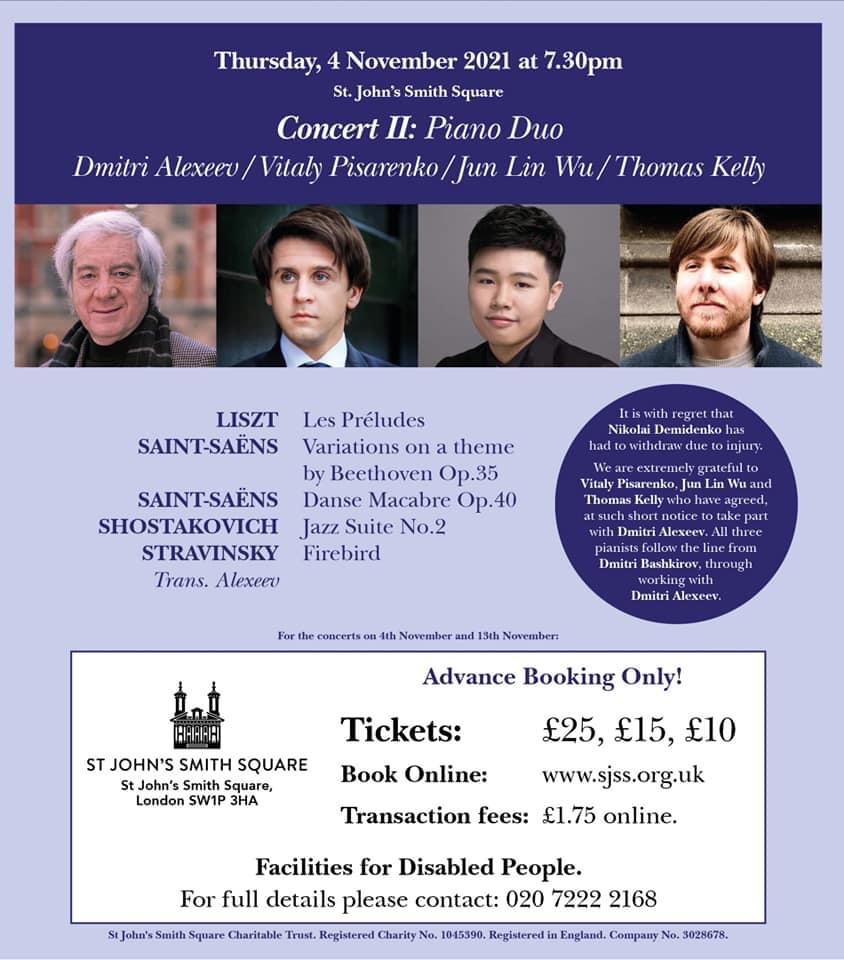
The second concert was to have been with Alexeev’s long time piano partner in a concert where the brilliance of Demidenko and Alexeev has thrilled audiences worldwide for many years.
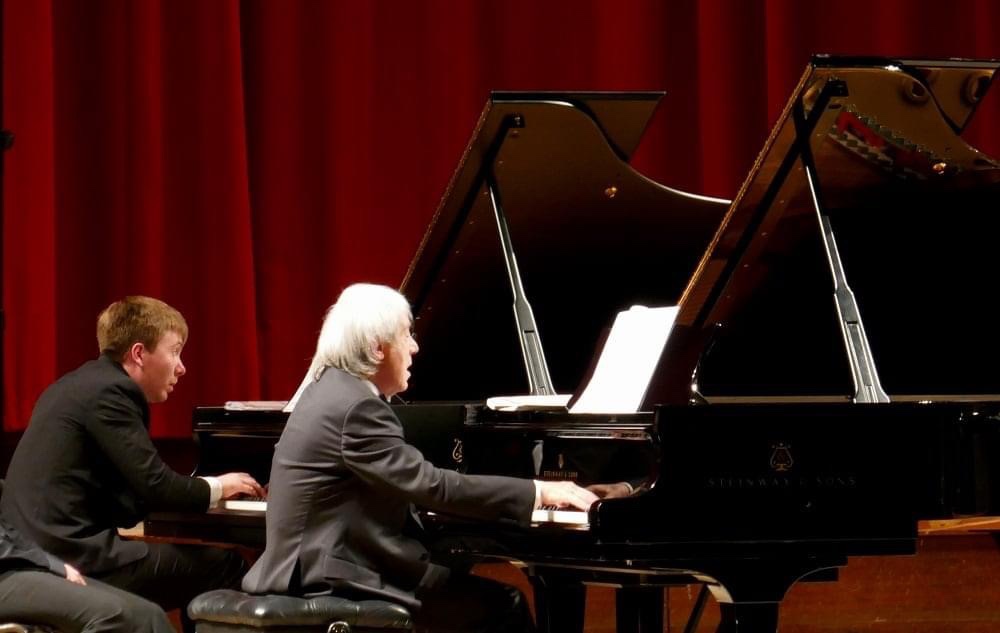
An unexpected injury to Demidenko’s hand allowed Alexeev to give the chance of playing with their master to Vitaly Pisarenko,Thomas Kelly and Jun Lin Wu .Allowing not only the same programme but adding all the fun and games of pianists alternating in an exhilarating exhibition of superlative music making
Vitaly Pisarenko,Thomas Kelly,Jun Lin Wu with AlexeevAlexeev with Thomas KellyDmitri Alexeev,Vitaly Pisarenko,Thomas Kelly,Jun Lin Wu
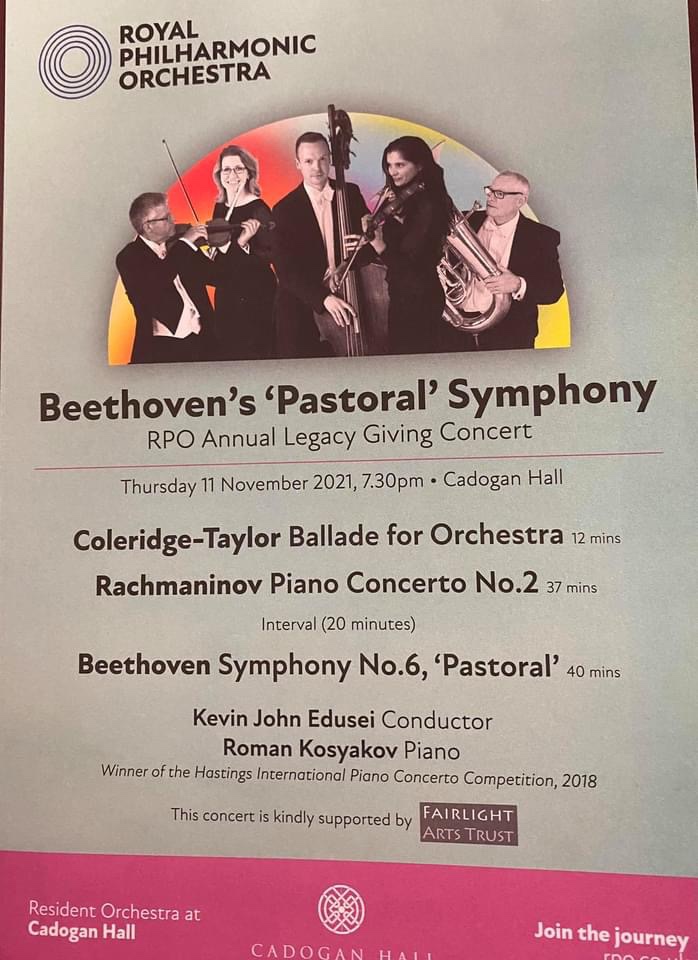
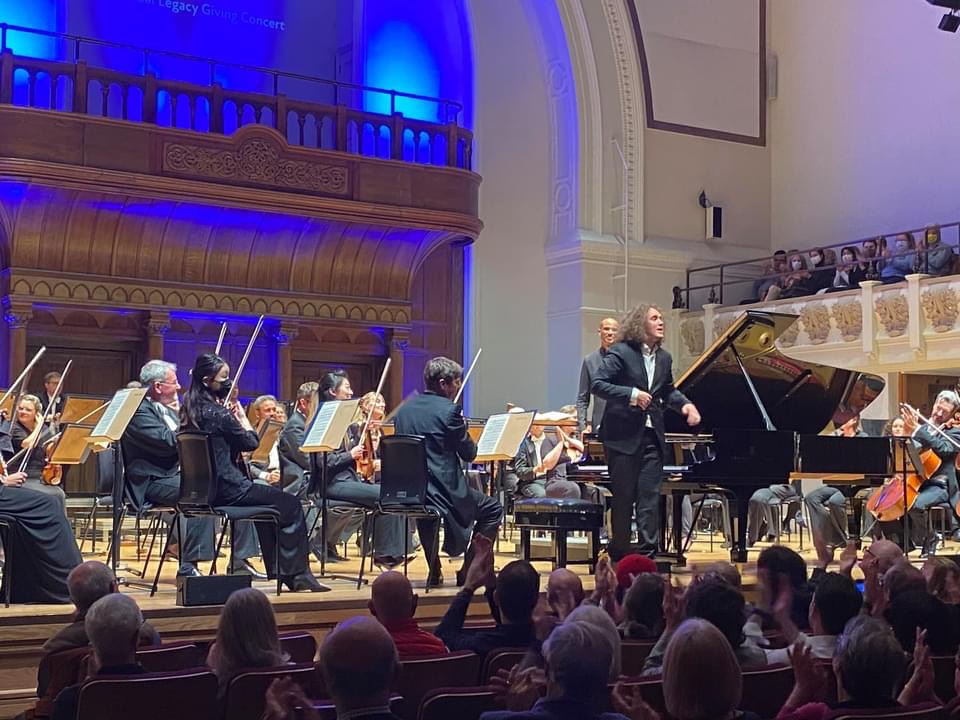
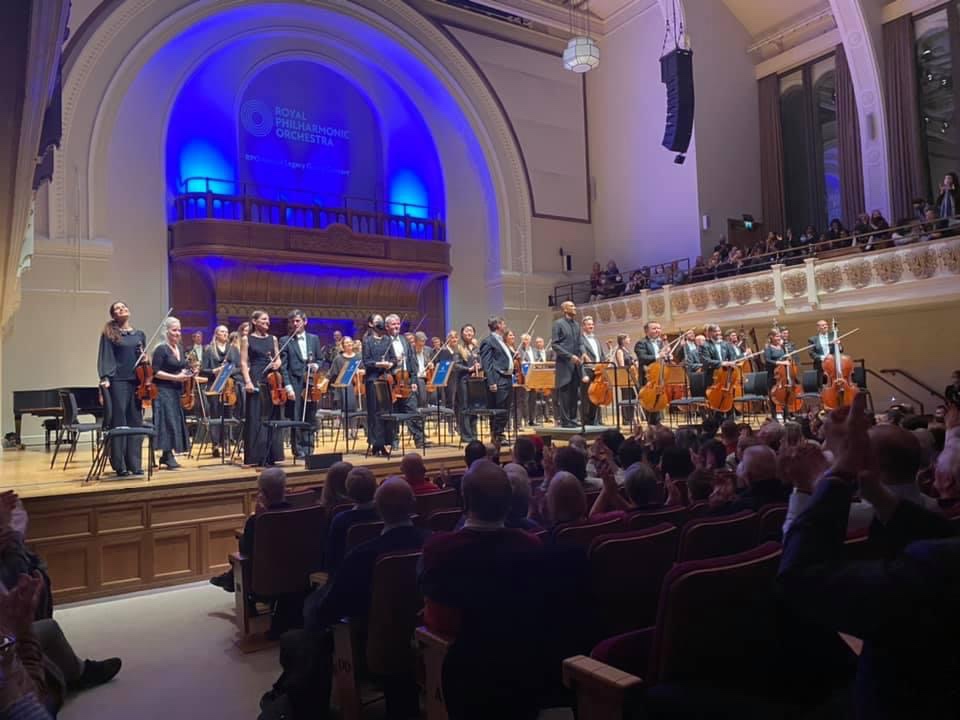
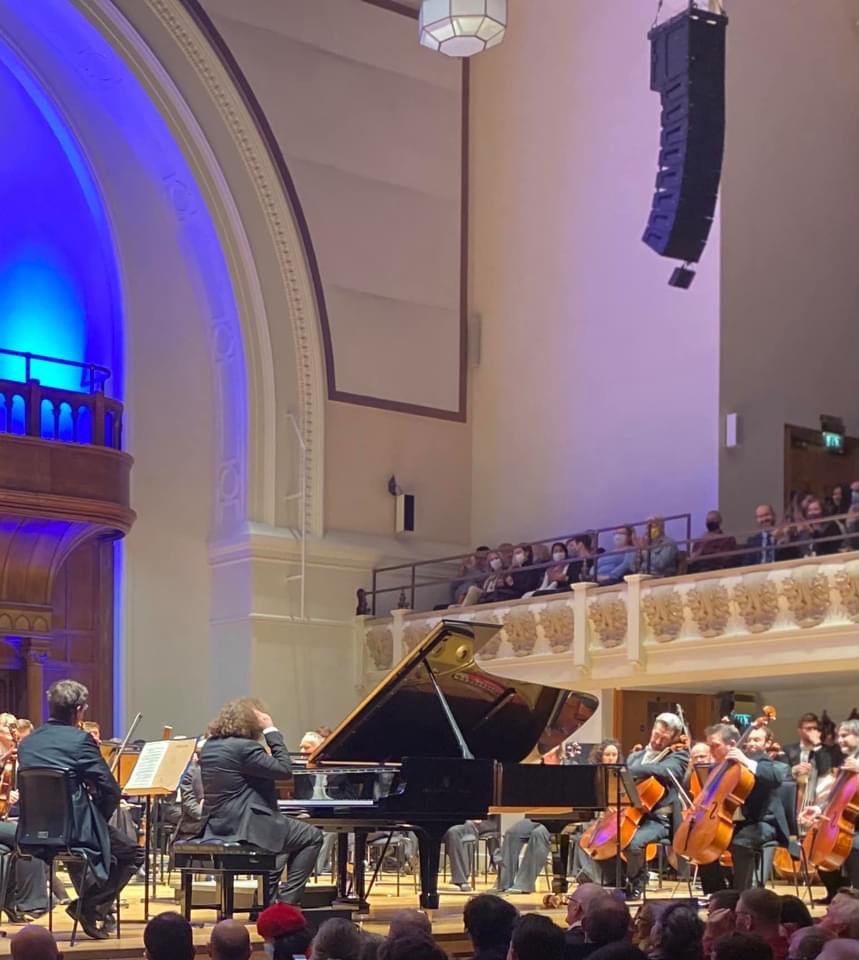
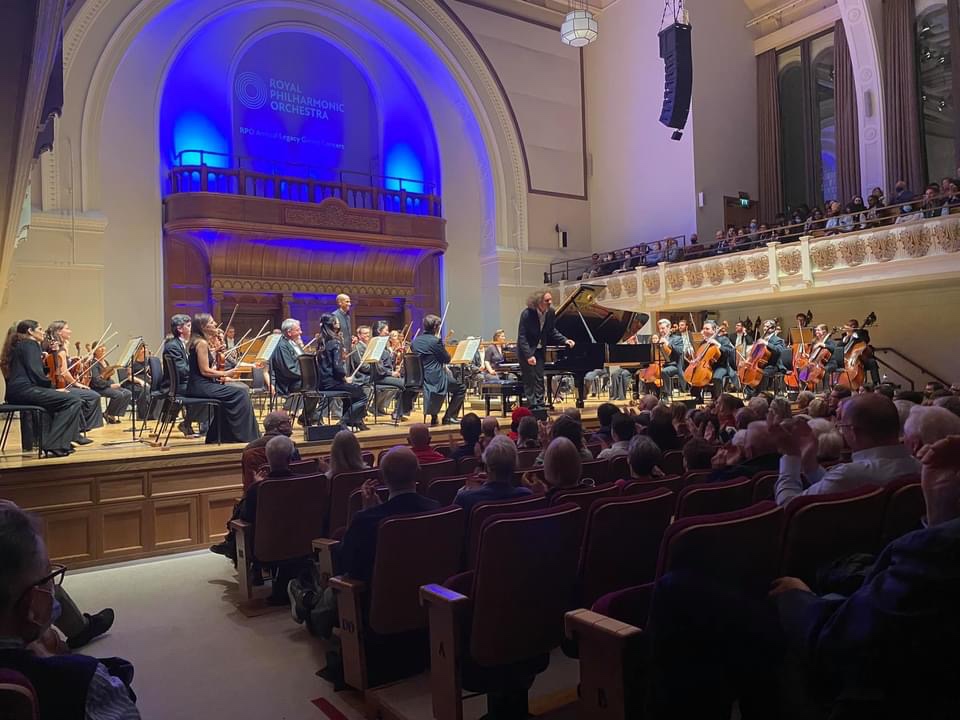
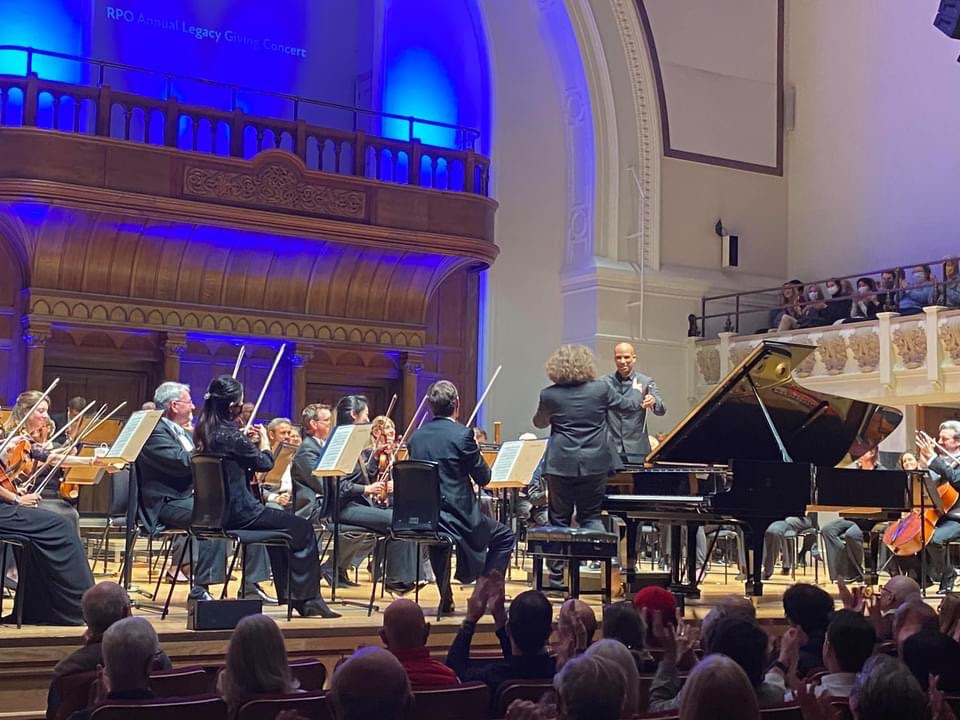
Roman Kosyakov winner of the 2018 Hastings International Piano Competition with the Royal Philharmonic at Cadogan Hall London
The Piano Concerto No. 2 in C minor,op.18, was written between the autumn of 1900 and April 1901 and the second and third movements were first performed with the composer as soloist on 2 December 1900 and the complete work was premiered, again with the composer as soloist, on 9 November 1901,with his cousin Alexander Siloti conducting.At its 1897 premiere, Rachmaninoff’s first symphony considered a significant achievement now,was derided by contemporary critics.Aggravated by problems in his personal life, Rachmaninoff fell into a depression that lasted for several years with only his second piano concerto confirming his recovery having been cured by courses of hypnotherapy and psychotherapy and helped by support from his family and friends. The concerto was dedicated to Nikolai Dahl the physician who had done much to restore Rachmaninoff’s self-confidence.
Roman Kosyakov gave a superb performance of Rachmaninov’s Concerto op 18 to a hall that had been sold out for months.A programme that included the Pastoral Symphony but also a rarely performed work by Samuel Coleridge -Taylor.A very fine German conductor Kevin John Edusei making his debut with the RPO and many other orchestras worldwide as his musical credentials are gradually being discovered.’Praised,repeatedly for the drama and tension that he brings to his music making ,for his clear sense of architecture and attention to detail’ It was exactly this that came across from the very first notes of the Ballade by Coleridge -Taylor.Rhythmic drive combined with sumptuous Philadelphian style sonorities that of course are very much the sound world of the Rachmaninov that was to follow.It was in fact with the Philadelphia orchestra under Stokowski that Rachmaninov recorded his second concerto in 1929.The “Philadelphia Sound” emerged under the leadership of Leopold Stokowski (music director from 1912 to 1938), who discarded a baton and conducted with his enormous, expressive hands. The sound continued to develop under Eugene Ormandy (music director from 1936 to 1980) with balance favouring the bottom voices (bass and cello) adding to the tonal richness and depth. Rachmaninov is said to have composed with the Philadelphia Orchestra’s sound in his mind and there are many original recordings of his works ending in 1941 with their performance of Rachmaninov’s last work the Symphonic Dances .
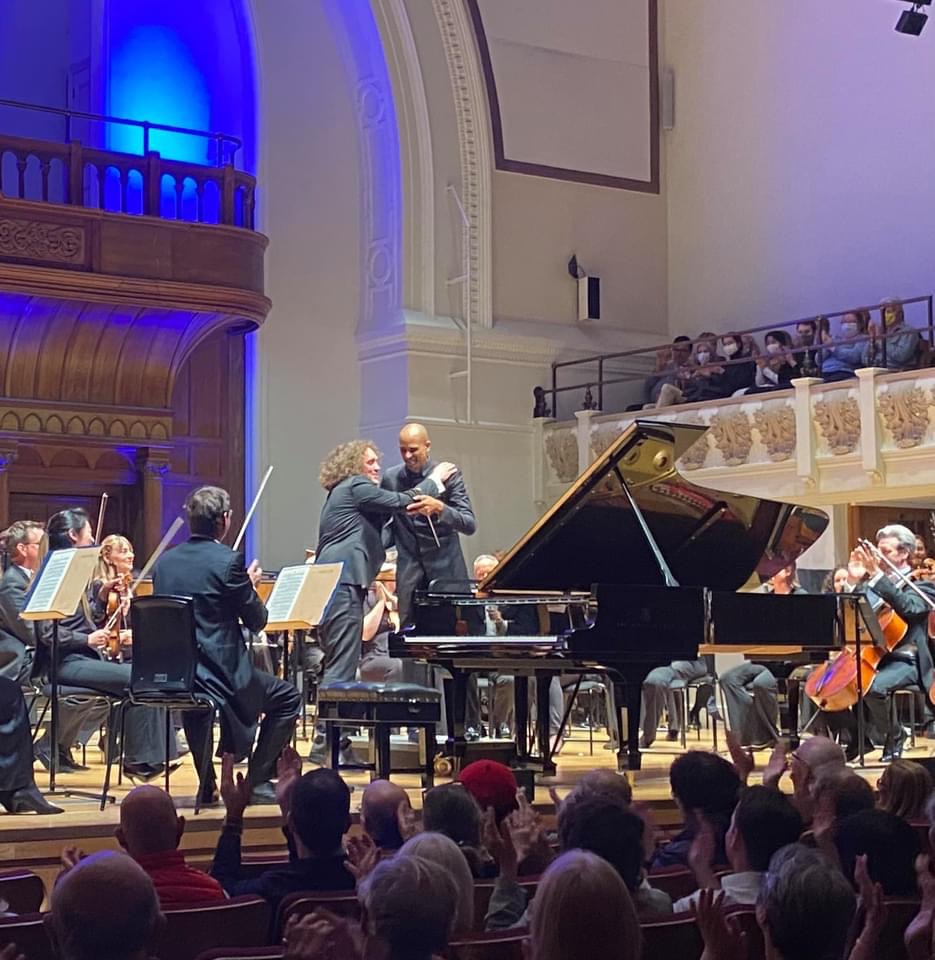
The concerto was played with a sense of line and natural architectural shape as the sweeping romantic sounds carried the music along on a carpet of sumptuous sounds of great power and delicacy .The opening chords had been played by Roman with such aristocratic poise and assurance and the great bass notes allowed to ring out with the sumptuous passionate outpouring on top from the strings.Delicacy too in a slow movement played with disarming simplicity of almost chamber music proportions as the players were listening so attentively to each other and the melodic line was passed from one to another .The opening of the last movement shot out of Roman’s hand like a thunderbolt as the driving rhythms and scintillating cascades of notes led to the final great outpouring of melody of almost Hollywoodian proportions.An exciting race to the final full stop brought the audience to their feet and Roman was persuaded by the orchestra and public to play an solo encore.A charming study by Sibelius of such delicacy and almost Scarlattian precision that we were reminded of the all to distant past visits and the clockwork precision of that other great Russian:Sokolov.His performance tonight has certainly made one aware that in Hastings there is another great piano competition on the horizon to join Leeds.All with ladies at their helm.Fanny Waterman,Imogen Cooper in Leeds and now Vanessa Latarche in Hastings and the indomitable Marcella Crudeli in Rome.
Roman Kosyakov embracing conductor Kevin John Edusei
Samuel Coleridge-Taylor (15 August 1875 – 1 September 1912) was an English composer and conductor achieving such success that he was referred to by white New York musicians as the “African Mahler”when he had three tours of the United States in the early 1900s.He was particularly known for his three cantatas on the epic poem Song of Hiawatha by American poet Longfellow and premiered the first section in 1898, when he was 22.He married an Englishwoman, Jessie Walmisley, and both their children had musical careers.Their son Hiawatha adapted his father’s music for a variety of performances whilst their daughter Avril became a composer-conductor.Coleridge-Taylor was brought up in Croydon where there were numerous musicians on his mother’s side and her father played the violin. He studied at the Royal College of Music from the age of 15 changing from violin to composition, working under professor Charles Villiers Stanford .After completing his degree, Taylor became a professional musician, soon being appointed a professor at the Crystal Palace School of Music and conducting the orchestra at the Croydon Conservatoire.He used the name “Samuel Coleridge-Taylor”, with a hyphen, said to be following a printer’s typographical error.
The Ballade is a fascinating piece rarely if ever heard in concert.It was commissioned for the Three Choirs Festival sometime around April 1898 at the suggestion of Edward Elgar (who was approached by them with a commission April 17 1898, and suggested Coleridge-Taylor instead – “I am sorry I am too busy to do so. I wish, wish, wish you would ask Coleridge-Taylor to do it. He still wants recognition, and he is far and away the cleverest fellow going amongst the young men.” A bold choice for a conductor making his debut in London.But played with such drive and colour it immediately became apparent the extraordinary clarity and communication that he was able to achieve from the very first notes.The Pastoral Symphony too had such clarity and architectural shape but at the same time a precision and delicacy that was so obviously greatly appreciated by an orchestra who played for him with such sumptuous sounds and a sense of balance that is the legacy of the great German school of Jochum or Klemperer.
The Hastings International Piano Concerto Competition is an internationally renowned biennial competition for young concert pianists from around the world, attracting 170 applicants in 2019 from across the globe, 40 of which came to compete in Hastings during February and March. Their prize: the opportunity to perform with the Royal Philharmonic Orchestra on a two-night final and to win a first prize of £15,000 and concert engagements across the UK and overseas.The next competition dates are now confirmed to be the 24th February – 5th March 2022 with successful entrants being selected from video auditions by a panel appointed by our President of the Jury Professor Vanessa Latarche, who is Head of Keyboard at The Royal College of Music in London .Professor Latarche joined the competition team last year to curate the competition, which was rescheduled to 2022, because of the White Rock’s closure. Professor Latarche will oversee record numbers of entrants through the audition process, as well as presiding over the esteemed international jury, who she has invited to join her in Hastings next summer.
The 2018 Hastings International Piano Concerto Competition winner Roman Kosyakov was born in a musical family and made his debut with an orchestra at the age of 12 with the Mozart Concerto No 23 in A Major. In 2012, he graduated from the Central Music School in Moscow where he studied with F.I. Nurizade and then in 2017 from the Tchaikovsky Moscow Conservatory with V. Ovchinnikov. Since September 2017, he has studied at the Royal Birmingham Conservatoire on a full scholarship with P. Nemirovski.He is a laureate and a winner of many national and international competitions, among them “Young Talents of Russia” (Russia, Moscow 2006), the 1st International competition “Sforzando” (1st Prize, Berlin, 2007), the International Alexander Scriabin Piano Competition (1st Prize, Paris 2011), the 8th Open Competition of Musicians Performers N. Savita (1st Prize, Russia, Ufa, 2012), the International Piano Competition “Minsk-2014” (2nd Prize, Republic of Belarus, Minsk, 2014), the 4th International Piano Competition “ Russian season in Ekaterinburg “ (1st Prize, Russia, Ekaterinburg, 2015), the 4th International Piano Competition “Vera Lotar-Shevchenko” (2nd Prize, Russia, Ekaterinburg, 2016), the 4th Prize of the 1st Saint-Priest International Piano Competition Saint-Priest (Lyon-France, 2017), the Gold award for the 3rd Manhattan International Music Competition ( 2018 ) and 1st Prize and the Audience prize for 10th Sheepdrove Piano Competition ( 2018, UK). He is regularly invited to give concerts in France, Italy, Germany, Republic of Belarus, Russia, UK, USA, and was guest soloist from 2014 to 2017 at the Kemerovsky State Symphony Orchestra.
This was the original programme : F. Schubert / F. Liszt: Wanderer-Fantasie, versione per pianoforte e archi (arr. I Massun) F. Liszt: Malédiction per archi e pianoforte G. Mahler: Adagietto dalla Sinfonia n. 5 in do diesis minore A. Copland: Concerto per clarinetto e archi Maurizio D’Alessandro, clarinetto Francesco Navelli, pianoforte Roma Tre Orchestra Sieva Borzak, direttore
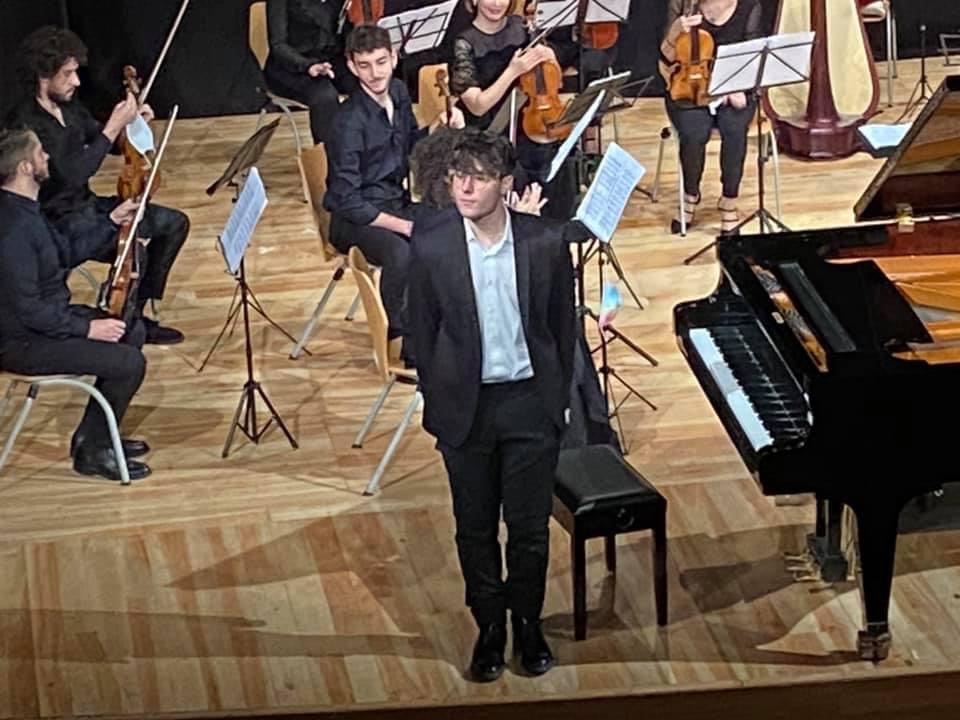
Francesco Navelli a star shining brightly at Teatro Palladium
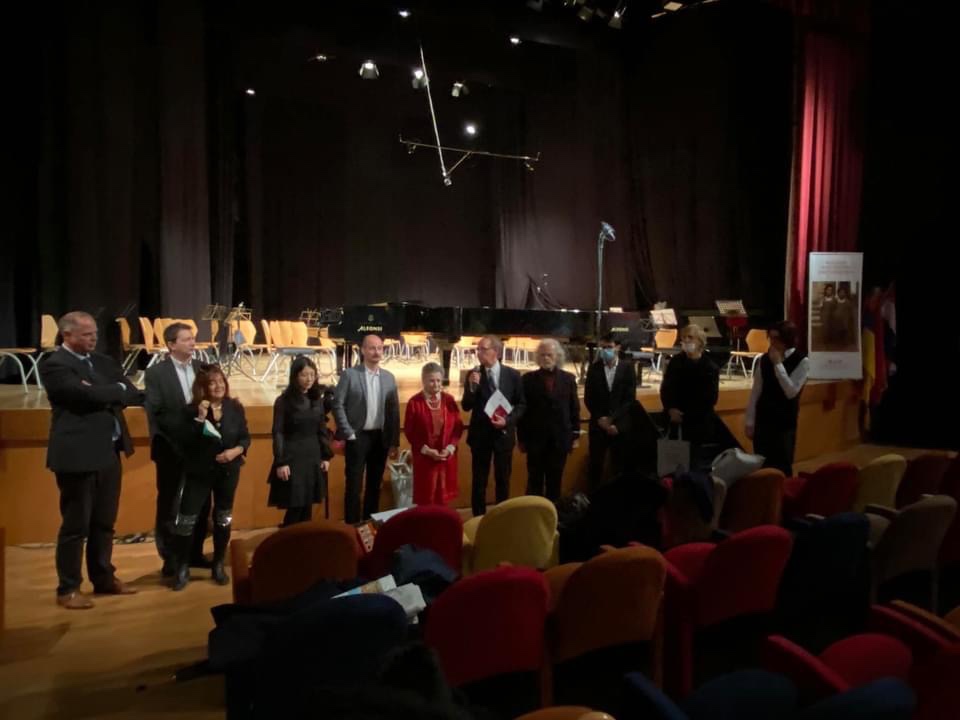
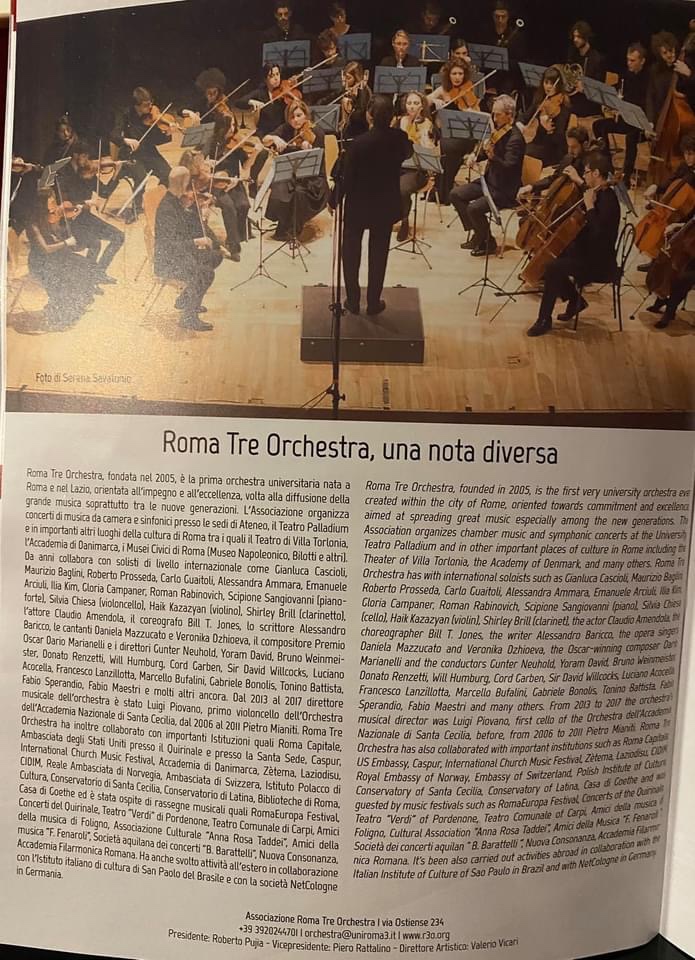
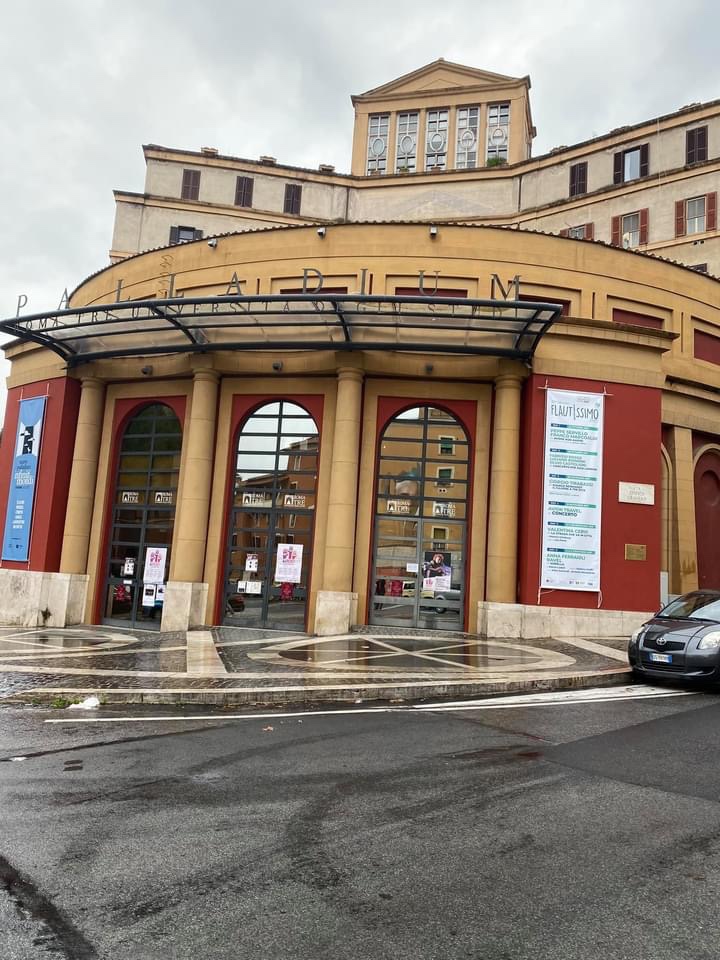
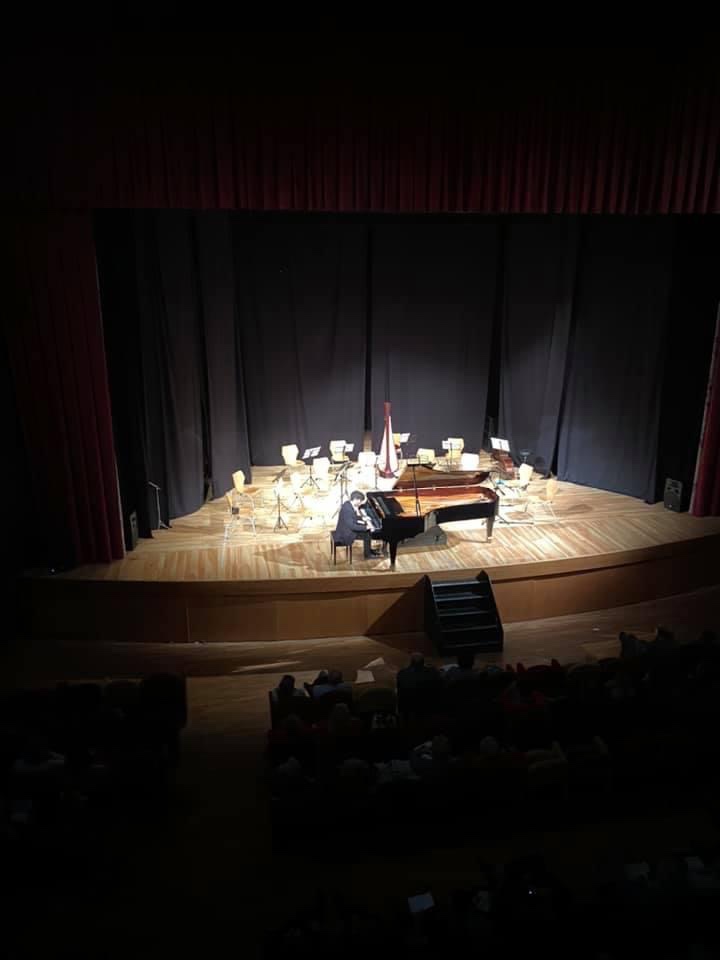
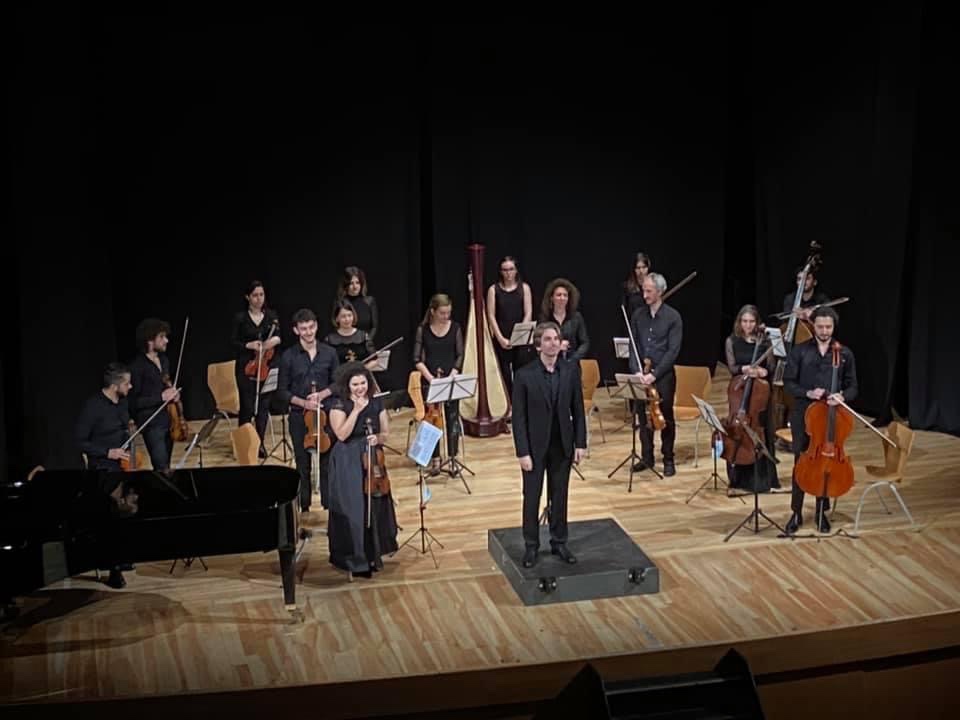
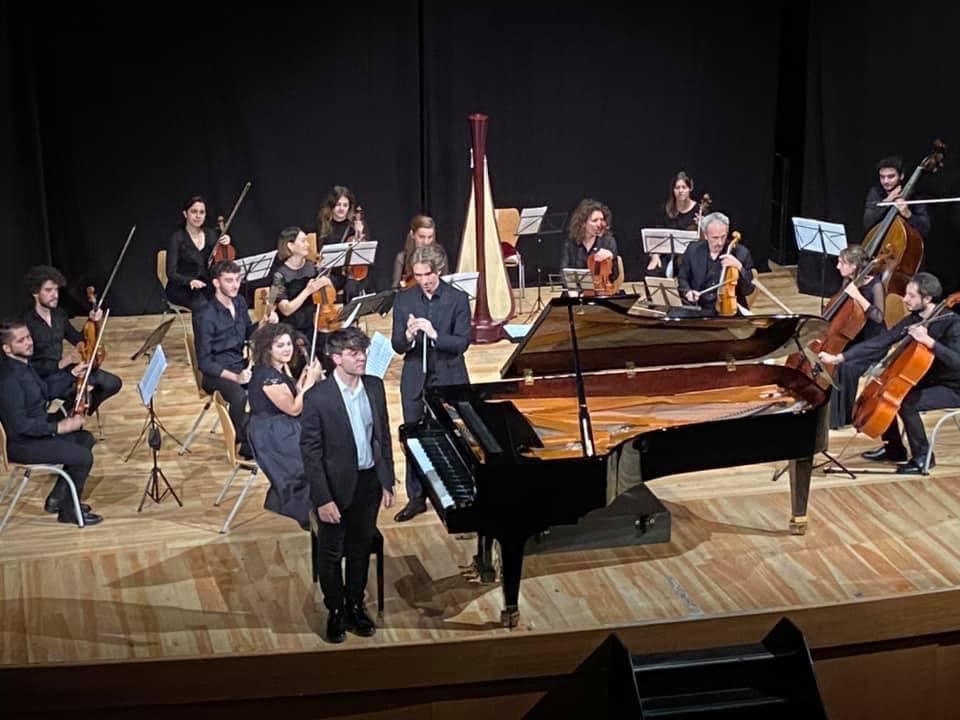
Roma 3 orchestra playing at home in their own Teatro Palladium in Rome after a brief tournée around Rome including an appearance at the Liszt Festival in Albano Laziale.A superb young pianist Francesco Navelli from the class of Magarius in Imola astonished ravished and seduced us with his total command of Liszt’s rarely heard Malédiction for piano and string orchestra.
On the programme was to have been an arrangement for string orchestra of Liszt’s also rarely performed transcription of the Wanderer Fantasie by Schubert. The ink was not yet dry on the page of this newly commissioned reduction for string orchestra (where Liszt had envisaged larger forces) so our valiant pianist stepped in performing the original by Schubert.
All’s well that ends well as they say and we were treated to a masterly performance of intelligence,rhythmic drive and enviable technical command.
Francesco Navelli’s monumental solo performance of Liszt’s much loved Schubert Fantasie
Followed by the famous Adagietto from Mahler’s fifth symphony played with subtle artistry guided by the sensitive hands of Sieva Borzak.
Sieva Borzak instilling artistry and poetry into his young colleagues performance of Mahler
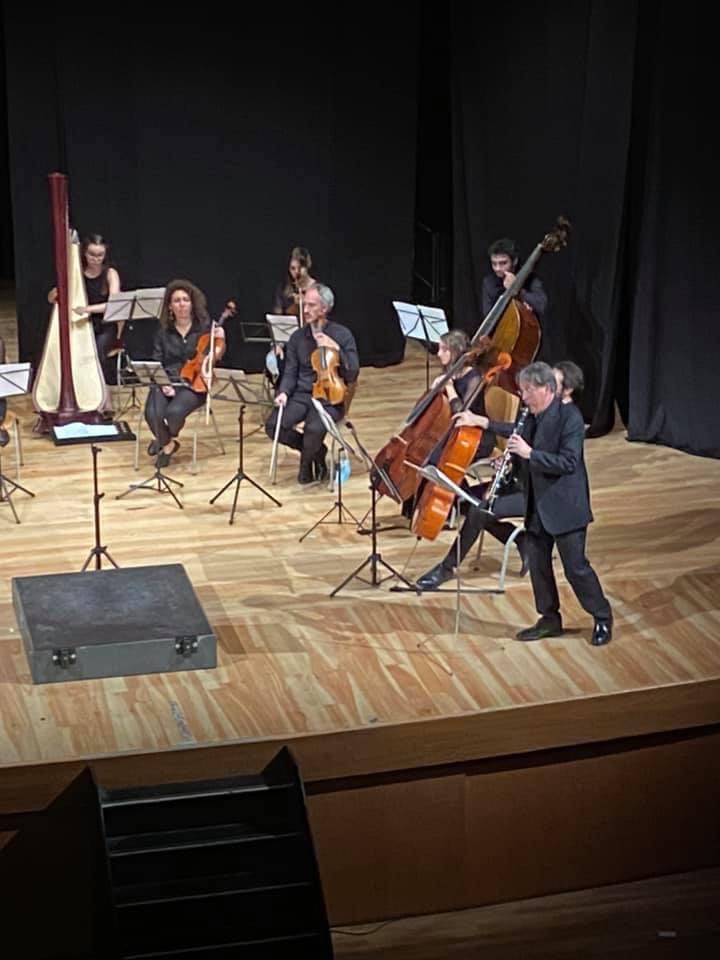
They were joined by Maurizio D’Alessandro for a superb performance of Copland’s Clarinet Concerto written in 1947 for Benny Goodman.
Maurizio D’Alessandro in a heart rending duet with the orchestra harpist .
By great request Francesco Navelli had played an encore of Scarlatti but it was Maurizio D’Alessandro who had seduced us with a ravishing duet with the orchestral harpist in a transcription of Puccini’s much loved :’O mio babino caro’
Francesco Navelli’s superb performance of Liszt with Roma 3 Orchestra under Sieva Borzak
It is to Leslie Howard that we turn to learn more about these rarely performed works of Liszt:’We do not know if Liszt ever heard his Concerto for Piano and Strings—the so-called Malédiction—even in rehearsal, and yet, on the evidence of surviving manuscripts, he spent some time over a period of years preparing the work . (A large manuscript of an earlier fragment for piano and strings containing some material in common with the final score is held at the Goethe-Schiller Archive in Weimar.) Nor do we know why he wrote on this occasion for strings only, since all his other works with solo piano of the same period, whether performed, published, completed or not, are all for symphony orchestra including trombones and percussion. This powerful single-movement piece is among Liszt’s earliest efforts at finding a way forward for the sonata principle; although its outlines conform to the general pattern of exposition (with the obligatory second subject and codetta), development and recapitulation, its narrative is susceptible to almost operatic changes of scene, mood and tempo’The opening motif is just this motif which Liszt labels ‘Malédiction’, rather than the whole score, which he left untitled.The strings first accompany this menacing theme with quiet trills, and next build a sinuous chromatic line around it. The opening motif generates the livelier transition material, the last much calmer section of which Liszt marked ‘Pleurs, angoisse’ (‘Tears, anguish’). A Recitativo introduced by piano and cello brings us to the second theme proper, in the traditional relative major, and to material which Liszt would recall in as late a work as the Valse oubliée No 3 of 1883. The recitative is fully incorporated into this theme before the livelier tempo Vivo is reached—effectively the codetta, which Liszt marks ‘Raillerie’—and a full close in G major is reached. The cello motif is incorporated into the first thematic group before a further increase in tempo brings the second subject material, transformed anon into the coda, with just a brief recall of the first theme in the last four bars.’
Indebted again to Leslie Howard :’Franz Schubert: Grosse Fantasie opus 15—symphonisch bearbeitet für Piano und Orchester—Liszt’s beloved ‘Wanderer’ Fantasy in his transcription which was for many years extremely popular. (I remember famous recordings of Clifford Curzon and Claudio Arrau).Apart from the tiny cadenza which forms the transition to the E flat section of the first movement, Liszt adheres scrupulously to Schubert’s work, very rarely allowing himself very much in the way of decoration.
Maurizio D’Alessandro in Copland’s concerto for clarinet,strings and harp
In 1947 clarinetist Benny Goodman commissioned Copland to write a concerto for clarinet: “I made no demands on what Copland should write. He had completely free rein, except that I should have a two-year exclusivity on playing the work. I paid two thousand dollars and that’s real money. At the time there were not too many American composers to pick from… We never had much trouble except for a little fracas about the spot before the cadenza where he had written a repetition of some phrase. I was a little sticky about leaving it out—it was where the viola was the echo to give the clarinet a cue. But I think Aaron finally did leave it out… Aaron and I played the concerto quite a few times with him conducting, and we made two recordings”While lecturing and conducting in Rio de Janeiro Copland made many drafts of the concerto. On August 26, 1948, he wrote that the concerto was still “dribbling along” and a month later, he wrote in a letter that the piece was almost done and in December 6, 1948, he wrote to composer Carlos Chavez that he had completed the composition and was pleased with the result.Benny Goodman premiered the concerto on an NBC radio broadcast with the conducted by Fritz Reiner on November 6, 1950.The concerto was later choreographed by Jerome Robbins for the ballet Pied Piper (1951).
Francesco Maria Navelli
Francesco Maria Navelli was born in 2003, he soon began studying the piano with Maestro Massimo Bertucci. He immediately established himself in several national and international competitions, including: 1st prize at the International Competition “Leopoldo Mugnone” city of Caserta, International Competition “Paola Galdi” of Vietri sul Mare, 1st prize at the “Napolinova” Piano Competition, 6th International Competition “Youth Academy Award 2016” city of Rome, 1st prize at the “Bach” Competition in Sestri Levante, 1st prize in both its category and up to 17 years at the “Città di Airola” International Performance Competition , 1st absolute prize and best performer prize of the entire Competition, at the 4th European Competition of musical performance “Jacopo Napoli” of Cava de ‘Tirreni. He recently won the 1st prize at the International Music Competition city of Nocera, section “Piano Execution”, without age limit and 3rd prize at the 21st International Competition “Pietro Argento” of Gioia del Colle, Section “Piano Execution (without age limit) also winning the” Best Italian Finalist “Award. At the age of 16, he won the third prize at the 29th International Competition for Piano and Orchestra Città di Cantù, reaching the final as the only Italian of the two sections: classical and romantic.At the age of 13 he entered, after hard selection, at the International Piano Academy “Incontri col Maestro” in Imola, where he still studies with Maestro Leonid Margarius. He participated in the Masters held by Alexander Romanovsky, Alexia Mouza., Ruben Talon, Antonio Pompa Baldi. Invited by various associations to hold recitals in various cities of Italy:, Verbania, Naples, Venice, Imola and abroad, Madrid and Leon in Spain. Participate in Piano City Naples and Milan 2018 edition, enjoying huge success. Invited by the Milan Quartet Society, in June he performed in the Sala Puccini of the “G. Verdi” Conservatory of Milan. In July he participated in the “Concerts on the terrace” organized by the San Carlo Theater in Naples and in August he made his debut as a soloist at the 34th Tagliacozzo Festival with the State Orchestra of Georgia, performing Concerto No. 3 for piano and orchestra of LV Beethoven. In September 2018 he received a three-year scholarship, one of the best talents of the Piano Academy, from the Imola Academy in collaboration with the Rotary Club of Imola. In addition to solo activity, he also works in the chamber, playing with his brother in a Violin-Piano duo, winning prizes in various competitions, gaining huge critical and public success.
Francesco Maria Navelli Nato nel 2003, Inizia prestissimo lo studio del pianoforte col M° Massimo Bertucci.Si afferma subito in diversi concorsi nazionali ed internazionali, tra questi: 1° premio al Concorso Internazionale “Leopoldo Mugnone” città di Caserta, Concorso Internazionale “Paola Galdi” di Vietri sul Mare, 1° premio al Concorso pianistico “Napolinova”, 6° Concorso Internazionale “Premio Accademia Giovani 2016” città di Roma, 1° premio al Concorso “Bach” di Sestri Levante, 1° premio assoluto sia nella sua categoria che in quella fino a 17 anni al Concorso Internazionale di Esecuzione Musicale “Città di Airola”, 1° premio assoluto e premio miglior esecutore di tutto il Concorso, al IV Concorso Europeo di esecuzione musicale “Jacopo Napoli” di Cava de’ Tirreni. Ha recentemente vinto il 1° premio al Concorso Internazionale Musicale città di Nocera, sezione “Esecuzione Pianistica”, senza limite di età e 3° premio al 21° Concorso Internazionale “Pietro Argento” di Gioia del Colle, Sez. “Esecuzione Pianistica (senza limite d’età) vincendo anche il Premio “ Miglior Finalista Italiano”.A soli 16 anni, vince il terzo premio al 29* Concorso Internazionale per Pianoforte e Orchestra Città di Cantù, giungendo in finale come unico italiano delle due sezioni: classica e romantica.All’età di 13 anni entra, dopo dura selezione, all’Accademia Pianistica Internazionale “Incontri col Maestro” di Imola, dove studia tuttora col M° Leonid Margarius. Ha partecipato ai Master tenuti dai Maestri Alexander Romanovsky , Alexia Mouza., Ruben Talon, Antonio Pompa Baldi. Invitato da diverse associazioni a tenere recitals in varie città d’Italia: , Verbania, Napoli, Venezia, Imola e all’estero, Madrid e Leon in Spagna.Partecipa a Piano City Napoli e Milano edizione 2018, riscuotendo enorme successo. Invitato dalla Società del Quartetto di Milano, a giugno si è esibito nella Sala Puccini del Conservatorio “G.Verdi” di Milano. A luglio ha partecipato alla rassegna “Concerti in terrazza” organizzato dal Teatro San Carlo di Napoli e In agosto ha debuttato come solista,, al 34° Festival di Tagliacozzo, con l’orchestra di Stato della Georgia , eseguendo il Concerto N. 3 per pianoforte e orchestra di L.V. Beethoven.Nel mese di Settembre 2018 ha ricevuto dall’Accademia di Imola in collaborazione col Rotary Club di Imola, una borsa di studio, della durata di 3 anni, come uno dei migliori talenti dell’Accademia Pianistica.All’attività solistica affianca anche quella da camera, suonando con suo fratello in duo Violino-Pianoforte, premiati in diversi concorsi, riscuotendo enorme successo di critica e di pubblico.
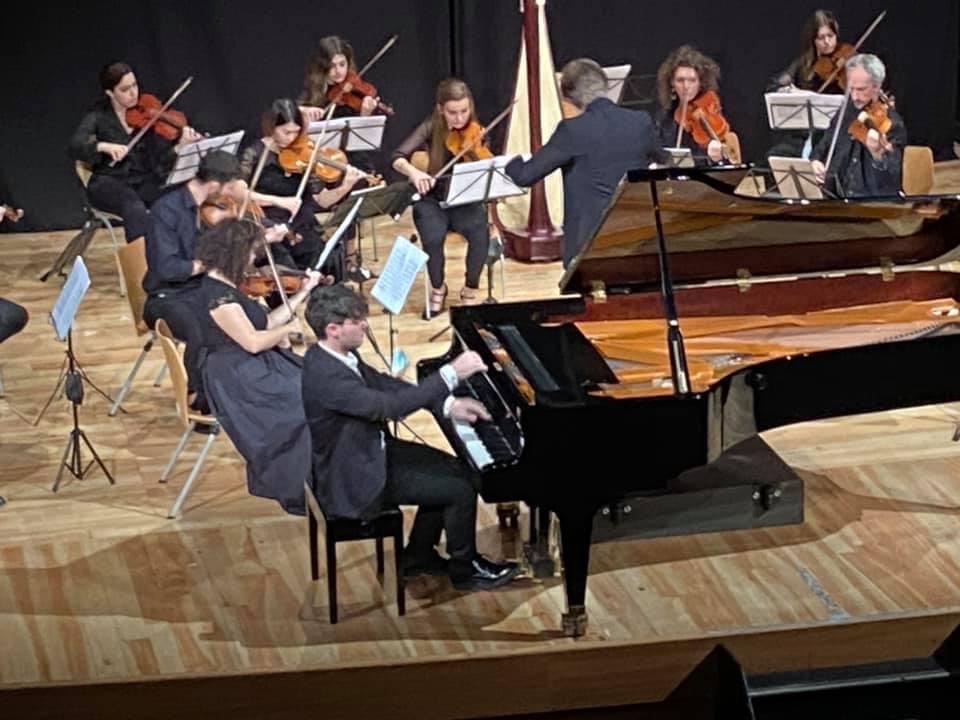
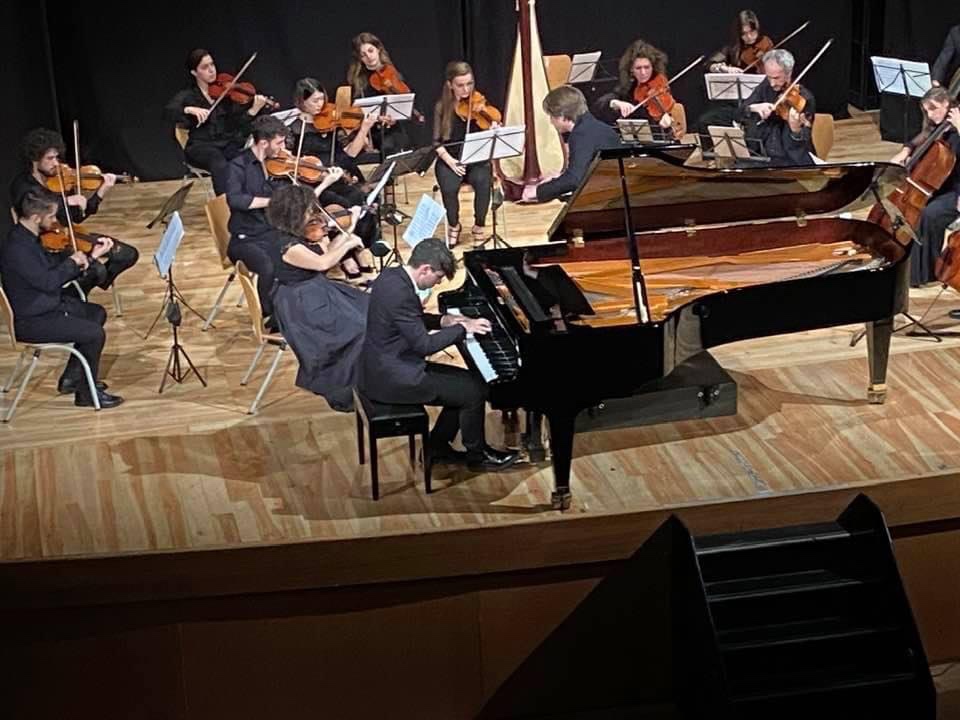
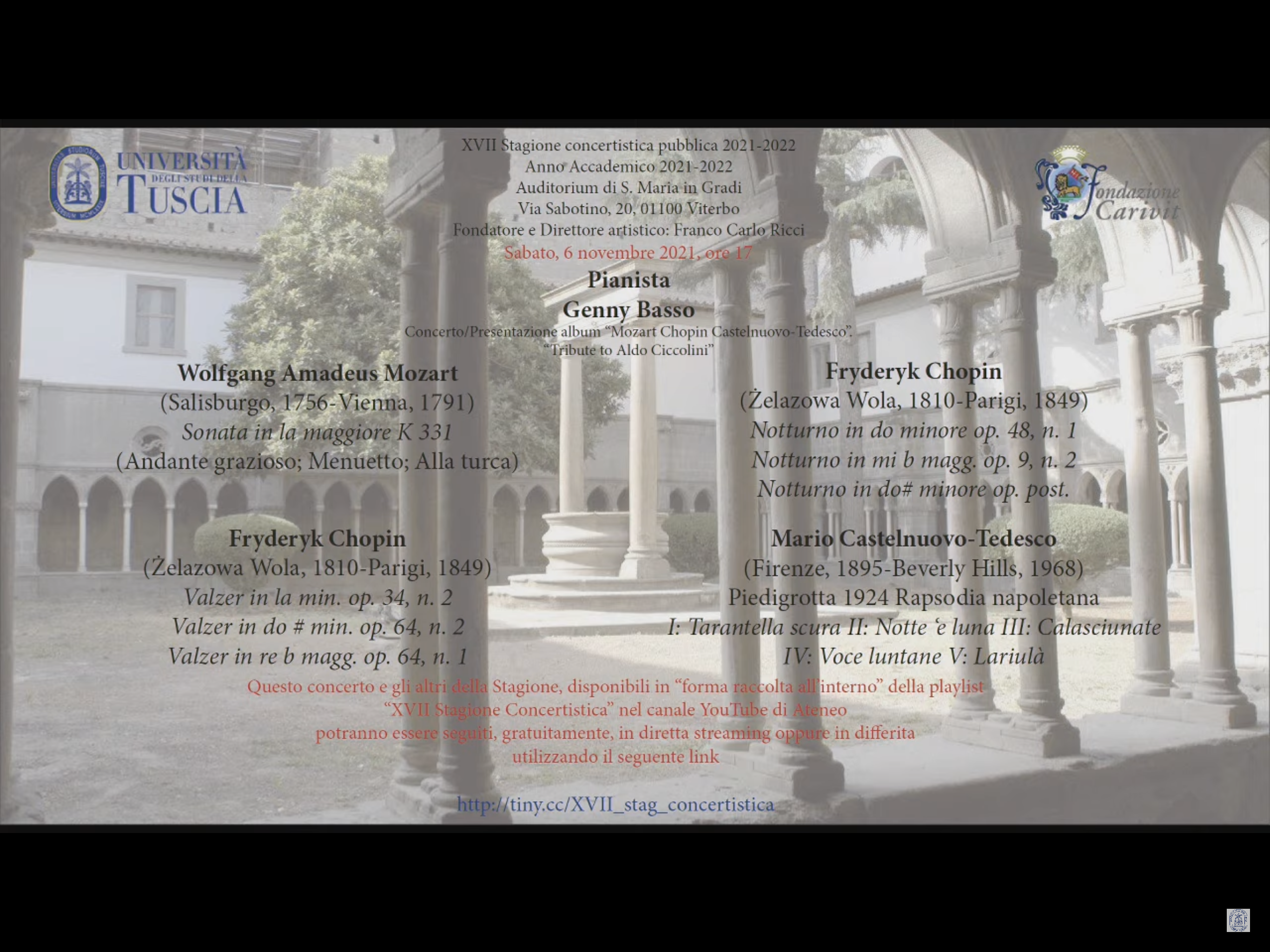
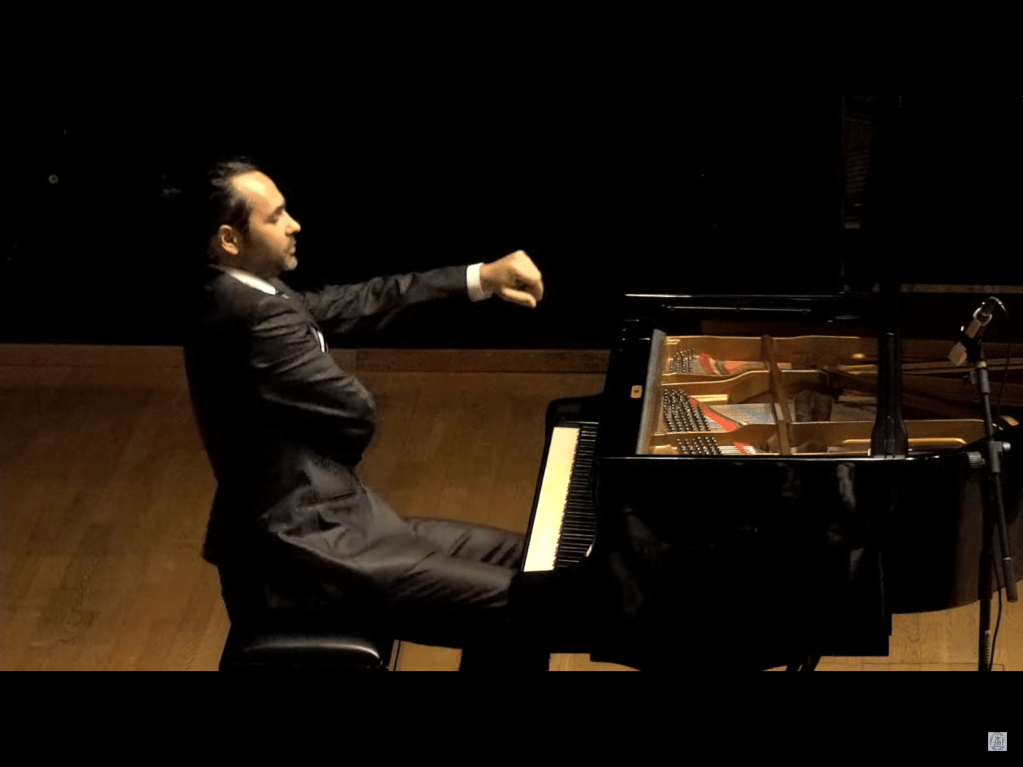
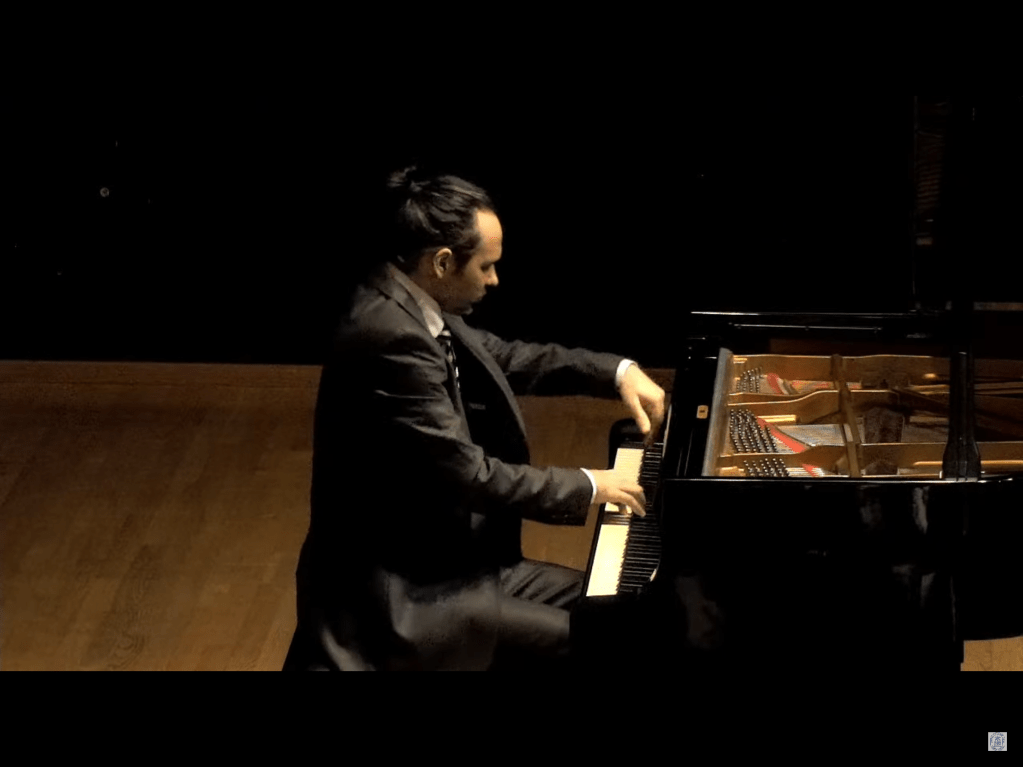
Some very fine playing from Genny Basso paying homage to his teacher Aldo Ciccolini in a presentation concert of his CD ‘Tribute to Aldo Ciccolini Mozart-Chopin-Castelnuovo Tedesco’ relayed live from Viterbo University. Mozart Sonata in A K 331 was played with great style and ravishing tone.A simplicity but of great character,from the opening variations played with great beauty and sense of architectural shape. A contrasting Menuetto played with imposing authority before the beguiling Alla turca played at a very deliberate tempo that was superbly maintained with irresistible charm and grace.
The sombre Waltz in A minor op 34 was played with a flexibility and subtle sense of rubato and the waltz in C sharp minor was played with a restrained elegance and a gradual accelerando that was quite captivating.After these two waltzes played with such aristocratic charm and grace the famous minute waltz did not quite capture the same flights of fancy and sounded a little grounded in comparison.
The three nocturnes were played with ravishing sound and great sense of style as you would expect from a pianist who had been for many years assistant to Aldo Ciccolini in Paris.From the aristocratic control of op 48 n.1 with a noble Lento was gradually trasformed into a deeply expressive Poco più lento choral in a gradual build up of sonority.Exploding into the passionate doppio movimento played with a sense of balance that allowed the melodic line to shine above the agitato accompaniment.The famous E flat nocturne was played with a disarming simplicity and aristocratic sense of rubato.The C sharp minor nocturne was played with a radiance and simplicity that was magical.
The Pedigrotta 1924 Rapsodia Napoletana by Mario Castelnuovo Tedesco opened up a world of colour and fantasy played by a pianist who had graduated from Naples Conservatory under Luigi Averna of the school of Arturo Benedetti Michelangeli.Later studying with Paul Blacher at the Ecole Normale de Musique a Paris and becoming the official assistant to Aldo Ciccolini in his International Piano Masterclasses in Paris. An encore of his own very atmospheric revisitation of the famous Neapolitan song by Denza’ Funiculi,Funiculà’ brought this very enjoyable recital to a festive conclusion by a Neapolitan artist of great style and integrity.
Genny Basso è un pianista nato a Napoli nel 1984. Il celebre Maestro Aldo Ciccolini, con cui ha vissuto per alcuni anni a Parigi diventandone l’assistente ufficiale nelle Masterclass internazionali di pianoforte, nel 2014 lo ha definito “una splendida promessa del concertismo internazionale […], un vero artista, dotato di una seducente musicalità e di un’impareggiabile preparazione pianistica”. Oggi la sua attività concertistica lo vede esibirsi in teatri e festival internazionali, come presso la Salle Gaveau di Parigi, il Teatro San Carlo di Napoli, l’”Hideyo Noguchi Memorial Fukushima International Music Festival”, il “Festival de Piano Rafael Orozco” a Cordoba, al “Bosa Musica Festival” in un concerto a due pianoforti con Aldo Ciccolini, il “Noli Musica Festival”, in Vaticano nella “Sala Accademica dell’Istituto Pontificio di Musica Sacra”, il Teatro Diana di Napoli, il Piano Salon Christophori di Berlino.Si avvicina alla musica in età precocissima e dopo esperienze formative in Irlanda e in Inghilterra si affida al Maestro Luigi Averna – che vanta una discendenza con la scuola di Arturo Benedetti Michelangeli – con cui consegue la laurea in pianoforte cum laude presso il Conservatorio S. Pietro a Majella di Napoli. Nel 2013 è ammesso a frequentare nella classe di Paul Blacher – erede didattico di France Clidat – l’ultimo anno dell’École Normale de Musique de Paris.Nel 2021 esordisce nel mondo discografico con l’album dal titolo “Mozart Chopin Castelnuovo-Tedesco”, pubblicato dall’etichetta tedesca ARS Produktion, recensito positivamente da riviste del calibro di Pizzicato e Phono Forum e con cui ottiene una nomination come “Young Artist of the Year” dall’Opus Klassik 2021 (Berlino). È invitato come membro della giuria di concorsi internazionali e nel 2017 è stato il Presidente della giuria del Beethoven International Piano Competition ASIA, in Giappone.Da sempre sensibile alla diffusione della musica classica in particolare tra i più giovani, è co-fondatore del canale Twitch “LaMusicaClassica”, attivo da gennaio 2021 e che già vanta la presenza di ospiti d’eccezione, tra cui il celebre violinista Uto Ughi.
‘God’ Bach/Gounod: Ave Maria Bach: Jesu Joy of Man’s Desiring Liszt: In festo transfigurationis Domini nostri Jesu Christi Liszt : Benediction de Dieu dans la solitude
‘Pray ‘. Franck: Prelude Chorale and Fugue
‘Love’ Liszt : Cantique d ‘ amour Bach/Naoumoff: ‘Aus Liebe Will Mein Heiland Sterben’ from St. Matthew ‘ s Passion Bach/Petri: ‘Sheep May Safely Graze’ Bach: Prelude in C BWV 846
He was with his mentor Julia Mustonen from the Ingesund School of music in Sweden and they suggested that I might like to hear his graduation recital in London at Milton Court/ Guildhall (where he has now been made a fellow).His performance of the ‘Hammerklavier’ at 10 am was quite astounding and I just wondered if the handful of people present -the adjudicators and a handful of friends -realised just what a phenomenal performance we had heard.His second half of Rachmaninov and Liszt was equally enthralling but it was his intellectual understanding of Beethoven allied to a transcendental command of the piano that was totally overwhelming.
I immediately contacted Dr Hugh Mather to suggest that he offer an engagement to this exceptionally talented young man who should be heard by a wider audience in London.The ever generous and enthusiastic Hugh offered him a slot that had by chance become available in his already over full season of young musicians.The concert today was what we were treated to.
It was with the arrival of Sviatoslav Richter in the west that we understood what Emil Gilels had meant when had exclaimed to an incredulous public ‘If you think I am good wait and see who comes after me!’Well, if someone like Gilels could have the humility to bow to genius I hope none of the very fine musicians who it has been my privilege to listen to over the years will understand when I say that Kajeng’s recital today was one of the greatest recitals that I have ever heard .One of the most moving experiences since listening to Richter himself play the Franck Prelude ,Choral and Fugue in the Festival hall in a programme that had included the Liszt B minor sonata .
Richter had refused to see anyone after the concert as he had not been happy with his performance of the B minor Sonata .Striving for perfection can be very difficult to live with and Richter was a tormented soul who shared his genius so generously but not without a great deal of suffering.His Cesar Franck had though reached the heights that we were treated to today by this young musician who has suddenly appeared on the scene thanks to Dr Mather and his enthusiastic team of retired professionals.
KaJeng had found a link that joined all the nine works in the programme starting and ending with the simple genius of Bach used by Gounod as the accompaniment to his ‘Ave Maria’ and after a kaleidoscopic outpouring of emotions ending with the sublime purity of the original Prelude n.1 in C .
This may be the right moment to quote Kajeng’s own words:’
In the first part, ‘God’. Began with Ave Maria (C major) and went into Jesu Joy of Man’s of desiring (G major/dominant of C) as Christ first came to earth. Then the third piece transcended from the C major/G major into the F-sharp, which is the key of the spiritual in Liszt’s music, and thus the Benediction that follows.At the very end the prelude in C returns. This time without the melody of the Ave Maria.So my point of this concert, is that after the story and teachings of Christianity, at the end of the journey, the ‘melody’ or the ‘thought’ of God’s grace no longer needed to be heard. It’s already ‘inside’ us. Spirituality is just something that attracts me. And I think it doesn’t take a Christian man to be holy/seeking’
The title of GOD- PRAY- LOVE was the name given to this most moving recital.Immediately from the very opening notes there was a liquidity of sound like water flowing gently where the melodic line was literally allowed to float on a sea of wondrous sounds.It was played with such a subtle flexibility of sound and colour that one could only marvel at Kajeng’s sense of control,balance and mastery of the pedal.All at the command of his superb musicianship and sense of architectural shape.Hardly moving his hands as they just hovered over the keys seminating golden sounds that were so exquisite that I wondered if this was the same piano that we are used to hearing so often at St Mary’s.This led straight into Jesu Joy or perhaps I should say floated in as the tenor melody was revealed amidst all the intricate weaving of knotty twine from which this glorious choral extricates itself in the famous transcription of Myra Hess.She of course had studied with Uncle Tobbs who had imparted all the secrets of the Matthay school to her and Moura Lympany.Imploring them to search for a microscopic sense of touch and balance where the beauty of sound was not disrupted by a battleground of unprotected projection!The treble voice sang out in Kajeng’s sensitive hands whilst there was an imperceptible build up of sonority equally disappearing just like an apparition of the miracles that were being created.
This in turn led without a break into the Liszt ‘In festa transfigurationis……’As Arthur Friedheim (1859-1932) a pupil of Liszt wrote:’Everything that was religious ,or that had the sound of worldly religion or that related to the Church,was transmuted by Liszt in the realm of mysticism.’Liszt composed this unusual and hypnotic piece in 1880.Starting from the depths of the keyboard it moves upwards to end with angelic chords in the high treble.It is typical of many of Liszt’s later works that expresses profound things with a minimum of notes.Leading so naturally into the flowing delicacy of ‘Benediction de Dieu dans la solitude’ from Liszt’s Harmonies poétiques et Religieuses It was played with such extraordinary artistry and real sentiment with a gradual release of sound as it built up to an overwhelming climax of aristocratic passion.Dying away to a mere whisper before the sudden ray of sunlight with the disarming simplicity of the Andante.It was played with a subtle change of colour with such poetry and a truly magical use of pedal.The più sostenuto quasi Preludio was like a prayer of thanksgiving with a continuous flow of mellifluous sounds .His hands did not seem to move as they communed with the keys in a final prayer at the ritenuto ad libitum.The andante reappearing like an apparition as sublime peace was created with three ever more poignant chords.I imagine that this combination might have been suggested to Kajeng by the noted Liszt expert Leslie Howard to whom I had suggested Kajeng visit to talk about the vast piano repertoire choices and in particular the lesser known works of Liszt.
What better prayer could there be than Franck’s Prelude,Choral and Fugue?With the prelude just floating on the keys as I remember Richter had seduced us with all those years ago.There was the same legato and luminosity that did not allow any percussive element even in the most fervent passionate outpourings.There was passionate declamation too – a capriccio- a momentary interruption and deep declaration of faith.And what significance and poignancy he brought to the deep bass notes that opened up a flood of marvellous sounds that led immediately into the Choral.Here there was magic in the air as the harp like chords were played with a luminosity and variety of sounds of such a sublime beauty that I had not even heard from Richter!He had,though,the same fervent overwhelming conviction that was every bit as breathtaking only defused by the opening statement of the Fugue.Such clarity with an unrelenting forward movement and passionate abandon of aristocratic poise.Cortot ‘s own words are the best to describe Kajeng’s miraculous performance: ‘it should appear like an almost supernatural emanation from a halo of celestial vibrations -Le motif du Choral,accompagné ici d’un ingénieux emprunt à la figuration initiale du Prélude ,doit se faire jour d’une manière quasi surnaturelle,et comme s’il émanait subitemant d’un halo de vibrations célestes’A burst of passionate fire ‘a tempo vivo’ where even the final great full stop was played with such significance.A quite overwhelming performance and unforgettable experience.
In the final part, ‘Love’ to quote KaJeng:’The cantique is a ‘Song of Love’ – a kind of spiritual love. Not like liebeslied.’
Opening in the rich tenor register with a wondrous sense of balance with the melodic line that was allowed to shine even with the accompaniment in all its many guises with this ever more passionate outpouring of love.Even in the most explosive passages his sense of line and musicianship allowed even the fortissimo appassionato to sing like a solo voice recitativo before the passionate final transcendental outpouring.
Quoting again Kajeng :’The St.Matthew Passion aria is titled ‘Jesus sacrificed in the name of love’, thus the choice.Cantique is in E major, and Matthew is in a minor. Thus the connection and flow.’
‘After Jesus’ death, ‘sheep may safely graze’. Thus the whole fundaments of Christian teaching.’
It useless to try to put into words these final moments of sublime beauty played with a luminosity of sound and heart rending simplicity and I can only advise anyone who has got this far to click on the link and listen to the recital and am sure be as moved and thankful as I have been today.
KaJeng Wong praised for his originality and exceptional musicianship, KaJeng was the winner at the Alaska International Piano E-Competition 2018, and was recently awarded Third Prize at the Maria Canals International Piano Competition 2019. Previously, KaJeng achieved success at Los Angeles IPC and Young Concert Artist Audition in New York. He received a commendation by the Hong Kong government and has been selected to represent Hong Kong at multiple international platforms, performing at Esplanade in Singapore, Shanghai Concert Hall, Palau de la Musica Catalana and participated in festivals such as PianoTexas, Verbier Festival and Hong Kong Arts Festival. The featured documentary about his growth, “KJ: Music & Life”, was awarded Best Documentary at the Golden Horse Awards. Besides his activities as a performer, he is involved in collaborative projects involving modern dance and theatres. Recently serving as Artist-in-residence at Zuni Icosahedron, they forged an ongoing relationship experimenting various productions crossing classical music. He also writes prolifically about music and was featured at the Pianist Magazine. Lately he hosted several TV/online programs promoting music in Asia. In the past 4 years, he has also curated the annual Music Lab Festival. After studies with Nancy Loo and Gabriel Kwok in Hong Kong, KaJeng further his training under Prof. Emile Naoumoff at the Indiana University. He is currently pursuing Artistic Diploma at Guildhall School of Music & Drama under Prof. Ronan O’Hora, and with Prof. Julia Mustonen-Dahlkvist at the Ingesund School of Music.
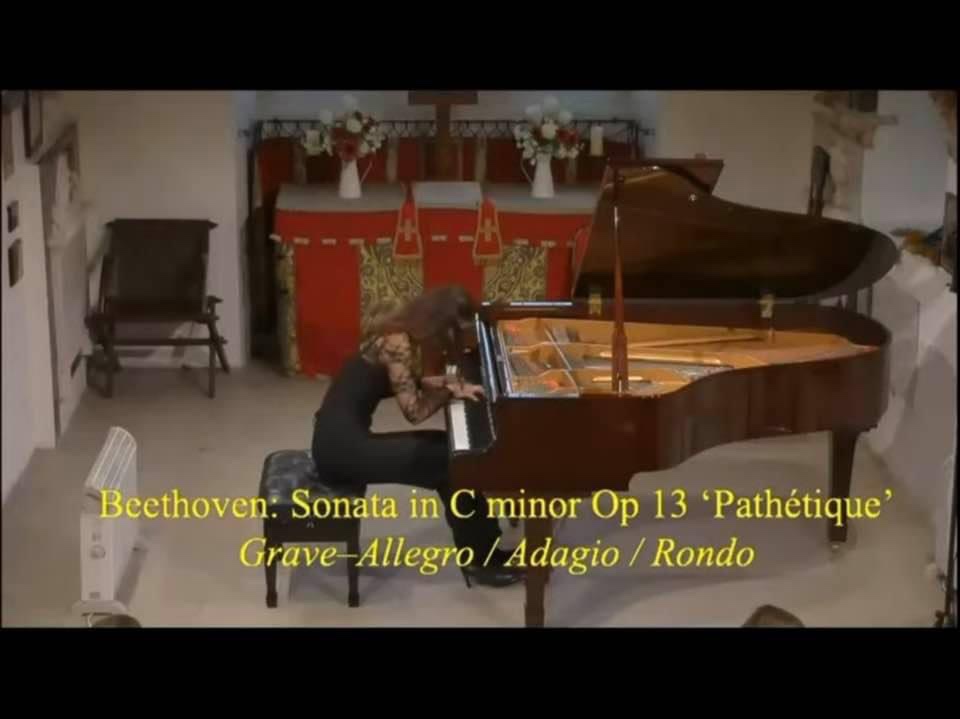
Beethoven: Sonata in C minor Op 13 “Pathétique” Grave-Allegro / Adagio / Rondo
Debussy: Images Book 1 Reflets dans l’eau / Hommage à Rameau / Mouvement
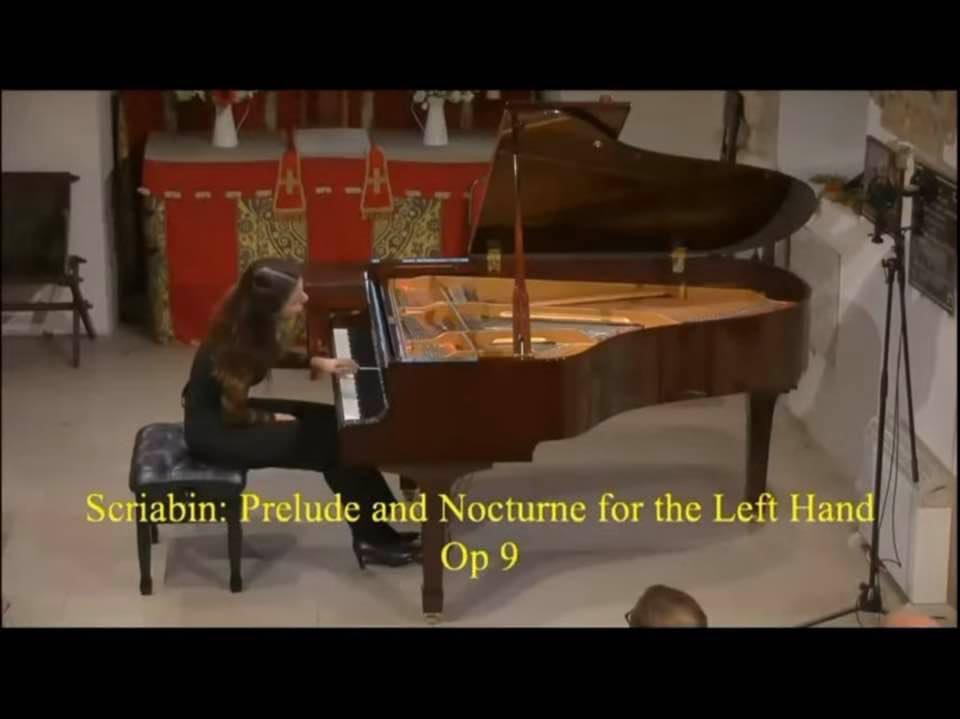
Scriabin: Prelude and Nocturne for the Left Hand Op 9
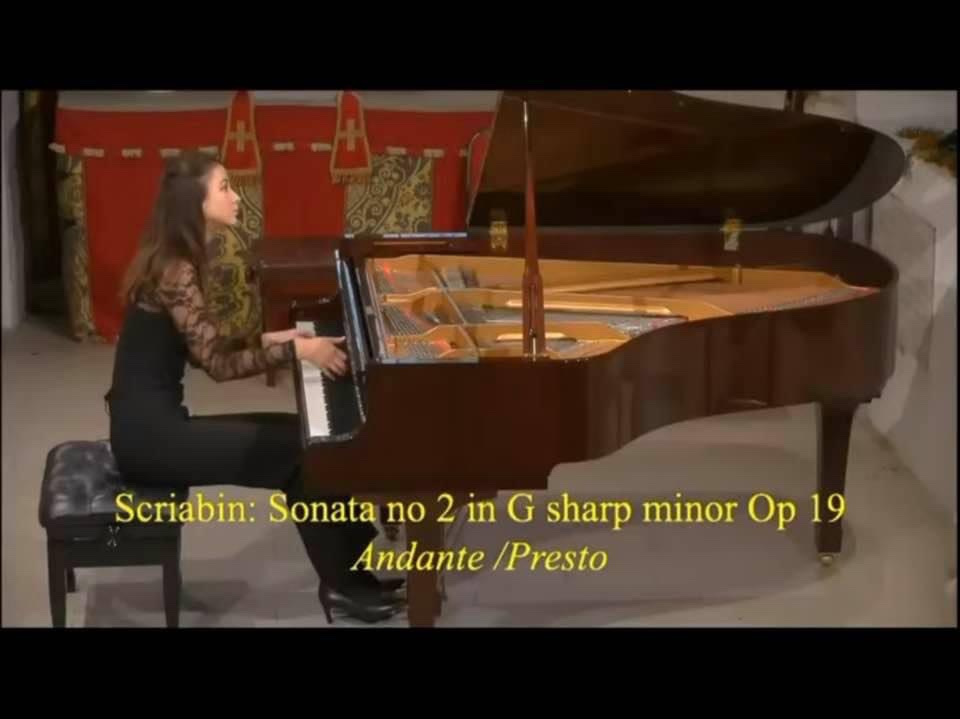
Scriabin: Sonata no 2 in G sharp minor Op 19 Andante / Presto
Nice to still be able to be in two places at once. From my country home in Italy to be able to hear a concert in Perivale was a necessity in the lock down but has now become a luxury. Thanks to Hugh Mather and his dedicated team of retired professionals I was able to listen to Zala Kravos who I had been advised not to miss by a very informed friend and colleague.
It was from the very first mighty chord of Beethoven’s Pathetique that she immediately caught my attention with the luminosity of sound and a sonority of an unusual richness.The poignancy of the silences too was quite arresting and I have rarely been aware of the importance of this much played work as she shaped the contours with a great sense of architectural line. Throughout the recital whatever she played had a weight and authority where every note had a meaning and significance from this very arresting opening to the ravishing beauty of the Adagio cantabile where in the contrasting central section she even found a completely different sound that was pure magic. The Rondo too was played with a clarity and subtle sense of phrasing as she brought such contrast and colour where every note had a meaning.
Debussy Images book 1 was full of ravishing colours from the subtle rubato of Reflets Dan’s l’eau to the stillness and desolation of Hommage a Rameau and the startling gentleness of Mouvement ,as Debussy asks for but very rarely gets,avec une légèreté fantastique mais précise -with a movement usually played like a study rather than the magic sound world that Zala could conjure up today.
There was such luminosity and a superb sense of balance in Scriabin’s Prelude for the left hand and the Nocturne had such ravishing sounds that it was hard to believe that only one hand was in play.
The second sonata was played with a wonderful sense of improvisation and her kaleidoscopic sense of colour allied to her superb natural musicianship gave a great sense of shape to this movement which is just a prelude to the unleashing of rhythmic drive and passion of the second movement.
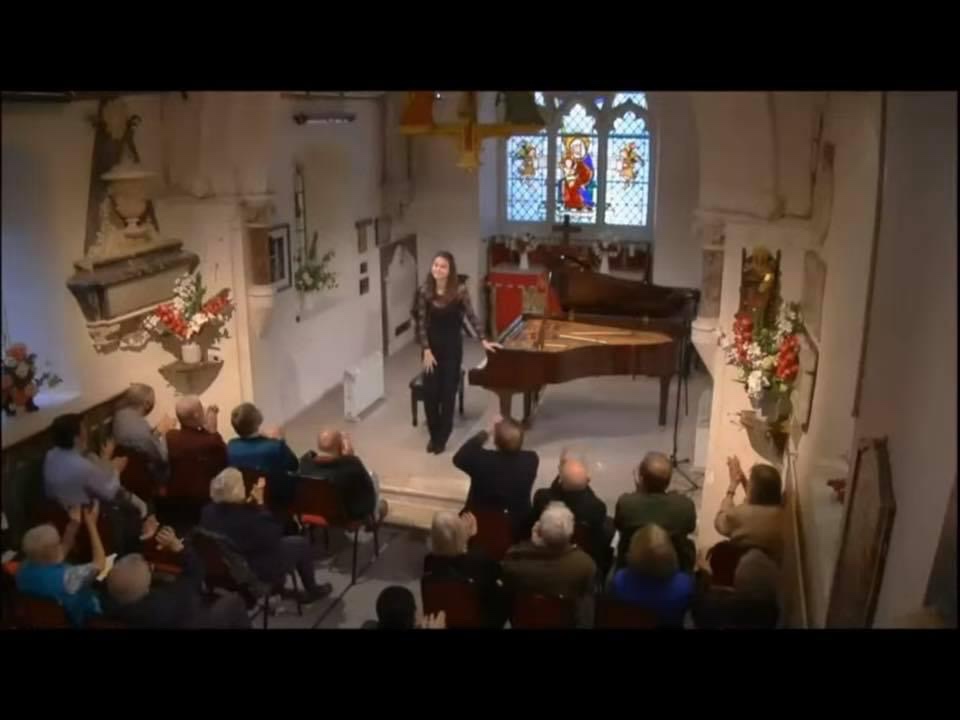
A real ovation from a full house at St Mary’s and thanks to Dr Mather we were treated to an encore of Scriabin Study op 8 n 12. It was here that all the qualities that we had enjoyed in this remarkable recital were underlined by a performance of transcendental control,ravishing sound and passionate commitment.
I had not realised that this nineteen year old pianist had already studied with Maria João Pires whose simple musicianship has been admired by a world starved of a transcendental command of the keyboard at the service of music.Pires like Zala today can shed fresh light on works that we have loved and cherished all our lives.Their playing is like a breath of fresh air in a world that we are fast destroying by our own pollution.As in music too where our insistence on bringing historic performances into modern concert halls to a vast public is becoming a case of a little knowledge that can become a dangerous thing.Pires with superb intelligence and scholarship is able to transmit with purity and simplicity the message that the great composers of the past have scribbled down on pieces of paper that of course a real interpreter should consult.Tortelier used to say that he would only play on a baroque cello when they discovered a baroque recording studio!Pires too when I thanked her for all she is doing to help young musicians she replied with simplicity and humility that it is she that should thank them for all that they gave her!I see that Zala continued her studies at La Chapelle with Louise Lortie,a pianist who I have admired for years.At only 19 she is now finishing her studies with another superb musician Norma Fisher -birds of a feather indeed and a disciple ready to be set free soon to fly high.
Zala Kravos was born in 2002 in Slovenia, and her family moved to Luxembourg in 2007. She studied there initially, and from 2012 to 2016 studied at the Queen Elisabeth Music Chapel in Brussels, in the piano section headed by Maria João Pires, and continued as the only ‘Young Artist’ with Louis Lortie, the new master in residence until May 2018, when she passed the ‘Young Artist Diploma’ exam. Since September 2019, she has been studying at the Royal College of Music with Norma Fisher. She has won many prestigious awards such as the Gold medal at the “Passion of Music 2016” international competition in New York, and Gold medal in European Competition for Piano Solo Luxembourg 2014 etc. She is quadrilingual (French, English, Slovenian, and Chinese) and likes reading, swimming, ski-ing (Bronze Star at the French Ski School), cycling and roller skating. She comes with exceptional recommendations such as ‘One of the best talents I have ever seen’ (Maria Joao Pires) etc.
From the ever enthusiastic Dr Hugh Mather:Excellent review as always, Christopher, of a remarkable recital. She is terrific and will always be welcome back. It was all remarkable but I was bowled over by her Scriabin, particularly the LH Prelude and Nocturne – simply ravishing control and sound. Here is the HD link
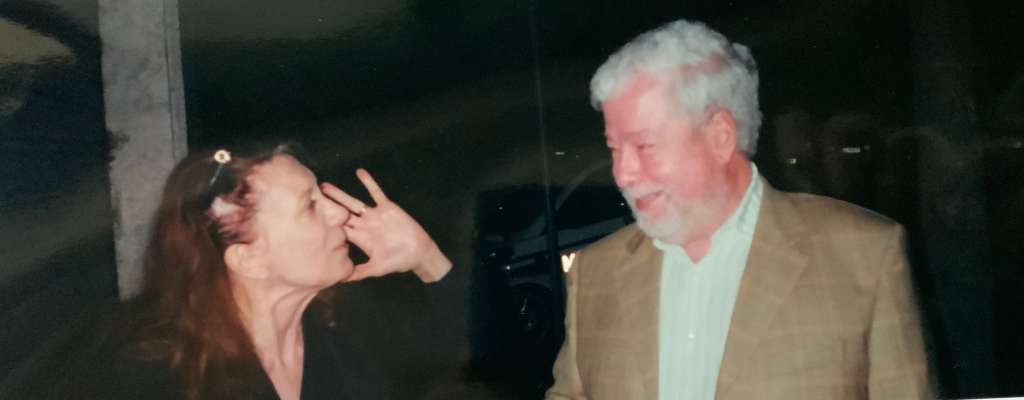
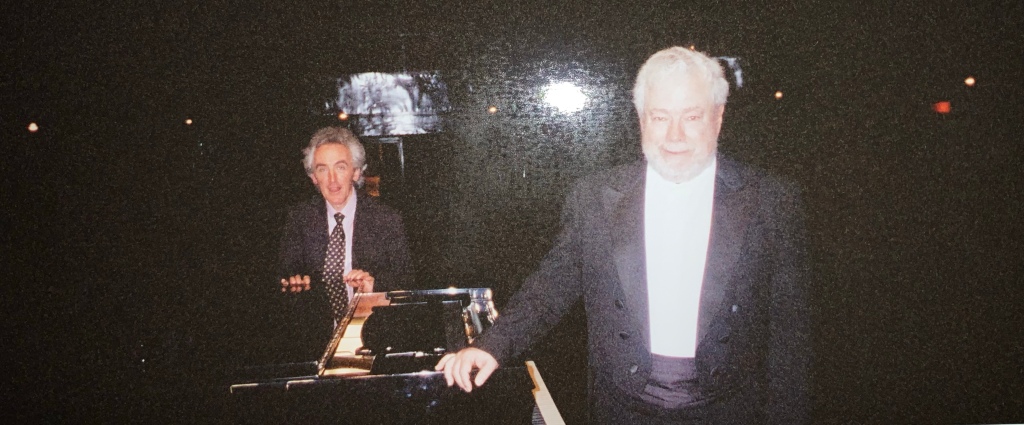
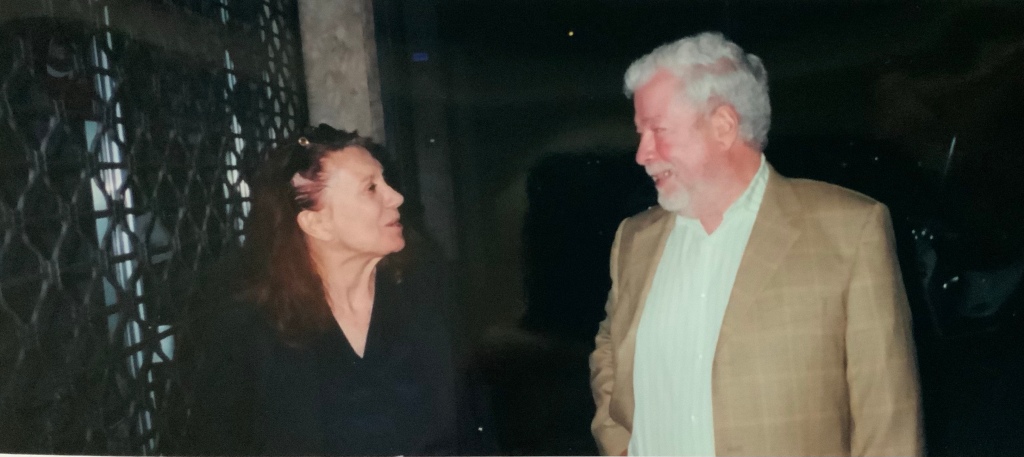
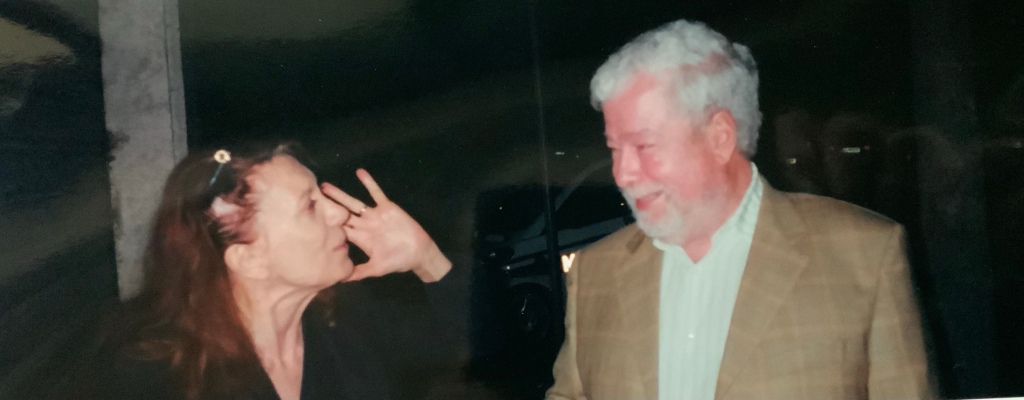
Nelson gave two recitals for us at the Ghione theatre .Memorable performances of Schumann Carnaval and Brahms F minor Sonata. It was a few years later after the death of my wife that he played at the Brazilian Embassy to repay their hospitality while he was playing Brahms 2 at S.Cecilia . It was a memorable occasion not only for the whole recital but for a little encore by Villa Lobos .After the concert I was surprised and very moved when he said that it had been my wife’s favourite encore at his concerts for us.
with Ileana Ghione
Nelson was like that a wonderful sensitive person and one of the greatest pianists I have heard .He was quite simply the Rubinstein of today.Like Rubinstein it was in live performance that the legend really began.His recordings are not always geared to the recording studio like his Chopin studies recorded at Snape where he adds an octave here and there as he and Rubinstein would do on the spur of the moment in the concert hall.His performance of Chopin 2 at the proms was notable for how he played a very light bass note at the beginning to open up the sonority of the piano entry high up on the keyboard.Always discreet and with great style not like some performers these days who think they have a special contact with Beethoven as they desecrate his most perfect creation :the Fourth Concerto with spread chords opening flourishes and alarming additions to the score in the name of authenticity.Some even add improvised Rachmaninovian cadenzas where Beethoven had left his own .
with Christopher Axworthy
There was none of this with Nelson who like Rubinstein with humility and love would seek out a performance of such simplicity and overwhelming beauty that would hold audiences mesmerised.He was a true legend in South America and we were lucky to catch only a rare glimpse of his solo recitals A great void has now opened but thank God we still have his best friend Martha Argerich who had left everything to be at his bedside. He was launched to fame in Europe when he stood in at a weeks notice for Shura Cherkassky learning especially Tchaikowsky n.2 creating a sensation and overnight success. Of course his duo concert at the Southbank festival with Martha Argerich after a shopping spree together in London just before has quite rightly gone down in legend




































 ChristopherAxworthy-MusicCommentary